The Points Guy believes that credit cards can transform lives, helping you leverage everyday spending for cash back or travel experiences that might otherwise be out of reach. That's why we publish a variety of editorial content and card comparisons: to help you find a great card to turn your goals into reality.
Our site may earn compensation when a customer clicks on a link, when an application is approved, or when an account is opened with our partners, and this may impact how or where these products appear. While we don't cover all available credit cards, our editorial team creates and maintains all of the analysis of these cards, and our content is not influenced nor subject to review by any credit card company, bank or partner prior to (or after) publication. Please view our advertising policy and product review methodology for more information.
Advertiser disclosure
The Points Guy believes that credit cards can transform lives, helping you leverage everyday spending for cash back or travel experiences that might otherwise be out of reach. That's why we publish a variety of editorial content and card comparisons: to help you find a great card to turn your goals into reality.
Our site may earn compensation when a customer clicks on a link, when an application is approved, or when an account is opened with our partners, and this may impact how or where these products appear. While we don't cover all available credit cards, our editorial team creates and maintains all of the analysis of these cards, and our content is not influenced nor subject to review by any credit card company, bank or partner prior to (or after) publication. Please view our advertising policy and product review methodology for more information.
Chris was a reporter at The Points Guy, where he covered the intersection of credit card rewards and travel. At TPG, he wrote a broad array of stories ranging from in-depth features and reports to trending travel news as it related to loyalty, card benefits and consumer behavior.
September 26, 2021 • 8 min read
The cards we feature here are from partners who compensate us when you are approved through our site, and this may impact how or where these products appear. We don't cover all available credit cards, but our analysis, reviews, and opinions are entirely from our editorial team. Terms apply to the offers listed on this page. Please view our advertising policy and product review methodology for more information.Editorial disclaimer: Opinions expressed here are the author's alone, not those of any bank, credit card issuer, airline or hotel chain, and have not been reviewed, approved or otherwise endorsed by any of these entities.
Comments
By commenting, you agree to our Community Guidelines to help create a positive space for conversation. The responses below are not provided or commissioned by the bank advertiser, our partners, or The Points Guy (“TPG”). They have not been reviewed, approved, or otherwise endorsed by any of these parties. All responses are submitted by individual contributors, and neither the bank advertiser, our partners, nor TPG are responsible for ensuring that all posts and/or questions are answered.
Related stories
Quick summary
Booking one-way flights can offer greater flexibility and sometimes lower costs, especially for domestic travel within the U.S.
Comparing one-way and round-trip fares may reveal savings, particularly when mixing airlines or using different payment methods like cash or miles.
International one-way tickets are often more expensive than half a round-trip, except with low-cost carriers that typically price one-ways more fairly.
Current airline policies allowing free changes or cancellations may make booking separate one-way tickets even more advantageous.
What to consider
Some airlines only allow one change per reservation, so booking separate one-way tickets could provide more flexibility if plans change.
International one-way fares on major carriers can be disproportionately expensive compared to round-trips, but low-cost airlines may offer more balanced pricing.
Managing multiple one-way bookings can be more complex, especially if disruptions affect one segment and not the other.
What you'll miss from the article
Specific examples and strategies for combining miles, cash and low-cost carriers to optimize flight bookings for flexibility and savings.
Generated by AI with support from our editorial team.
Update: Some offers mentioned below are no longer available. View the current offers here.
Airline pricing is complicated. But instead of digging into the nitty-gritty nuances of airfare algorithms, here’s a real-world application.
When I’m booking a flight, I care about the lowest price and maximum flexibility, among other factors. Sometimes I want to pay in cash but often if I have miles to spare or want to fly in a premium cabin, I’ll redeem miles. By strategically booking one-way flights, I have been able to maintain half the cost of a round-trip ticket and still give myself options to pay how I want.
In fact, I almost always book one-way flights. And it makes even more sense to do so now during the pandemic. Here’s why I book one-way flights — and why you should consider the same when planning your next trip.
It can be cheaper
Fly two airlines instead of one. (Photo by Alberto Riva/The Points Guy)
When traveling within the U.S., airlines typically price one-way flights at exactly half the cost of a round-trip. There certainly are exceptions, especially for those that fly out of smaller, regional airports.
However, with my home base in New York City being a major hub, I can’t recall the last time I saw a one-way at more than half the cost of a round-trip when flying domestically.
Booking a one-way vs. a round-trip
When paying with cash, my first rule of thumb is to always search and compare the costs for both a round-trip flight and the one-way flight segments. I typically do this with a simple Google Flights search. There have been many cases where booking two one-way flights — with two different airlines — is less expensive than booking a round-trip with a single airline.
Whenever I search for flights, sometimes I use points and miles, sometimes I pay with cash and sometimes I do both. Booking one-way flights allow me to have the most flexible options when it comes to my method of payment.
If I want to use airline miles for a flight, there often may only be availability or a low-mileage option for just one portion of an itinerary. This is often the case for holiday periods or long weekends.
A one-way, flexible booking example
If I planned to leave from my home in New York to head to Miami on the Wednesday before Thanksgiving, I could use 10,500 American Airlines AAdvantage miles for the flight.
(Screenshot courtesy of AA)
However, if I wanted to return back to New York on the Sunday after Thanksgiving, a peak travel day, it could cost up to 51,000 AAdvantage miles for the flight home.
(Screenshot courtesy of AA)
I wouldn’t spend a whopping 51,000 miles on this return flight (which TPG considers to be worth $714), so would explore three other options instead:
Search for lower mileage opportunities with another airline
Search for cash fares using Google Flights and paying with one of the best cards for airfare
This is where the power of booking a one-way flight comes into play. It provides you maximum flexibility to mix and match the flights of your choosing using a variety of payment methods.
To continue with this hypothetical Thanksgiving weekend trip example, I found a one-way JetBlue flight for $221 from Miami to New York. I’d much rather pay this cash fare than redeem 51,000 AAdvantage miles.
(Screenshot courtesy of Google)
And lo and behold, now I have two one-way flights between New York and Miami — one using miles on American and one using cash on JetBlue.
It works for some international flights, too
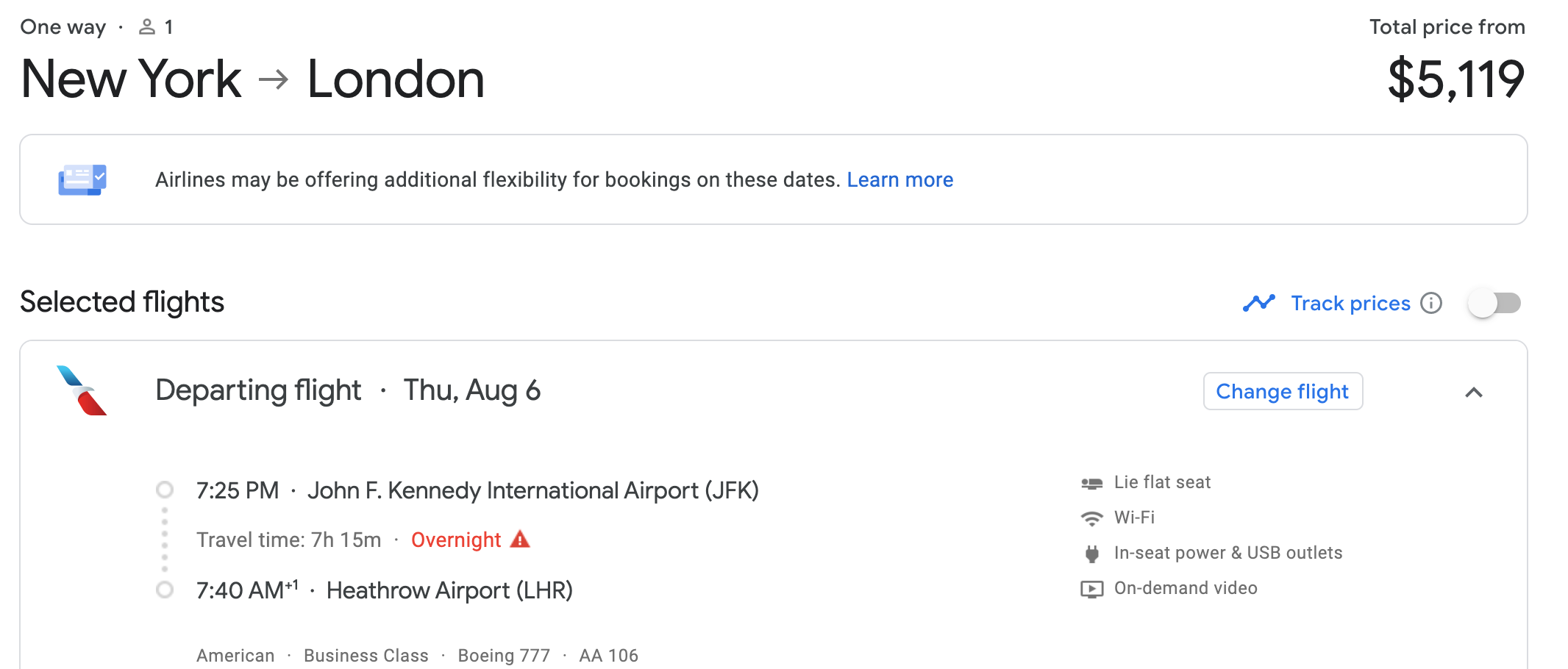
What I’ve discussed so far only applies to domestic flights. What about international flying? Many airlines will price international one-way tickets more than a round-trip ticket (or close to it) even though you’re flying half the amount.
As an extreme example, here’s a one-way business class ticket between New York and London on American for $5,119. Photo courtesy of Google
Now, let’s take that same outbound flight to London and add in a return flight to New York. It’s still far from cheap but a round-trip only slightly increases the total cost. Photo courtesy of Google
This is a very common practice and is often found on premium cabin tickets. One of the main reasons that one-way tickets can be so expensive for international flying is because they’re often purchased by business travelers who have rigid date and time requirements and are generally less sensitive to price.
Low-cost international airlines
However, low-cost airlines will not impose these types of pricing practices. Booking a one-way between the U.S. and Europe on a low-cost carrier will almost always be half the cost of a round-trip.
This not only applies to trans-Atlantic flights but also to international flights within a region. In my travels, I have often attached one-way flights on low-cost airlines to existing itineraries when flying within Europe (i.e. Ryanair) or within Asia (i.e. Air Asia). I’m a huge fan of low-cost carrier AirAsia. (Photo courtesy of Airbus)
Therefore, by piecing together one-way, low-cost international flights on a low-cost airline and using points and miles for the rest of the flights, I have been able to make trips happen at a fraction of what they would have cost with a round-trip or multicity cash booking.
It’s a good time to book a one way
With airline bookings still down from 2019, airlines have been offering some assurance in the way of free changes and cancellations to future reservations. However, some airlines may only offer a one-time change per reservation. By booking two one-way tickets that are on two different reservations — instead of a single round-trip, — you may get more flexibility when it comes to taking advantage of change policies.
(Photo by Nick Ellis/The Points Guy)
There’s one exception to my personal one-way flight booking rule: flight deals. If I come across an incredible round-trip fare — either in cash or miles — I wouldn’t hesitate to book it just because it is a round-trip.
For instance, airlines such as Delta often only offer low SkyMiles award redemptions when booking a round-trip. Or there might be a round-trip international flight deal in first class that’s just too good to pass up, and it’s not offered as a one-way.
Another reason why you may want to book a round-trip
Besides saving money or miles, you might also want to book a round-trip for a simple reason — it’s easier to manage. Instead of multiple itineraries and airlines, a round-trip may just make your life easier if you don’t want to deal with more than one reservation at a time.
In addition, two different reservations could become a hassle if one flight delay or cancellation on the outbound forces you to cancel or change the return trip. Because these are booked on two different reservations (sometimes on different airlines), you may be restricted in making alterations.
Best cards for booking flights
Don’t forget to use a card that earns additional points on airfare purchases, such as The Platinum Card® from American Express (5x on airfare booked directly with the airline or through Amex Travel, on up to $500,000 on these purchases per calendar year), the Citi Premier® Card (see rates and fees) or the Chase Sapphire Reserve (both 3x on travel), American Express® Gold Card (3x on airfare when booked directly with the airline or through Amex Travel) or Chase Sapphire Preferred Card (2x on travel, which rises to 5x when booked through the Ultimate Rewards Travel portal).
Bottom line
Over the last several months, I've finally taken to the skies once again.
I’m looking forward to the several trips that I have sketched out for the months ahead. I will continue to try to book one-way flights — and recommend doing so for maximum flexibility. But know that there are caveats too. With some airlines currently offering one change fee waiver per booking, now is an even better time to do so.
Comments
By commenting, you agree to our Community Guidelines to help create a positive space for conversation. The responses below are not provided or commissioned by the bank advertiser, our partners, or The Points Guy (“TPG”). They have not been reviewed, approved, or otherwise endorsed by any of these parties. All responses are submitted by individual contributors, and neither the bank advertiser, our partners, nor TPG are responsible for ensuring that all posts and/or questions are answered.