TPG exclusive: Frontier Airlines CEO says 'it's time to fly,' fate of recovery rests with travelers

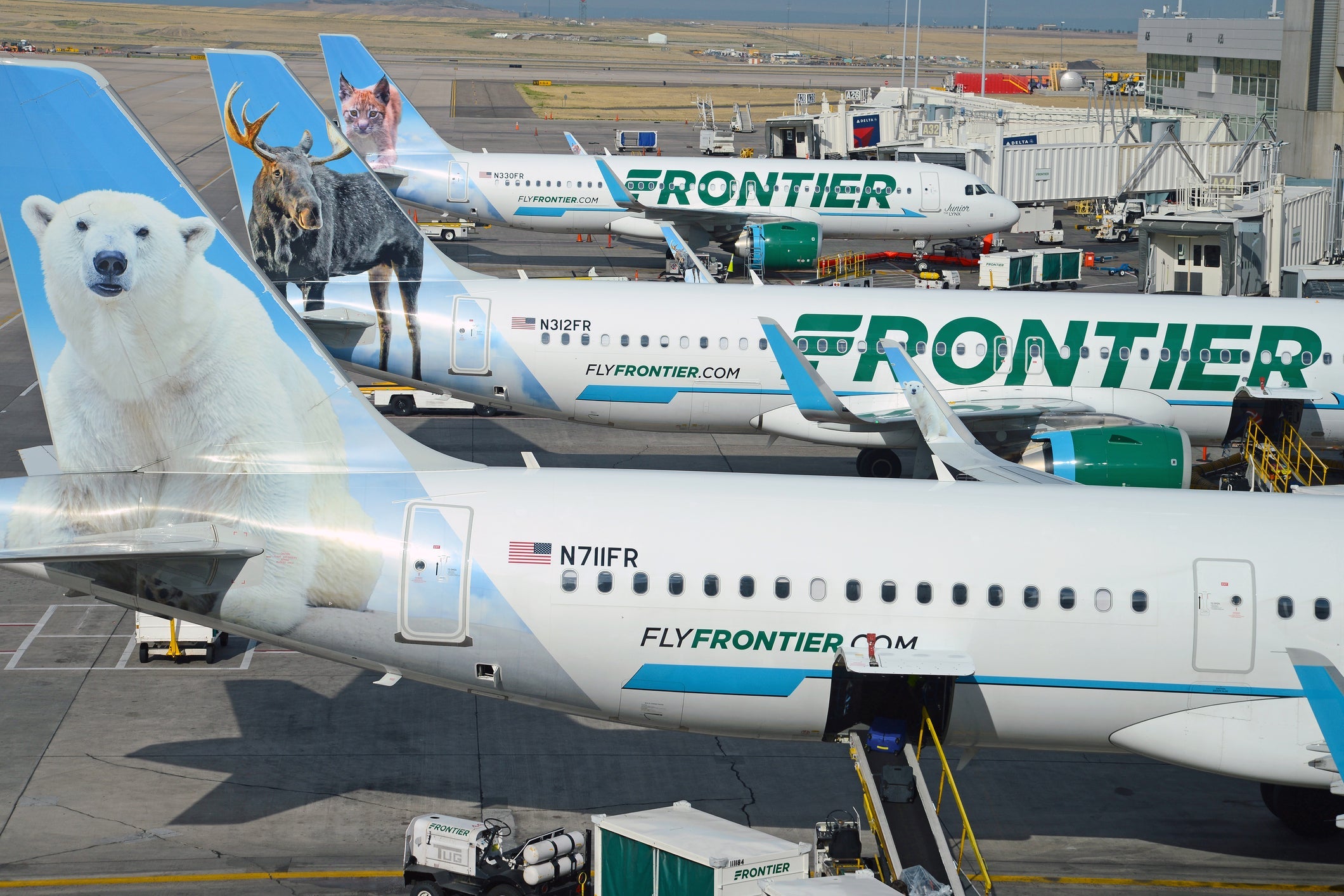
U.S. airlines are at something of a tipping point. Either Americans keep returning to the skies as they did before July and carriers avoid massive staff cuts this fall — potentially with additional government aid — or the travel industry retracts and takes years to recover.
At least that's the view of Frontier Airlines CEO Barry Biffle. Like every carrier, Frontier saw a recovery in travel that stalled around the end of June, dramatically setting back its hope to fly as much as 90% of its 2019 schedule by the end of the year. Now, Frontier reset its goal, saying it plans to fly just 50% to 70% of last year's schedule by the end of December. But, beyond that, Biffle said the industry is at another crossroads that could determine its trajectory in the coming years.
"We need to see the American people gain confidence in travel," he told TPG in an exclusive interview on Thursday. The alternative: more cuts this fall and an increased likelihood of furloughs for hundreds of Frontier flight attendants and pilots.
Sign up for the free daily TPG newsletter for more airline news!
Travelers are not returning to the skies as quickly as they were in June. Data from trade group Airlines for America (A4A) shows U.S. passenger numbers stalled at down around 80% year-over-year since the beginning of July. The plateau is widely attributed to the resurgence of coronavirus cases and local travel restrictions across much of the U.S.
"Ahead of any vaccine, [the recovery] really does depend on how well countries manage to control the virus," International Air Transport Association chief economist Brian Pearce said July 28. The organization pushed back its timeline for the recovery in air travel by a year to 2024, with Pearce citing some "issues arising" in places like the U.S. and elsewhere.
Estimates for when a vaccine will be widely available range dramatically. Biffle anticipates one by next spring, perhaps in time for airlines to capture Spring Break travel. But not everyone is as optimistic. United Airlines CEO Scott Kirby, for example, does not expect one until the end of 2021.
But vaccine or not, Biffle insists that flying is safe today.
Related: Global air travel unlikely to recover until 2024 as COVID remains 'issue' in US, elsewhere

Out of the four million people that Frontier has flown since the Centers for Disease Control and Prevention (CDC) began tracking COVID-19 infections in January, not a single case is attributed to exposure onboard one of the airline's planes, said Biffle.
"Flying is one of the safest things you can do outside your home. The air is as clean as a hospital surgery room," he said. "It's time to fly."
CDC data shows more than 4.8 million confirmed COVID-19 cases in the U.S. A spokesperson was not immediately available for comment on whether any were attributable to transmission onboard a flight.
The CDC does warn would-be flyers that travel increases their chances of getting the coronavirus. Staying home is the best way to avoid infection, its website says.
Related: Frontier hopes to buck pandemic trend with growth, but says masks are a must
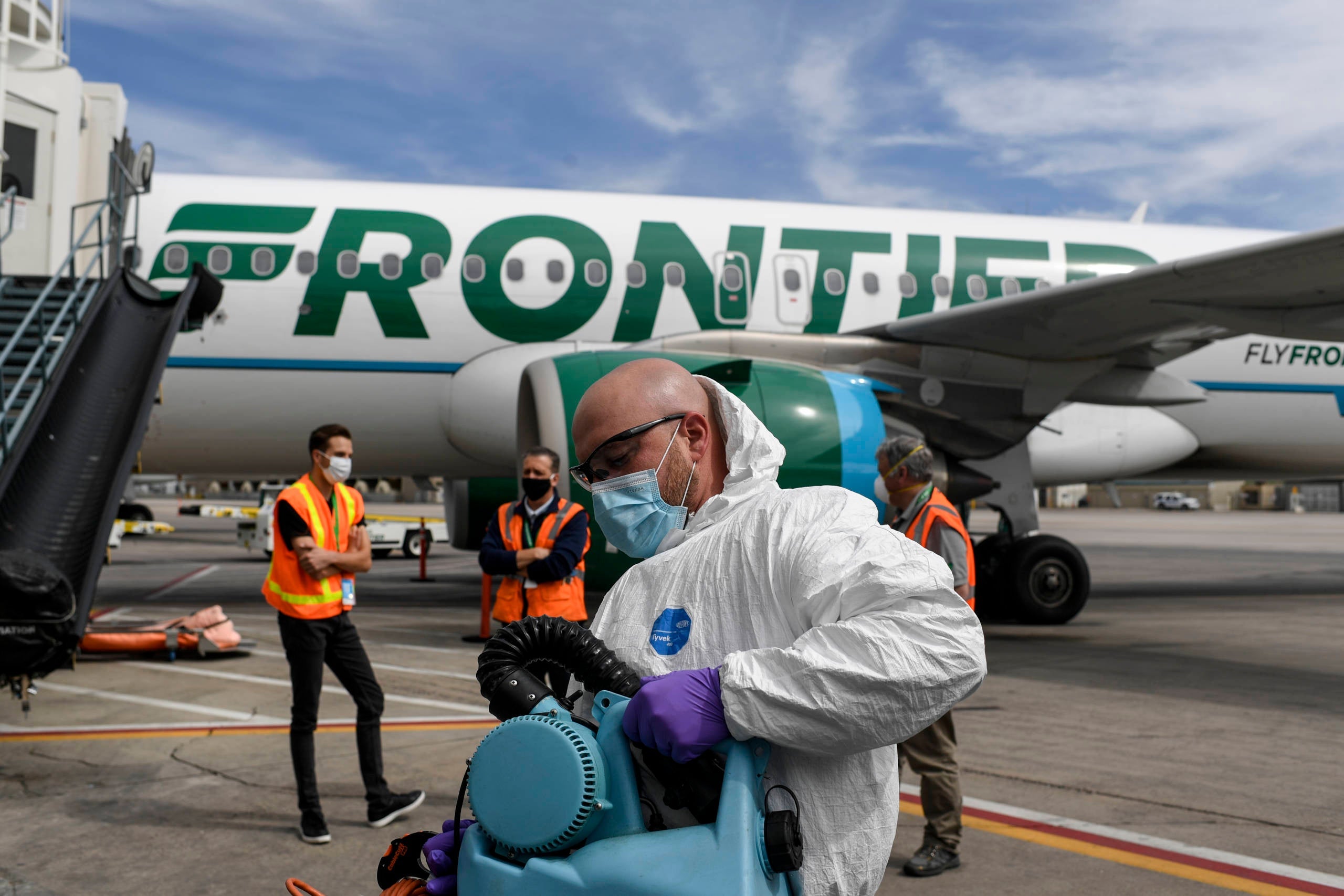
All U.S. airlines are taking a multi-layered approach to safety. Masks onboard flights are universally mandated by carriers, while every airline has stepped up cleaning procedures and some have instituted health declarations at check in. Several airlines are blocking middle seats in the auspices of social distancing onboard and Frontier alone checks the temperature of every traveler before they board a flight.
Every carrier argues that these measures keep travelers and crews safe from the coronavirus. And few cases of COVID-19 globally have been directly attributed to transmission onboard a plane.
But airports are a potential weak point in safety protocols. Many lack the sophisticated air filtration found onboard airplanes, and some do not mandate masks inside their facilities. However, airlines are moving to address the latter issue, with United recently threatening to ban travelers who do not wear masks in airport terminals.
Related: Which US airlines are blocking middle seats and requiring masks?
Still, Biffle pressed the case that it's safe to fly.
"Should you fly on an airplane? Yes. Should you go to a crowded bar? Probably not," he said.
While Las Vegas casinos and Orlando theme parks may spook those worried about crowds during the pandemic, there are plenty of others destinations that feature wide open spaces an opportunities for outdoor, socially distance recreation. Conveniently, Frontier serves many of those outdoor-oriented destinations. That includes Colorado, where the airline and operates its busiest hub in Denver, but also destinations in Montana, Oregon and Wyoming, among others.
"We can't live in fear of everything," said Biffle. "We need to try to get back to some level of normalcy."
Related: State-by-state guide to coronavirus reopening
Biffle's push to convince Americans that flying is safe is far from altruistic. Frontier stands to benefit from any uptick in holidaygoers, who have made up the vast majority of its customers — both before and during the pandemic. The airline continues to take delivery of new jets, with its 100th Airbus A320 family plane arriving at the end of July.
An uptick would also help it avoid some of the painful furloughs that threaten airlines and their staff this fall. Frontier has notified 925 flight attendants and 559 pilots of possible furloughs, or roughly 35% of both employee groups.
The issue is timing. Airlines are planning their fall and winter schedules now and, as part of that, making decisions on their staffing needs for the foreseeable future.
Related: Fast-growing Frontier Airlines takes delivery of 100th Airbus
Frontier launched a new sale in recent days in the hopes of luring more would-be travelers onto planes. But there is not much time; for the sale to work the airline needs to see a significant uptick in bookings over the next two weeks to avoid further cuts — and potentially furloughs — this fall, said Biffle.
He is not alone is acknowledging that travelers need to return if the airline industry is to fly out of the crisis. Other executives are singing a similar tune, though many doubt a full recovery is likely until there is a vaccine.
"We need to see a pickup in revenue," Delta Air Lines CEO Ed Bastian wrote in a memo to staff on Thursday that was viewed by TPG. The Atlanta-based carrier has cut costs in half and, barring the furlough of some 2,500 pilots this fall, will likely find it difficult to cut further.
Related: US airlines send another 10,500 furlough notices as industry faces dramatic contraction
Biffle sees three paths forward. His preferred path is travelers continue to return and revenues rise. Another is that the federal government extends employment protections first provided under the CARES Act through March 2021, a move that would allow carriers to keep workers on the payroll and quickly ramp up in flights when flyers return. Or three, travelers do not return and the federal government does not extend payroll assistance, forcing potentially drastic cuts starting Oct. 1.
One issue with furloughing pilots is training and certification. Once these lapse, regulators require retraining when they return to an airline — regardless of whether they were gone for one month or two years.
"If you don't do this, then you're going to be in a situation where you hurt the economic recovery," Biffle said on the potential extension of federal payroll aid under the CARES Act.
Related: United is latest to back union-led effort to extend coronavirus employment protections
The push to extend the CARES Act is led by 13 labor unions, including the Air Line Pilots Association (ALPA) and Association of Flight Attendants-CWA (AFA) that represent crews at Frontier. The measure is currently being debated as part of a larger aid package in Congress.
While further government support may be necessary to keep flight attendants and pilots ready for the upturn, Biffle does not see it as the key to a recovery — or to keeping airlines in business. That, he said, depends on getting people back into the air.
"Don't you think it'd be good for everybody's sanity over the next 60 to 90 days to still get out and see the country? Go see a beach, go see some mountains, go see some trees and change your scenery," he said. "If we don't start doing that, I think you're going to have significant depression — not just economically, but mentally."
Related: Frontier is now screening passengers' temperatures, a first in the US
This is the latest installment in our on-going "CEO chat" series of interviews with airline executives on how they are navigating the coronavirus pandemic. Read the our interviews with the leaders of Cape Air, Frontier, Spirit Airlines and Sun Country Airlines.
TPG featured card

at American Express's secure site
Terms & restrictions apply. See rates & fees.
| 4X | Earn 4X Membership Rewards® points per dollar spent on purchases at restaurants worldwide, on up to $50,000 in purchases per calendar year, then 1X points for the rest of the year. |
| 4X | Earn 4X Membership Rewards® points per dollar spent at US supermarkets, on up to $25,000 in purchases per calendar year, then 1X points for the rest of the year. |
| 5X | Earn 5X Membership Rewards® points on prepaid hotel stays booked through AmexTravel.com or the Amex Travel App™. |
| 3X | Earn 3X Membership Rewards® points on flights booked through AmexTravel.com, the Amex Travel App™, or purchased directly from airlines. |
| 2X | Earn 2X Membership Rewards® points on prepaid car rentals booked through AmexTravel.com or the Amex Travel App™ and cruises booked and paid through AmexTravel.com. |
| 1X | Earn 1X Membership Rewards® point per dollar spent on all other eligible purchases. |
Pros
- Valuable dining and food-related credits
- Flexible rewards with airline and hotel transfer partners
- Multiple travel and purchase protections
- No foreign transaction fees
- Access to Amex Offers for additional savings (enrollment required)
Cons
- Not as useful for those living outside the U.S.
- Some may have trouble using Uber and other dining credits
- You may be eligible for as high as 100,000 Membership Rewards® Points after you spend $8,000 in eligible purchases on your new Card in your first 6 months of Card Membership. Welcome offers vary and you may not be eligible for an offer. Apply to know if you’re approved and find out your exact welcome offer amount – all with no credit score impact. If you’re approved and choose to accept the Card, your score may be impacted.
- Earn 4X Membership Rewards® points per dollar spent on purchases at restaurants worldwide, on up to $50,000 in purchases per calendar year, then 1X points for the rest of the year.
- Earn 4X Membership Rewards® points per dollar spent at US supermarkets, on up to $25,000 in purchases per calendar year, then 1X points for the rest of the year.
- Earn 5X Membership Rewards® points on prepaid hotel stays booked through AmexTravel.com or the Amex Travel App™.
- Earn 3X Membership Rewards® points on flights booked through AmexTravel.com, the Amex Travel App™, or purchased directly from airlines.
- Earn 2X Membership Rewards® points on prepaid car rentals booked through AmexTravel.com or the Amex Travel App™ and cruises booked and paid through AmexTravel.com.
- Earn 1X Membership Rewards® point per dollar spent on all other eligible purchases.
- Pay It® lets you tap in the American Express® App to quickly pay for small purchase amounts throughout the month and still earn rewards the way you usually do. Plan It® gives you the option to split up big purchases into equal monthly payments with a fixed fee. You’ll know upfront exactly how much you’ll pay.
- $120 Dining Credit: Earn up to a total of $10 in statement credits monthly when you pay with the Gold Card at Grubhub (including Seamless), Buffalo Wild Wings, Five Guys, The Cheesecake Factory, and Wonder. This can be an annual savings of up to $120. Enrollment required.
- $100 Resy Credit: Get up to $100 in statement credits each calendar year at over 10,000 qualifying U.S. Resy restaurants after you pay for eligible purchases with the American Express® Gold Card. That’s up to $50 in statement credits semi-annually. Enrollment required.
- $84 Dunkin' Credit: Earn up to $7 in monthly statement credits after you pay with the American Express® Gold Card at U.S. Dunkin’ locations. Enrollment required.
- $120 Uber Cash on Gold: Enjoy up to $120 in Uber Cash annually with your Gold Card. Just add your Card to your Uber account and you'll get $10 in Uber Cash each month to use on orders and rides in the U.S. when you select an Amex Card for your transaction.
- Enjoy complimentary Hertz Five Star® Status benefits like skipping the counter at select locations, adding an additional driver at no additional cost*, and vehicle upgrades**. Benefit enrollment and Hertz Gold+ registration are required. *Additional drivers must meet standard rental qualifications and must be a spouse or domestic partner to qualify as complimentary. Other additional drivers subject to fees. **Benefits are subject to availability and vary by location. Additional Hertz program Terms and Conditions including age restrictions apply.
- Book two nights or more with The Hotel Collection through AmexTravel.com or the Amex Travel App™ and receive a $100* credit towards eligible charges at over 1,400 upscale hotels worldwide. *Eligible charges vary by property.
- Book your travel through the Amex Travel App™ with added peace of mind – backed by American Express® service and support. Only for American Express® Card Members.
- Whenever you need us, we're here. Our Member Services team will ensure you are taken care of. From lost Card replacement to statement questions, we are available to help 24/7.
- No Foreign Transaction Fees.
- Annual Fee is $325.
- Terms Apply.