The Points Guy believes that credit cards can transform lives, helping you leverage everyday spending for cash back or travel experiences that might otherwise be out of reach. That's why we publish a variety of editorial content and card comparisons: to help you find a great card to turn your goals into reality.
Our site may earn compensation when a customer clicks on a link, when an application is approved, or when an account is opened with our partners, and this may impact how or where these products appear. While we don't cover all available credit cards, our editorial team creates and maintains all of the analysis of these cards, and our content is not influenced nor subject to review by any credit card company, bank or partner prior to (or after) publication. Please view our advertising policy and product review methodology for more information.
Advertiser disclosure
The Points Guy believes that credit cards can transform lives, helping you leverage everyday spending for cash back or travel experiences that might otherwise be out of reach. That's why we publish a variety of editorial content and card comparisons: to help you find a great card to turn your goals into reality.
Our site may earn compensation when a customer clicks on a link, when an application is approved, or when an account is opened with our partners, and this may impact how or where these products appear. While we don't cover all available credit cards, our editorial team creates and maintains all of the analysis of these cards, and our content is not influenced nor subject to review by any credit card company, bank or partner prior to (or after) publication. Please view our advertising policy and product review methodology for more information.
Guides
Capital One Venture Rewards vs. Venture X: Are the premium perks worth $300 more?
Stephanie Stevens is an associate writer with TPG's credit cards team. She focuses on creating timely credit cards content for TPG readers.
September 28, 2026 • 16 min read
The cards we feature here are from partners who compensate us when you are approved through our site, and this may impact how or where these products appear. We don't cover all available credit cards, but our analysis, reviews, and opinions are entirely from our editorial team. Terms apply to the offers listed on this page. Please view our advertising policy and product review methodology for more information.
Editorial note: This is a recurring post, regularly updated with new information and offers.
Editorial disclaimer: Opinions expressed here are the author's alone, not those of any bank, credit card issuer, airline or hotel chain, and have not been reviewed, approved or otherwise endorsed by any of these entities.
Comments
By commenting, you agree to our Community Guidelines to help create a positive space for conversation. The responses below are not provided or commissioned by the bank advertiser, our partners, or The Points Guy (“TPG”). They have not been reviewed, approved, or otherwise endorsed by any of these parties. All responses are submitted by individual contributors, and neither the bank advertiser, our partners, nor TPG are responsible for ensuring that all posts and/or questions are answered.
Related stories
Quick summary
Two popular travel rewards cards are compared, focusing on differences in annual fees, travel credits and premium perks.
Both cards earn the same type of points, offer access to over 15 transfer partners and provide similar redemption options.
One card features a lower annual fee and straightforward earning, while the other offers a higher fee in exchange for premium benefits like lounge access and hotel credits.
The choice depends on whether you can consistently use premium perks such as travel credits and lounge access.
What to consider
Eligibility for welcome bonuses is restricted if you have received a bonus on either card within the past 48 months.
The higher-fee card's travel credit must be used through the issuer's travel portal and expires on your account anniversary.
Adding authorized users for lounge access incurs an extra charge per user.
What you'll miss from the article
A detailed side-by-side comparison of benefits, earning rates at travel merchants and redemption strategies for each card.
Generated by AI with support from our editorial team.
Both cards earn at least 2 Capital One miles per dollar spent and offer the same redemption options and transfer partners. The Venture Rewards charges a $95 annual fee, while the Venture X charges $395 in exchange for stronger travel perks and higher earning rates through Capital One Travel.
Ultimately, the choice comes down to how much you'll use the Venture X's premium benefits. Let's compare the two cards to see which is the better fit for you.
Capital One Venture Rewards vs. Capital One Venture X: At a glance
Annual fee
$95
$395
Welcome offer
Earn 75,000 bonus miles after spending $4,000 on purchases in the first three months from account opening, plus receive a $300 credit to use on hotel and vacation rentals booked through Capital One Travel in the first cardholder year.
Earn 75,000 bonus miles after spending $4,000 on purchases in the first three months from account opening.
Authorized user fee
None
Free without lounge access; $125 per user annually with lounge access (up to four authorized users)
Quick picks by traveler type
Best for
Card
Travelers who want simple flat-rate earning with a lower annual fee
Venture Rewards
Travelers who don't want to rely on annual travel credits to offset a higher annual fee
Venture Rewards
Travelers who can consistently use the $300 annual Capital One Travel credit
Venture X
Travelers who value airport lounge access and premium hotel perks
Venture X
Venture Rewards vs. Venture X: Welcome bonus
The current Venture X welcome bonus offers new cardholders 75,000 bonus miles after spending $4,000 on purchases in the first three months from account opening.
TPG's September 2026 valuations place the value of this bonus at $1,388. This is the offer we typically see on this card.
Meanwhile, the current Venture Rewards welcome bonus offers new cardholders 75,000 bonus miles after spending $4,000 on purchases in the first three months from account opening, plus a $300 credit to use on hotel and vacation rentals booked through Capital One Travel in the first cardholder year.
This offer is worth $1,688 (including the stays credit) according to TPG's valuations.
SUMMER HULL/THE POINTS GUY
Keep in mind that Capital One has restrictions on who is eligible for these welcome bonuses. You won't be eligible for the Venture Rewards bonus if you've received a bonus on either the Venture Rewards or Venture X within the past 48 months. For the Venture X, you won't be eligible for the bonus if you've received a Venture X new cardholder bonus within the past 48 months.
Before applying, check when you last received a welcome bonus on either card to make sure you're eligible for the offer.
Winner: Venture Rewards. Its current offer is worth $300 more than the Venture X's, thanks to the stays credit.
The biggest advantage of the Venture X is the combination of its $300 annual Capital One Travel credit and a 10,000-mile anniversary bonus.
The $300 credit can be applied toward eligible bookings through Capital One Travel at checkout, either all at once or across multiple purchases. However, it expires on your next account anniversary, so you'll need to be comfortable booking at least $300 in travel through Capital One's portal each year to get its full value.
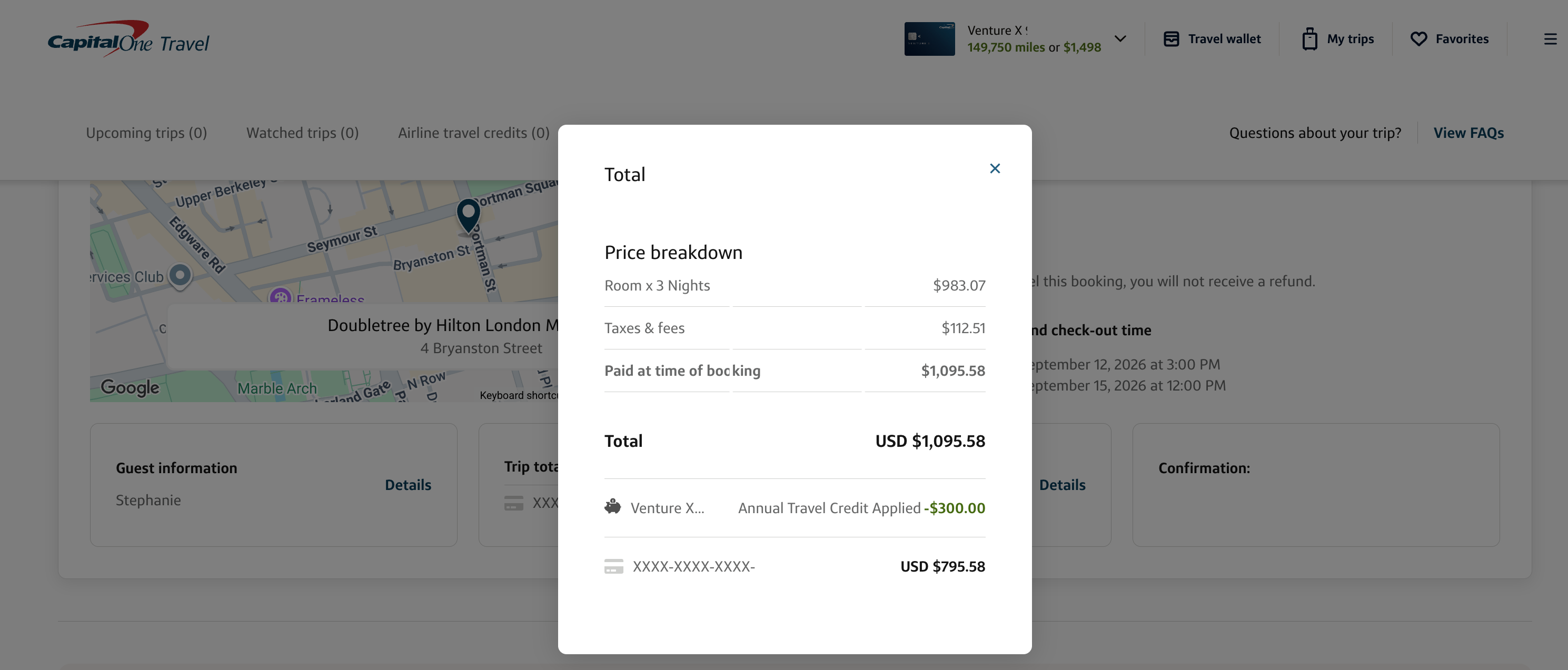
I've found the credit easy to use because you can apply it directly at checkout rather than waiting for a statement credit. For example, I recently used my $300 credit toward a three-night stay at the DoubleTree Marble Arch in London, bringing the cost from $1,096 down to $796.
CAPITAL ONE
Still, I wouldn't value it exactly like $300 in cash since you're limited to bookings made through Capital One Travel rather than booking directly with a hotel or airline.
The 10,000 anniversary miles provide another reason the Venture X can make sense long term. Those miles are worth $185 per our valuations, though you'll need to wait until your first cardholder anniversary to receive them.
The Venture Rewards has a lower annual fee, but the Venture X offers more ways to offset its higher cost if you consistently maximize its perks.
Lounge access
If airport lounge access matters to you, this comparison is straightforward: The Venture X is the only one of the two cards that provides it.
Venture X primary cardholders receive complimentary access to Capital One Lounges and Landings, along with access to Priority Pass lounges (enrollment required). The Venture Rewards doesn't include any airport lounge access.
GABRIELLE BERNARDINI/THE POINTS GUY
Lounge access is one of the main reasons I decided to add the Venture X to my wallet; however, its lounge benefits come with some limitations. Guests cost extra unless you spend $75,000 on your card in a calendar year, in which case you can bring two complimentary guests into Capital One lounges and one guest into Landings. Travelers who frequently visit lounges with companions should factor those costs into the card's value.
You can add up to four authorized users to your Venture X account, but you'll need to pay an additional $125 fee per authorized user to give them their own lounge access privileges.
Other travel benefits and protections
There is more overlap between the cards outside of the Venture X's headline perks. Both provide up to a $120 credit toward a Global Entry or TSA PreCheck application fee every four years, so you don't need to pay the Venture X's higher annual fee just to receive this perk.
Both cards also provide access to Capital One's Lifestyle Collection of hotels, which includes benefits such as a $50 experience credit on eligible stays. The Venture X goes a step further with access to the more upscale Premier Collection, where eligible hotel stays can include a $100 experience credit, daily breakfast for two, and room upgrades, early check-in and late checkout (where available).
KATYA GROZOVSKAYA/CAPITAL ONE
The Venture X also comes with some stronger ancillary benefits, including cellphone protection and Hertz President's Circle status, while Venture Rewards cardholders receive mid-tier Hertz Five Star status. Both cards include various travel and purchase protections, although exact coverage and eligibility requirements vary by benefit.
For travelers who mainly want to earn Capital One miles and a few useful travel perks, the Venture Rewards covers many of the basics without requiring a $395 annual fee. But if you'll use the annual Capital One Travel credit, anniversary miles and lounge access, the Venture X offers considerably more ongoing value.
Winner: Venture X.It has the edge for frequent travelers who can make the most of its premium perks.
How to earn and redeem rewards with the Venture Rewards vs. Venture X
Both the Venture Rewards and the Venture Xearn Capital One miles, so there is significant overlap in how you'll earn, redeem and transfer your rewards. The biggest difference comes down to earning rates on purchases made through Capital One Travel.
Earning miles with the Venture Rewards vs. Venture X
Purchase
Venture Rewards
Venture X
Hotels and rental cars booked through Capital One Travel
5 miles per dollar
10 miles per dollar
Vacation rentals booked through Capital One Travel
5 miles per dollar
5 miles per dollar
Flights booked through Capital One Travel
2 miles per dollar
5 miles per dollar
All other purchases
2 miles per dollar
2 miles per dollar
For most purchases, there's no difference between the two cards. Both earn a straightforward 2 miles per dollar spent, making them useful options for purchases that don't typically fall into a credit card bonus category.
TPG lead writer for points and loyalty Katie Genter appreciates the simplicity she gets with her Venture Rewards, saying, "I like the Venture's straightforward earning structure and the fact that it earns versatile yet valuable Capital One miles."
The Venture X pulls ahead when you book certain travel through Capital One Travel. It earns 10 miles per dollar spent on hotels and rental cars booked through the portal, double the Venture Rewards' 5-mile-per-dollar rate. It also earns 5 miles per dollar on flights booked through Capital One Travel, compared with 2 miles per dollar with the Venture Rewards.
However, both cards earn the same 5 miles per dollar on vacation rentals booked through Capital One Travel. So, the Venture X's earning advantage is primarily useful if you regularly book hotels, rental cars or flights through the portal.
Winner: Venture X. Both cards earn the same amount of miles on everyday purchases, but the Venture X offers higher earning rates on hotels, rental cars and flights booked through Capital One Travel.
Redeeming miles with the Venture Rewards vs. Venture X
Both the Venture Rewards and the Venture X earn Capital One miles and give you the same redemption options.
You'll get the most value by transferring your miles to one of Capital One's 15-plus transfer partners. Alternatively, you can redeem them for a statement credit to cover travel purchases (at a flat rate of 1 cent per mile) or for gift cards.
BEN SMITHSON/THE POINTS GUY
Because carrying the pricier Venture X doesn't unlock a higher-value redemption method, your Capital One miles are worth essentially the same with either card.
Winner: Tie. Both cards offer the same options for redeeming your miles.
Most partners transfer at a 1:1 ratio, and neither card receives a preferential transfer ratio simply because of its annual fee, so a mile earned with the Venture Rewards has the same transfer potential as a mile earned with the Venture X.
Personally, I get the most value from my Capital One miles by transferring them to airline partners. I recently transferred 7,000 miles to Air France-KLM Flying Blue to book a flight from Stockholm Arlanda Airport (ARN) to Amsterdam Airport Schiphol (AMS), paying just $11 in taxes and fees. A comparable cash fare was $219, yielding a redemption value of nearly 3 cents per mile.
Can I have both the Venture Rewards and Venture X?
Yes, you can hold both the Venture Rewards and Venture X at the same time. However, having one doesn't guarantee approval for the other, and Capital One can be difficult to predict when it comes to approving applicants with existing cards.
Also, there may not be much reason to keep both long-term. The cards earn the same Capital One miles, share the same transfer partners and both earn at least 2 miles per dollar on everyday purchases. If you already have one, consider whether the other offers enough additional value to justify paying $490 in combined annual fees.
Should I get the Venture Rewards or the Venture X?
The Venture Rewards is a better fit if you want to earn transferable Capital One miles without paying a premium annual fee. For $95 per year, you'll earn at least 2 miles per dollar on purchases, have access to Capital One's transfer partners and receive several useful travel benefits.
It's also the better option if you don't want to rely on an annual travel credit to justify a higher annual fee. You give up perks like airport lounge access and anniversary bonus miles, but you also don't need to make sure you're spending at least $300 through Capital One Travel every year.
XAVIER LORENZO/GETTY
The Venture X makes more sense if you can consistently use its $300 annual Capital One Travel credit and value perks like airport lounge access and premium hotel benefits. It's also more rewarding if you frequently book hotels, rental cars or flights through Capital One Travel, thanks to its higher earning rates on those purchases.
Upgrading or downgrading between the Venture Rewards and Venture X
If you already have the Venture Rewards and want the Venture X's additional benefits, you may be eligible to upgrade your card by requesting a product change from Capital One. Likewise, Venture X cardholders may be able to downgrade to the Venture Rewards if they no longer get enough value from the premium card's benefits.
Keep in mind that product-change offers can vary by cardholder, so you'll need to check with Capital One to see which options are available for your account. You also won't earn a new cardholder welcome bonus when upgrading or downgrading as part of a product change.
Get the Venture Rewards if you want to earn transferable Capital One miles at a strong flat rate while keeping your annual fee relatively low.
Choose the Venture X if you'll consistently use its $300 Capital One Travel credit and can get meaningful value from its lounge access, anniversary miles and other premium travel perks.
If you don't travel enough to take advantage of either card's benefits or don't want to pay an annual fee, skip both and consider a no-annual-fee rewards card instead.
For Capital One products listed on this page, some of the benefits may be provided by Visa® or Mastercard® and may vary by product. See the respective Guide to Benefits for details, as terms and exclusions apply.
Comments
By commenting, you agree to our Community Guidelines to help create a positive space for conversation. The responses below are not provided or commissioned by the bank advertiser, our partners, or The Points Guy (“TPG”). They have not been reviewed, approved, or otherwise endorsed by any of these parties. All responses are submitted by individual contributors, and neither the bank advertiser, our partners, nor TPG are responsible for ensuring that all posts and/or questions are answered.