The Points Guy believes that credit cards can transform lives, helping you leverage everyday spending for cash back or travel experiences that might otherwise be out of reach. That's why we publish a variety of editorial content and card comparisons: to help you find a great card to turn your goals into reality.
Our site may earn compensation when a customer clicks on a link, when an application is approved, or when an account is opened with our partners, and this may impact how or where these products appear. While we don't cover all available credit cards, our editorial team creates and maintains all of the analysis of these cards, and our content is not influenced nor subject to review by any credit card company, bank or partner prior to (or after) publication. Please view our advertising policy and product review methodology for more information.
Advertiser disclosure
The Points Guy believes that credit cards can transform lives, helping you leverage everyday spending for cash back or travel experiences that might otherwise be out of reach. That's why we publish a variety of editorial content and card comparisons: to help you find a great card to turn your goals into reality.
Our site may earn compensation when a customer clicks on a link, when an application is approved, or when an account is opened with our partners, and this may impact how or where these products appear. While we don't cover all available credit cards, our editorial team creates and maintains all of the analysis of these cards, and our content is not influenced nor subject to review by any credit card company, bank or partner prior to (or after) publication. Please view our advertising policy and product review methodology for more information.
Zach Griff is a senior reporter at TPG. He writes travel and product reviews, deep dives into loyalty programs, news about the airline industry and more.
January 5, 2020 • 9 min read
The cards we feature here are from partners who compensate us when you are approved through our site, and this may impact how or where these products appear. We don't cover all available credit cards, but our analysis, reviews, and opinions are entirely from our editorial team. Terms apply to the offers listed on this page. Please view our advertising policy and product review methodology for more information.Editorial disclaimer: Opinions expressed here are the author's alone, not those of any bank, credit card issuer, airline or hotel chain, and have not been reviewed, approved or otherwise endorsed by any of these entities.
Comments
By commenting, you agree to our Community Guidelines to help create a positive space for conversation. The responses below are not provided or commissioned by the bank advertiser, our partners, or The Points Guy (“TPG”). They have not been reviewed, approved, or otherwise endorsed by any of these parties. All responses are submitted by individual contributors, and neither the bank advertiser, our partners, nor TPG are responsible for ensuring that all posts and/or questions are answered.
Related stories
Quick summary
United now offers inflight internet on nearly all mainline aircraft and two-cabin regional jets, with only a few exceptions on select smaller planes.
Four different network providers supply Wi-Fi across the fleet, each with varying coverage areas and reliability, which can impact your connectivity experience.
Wi-Fi pricing is not published in advance and varies by route and flight duration, with options for hourly or full-flight passes, as well as monthly and annual subscription plans.
You can pay for Wi-Fi with cash or miles, but redeeming miles for Wi-Fi typically yields less value than other redemption options, per TPG's valuations as of June 2024.
What to consider
Wi-Fi is only available on one device at a time unless you sign in with your loyalty account to switch devices.
Monthly and annual Wi-Fi subscriptions are tied to your loyalty account and may not be refundable for individual flight issues.
Purchasing Wi-Fi in advance or using certain travel credits or discounts can reduce your overall cost.
What you'll miss from the article
Detailed comparisons of network providers, tips for maximizing value from subscriptions and advice on troubleshooting or seeking refunds for Wi-Fi issues.
Generated by AI with support from our editorial team.
Update: Some offers mentioned below are no longer available. View the current offers here.
United has gone to great lengths to improve its inflight internet offering. The network used to be riddled with connectivity issues — often resulting in cross-country or international flights without functioning Wi-Fi. Being disconnected sounds lovely ... until it isn't.
United CRJ550 (Photo by Zach Griff/The Points Guy.)
But, those days are (mostly) gone, so if you need to be connected to what's happening on the ground while you are in the sky, bookmark this guide to navigating United’s Wi-Fi network.
Availability
Every United mainline plane and two-cabin regional jet now offers internet access. As such, the only two aircraft models that don’t offer internet access are the Bombardier CRJ-200 and Embraer 145. Fortunately, those planes usually fly some of the carrier’s shortest routes, so you won’t be disconnected for too long.
Though it’s easy to assume that Wi-Fi access equates to functioning internet, there’s a lot more to understand behind-the-scenes. Firstly, the airline uses four different network providers that each have different coverage maps and reliability.
United CRJ550 (Photo by Zach Griff/The Points Guy.)
If you’re flying United long-haul, chances are that you’ll be on a plane with Panasonic Wi-Fi. This provider is the only one of the four that offers a truly global coverage network, so it’s no surprise that United has outfitted its wide-body aircraft with Panasonic. Some single-aisle planes also feature Panasonic Wi-Fi, such as select Airbus A319, A320 and 757.
Thales offers satellite-based internet over the continental United States. You’ll find Thales-powered Wi-Fi on an assortment of the airline’s Boeing 737s, as well as some 757-300s. It's worth noting that there were multiple reports of Wi-Fi issues on Thales-equipped 737s near the end of 2019. If Wi-Fi is critical for you, you may want to avoid this type of plane on United for now.
Finally, my personal favorite— ViaSat— provides Wi-Fi across most of North America, Latin America, the Caribbean and Europe. ViaSat tends to offer the fastest internet speeds, but it’s also available on the smallest proportion of United’s fleet— just select Airbus A319s, 757s and the 737 MAX 9, which of course are currently grounded.
If you’re curious about which provider will power your internet session, be sure to check the flight status page 48 hours before your flight.
Related: Best credit cards for flying United
How to access the internet
Once you’re in the air above 10,000 feet, connecting to United's internet isn’t hard. Turn on Wi-Fi and select the “United Wi-Fi” network. After connecting, fire up your browser and head to unitedwifi.com to access the landing page.
The landing page is where you'll purchase internet access. If you’re using a laptop, it’s also the hub for all the complimentary streaming entertainment that United offers.
When purchasing Wi-Fi, you’ll only have internet access on one device at a time. If you sign in with your MileagePlus account information when purchasing Wi-Fi, you can switch devices through the landing page.
How much does it cost
Unfortunately, United doesn’t publish Wi-Fi pricing ahead of time. The price varies based on many factors, such as flight duration and route.
When purchasing Wi-Fi onboard, you’ll need to select from one of three plans: a one-hour, two-hour or full flight pass. There are no data caps for using the internet.
While some other airlines offer full-day passes, United’s are flight-specific. So if you’re connecting to another flight, you unfortunately won’t be able to use your internet purchase on subsequent same-day flights.
When researching for this guide, I collected some data points on United Wi-Fi pricing that I’ve sorted in the table below.
Origin
Destination
Full-flight cost
EWR
PBI
$11.99
PBI
EWR
$9.99
EWR
TLV
$16.99
TLV
SFO
$31.99
SFO
EWR
$40.99
EWR
PHX
$18.99
ORD
LGA
$14.99
BRU
EWR
$20.99
EWR
CLT
$10.99
LGA
ORD
$17.99
ORD
EWR
$17.99
EWR
SJO
$6.99
EWR
DEN
$20.99
EWR
IAH
$18.99
EGE
IAH
$9.99
If you have a card such as the United Explorer Card, the final price to you will be a bit lower in many cases as the card provides a 25% statement credit on in-flight United purchases, such as Wi-Fi.
You can also redeem MileagePlus miles towards the cost of Wi-Fi at a rate of about 0.6 cents per mile. We at TPG value United miles at 1.3 cents per mile, so I’d highly recommend saving your miles for a more valuable redemption down the line.
Is it worth it to buy a United internet subscription?
The other alternative to purchasing single-use passes is to subscribe to one of United's two subscription plans. The difference between the two plans is the regions where the plans work.
The cheaper plan, at $49 a month, can be used on flights within North and Central America. The more expensive plan, at $69 a month, can be used on flights globally. Monthly subscriptions are tied to your MileagePlus account, so you’ll need to sign-in on each eligible flight to access the internet.
(If you choose the cheaper plan but end up on a long-haul flight, you’ll need to purchase a one-time pass for internet access).
The rates above are on a month-to-month basis. If you’re a very frequent United flier, the airline offers discounts if you’re willing to commit to an annual contract. The North and Central America plan is $539 annually, while the global plan is $689 annually. As with individual Wi-Fi sessions, you can purchase a subscription using miles.
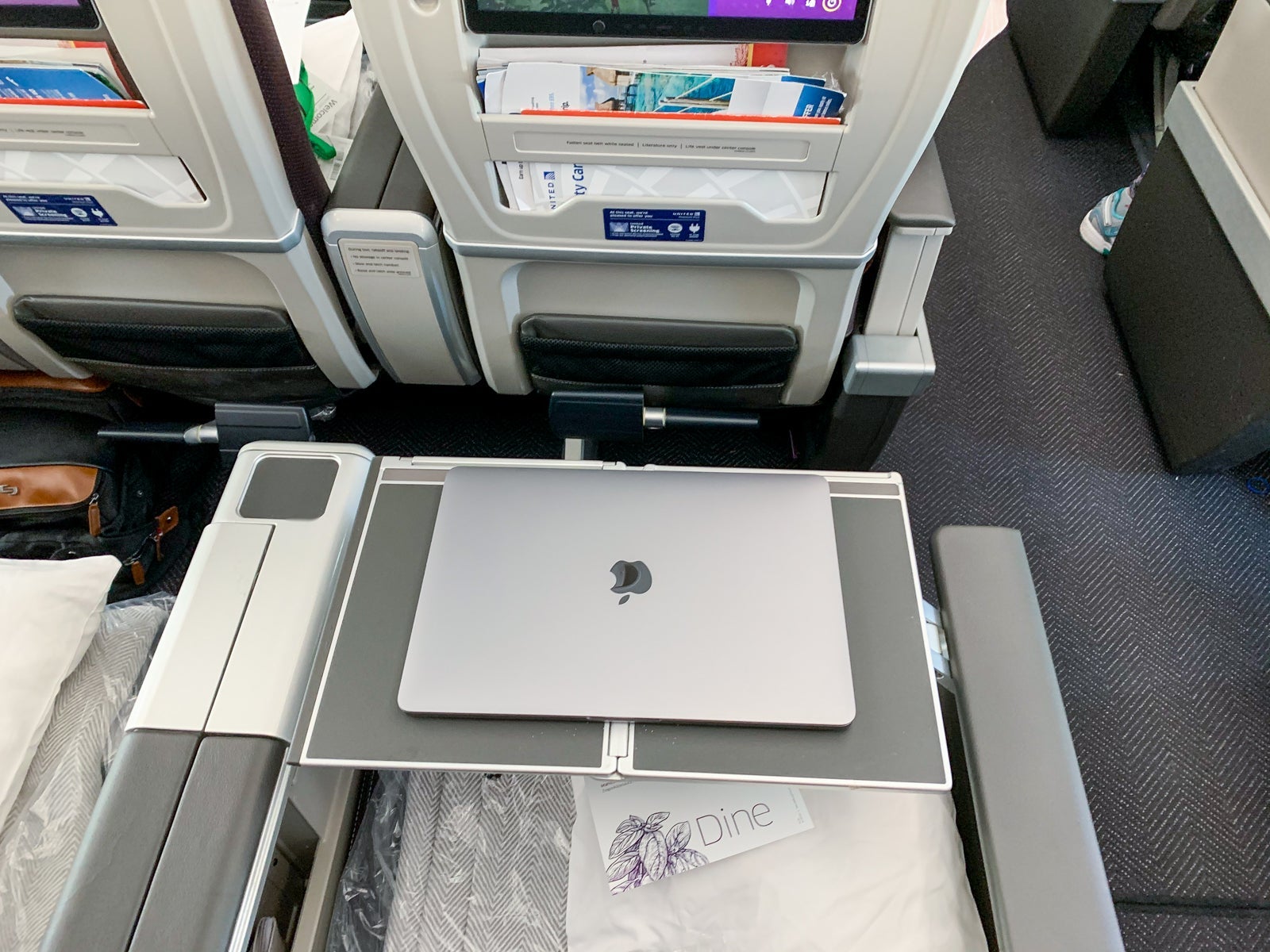
United Premium Plus on the Boeing 787-10 (Photo by Zach Griff/The Points Guy.)
I find the most value in purchasing monthly Wi-Fi subscriptions. I’m often traveling for two weeks at a time, and then off for a few weeks, before restarting again. Instead of committing to an annual contract, I love purchasing Wi-Fi for a month, letting it expire and then only purchasing another subscription when I’ve got lots of United flights scheduled. This way, I’m not paying for time I won’t use, and I’m still saving money over paying for internet on a per-flight basis.
With Newark to Houston flights ringing in at about $36 in Wi-Fi per round trip, spending $49 per month can quickly become the better deal.
My rule of thumb is that it takes five short-haul flights to recoup the cost of the cheaper monthly plan. If you’re flying medium to longer-haul flights, it could take 3 flights or less. If you fly internationally at least once per month, then it makes sense to upgrade to the global plan.
As mentioned earlier, if you hold a United Explorer Card or United Club card, you get a 25% statement credit for all inflight purchases including Wi-Fi. Single-use passes, as well as monthly and annual subscriptions, are eligible for the discount.
The information for the United Club has been collected independently by The Points Guy. The card details on this page have not been reviewed or provided by the card issuer.
If your United Wi-Fi does not work as intended, be sure and request a refund from the airline. However, know that if you have a monthly subscription plan, a refund will not likely be issued for malfunctioning Wi-Fi on any given flight.
Bottom line
The good news is that almost all United planes now feature Wi-Fi. While the carrier uses a hodgepodge of network providers on different aircraft types, the pricing structure is relatively simple. For regular United flyers, it can make sense to purchase a monthly Wi-Fi subscription -- and you can save even more money if you pay with the right credit cards. Armed with this guide, you’ll be cloud surfing in no time.
Comments
By commenting, you agree to our Community Guidelines to help create a positive space for conversation. The responses below are not provided or commissioned by the bank advertiser, our partners, or The Points Guy (“TPG”). They have not been reviewed, approved, or otherwise endorsed by any of these parties. All responses are submitted by individual contributors, and neither the bank advertiser, our partners, nor TPG are responsible for ensuring that all posts and/or questions are answered.