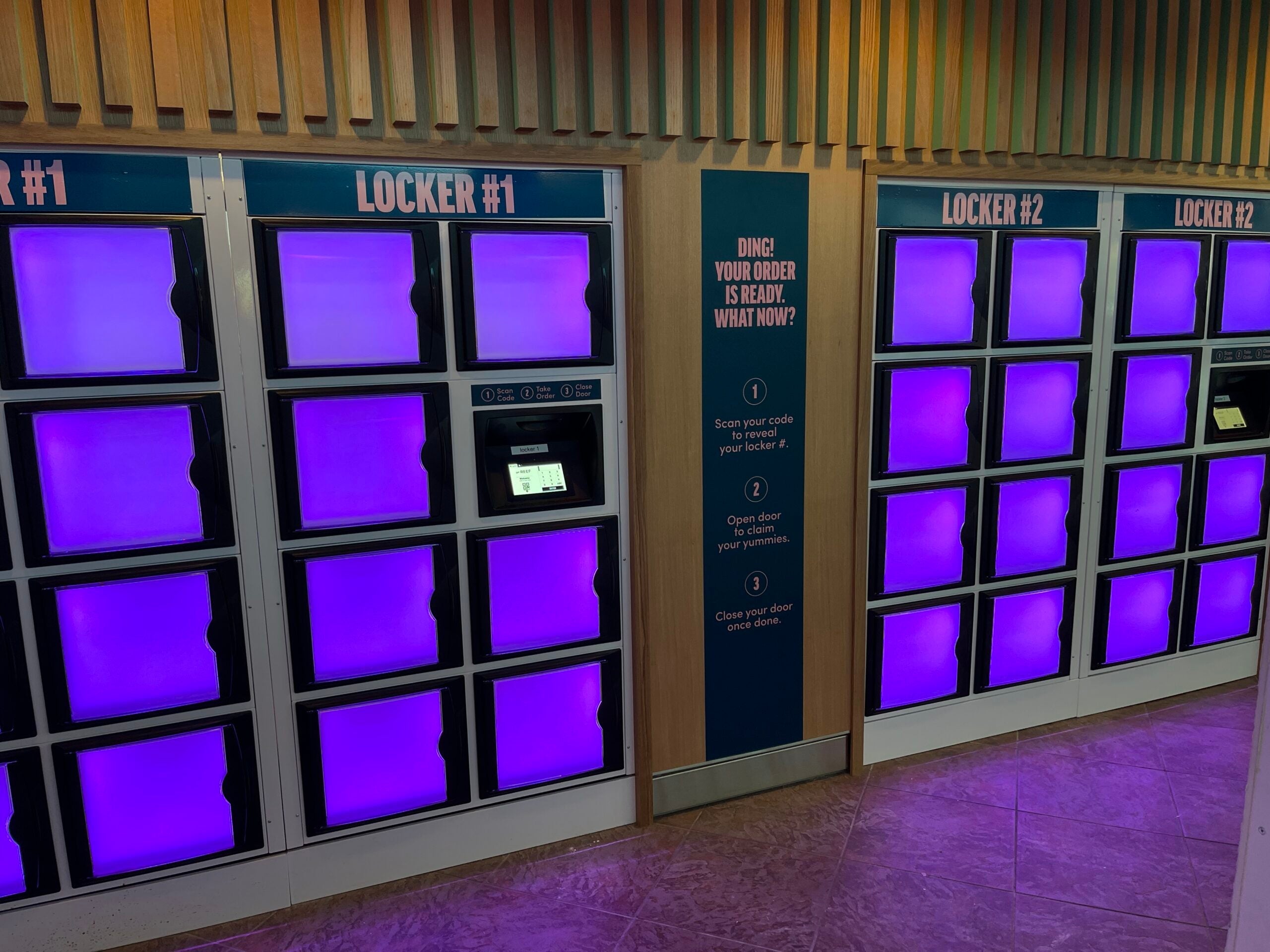

The concept, which opened earlier this month, is being referred to as a “ghost kitchen” or a “mobile food hall” at the airport.

It’s a first-of-its-kind design, the vendor behind the setup tells TPG, which functions by placing a handful of restaurants inside a single kitchen, operated by a single set of workers who prepare orders, then deliver them to a locker.

“We came across this idea and thought it would be a great fit, and said, 'Hey, let’s try it,'” RDU's media relations director, Stephanie Hawco, told TPG as we talked with her in front of Get Reef Virtual Food Hall.

As a resident of North Carolina’s Research Triangle, where RDU sits, the term "food hall" instantly caught my eye when I saw Get Reef under construction in July. This region is rich with food halls that combine local restaurants, breweries, coffee shops and the like under one roof. I frequent one such location for lunch in downtown Durham, about 15 minutes from the airport.

What makes this airport setup different, though, is that there’s not limited human-to-human interaction; there’s none.
It all starts when you place an order at one of the touchscreens along the wall next to Get Reef’s lockers.

You can also scan a QR code to access a menu and place the order on your phone.

Depending on the time of day, you’ll have your choice of up to nine different vendors ranging from national chains to local businesses.
Related: Detroit’s new personalized flight information board is straight out of a sci-fi novel
Using the touchscreen, I placed an order for a cup of coffee from Beyu, a popular local coffee shop.

Once I submitted the order, I got a text on my phone from my "virtual waiter" letting me know I could text back with any questions. I also received a link I could use to pay.

After entering my credit card information on my phone, I formally submitted the order. Then I started the stopwatch on my phone to see how long it would take.
Exactly two minutes went by before I got another message: The order was complete and ready for pickup.

The text message directed me to Locker #1 and provided me with two options: walk up to the lockers and scan a QR code to get my order or punch in a code on a screen to unlock the door.

As soon as I punched in the code, a door swung open and there was my coffee.

Alan Phillips, chief creative officer of Reef, says the concept is a first of its kind at a U.S. airport. He believes the concept is most notable for its efficiency.
“There’s definitely less staff required due to the efficiency of the product and the use of technology,” Philips said. “It is more efficient from a labor perspective than an average restaurant.”
That’s important at a time when airport restaurants, bars and retailers have faced continued staffing shortages even as travel has rebounded. While you’ve probably noticed improvement as you’ve navigated airports this summer compared to even just a few months ago, the challenges have not entirely disappeared.

At airports across the country, staffing shortages can mean food and drink concessionaires open late, close early or stay closed, reducing customer choices and leading to backlogs at the businesses that are open.
At RDU, officials see Reef as a potential solution.
“By having this kitchen that’s shared among nine different concepts, it really cuts down on the amount of labor they need, so we’re really looking at this as something that’s not only convenient for the customer but something that’s very helpful for the businesses as well,” Hawco said.

While Reef chose RDU as its first airport terminal with the concept, Phillips anticipates you’ll eventually see similar "virtual food halls" in other concourses across the country, citing interest from airports in other cities.
Later this summer, in addition to having pickup available from a locker, Get Reef plans to start food delivery to each gate, which is a concept other airports have rolled out, including in New York and at airports in the Washington, D.C. area.