Can a cruise help with jet lag? The answer might surprise you


Editor's note: TPG's Ashley Kosciolek was hosted by Cunard Line on a transatlantic crossing aboard Queen Mary 2. The opinions expressed below are entirely hers and weren't subject to review by the line.
My last international trip ended four days ago, but I'm still suffering from jet lag. There are tons of tips for both battling it and avoiding it in the first place. However, I find that the older I get, the less effective most methods are for me.
But one remedy you might not expect is a cruise — specifically, replacing your transatlantic flight with a weeklong ocean crossing.
Can a transatlantic voyage actually help to stave off severe jet lag? The answer depends on the itinerary you select and whether you're a morning person.
The background

Two weeks ago, I embarked on a transatlantic voyage on Cunard's Queen Mary 2, sailing from Brooklyn's Red Hook cruise terminal in New York to Southampton, England — a seven-day trip with no port calls in between.
Because there's currently a time difference of five hours between New York and Southampton, the clocks on my ship advanced one hour each day beginning on the third day of the cruise. Unfortunately, the gradual jumping ahead didn't make the adjustment any easier for my body, especially as the disparity grew between the time at home and the time on board.
Then why am I suggesting that a cruise could be a less shocking-to-the-system — albeit more time-consuming — option to make your way between the two continents? There's also a westbound voyage.
Differences between eastbound and westbound voyages

On the eastbound journey from New York to Southampton, you'll lose an hour each day, which makes it feel earlier than it actually is. In turn, that can make it more difficult to get out of bed, particularly if — like me — you're not an early riser.
On the flip side, when the ship sails west, from the U.K. to the U.S., you'll gain an hour, which is a dream for people who enjoy sleeping in, though it can also make you feel tired at an earlier time at night because your body thinks it's later than what the clocks show.

Four years ago, I did the westbound sailing from Southampton to Brooklyn, and I found that gaining an hour each day made acclimating to the time change much easier. For me, going to bed early is preferable to waking up early, so I like sailing the western route.
In both directions, the effects are usually felt more strongly as the voyage progresses.
When and how time changes occur
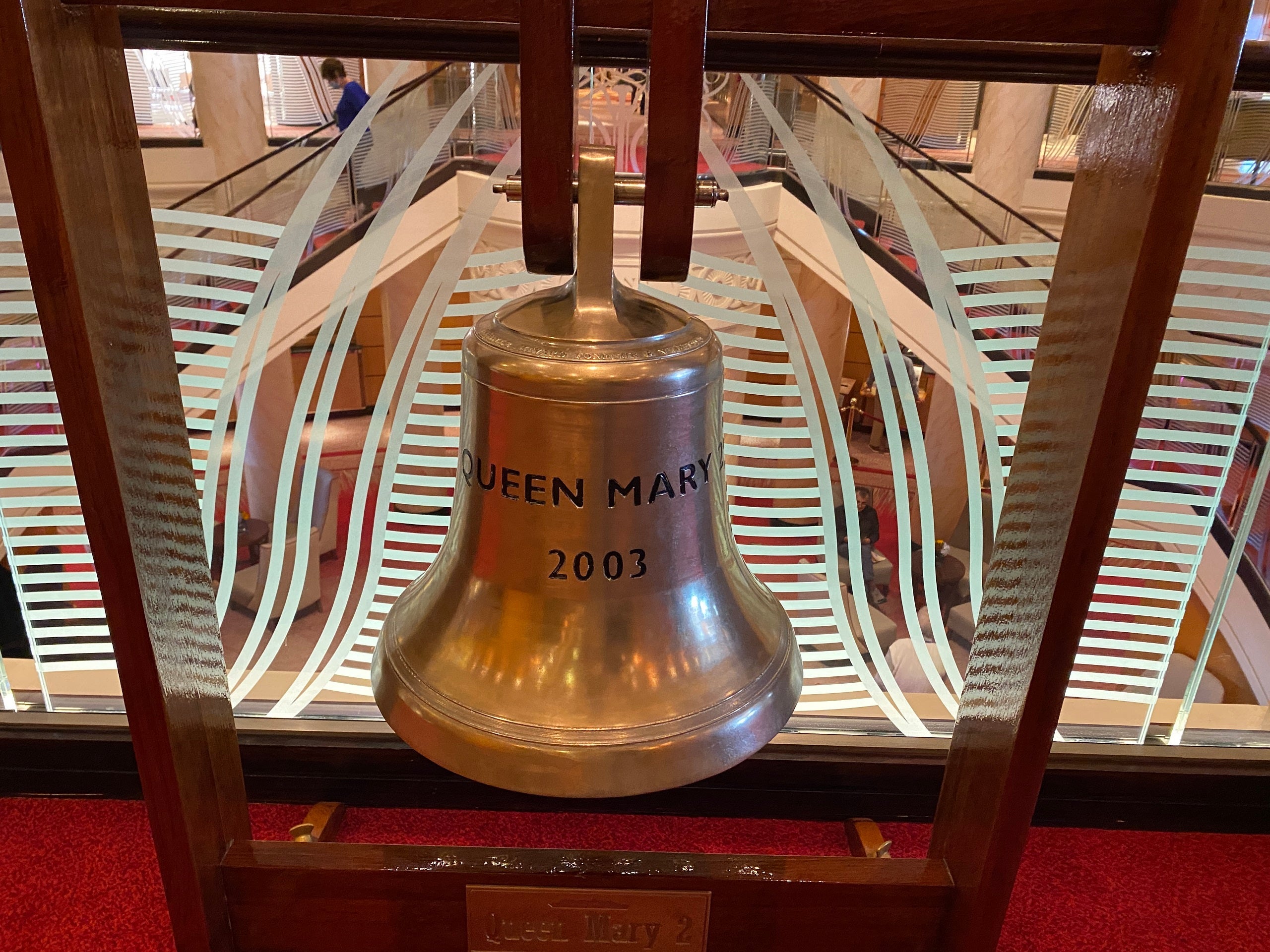
On each day when a time change is necessary, the Queen Mary 2 captain comes on the ship's public address system just before noon to announce that the ship's clocks will either jump forward by an hour (on eastbound crossings) or back by an hour (if you're headed west). Essentially, the noon hour doesn't exist on those days; what would have been noon either becomes 1 p.m. or 11 a.m., depending on the voyage direction.
A bell in the vessel's two-deck lobby then rings eight times to signal the change before the captain makes his daily update.
The midday change, rather than one that happens while you sleep, is helpful because it doesn't force you to remember to change your watch before you go to bed. It also ensures that nobody — neither passengers nor the hard-working crew — loses an hour of sleep.
Tips for adjusting to the onboard time changes

Adjusting to new time zones is often difficult, but I picked up a few bits of wisdom along the way to help with that. Try these tricks to help you acclimate.
- Choose your cruise carefully. If you sail an itinerary that has port stops, you could be forced to move hours ahead or back all at once instead of gradually. If you choose a route that doesn't include any calls, go for the one that best suits your habits — early to bed (west) or early to rise (east).
- Don't forget to update your watch and/or phone. The ship's clocks will automatically move forward or back at noon on the necessary days, but your phone and watch won't, especially if they're on airplane mode (which they should be if you don't want to accrue massive fees).
- Pace yourself. There's nothing wrong with sleeping in an extra hour or going to bed a bit early if you're tired. Listen to your body.
- Stay hydrated. It might sound silly, but you'd be amazed how much more awake you'll feel at any time of day if you drink enough water.
- Build in some extra time. If you're able to, take an extra couple of days off at the end of your voyage so you can fully adjust to the time changes without having to be at peak performance for work or other commitments.
Planning a cruise? Start with these stories:
- The 5 most desirable cabin locations on any cruise ship
- A beginners guide to picking a cruise line
- The 8 worst cabin locations on any cruise ship
- A quick guide to the most popular cruise lines
- 21 tips and tricks that will make your cruise go smoothly
- 15 ways cruisers waste money
- 12 best cruises for people who never want to grow up
- The ultimate guide to what to pack for a cruise
TPG featured card
at American Express's secure site
Terms & restrictions apply. See rates & fees.
| 4X | Earn 4X Membership Rewards® points per dollar spent on purchases at restaurants worldwide, on up to $50,000 in purchases per calendar year, then 1X points for the rest of the year. |
| 4X | Earn 4X Membership Rewards® points per dollar spent at US supermarkets, on up to $25,000 in purchases per calendar year, then 1X points for the rest of the year. |
| 5X | Earn 5X Membership Rewards® points on prepaid hotel stays booked through AmexTravel.com or the Amex Travel App™. |
| 3X | Earn 3X Membership Rewards® points on flights booked through AmexTravel.com, the Amex Travel App™, or purchased directly from airlines. |
| 2X | Earn 2X Membership Rewards® points on prepaid car rentals booked through AmexTravel.com or the Amex Travel App™ and cruises booked and paid through AmexTravel.com. |
| 1X | Earn 1X Membership Rewards® point per dollar spent on all other eligible purchases. |
Pros
- Valuable dining and food-related credits
- Flexible rewards with airline and hotel transfer partners
- Multiple travel and purchase protections
- No foreign transaction fees
- Access to Amex Offers for additional savings (enrollment required)
Cons
- Not as useful for those living outside the U.S.
- Some may have trouble using Uber and other dining credits
- You may be eligible for as high as 100,000 Membership Rewards® Points after you spend $8,000 in eligible purchases on your new Card in your first 6 months of Card Membership. Welcome offers vary and you may not be eligible for an offer. Apply to know if you’re approved and find out your exact welcome offer amount – all with no credit score impact. If you’re approved and choose to accept the Card, your score may be impacted.
- Earn 4X Membership Rewards® points per dollar spent on purchases at restaurants worldwide, on up to $50,000 in purchases per calendar year, then 1X points for the rest of the year.
- Earn 4X Membership Rewards® points per dollar spent at US supermarkets, on up to $25,000 in purchases per calendar year, then 1X points for the rest of the year.
- Earn 5X Membership Rewards® points on prepaid hotel stays booked through AmexTravel.com or the Amex Travel App™.
- Earn 3X Membership Rewards® points on flights booked through AmexTravel.com, the Amex Travel App™, or purchased directly from airlines.
- Earn 2X Membership Rewards® points on prepaid car rentals booked through AmexTravel.com or the Amex Travel App™ and cruises booked and paid through AmexTravel.com.
- Earn 1X Membership Rewards® point per dollar spent on all other eligible purchases.
- Pay It® lets you tap in the American Express® App to quickly pay for small purchase amounts throughout the month and still earn rewards the way you usually do. Plan It® gives you the option to split up big purchases into equal monthly payments with a fixed fee. You’ll know upfront exactly how much you’ll pay.
- $120 Dining Credit: Earn up to a total of $10 in statement credits monthly when you pay with the Gold Card at Grubhub (including Seamless), Buffalo Wild Wings, Five Guys, The Cheesecake Factory, and Wonder. This can be an annual savings of up to $120. Enrollment required.
- $100 Resy Credit: Get up to $100 in statement credits each calendar year at over 10,000 qualifying U.S. Resy restaurants after you pay for eligible purchases with the American Express® Gold Card. That’s up to $50 in statement credits semi-annually. Enrollment required.
- $84 Dunkin' Credit: Earn up to $7 in monthly statement credits after you pay with the American Express® Gold Card at U.S. Dunkin’ locations. Enrollment required.
- $120 Uber Cash on Gold: Enjoy up to $120 in Uber Cash annually with your Gold Card. Just add your Card to your Uber account and you'll get $10 in Uber Cash each month to use on orders and rides in the U.S. when you select an Amex Card for your transaction.
- Enjoy complimentary Hertz Five Star® Status benefits like skipping the counter at select locations, adding an additional driver at no additional cost*, and vehicle upgrades**. Benefit enrollment and Hertz Gold+ registration are required. *Additional drivers must meet standard rental qualifications and must be a spouse or domestic partner to qualify as complimentary. Other additional drivers subject to fees. **Benefits are subject to availability and vary by location. Additional Hertz program Terms and Conditions including age restrictions apply.
- Book two nights or more with The Hotel Collection through AmexTravel.com or the Amex Travel App™ and receive a $100* credit towards eligible charges at over 1,400 upscale hotels worldwide. *Eligible charges vary by property.
- Book your travel through the Amex Travel App™ with added peace of mind – backed by American Express® service and support. Only for American Express® Card Members.
- Whenever you need us, we're here. Our Member Services team will ensure you are taken care of. From lost Card replacement to statement questions, we are available to help 24/7.
- No Foreign Transaction Fees.
- Annual Fee is $325.
- Terms Apply.