State of the Electronics Ban — Who's Cleared, Who's Still Banned

Update 7/19/2017: Saudia has been cleared for flights departing Riyadh (RUH) effective July 19. This marks the final airport removed from the list. Currently, no airports are subject to the large carry-on electronics ban.
Update 7/17/2017: Saudia has been cleared for flights departing Jeddah (JED) effective July 17.
Update 7/12/2017: EgyptAir has been cleared effective July 12. It remains in place for flights from Cairo to London.
Update 7/12/2017: Royal Air Maroc has been cleared effective July 13, six days earlier than originally expected.
Update 7/9/2017: Kuwait Airways has been cleared effective today.
Update 7/9/2017: Royal Jordanian has been cleared effective July 9.
Update 7/6/2017: Royal Air Maroc expects to be cleared by July 19.
Update 7/6/2017: Qatar has now been cleared from the electronics ban.
Just a couple of weeks ago, the Department of Homeland Security (DHS) Secretary John Kelly told lawmakers that an expansion of the electronics ban to European airports was "likely and imminent." Since then, things have changed. Rather than expanding, the large carry-on electronics ban has retracted. Abu Dhabi (Etihad), Doha (Qatar), Istanbul (Turkish) and Dubai (Emirates) are off the list. Saudia says that it expects to be cleared by July 19. With all of the recent changes, here's where the electronics ban currently stands.
Original Electronics Ban
The large carry-on electronics ban affected nine airlines across 10 airports in eight countries. This ban was made official on March 21, with airlines given just 96 hours to fully comply — or lose their right to operate flights to the US. All nine airlines pulled it off, with some introducing gate-checking of electronics and loaner laptops within a week.
The United Kingdom — sharing the same intelligence data as the United States — also rolled out a similar electronics ban. There was one noticeable difference: The "Middle East Three" (Emirates, Etihad, Qatar), along with Kuwait and Morocco, were absent from the UK's list.
As of publication date, some of these airports are meeting the newly released requirements and getting cleared from the US electronics ban. Here's the current state of affairs:
| Airport | Airline | Status |
|---|---|---|
Abu Dhabi International Airport (AUH) | Etihad Airways | |
Ataturk International Airport (IST) | Turkish Airlines | |
Dubai International Airport (DXB) | Emirates | |
Hamad International Airport (DOH) | Qatar Airways | |
Queen Alia International Airport (AMM) | Royal Jordanian Airlines | |
Kuwait International Airport (KWI) | Kuwait Airways | |
Cairo International Airport (CAI) | EgyptAir | |
Mohammed V Airport (CMN) | Royal Air Maroc | |
King Abdul-Aziz International Airport (JED) | Saudia | |
King Khalid International Airport (RUH) | Saudia |
European Airports
Despite plenty of speculation and discussion, no European airports have been subject to the electronics ban (except Istanbul, which is technically in Europe), but it's going to take some effort to stay off the list. The DHS is requiring all airports with nonstop flights to the US to comply with a laundry list of new regulations. If airports meet these requirements, then it's business as usual. If the DHS determines that some airports aren't fully complying, the large carry-on electronics ban will include these airports.

Tips for Flying Through Still-Banned Airports
What happens if you're still flying from one of the affected airports? First, it's important to remember that the ban only affects nonstop flights from the affected airports to the US. If you're flying from Cairo (CAI) via London before heading back to the US, you can keep your electronics with you the whole time — but not if you're on an EgyptAir nonstop from Cairo (CAI) directly to the US. No flights departing the US are affected.
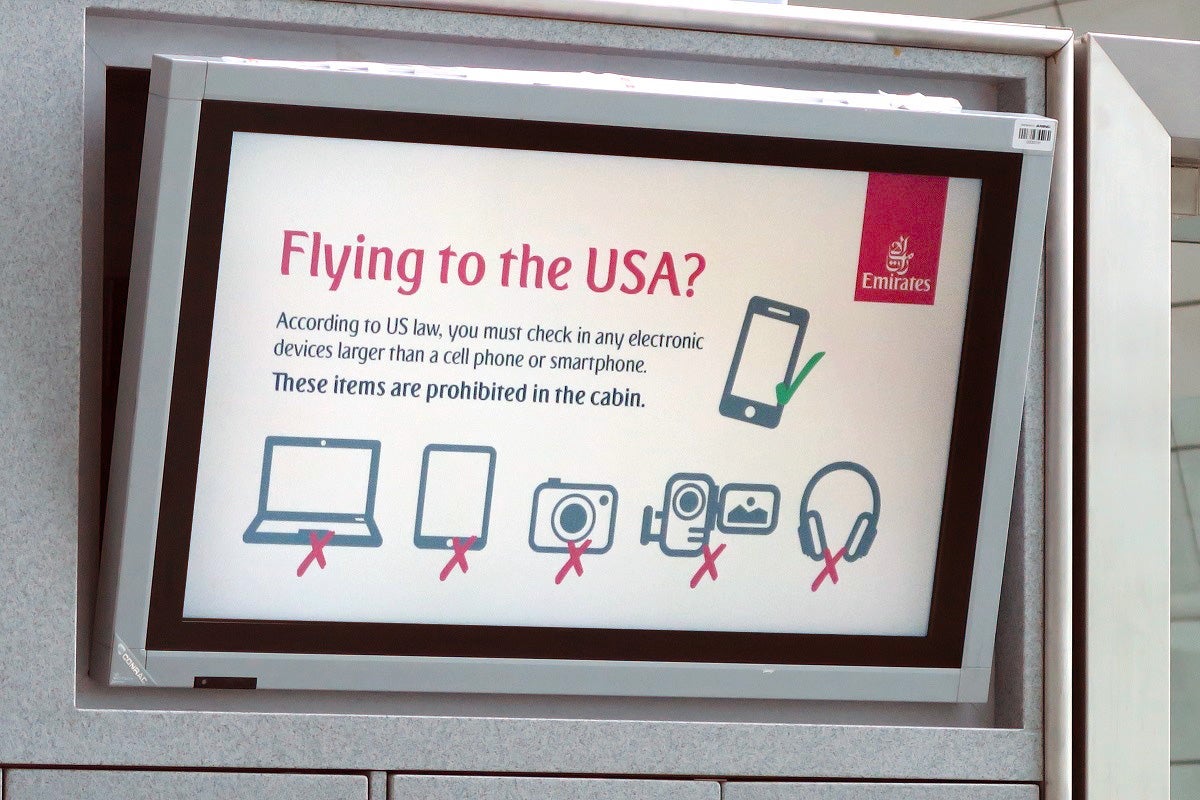
Next, it's important to know what's banned and not. Technically, any electronics that are larger than a smartphone are banned. For some airlines, this is being applied to noise-canceling headphones; they're electronics and larger than a phone. But this rule isn't being consistently enforced.
Finally, if you need to check your electronics, you should read up on how to pack your electronics, what damage your credit card might and might not cover and how to survive long flights with kids with no electronics.
TPG featured card
at American Express's secure site
Terms & restrictions apply. See rates & fees.
| 4X | Earn 4X Membership Rewards® points per dollar spent on purchases at restaurants worldwide, on up to $50,000 in purchases per calendar year, then 1X points for the rest of the year. |
| 4X | Earn 4X Membership Rewards® points per dollar spent at US supermarkets, on up to $25,000 in purchases per calendar year, then 1X points for the rest of the year. |
| 5X | Earn 5X Membership Rewards® points on prepaid hotel stays booked through AmexTravel.com or the Amex Travel App™. |
| 3X | Earn 3X Membership Rewards® points on flights booked through AmexTravel.com, the Amex Travel App™, or purchased directly from airlines. |
| 2X | Earn 2X Membership Rewards® points on prepaid car rentals booked through AmexTravel.com or the Amex Travel App™ and cruises booked and paid through AmexTravel.com. |
| 1X | Earn 1X Membership Rewards® point per dollar spent on all other eligible purchases. |
Pros
- Valuable dining and food-related credits
- Flexible rewards with airline and hotel transfer partners
- Multiple travel and purchase protections
- No foreign transaction fees
- Access to Amex Offers for additional savings (enrollment required)
Cons
- Not as useful for those living outside the U.S.
- Some may have trouble using Uber and other dining credits
- You may be eligible for as high as 100,000 Membership Rewards® Points after you spend $8,000 in eligible purchases on your new Card in your first 6 months of Card Membership. Welcome offers vary and you may not be eligible for an offer. Apply to know if you’re approved and find out your exact welcome offer amount – all with no credit score impact. If you’re approved and choose to accept the Card, your score may be impacted.
- Earn 4X Membership Rewards® points per dollar spent on purchases at restaurants worldwide, on up to $50,000 in purchases per calendar year, then 1X points for the rest of the year.
- Earn 4X Membership Rewards® points per dollar spent at US supermarkets, on up to $25,000 in purchases per calendar year, then 1X points for the rest of the year.
- Earn 5X Membership Rewards® points on prepaid hotel stays booked through AmexTravel.com or the Amex Travel App™.
- Earn 3X Membership Rewards® points on flights booked through AmexTravel.com, the Amex Travel App™, or purchased directly from airlines.
- Earn 2X Membership Rewards® points on prepaid car rentals booked through AmexTravel.com or the Amex Travel App™ and cruises booked and paid through AmexTravel.com.
- Earn 1X Membership Rewards® point per dollar spent on all other eligible purchases.
- Pay It® lets you tap in the American Express® App to quickly pay for small purchase amounts throughout the month and still earn rewards the way you usually do. Plan It® gives you the option to split up big purchases into equal monthly payments with a fixed fee. You’ll know upfront exactly how much you’ll pay.
- $120 Dining Credit: Earn up to a total of $10 in statement credits monthly when you pay with the Gold Card at Grubhub (including Seamless), Buffalo Wild Wings, Five Guys, The Cheesecake Factory, and Wonder. This can be an annual savings of up to $120. Enrollment required.
- $100 Resy Credit: Get up to $100 in statement credits each calendar year at over 10,000 qualifying U.S. Resy restaurants after you pay for eligible purchases with the American Express® Gold Card. That’s up to $50 in statement credits semi-annually. Enrollment required.
- $84 Dunkin' Credit: Earn up to $7 in monthly statement credits after you pay with the American Express® Gold Card at U.S. Dunkin’ locations. Enrollment required.
- $120 Uber Cash on Gold: Enjoy up to $120 in Uber Cash annually with your Gold Card. Just add your Card to your Uber account and you'll get $10 in Uber Cash each month to use on orders and rides in the U.S. when you select an Amex Card for your transaction.
- Enjoy complimentary Hertz Five Star® Status benefits like skipping the counter at select locations, adding an additional driver at no additional cost*, and vehicle upgrades**. Benefit enrollment and Hertz Gold+ registration are required. *Additional drivers must meet standard rental qualifications and must be a spouse or domestic partner to qualify as complimentary. Other additional drivers subject to fees. **Benefits are subject to availability and vary by location. Additional Hertz program Terms and Conditions including age restrictions apply.
- Book two nights or more with The Hotel Collection through AmexTravel.com or the Amex Travel App™ and receive a $100* credit towards eligible charges at over 1,400 upscale hotels worldwide. *Eligible charges vary by property.
- Book your travel through the Amex Travel App™ with added peace of mind – backed by American Express® service and support. Only for American Express® Card Members.
- Whenever you need us, we're here. Our Member Services team will ensure you are taken care of. From lost Card replacement to statement questions, we are available to help 24/7.
- No Foreign Transaction Fees.
- Annual Fee is $325.
- Terms Apply.