U.S. Congress edges closer to passing hotel 'junk fee' transparency laws

On Wednesday, the U.S. Senate Committee on Commerce, Science and Transportation voted to pass a bill that, if it receives a majority vote in the Senate, would prohibit hotel and vacation rental companies from advertising unfair and deceptive pricing — aka booking "junk fees."
The bipartisan bill known as the Hotel Fees Transparency Act of 2023 was introduced by Sen. Amy Klobuchar and Sen. Jerry Moran last July and, once passed, would set a national mandatory standard for clear, transparent fee pricing across the industry. It now awaits a vote by the full Senate.
In the hotel and rental industry, surprise additions to a final bill are often labeled as "destination," "resort" or "urban" fees. These hidden charges are often added to your bill during checkout without being clearly stated earlier in the booking process; they also often come with their own taxes and fees. So, once consumers are ready to pay, the final price for a hotel or rental stay can be significantly higher than what they anticipated or what was initially advertised.
Prices are also displayed differently depending on whether the hotel you're interested in is based in the U.S. or abroad. For domestic properties, Hilton, Hyatt and Marriott all advertise prices that include resort fees (excluding tax). For hotels outside of the U.S., however, the displayed price is often nowhere near the final fee.
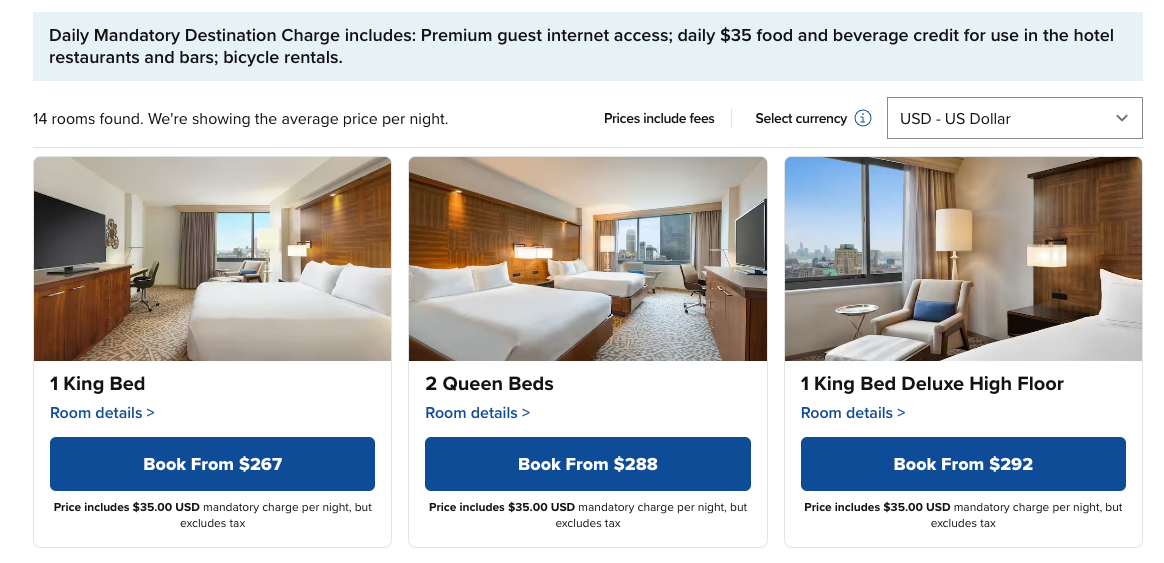
For example, if you wanted to book the Hilton New York Times Square online, the rate appears to be $267 per night for Hilton Honors members — at first glance. However, once you reach the final booking page, after adding taxes and a mandatory destination fee, the total is $310.35. Even with some mandatory charges included in the displayed price, it's still over $40 more expensive than the booking site first indicated once taxes are added.
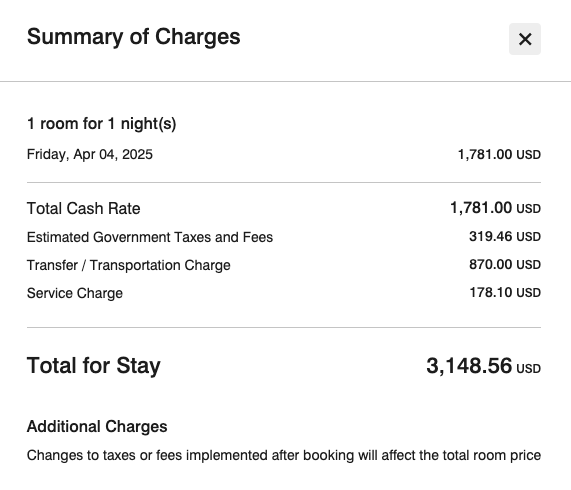
The disparity can be even more extreme when you look at hotels outside the U.S. For example, The St. Regis Maldives Vommuli Resort initially shows a nightly rate of $1,781 on Marriott's website. The final booking price (after taxes and other fees are added) increases to a whopping $3,148.56 per night thanks to additional expenses for airport transfers, government taxes and fees and a vague "service charge."
Similarly, the U.S. House of Representatives passed the No Hidden FEES Act in June. Ideally, both pieces of legislation would work in tandem to establish better pricing practices across the industry.
"Today's committee vote in the Senate is an important step toward a more transparent booking process for guests and a level playing field across the lodging industry — including short-term rentals, online travel agencies, metasearch sites, and hotels," said Kevin Carey, interim president of the American Hotel and Lodging Association, in a statement.
Both bills are part of a larger push sparked by the Biden administration to crack down on corporate junk fee charges that unfairly raise prices for consumers.

"We're not going to stop until every junk fee we know about is either repealed or at least elevated into the light," said Jared Bernstein, the chair of the United States Council of Economic Advisers, in a May interview with TPG managing editor Clint Henderson.
And some states, such as California, are crusading against junk fees on their own. As of July 1, California hotels must now "clearly and conspicuously" disclose any surprise fees — including resort and cleaning fees — from the get-go. The legislation also applies to Airbnb bookings.
The hotel and vacation rental industries aren't the only ones under the microscope. In March, federal regulators finalized a new rule to cap credit card late fees at $8. Commercial airlines are also being pressured to be more transparent about fares and eradicate junk fees.
Earlier this week, for example, Biden announced a proposal to ban airlines from charging parents extra to sit next to their children on flights.
But it's not all good news. Airline junk fee regulations faced setbacks this week after the 5th U.S. Circuit Court of Appeals temporarily halted a U.S. Department of Transport rule that called for airlines to clearly disclose any add-on charges.
The regulation, set to take effect in late April 2025, faced considerable backlash from U.S. airlines and lobbying groups, including Airlines for America and the International Air Transport Association.
The panel of judges temporarily halted its enforcement, stating that the rule "likely exceeds DOT's authority and will irreparably harm airlines." Currently, airlines do not need to change current price displays, fees or fares until the case is resolved.
Bottom line
Though junk fee regulations in the airline industry faced a setback this week, hotel guests are one step closer to getting much-needed transparency regarding hidden booking costs. If the Hotel Fees Transparency Act of 2023 passes a full Senate vote, hotels and vacation rental companies will be required to disclose the true cost of a stay upfront — a win for consumers.
Related reading:
TPG featured card
at American Express's secure site
Terms & restrictions apply. See rates & fees.
| 4X | Earn 4X Membership Rewards® points per dollar spent on purchases at restaurants worldwide, on up to $50,000 in purchases per calendar year, then 1X points for the rest of the year. |
| 4X | Earn 4X Membership Rewards® points per dollar spent at US supermarkets, on up to $25,000 in purchases per calendar year, then 1X points for the rest of the year. |
| 5X | Earn 5X Membership Rewards® points on prepaid hotel stays booked through AmexTravel.com or the Amex Travel App™. |
| 3X | Earn 3X Membership Rewards® points on flights booked through AmexTravel.com, the Amex Travel App™, or purchased directly from airlines. |
| 2X | Earn 2X Membership Rewards® points on prepaid car rentals booked through AmexTravel.com or the Amex Travel App™ and cruises booked and paid through AmexTravel.com. |
| 1X | Earn 1X Membership Rewards® point per dollar spent on all other eligible purchases. |
Pros
- Valuable dining and food-related credits
- Flexible rewards with airline and hotel transfer partners
- Multiple travel and purchase protections
- No foreign transaction fees
- Access to Amex Offers for additional savings (enrollment required)
Cons
- Not as useful for those living outside the U.S.
- Some may have trouble using Uber and other dining credits
- You may be eligible for as high as 100,000 Membership Rewards® Points after you spend $8,000 in eligible purchases on your new Card in your first 6 months of Card Membership. Welcome offers vary and you may not be eligible for an offer. Apply to know if you’re approved and find out your exact welcome offer amount – all with no credit score impact. If you’re approved and choose to accept the Card, your score may be impacted.
- Earn 4X Membership Rewards® points per dollar spent on purchases at restaurants worldwide, on up to $50,000 in purchases per calendar year, then 1X points for the rest of the year.
- Earn 4X Membership Rewards® points per dollar spent at US supermarkets, on up to $25,000 in purchases per calendar year, then 1X points for the rest of the year.
- Earn 5X Membership Rewards® points on prepaid hotel stays booked through AmexTravel.com or the Amex Travel App™.
- Earn 3X Membership Rewards® points on flights booked through AmexTravel.com, the Amex Travel App™, or purchased directly from airlines.
- Earn 2X Membership Rewards® points on prepaid car rentals booked through AmexTravel.com or the Amex Travel App™ and cruises booked and paid through AmexTravel.com.
- Earn 1X Membership Rewards® point per dollar spent on all other eligible purchases.
- Pay It® lets you tap in the American Express® App to quickly pay for small purchase amounts throughout the month and still earn rewards the way you usually do. Plan It® gives you the option to split up big purchases into equal monthly payments with a fixed fee. You’ll know upfront exactly how much you’ll pay.
- $120 Dining Credit: Earn up to a total of $10 in statement credits monthly when you pay with the Gold Card at Grubhub (including Seamless), Buffalo Wild Wings, Five Guys, The Cheesecake Factory, and Wonder. This can be an annual savings of up to $120. Enrollment required.
- $100 Resy Credit: Get up to $100 in statement credits each calendar year at over 10,000 qualifying U.S. Resy restaurants after you pay for eligible purchases with the American Express® Gold Card. That’s up to $50 in statement credits semi-annually. Enrollment required.
- $84 Dunkin' Credit: Earn up to $7 in monthly statement credits after you pay with the American Express® Gold Card at U.S. Dunkin’ locations. Enrollment required.
- $120 Uber Cash on Gold: Enjoy up to $120 in Uber Cash annually with your Gold Card. Just add your Card to your Uber account and you'll get $10 in Uber Cash each month to use on orders and rides in the U.S. when you select an Amex Card for your transaction.
- Enjoy complimentary Hertz Five Star® Status benefits like skipping the counter at select locations, adding an additional driver at no additional cost*, and vehicle upgrades**. Benefit enrollment and Hertz Gold+ registration are required. *Additional drivers must meet standard rental qualifications and must be a spouse or domestic partner to qualify as complimentary. Other additional drivers subject to fees. **Benefits are subject to availability and vary by location. Additional Hertz program Terms and Conditions including age restrictions apply.
- Book two nights or more with The Hotel Collection through AmexTravel.com or the Amex Travel App™ and receive a $100* credit towards eligible charges at over 1,400 upscale hotels worldwide. *Eligible charges vary by property.
- Book your travel through the Amex Travel App™ with added peace of mind – backed by American Express® service and support. Only for American Express® Card Members.
- Whenever you need us, we're here. Our Member Services team will ensure you are taken care of. From lost Card replacement to statement questions, we are available to help 24/7.
- No Foreign Transaction Fees.
- Annual Fee is $325.
- Terms Apply.