How to help your baby with jet lag when traveling


When I decided to take a trip to Portugal with my 10-week-old, I knew all the horror stories of traveling with a baby. If I believed them, he was inevitably going to scream through the whole flight, my husband and I would have to limit our sightseeing and I'd have to breastfeed in some strange places.
Amazingly, none of that happened. Well, there was a feeding session in a castle — but that was actually pretty cool. The hardest part of vacationing overseas with a newborn? The jet lag.
Related: The best credit cards for family travel
Yes, I knew sleeping would be off for me and my little one. But I wasn't fully prepared for the brutal six-hour time change. Had we traveled to another part of the world, that number could have been even worse. Luckily, he adjusted to Portugal time relatively quickly after our overnight flight. Coming home, however, was a different story. There were multiple sleepless nights and I feared I had ruined his sleep schedule forever.
I did what every tired mom does in a state of sleepy panic: I researched how to handle jet lag with a baby. To my surprise, there wasn't a truly comprehensive guide on how to handle that pesky time change, especially with a newborn. So, to help other parents who want to cross time zones with their tots, I chatted with certified infant and child sleep consultant Lauren Wolf to get her expert advice on preventing – and dealing with – baby jet lag.
Here is TPG's complete guide to preparing for and surviving jet lag with a baby:
Before you travel
According to Wolf, you should anticipate one day of adjustment for every time zone crossed. So, if you're heading from New York to California, expect children to need three days to adjust to the new time zone, more or less.

What can you do ahead of time to make the transition smoother? "If you want to prepare before the trip, you can start shifting your child's naps and bedtime later a few days before your departure," she says.
For example, if your child usually sleeps from 9 p.m. to 9 a.m., and you travel from New York to Colorado (two time zones), you could have them sleep from 7 p.m. to 7 a.m. for a few days before and then during the trip, and then just go right back to normal upon your return home.

Adjusting nap times and sleep schedule
Quick trips with babies are great, but the impact of small time differences on little ones' routines can be unpredictable. "If the trip is really short, you could choose to keep your child on their regular time zone," says Wolf, adding, "Especially if you're only traveling through one or two time zones."
If you are dealing with a three- or four-hour time difference, however, you will need to shift your baby's bedtime to help them adjust.
Using an East Coast to West Coast example, "When you arrive, your child will want to go to sleep three hours earlier than usual. If their normal bedtime is 7 p.m., your child will be ready for bed at 4 p.m. Pacific Time. It's best to try and keep them up as long as you can the first night. Even if you can hold them off an hour the first night, this could help them adjust more quickly," says Wolf.
If you're traveling eastbound, from California to New York, for example, your child will most likely want to go to sleep three hours later than usual. If your child usually goes to bed at 7 p.m., he or she most likely will be ready for bed around 10 p.m. This makes the strategy a bit different, so what should you do?
"It's challenging to force your child to fall asleep when they aren't tired. My advice for traveling east is to try and put your baby to bed say 30 minutes earlier than normal (meaning 9:30 p.m. instead of 10 p.m. local time)," says Wolf. "And then wake them at their normal wake-up time the next morning. This should help reset them for the following day."
Planning activities
Eyeing that European trip or a trip out to Hawaii? Be ready for a few potentially rough days. "For international travel/crossing multiple time zones, you can expect it to take at least a week for children to adjust," warns Wolf.
Her advice to help minimize the pain?
"Plan the busy parts of your trip toward the back end if you can because the first few days will be the roughest," she says. "Also, while away and when you return, it's important to limit naps to regular length. Often, children will make up for the loss of nighttime sleep/jet lag with long naps. This can delay the process of getting them on the new time zone."

Exposure to sunlight
I've been on plenty of planes to Asia with many babies aboard, so a long-haul trip with your tot is not out of the question. But again, be prepared for some serious time warps.
There's actually not a huge difference in what you need to do for an eight-hour trip versus a 12-hour journey, according to Wolf. Try your best to get on the new time zone as quickly as possible by being conscious of light exposure and your internal body clock.
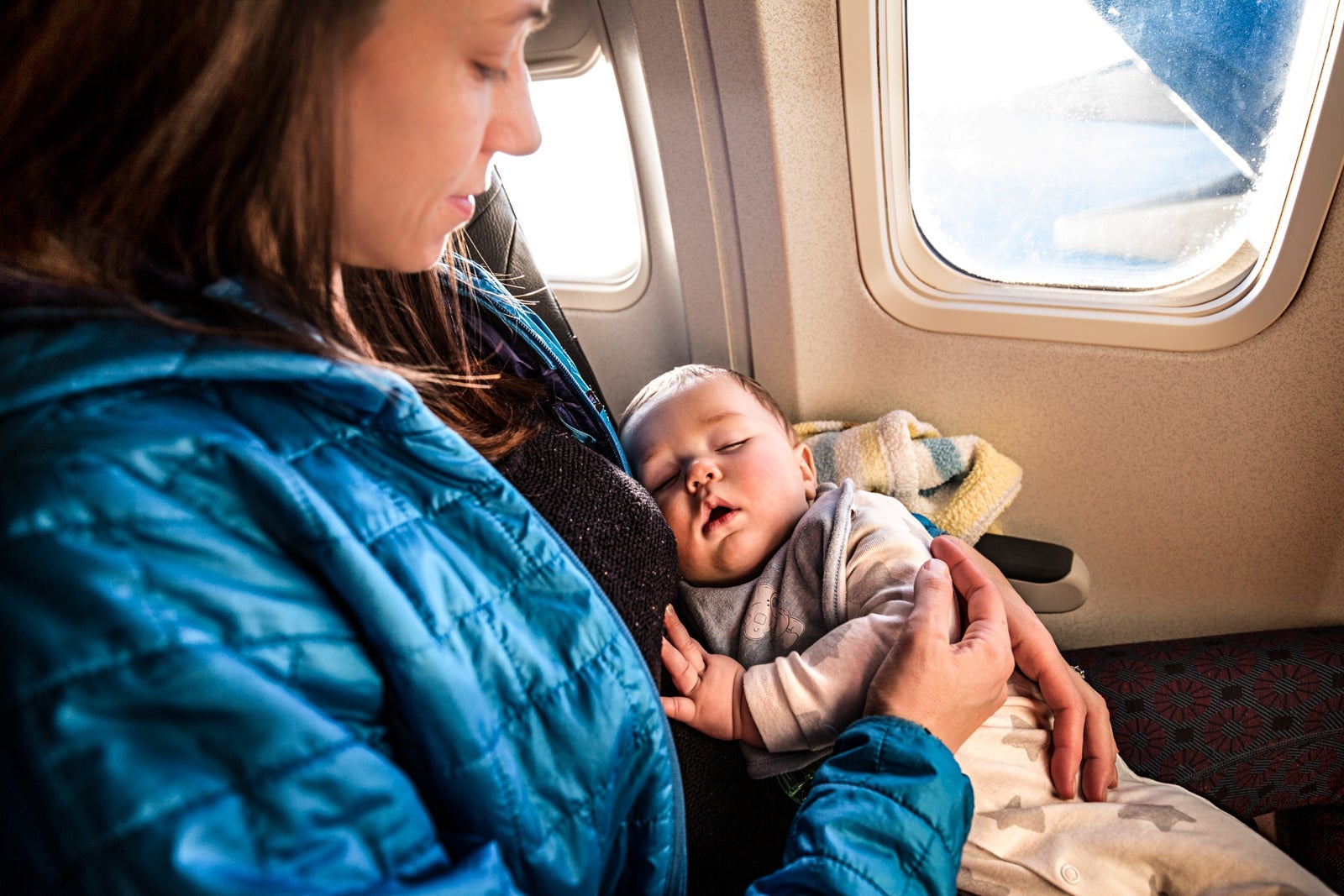
"By shifting mealtime right away, our body's sleep clock often follows suit," says Wolf. "Don't worry about what time zone you are on while on the plane either. Just try and eat and sleep normally and when you touch down at your location, then start to shift gears," she says.
She adds, "Also, as soon as you arrive, try to move to the local time zone quickly. Get outside as much as possible during the day to expose your child to sunlight. This helps to reset their circadian rhythms. When it's time for naps or bedtime, ensure the room is dark (think cave-like) to help set the stage for sleep."
Arriving home
Always factor in your jet lag when it comes to planning day-to-day activities, both on the road and when you arrive home. Without the anticipation and thrill of your vacation, the return to normal life can be a much tougher proposition.
Personally, I try to have a few low-key days when after vacation to help my baby return to a normal sleeping schedule. Having a long weekend to readjust helped my husband and me survive the first few rough nights back home. Try to arrive home on a Friday if you need to be back at work on Monday to give everyone's schedules a little time to adjust.
Bottom line
Jet lag isn't easy to deal with, but with an actionable plan and some managed expectations, it doesn't have to be a barrier to exploring the world with your kids.
Need more tips for traveling with a baby? TPG's got you covered:
TPG featured card

at Capital One's secure site
Terms & restrictions apply. See rates & fees.
| 5X miles | Earn 5X miles on hotels, vacation rentals and rental cars booked through Capital One Travel |
| 2X miles | Earn unlimited 2X miles on every purchase, every day |
Pros
- Stellar welcome offer of 75,000 miles after spending $4,000 on purchases in the first three months from account opening. Plus, a $250 Capital One Travel credit to use in your first cardholder year upon account opening.
- You'll earn 2 miles per dollar on every purchase, which means you won't have to worry about memorizing bonus categories
- Rewards are versatile and can be redeemed for a statement credit or transferred to Capital One’s transfer partners
Cons
- Highest bonus-earning categories only on travel booked via Capital One Travel
- LIMITED-TIME OFFER: Enjoy $250 to use on Capital One Travel in your first cardholder year, plus earn 75,000 bonus miles once you spend $4,000 on purchases within the first 3 months from account opening - that’s equal to $1,000 in travel
- Earn unlimited 2X miles on every purchase, every day
- Earn 5X miles on hotels, vacation rentals and rental cars booked through Capital One Travel
- Miles won't expire for the life of the account and there's no limit to how many you can earn
- Receive up to a $120 credit for Global Entry or TSA PreCheck®
- Use your miles to get reimbursed for any travel purchase—or redeem by booking a trip through Capital One Travel
- Enjoy a $50 experience credit and other premium benefits with every hotel and vacation rental booked from the Lifestyle Collection
- Transfer your miles to your choice of 15+ travel loyalty programs
- Top rated mobile app