What to Do if You Suffer an In-Flight Heart Attack

Not every trip is going to go smoothly, but while that usually means missed connections or sitting next to a crying baby, for some passengers it can mean a life-altering medical event. Read on to learn what to do if you, or another passenger, suffers a heart attack in flight — it could save a life.
First, some background. "Heart attack" is actually not a medical term —"myocardial infarction" is the proper name. According to the NIH, "Most heart attacks are caused by a blood clot that blocks one of the coronary arteries. The coronary arteries bring blood and oxygen to the heart. If the blood flow is blocked, the heart is starved of oxygen and heart cells die." This differs from sudden cardiac arrest, which occurs when the heart develops an arrhythmia that causes it to stop beating.
It's important to note that women and men can present very different symptoms of a heart attack. Per the American Heart Association, "As with men, women's most common heart attack symptom is chest pain or discomfort. But women are more likely than men to experience some of the other common symptoms, particularly shortness of breath, nausea/vomiting, and back or jaw pain."
In general, following are the common symptoms of a heart attack, again per MedicineNet:
- pain, fullness, and/or squeezing sensation of the chest
- nausea, vomiting, and/or general discomfort in the upper-middle abdomen
- upper back pain
- arm pain (more commonly the left arm, but may be either arm)
- jaw pain, toothache or headache
- shortness of breath
- sweating
- heartburn and/or indigestion
- general malaise (vague feeling of illness)
- no symptoms — approximately 1/4 of all heart attacks are silent, without chest pain or new symptoms
- silent heart attacks are especially common among patients with diabetes mellitus
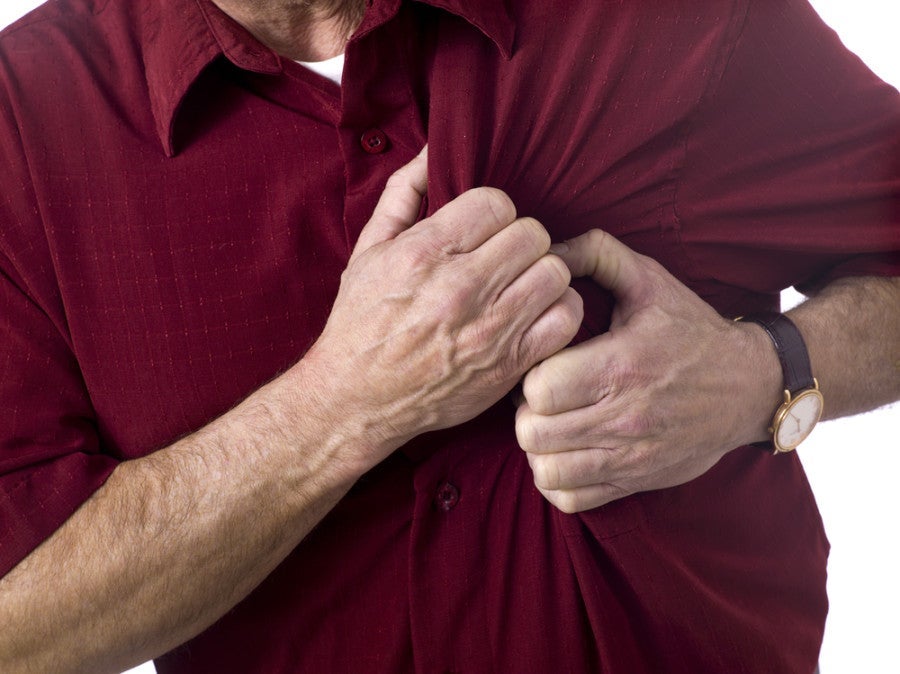
Dr. James Pointer, an Emergency Medicine Specialist with 25 years of experience in training paramedics, sheds some light on the best course of action for heart problems on a plane, having assisted in treating fellow passengers, by his count, a dozen times in his career.
Specifically, he pointed out that there are differences in treating someone having a heart attack versus someone in sudden cardiac arrest. "The three things someone needs when they're having a heart attack are an aspirin, oxygen and nitroglycerin," Dr. Pointer said. All three should be found in a plane's emergency medical kit.
"It's important that the aspirin is chewable, or at least that the person chew it so that it gets into their system as quickly as possible," he said. Even if the person has an intolerance to aspirin — for example, if it causes nausea or bleeding in the stomach — it should be chewed and swallowed immediately. The only reason not to give an aspirin to someone is if they have a life-threatening allergy.
Administering these three things to someone exhibiting symptoms of a heart attack can prevent it from escalating to sudden cardiac arrest. And if the person is instead simply having severe heartburn or a panic attack, this course of treatment won't do any additional harm.

The difference between a heart attack and cardiac arrest in terms of visible symptoms is that with cardiac arrest, the person will lose consciousness because their heart has stopped beating.
If this happens, the single most important thing to do is to act as quickly as humanly possible. Per the Sudden Cardiac Arrest Foundation, "326,200 people of all ages experience (sudden cardiac arrest) each year and nine out of 10 victims die." Dr. Pointer stresses that the reason for those deaths is lack of immediate action.
This means that while flight staff should be called, it's a person's fellow passengers who could save his life, by doing the following:
- Confirm that the person is in fact unconscious. There is no need to feel for a pulse, as it can take too long for a lay person to find.
- Lay them down in the aisle.
- Start chest compressions. They should be fast and deep, and, most importantly, consistent, with no pause whatsoever. (To set the right pace, think of the song "Staying Alive" by the Bee Gees.)
Mike Hamilton, a United Airlines pilot (full disclosure: Hamilton is a relative of this writer), shares more on-board protocol you can expect in the event of in-flight heart attack:
On my Boeing 777, medical emergencies are the number one reason for diverts, outpacing weather and mechanical diversions by a wide margin. At United we use a company called MedLink, which has 24-hour nurse and doctor availability that we can contact via two-way VHF radio or SATCOM (our satellite phone) whenever we have a medical emergency. The normal sequence of events would be as follows: Flight attendants will ask if there are any medical professionals on board. We have two medical kits on the plane. One medical kit has equipment for general first aid (band-aids, antiseptic, etc.) and the other can only be released to doctors, nurses or paramedics with proper identification. The second kit has drugs and equipment to handle more serious medical situations. In addition, the planes also have portable AEDs (heart defibrillators) that can be used to help someone experiencing a heart attack. The flight attendants are trained to use these and have on a number of cases, saving the lives of those passengers. After the flight attendants have started treatment in the cabin, they will contact the cockpit with all the passenger's information and vitals. We will then contact our dispatch who will call MedLink and patch them through to us. We will then serve as the conduit between the flight attendants and MedLink. On some planes there are phones in the back that the flight attendants can use to talk directly to MedLink.

While the medical issues are being worked, the pilots and dispatchers will start putting a plan together in case a diversion is necessary. This can be very complicated on an international flight due to the distance from adequate airports and, more importantly, locations with sufficient medical resources available upon arrival. For instance, on a Pacific flight we would likely pass an option like Petropavlovsk Russia for locations in Northern Japan, even though they are an hour or two further down line. Domestically there are numerous options with adequate medical resources that are usually no more than 45 minutes at the most at any point in time. Once we have made the decision to divert we contact air traffic control, declare a medical emergency to get priority handling to the airport and then start the rather hectic process of changing the destination and getting the aircraft safely on the ground in as little time as possible. As we are heading to our diversion airport the company will coordinate with the appropriate people to have medical personnel waiting for the aircraft's arrival for immediate care of the sick passenger. This whole process is practiced and simulated both in pilot and dispatcher training so we are ready to handle the situation safely and quickly if it ever occurs in real life.
Rest assured that while a medical emergency like an in-flight heart attack may occur, it doesn't have to result in a tragedy. Keep yourself informed, stay aware of your body (and pay attention to the symptoms of your loved ones) and know that your flight crew is trained and ready for a worst-case scenario.
In other words, take heart — and travel safe.
[card card-name='Citi ThankYou® Premier Card' card-id='221410120' type='javascript' bullet-id='1']
TPG featured card
at American Express's secure site
Terms & restrictions apply. See rates & fees.
| 4X | Earn 4X Membership Rewards® points per dollar spent on purchases at restaurants worldwide, on up to $50,000 in purchases per calendar year, then 1X points for the rest of the year. |
| 4X | Earn 4X Membership Rewards® points per dollar spent at US supermarkets, on up to $25,000 in purchases per calendar year, then 1X points for the rest of the year. |
| 5X | Earn 5X Membership Rewards® points on prepaid hotel stays booked through AmexTravel.com or the Amex Travel App™. |
| 3X | Earn 3X Membership Rewards® points on flights booked through AmexTravel.com, the Amex Travel App™, or purchased directly from airlines. |
| 2X | Earn 2X Membership Rewards® points on prepaid car rentals booked through AmexTravel.com or the Amex Travel App™ and cruises booked and paid through AmexTravel.com. |
| 1X | Earn 1X Membership Rewards® point per dollar spent on all other eligible purchases. |
Pros
- Valuable dining and food-related credits
- Flexible rewards with airline and hotel transfer partners
- Multiple travel and purchase protections
- No foreign transaction fees
- Access to Amex Offers for additional savings (enrollment required)
Cons
- Not as useful for those living outside the U.S.
- Some may have trouble using Uber and other dining credits
- You may be eligible for as high as 100,000 Membership Rewards® Points after you spend $8,000 in eligible purchases on your new Card in your first 6 months of Card Membership. Welcome offers vary and you may not be eligible for an offer. Apply to know if you’re approved and find out your exact welcome offer amount – all with no credit score impact. If you’re approved and choose to accept the Card, your score may be impacted.
- Earn 4X Membership Rewards® points per dollar spent on purchases at restaurants worldwide, on up to $50,000 in purchases per calendar year, then 1X points for the rest of the year.
- Earn 4X Membership Rewards® points per dollar spent at US supermarkets, on up to $25,000 in purchases per calendar year, then 1X points for the rest of the year.
- Earn 5X Membership Rewards® points on prepaid hotel stays booked through AmexTravel.com or the Amex Travel App™.
- Earn 3X Membership Rewards® points on flights booked through AmexTravel.com, the Amex Travel App™, or purchased directly from airlines.
- Earn 2X Membership Rewards® points on prepaid car rentals booked through AmexTravel.com or the Amex Travel App™ and cruises booked and paid through AmexTravel.com.
- Earn 1X Membership Rewards® point per dollar spent on all other eligible purchases.
- Pay It® lets you tap in the American Express® App to quickly pay for small purchase amounts throughout the month and still earn rewards the way you usually do. Plan It® gives you the option to split up big purchases into equal monthly payments with a fixed fee. You’ll know upfront exactly how much you’ll pay.
- $120 Dining Credit: Earn up to a total of $10 in statement credits monthly when you pay with the Gold Card at Grubhub (including Seamless), Buffalo Wild Wings, Five Guys, The Cheesecake Factory, and Wonder. This can be an annual savings of up to $120. Enrollment required.
- $100 Resy Credit: Get up to $100 in statement credits each calendar year at over 10,000 qualifying U.S. Resy restaurants after you pay for eligible purchases with the American Express® Gold Card. That’s up to $50 in statement credits semi-annually. Enrollment required.
- $84 Dunkin' Credit: Earn up to $7 in monthly statement credits after you pay with the American Express® Gold Card at U.S. Dunkin’ locations. Enrollment required.
- $120 Uber Cash on Gold: Enjoy up to $120 in Uber Cash annually with your Gold Card. Just add your Card to your Uber account and you'll get $10 in Uber Cash each month to use on orders and rides in the U.S. when you select an Amex Card for your transaction.
- Enjoy complimentary Hertz Five Star® Status benefits like skipping the counter at select locations, adding an additional driver at no additional cost*, and vehicle upgrades**. Benefit enrollment and Hertz Gold+ registration are required. *Additional drivers must meet standard rental qualifications and must be a spouse or domestic partner to qualify as complimentary. Other additional drivers subject to fees. **Benefits are subject to availability and vary by location. Additional Hertz program Terms and Conditions including age restrictions apply.
- Book two nights or more with The Hotel Collection through AmexTravel.com or the Amex Travel App™ and receive a $100* credit towards eligible charges at over 1,400 upscale hotels worldwide. *Eligible charges vary by property.
- Book your travel through the Amex Travel App™ with added peace of mind – backed by American Express® service and support. Only for American Express® Card Members.
- Whenever you need us, we're here. Our Member Services team will ensure you are taken care of. From lost Card replacement to statement questions, we are available to help 24/7.
- No Foreign Transaction Fees.
- Annual Fee is $325.
- Terms Apply.