The Points Guy believes that credit cards can transform lives, helping you leverage everyday spending for cash back or travel experiences that might otherwise be out of reach. That's why we publish a variety of editorial content and card comparisons: to help you find a great card to turn your goals into reality.
Our site may earn compensation when a customer clicks on a link, when an application is approved, or when an account is opened with our partners, and this may impact how or where these products appear. While we don't cover all available credit cards, our editorial team creates and maintains all of the analysis of these cards, and our content is not influenced nor subject to review by any credit card company, bank or partner prior to (or after) publication. Please view our advertising policy and product review methodology for more information.
Advertiser disclosure
The Points Guy believes that credit cards can transform lives, helping you leverage everyday spending for cash back or travel experiences that might otherwise be out of reach. That's why we publish a variety of editorial content and card comparisons: to help you find a great card to turn your goals into reality.
Our site may earn compensation when a customer clicks on a link, when an application is approved, or when an account is opened with our partners, and this may impact how or where these products appear. While we don't cover all available credit cards, our editorial team creates and maintains all of the analysis of these cards, and our content is not influenced nor subject to review by any credit card company, bank or partner prior to (or after) publication. Please view our advertising policy and product review methodology for more information.
Guides
Flying while pregnant? Here’s what you need to know
Summer Hull has been covering (and using) travel tips, rewards credit cards and loyalty programs for over a decade. She has flown close to a million miles, often on points and miles and with her family in tow.
July 4, 2022 • 12 min read
The cards we feature here are from partners who compensate us when you are approved through our site, and this may impact how or where these products appear. We don't cover all available credit cards, but our analysis, reviews, and opinions are entirely from our editorial team. Terms apply to the offers listed on this page. Please view our advertising policy and product review methodology for more information.Editorial disclaimer: Opinions expressed here are the author's alone, not those of any bank, credit card issuer, airline or hotel chain, and have not been reviewed, approved or otherwise endorsed by any of these entities.
Comments
By commenting, you agree to our Community Guidelines to help create a positive space for conversation. The responses below are not provided or commissioned by the bank advertiser, our partners, or The Points Guy (“TPG”). They have not been reviewed, approved, or otherwise endorsed by any of these parties. All responses are submitted by individual contributors, and neither the bank advertiser, our partners, nor TPG are responsible for ensuring that all posts and/or questions are answered.
Related stories
Quick summary
Air travel during pregnancy is generally considered safe, especially in the first and second trimesters, but individual airline policies and medical advice should be reviewed.
Most airlines have specific restrictions or documentation requirements for those in their third trimester, with some prohibiting travel after a certain week or requiring a medical certificate.
Comfort and safety tips for pregnant travelers include wearing compression socks, moving regularly during the flight, staying hydrated and consulting with a healthcare provider before flying.
Medical documentation may be necessary, particularly for late-stage pregnancies, and should be detailed, signed and dated close to the departure date.
What to consider
Airline policies on pregnant travelers vary widely, with different cutoff weeks and documentation requirements, especially for international travel or multiple pregnancies.
Certain health conditions may make flying riskier, so a thorough discussion with a healthcare provider is essential before booking a flight.
Medical certificates should include specific details and be prepared according to each airline's requirements, often within 72 hours of departure.
What you'll miss from the article
A detailed chart comparing major airlines' pregnancy travel policies and expert recommendations for managing comfort and health risks while flying.
Generated by AI with support from our editorial team.
Editors note: This guide has been updated with the latest information.
During pregnancy, seemingly harmless things like eating deli meat and cleaning your cat's litter box are suddenly off-limits, along with more obvious restrictions on sports like skiing and scuba diving.
But what about "grey area" activities like flying in an airplane?
There's no single set of guidelines governing air travel during pregnancy and every airline has different restrictions, timelines and requirements. Some airlines may also require a medical certificate from a primary attending doctor or midwife for air travel during the final months of pregnancy, though even that varies, with U.S. airlines typically offering more flexibility than international carriers.
In the absence of clear guidelines, TPG turned to Dr. Nithya Gopal, a board-certified OB-GYN physician and the Director of OB-GYN services at Viva Eve in New York City, for her expert recommendations on safe air travel during pregnancy.
Here's what she had to say:
Is it safe to fly when you are pregnant?
There is no evidence of adverse pregnancy outcomes due to flying, according to Dr. Gopal.
"The general consensus is that it is safest to fly in the first and second trimesters," Dr. Gopal told The Points Guy. "While the first and third trimesters tend to be when the most obstetric emergencies are going to happen, I personally become more cautious with my patients after 32 weeks because of the increased risk for premature labor and the possibility of needing urgent medical attention when you are in the sky."
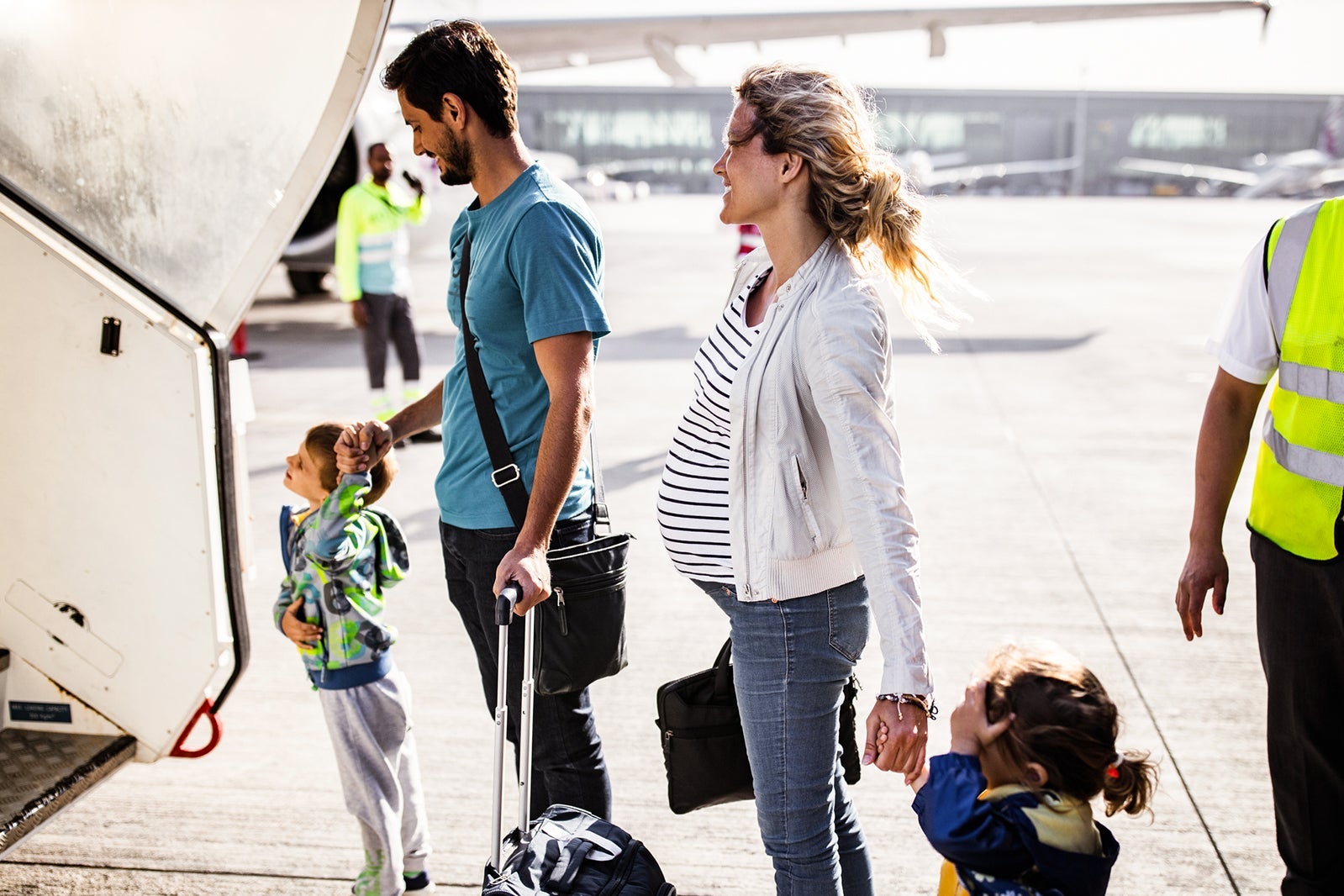
(Photo by Caiaimage/Agnieszka Olek/Getty Images)
The most important thing you can do, no matter how far along you are in your pregnancy, is to consult with your healthcare provider before flying.
"Any time you are planning to fly during pregnancy, you should be having that conversation," Dr. Gopal said. Your provider will be familiar with any safety precautions you should take to ensure a safe and healthy flight.
The airline you are flying may have its own cutoff, so you will want to confirm with it beforehand whether you will be allowed to fly if you are in (or nearing) your third trimester. We've included a chart below that outlines the rules for most major airline carriers.
What can you do to stay comfortable on a flight?
(Photo by Nadezhda1906/Getty Images)
When you factor in morning sickness and general pregnancy discomfort with the increased risk for blood clots that all fliers need to be aware of, flying during pregnancy can be uncomfortable even when it is deemed safe.
Dr. Gopal shared her recommendations for addressing these common issues when you take to the (baby-) friendly skies during pregnancy. Her number one tip for staying comfortable while in flight is to wear compression socks to help maintain blood flow and reduce swelling in the legs.
In addition, "I also tell my patients to get up and move at least every hour when they are on the plane," Dr. Gopal said.
To prevent clotting, "some doctors may also prescribe a low-dose aspirin," she added. "It isn't something that is recommended by the American College of Obstetricians and Gynecologists (ACOG), but it isn't harmful, either."
If it's nausea or acid reflux that ail you, there are medications generally considered safe that you can take to alleviate your symptoms. These would be the same ones prescribed by your doctor for morning sickness, so speak with your provider before your flight to ensure you have what you need at the ready.
Dr. Gopal also advises wearing loose, unrestrictive clothing (along with your seatbelt, or course) and drinking extra fluids to counteract the pressurized air in the cabin and keep you hydrated.
"Over-the-counter Gas-X may also help with bloating that can happen as a result of the pressurized air," Dr. Gopal said.
Must you speak with your healthcare provider before flying?
(Photo by Fly View Productions/Getty Images)
Even if your pregnancy is considered low-risk, it's always a smart idea to speak with your healthcare provider before flying. "There are a number of potential risks that go along with flying during pregnancy and those risks can change from week to week and month to month, so it's important to have that honest conversation with your doctor," Dr. Gopal said.
There are certain pregnancy conditions that may make flying more risky or unadvisable. If you are hypertensive, asthmatic or prone to clotting disorders, it's even more critical to speak with your doctor before flying.
Airline policies differ, but if you need documentation, it never hurts to include enough detail to satisfy the most stringent airline requirements.
"As with many things related to air travel, it's better to be safe than sorry," Dr. Gopal said. "It's definitely worth it, and sometimes necessary, to have medical documentation from your provider's office."
A thorough medical certificate or waiver should state:
The number of weeks of pregnancy.
The estimated delivery date.
Whether the pregnancy is single or multiple.
Whether there are any complications.
That you are in good health and fit to travel through the date of your final flight.
Additionally, the certificate should be:
Written on official clinic or hospital letterhead if possible.
Signed by the doctor or attending midwife.
Be dated no later than 72 hours before the departure date.
Be written in clear, simple English.
Carry this certificate with you on your flight. Some airlines won’t ask to see it, but others will. Some airlines also may have their own documentation requirements. See the chart below to find out which airlines require it.
Airline policies for pregnant women
Airline
Before 28 weeks
Between 29-36 weeks
After 37 weeks (33 weeks if pregnant with multiples)
Travel permitted; requires medical certificate beginning 4 weeks before your due date.
For international travel, or travel over water, clearance from a special assistance coordinator is required, as well as a medical certificate dated within 48 hours of departure date.
For domestic flights under 5 hours, travel within 7 days of due date or 7 days after birth requires special permission from an American Airlines special assistance coordinator.
No restrictions but recommend that you carry a letter stating whether your pregnancy is single or multiple, expected due date and that there are no complications.
Travel not permitted after the end of the 32nd week if pregnant with multiple babies.
Travel not permitted after the end of the 36th week if pregnant with one baby.
Travel permitted. For pregnancies with known complications, passengers must complete a Cathay medical form no less than 48 hours before travel and receive clearance from the airline to travel.
Travel permitted. Requires medical certificate dated within 10 days of departure date. Travel not permitted for uncomplicated multiple pregnancy after the 32nd week.
Travel not permitted.
Medical clearance required for mothers traveling within 7 days after birth.
Infants are not permitted to travel within 48 hours after birth, and require medical clearance between 3-7 days after birth.
No restrictions until 30 days before delivery date.
Medical certificate required within 7 days of due date within Hawaii. Statement from your physician dated within 48 hours of travel required for travel beyond Hawaii within 30 days of due date.
Medical certificates required for travel beginning the 36th week, when due date is unknown, if multiple births are expected or if there has been a previous premature delivery.
When the due date is in 14 days or less, an obstetrician must accompany the expectant mother on the flight.
Travel permitted; medical certificate required beginning at 28 weeks; multiple pregnancies can only fly only until the 32nd week.
Travel not permitted unless necessary for urgent medical or compassionate reasons. Travel under these conditions requires approval from Virgin Atlantic’s medical team (contact the airline directly for details) and a companion is strongly recommended.
Travel permitted; requires a medical certificate dated within 10 days of departure date once you reach 28 weeks.
For flights longer than four hours, travel is not permitted after 36 weeks of pregnancy (32 weeks if pregnant with multiples), or within 48 hours of normal vaginal delivery.
For flights shorter than four hours, travel is not permitted after 40 weeks of pregnancy (36 weeks if pregnant with multiples), or within 48 hours of normal vaginal delivery.
Bottom line
(Photo by skynesher/Getty Images)
Even though it may be deemed safe, flying during pregnancy can be uncomfortable — and it is perfectly acceptable to implement your own cutoff for flying with your baby bump in tow.
The majority of the time, though, flying is perfectly safe during pregnancy, providing that you follow the guidelines of the airline and your healthcare provider.
Read on to learn more about traveling before, during and after pregnancy:
Additional reporting by Katherine Fan and Tarah Chieffi.
Comments
By commenting, you agree to our Community Guidelines to help create a positive space for conversation. The responses below are not provided or commissioned by the bank advertiser, our partners, or The Points Guy (“TPG”). They have not been reviewed, approved, or otherwise endorsed by any of these parties. All responses are submitted by individual contributors, and neither the bank advertiser, our partners, nor TPG are responsible for ensuring that all posts and/or questions are answered.