How long will US airlines' cash last? Between 4 months and a year, analyst says

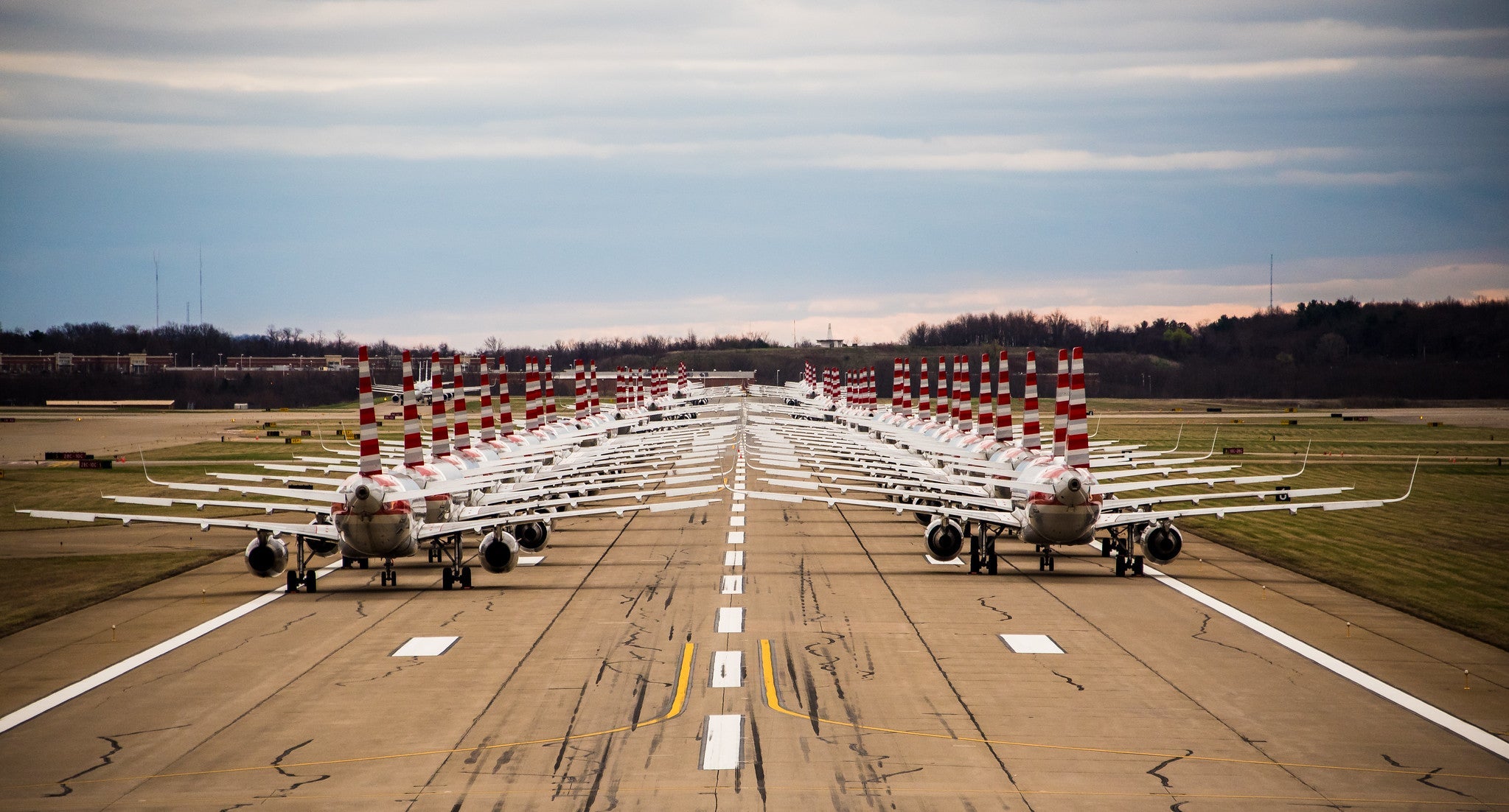
U.S. airlines have enough cash, on average, to survive nearly eight months before they face the prospect of bankruptcy or worse, a new report from Raymond James finds.
The industry has enough cash to cover its bills — in other words cash-on-hand minus how much an airline must spend daily — for an average of 7.9 months, the report on April 5 finds. The analysis finds that American Airlines, which has the most debt among U.S. carriers, only has enough cash to cover only about 4.8 months of expenses while regional SkyWest Airlines has cash to cover nearly a year.
The estimates do not include any potential CARES Act grants that at least eight carriers applied for on April 3. Raymond James analysts said the aid could slow airlines' cash burn by about half, theoretically doubling the number of months they would be able to cover.
Get Coronavirus travel updates. Stay on top of industry impacts, flight cancellations, and more.
U.S. airlines are in the enviable position of being among the best capitalized around the world. The International Air Transport Association (IATA) has estimated that carriers around the globe only have about three months of cash on hand, on average. The organization has warned that around half of airlines could collapse or consolidate without government support.
"At times like this, it's actually balance sheets that are critical to survival," said IATA chief economist Brian Pearce during a press briefing in March.
Lack of liquidity — another word for cash — has proven a deciding factor in many recent airline collapses. This felled both Thomas Cook and WOW air in 2019, and regional RavnAir Group in Alaska stopped flying and filed for bankruptcy when it could not secure needed operating funds.
This is also why many airlines, to the annoyance of numerous travelers, are issuing certificates for the value of cancelled trips rather than offering refunds. The goal is to hold onto as much as cash as possible.
Related: It may be years until passenger demand returns to 2019 levels for US airlines

Despite being well capitalized and having access to CARES funds, U.S. airlines are not out of the woods. American's decision to pay for the majority of its new aircraft deliveries in recent years with debt resulted in its having $21.5 billion in outstanding long-term debt at the end of December. The airline also maintained a high cash balance, with $3.8 billion on hand at the end of the year.
American had $12.4 billion in debt payments and other obligations due this year for things such as aircraft lease payments, according to its 2019 annual report. This equals just over $1 billion in fixed expenses monthly.
"The margin for error for American management to navigate this crisis outside of the courts is growing uncomfortably thin," wrote J.P. Morgan analyst Jamie Baker in a report on Monday.
Both J.P. Morgan and Raymond James note in their respective reports that airlines, including American, have not tapped every credit source that they can. Many also have additional assets, like aircraft, that they can use as collateral for new loans.
The CARES Act also includes $25 billion for loans to airlines that have exhausted all other options to raise liquidity. The funds are in addition to the grants that carriers have already applied for.
Related: American, Delta, United among first applicants for coronavirus aid
Airlines are still in the process of winding down their operations and adjusting to the current reality of near-zero demand for air travel. The peak of COVID-19 cases in many parts of the U.S. is not expected for weeks — maybe months — to come suggesting demand could stay depressed for some time.
Analysts expect a smaller industry when things come back. Several Wall Street estimates put the number of travelers flying in 2021 at roughly four-fifths the number in 2019 — or back to about 2013 passenger levels.
Airlines will have to shrink everything from their maps to their fleets and their workforces in the face of a 20% smaller industry.
Related: How will airlines rebuild their route maps after the coronavirus?
Raymond James' "Cash Burn Forecast"
- SkyWest: 11.8 months of implied cash on hand*
- Allegiant: 10.6 months
- Southwest: 9.4 months
- Spirit: 8.8 months
- JetBlue: 8.7 months
- Alaska: 6.6 months
- Mesa: 6.3 months
- Delta: 6.2 months
- United: 5.7 months
- American: 4.8 months
* = Raymond James calculated "implied months of cash on hand" by analyzing each carriers' cash and credit reserves, and estimated cash burn. The calculations do not include any possible government funds from the CARES Act.
TPG featured card

at American Express's secure site
Terms & restrictions apply. See rates & fees.
| 3X | Earn 3X Miles on Delta purchases. |
| 1X | Earn 1X Miles on all other eligible purchases. |
Pros
- Delta SkyClub access when flying Delta
- Annual companion ticket for travel on Delta (upon renewal)
- Ability to earn MQDs through spending
- Various statement credits for eligible purchases
Cons
- Steep annual fee of $650
- Other Delta cobranded cards offer superior earning categories
- Earn 100,000 Bonus Miles after you spend $6,000 or more in purchases with your new Card within the first 6 months of Card Membership and an additional 25,000 bonus miles after you make an additional $3,000 in purchases on the Card within your first 6 months, starting from the date that your account is opened. Offer Ends 04/01/2026.
- Delta SkyMiles® Reserve American Express Card Members receive 15 Visits per Medallion® Year to the Delta Sky Club® when flying Delta and can unlock an unlimited number of Visits after spending $75,000 in purchases on your Card in a calendar year. Plus, you’ll receive four One-Time Guest Passes each Medallion Year so you can share the experience with family and friends when traveling Delta together.
- Enjoy complimentary access to The Centurion® Lounge in the U.S. and select international locations (as set forth on the Centurion Lounge Website), Sidecar by The Centurion® Lounge in the U.S. (see the Centurion Lounge Website for more information on Sidecar by The Centurion® Lounge availability), and Escape Lounges when flying on a Delta flight booked with the Delta SkyMiles® Reserve American Express Card. § To access Sidecar by The Centurion® Lounge, Card Members must arrive within 90 minutes of their departing flight (including layovers). To access The Centurion® Lounge, Card Members must arrive within 3 hours of their departing flight. Effective July 8, 2026, during a layover, Card Members must arrive within 5 hours of the connecting flight.
- Receive $2,500 Medallion® Qualification Dollars with MQD Headstart each Medallion Qualification Year and earn $1 MQD for each $10 in purchases on your Delta SkyMiles® Reserve American Express Card with MQD Boost to get closer to Status next Medallion Year.
- Enjoy a Companion Certificate on a Delta First, Delta Comfort, or Delta Main round-trip flight to select destinations each year after renewal of your Card. The Companion Certificate requires payment of government-imposed taxes and fees of between $22 and $250 (for itineraries with up to four flight segments). Baggage charges and other restrictions apply. Delta Basic experiences are not eligible for this benefit.
- $240 Resy Credit: When you use your Delta SkyMiles® Reserve American Express Card for eligible purchases with U.S. Resy restaurants, you can earn up to $20 each month in statement credits. Enrollment required.
- $120 Rideshare Credit: Earn up to $10 back in statement credits each month after you use your Delta SkyMiles® Reserve American Express Card to pay for U.S. rideshare purchases with select providers. Enrollment required.
- Delta SkyMiles® Reserve American Express Card Members get 15% off when using miles to book Award Travel on Delta flights through delta.com and the Fly Delta app. Discount not applicable to partner-operated flights or to taxes and fees.
- With your Delta SkyMiles® Reserve American Express Card, receive upgrade priority over others with the same Medallion tier, product and fare experience purchased, and Million Miler milestone when you fly with Delta.
- Earn 3X Miles on Delta purchases and earn 1X Miles on all other eligible purchases.
- No Foreign Transaction Fees. Enjoy international travel without additional fees on purchases made abroad.
- $650 Annual Fee.
- Apply with confidence. Know if you're approved for a Card with no impact to your credit score. If you're approved and you choose to accept this Card, your credit score may be impacted.
- Terms Apply.
- See Rates & Fees