1st look: United's new Boeing 767-300 configuration with Premium Plus recliners

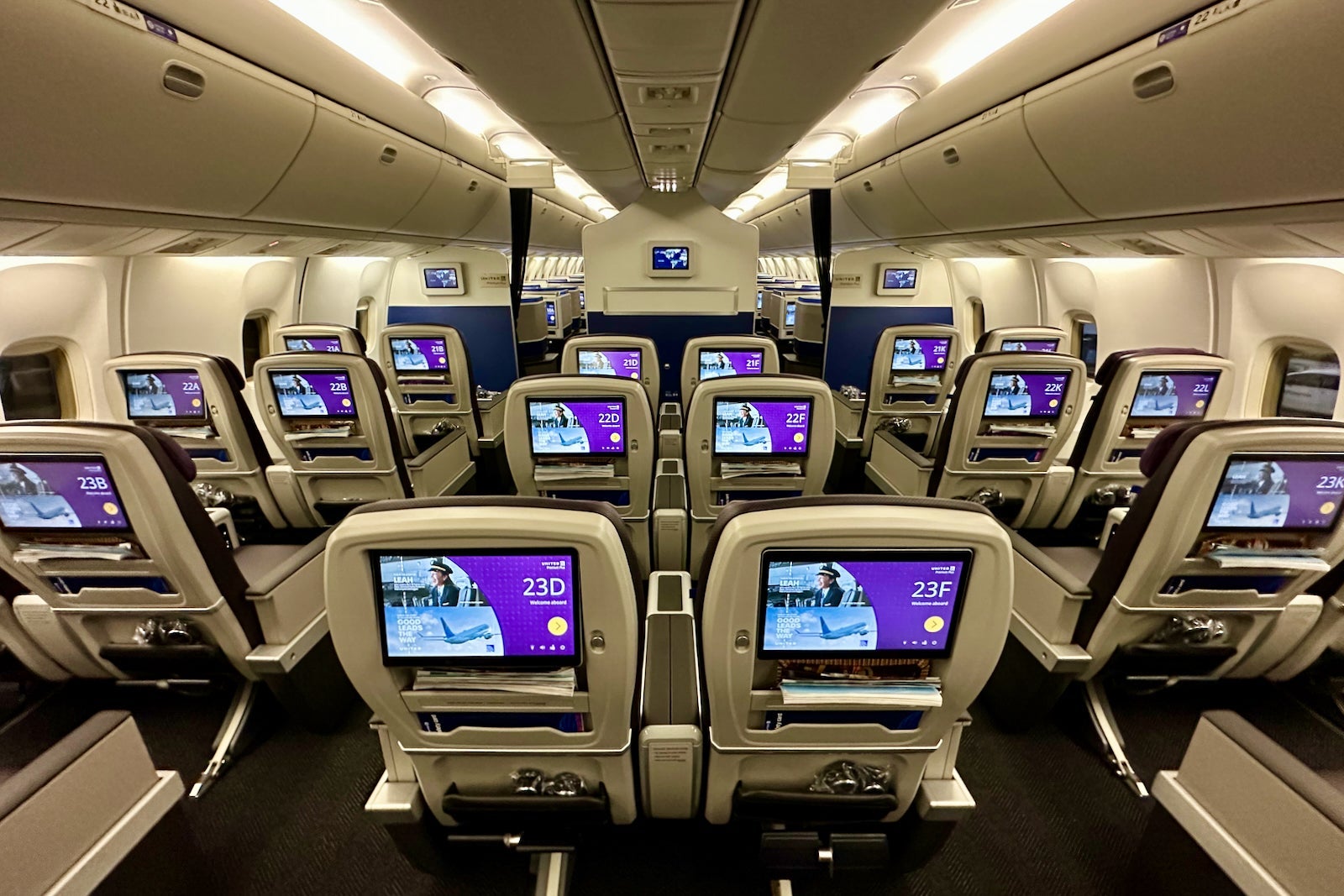
Premium economy is all the rage these days.
This intermediate cabin between business class and economy has soared in popularity in recent years, as travelers look for an upgrade option that packs some more perks without breaking the bank for a lie-flat bed.
United's take on premium economy, dubbed Premium Plus, first started rolling out in 2019. Since then, the carrier has installed the "purple seats," as loyalists affectionately call them, on most of its long-haul wide-body fleet.
Yet there's an aircraft type that didn't originally get the recliners: the Boeing 767-300.
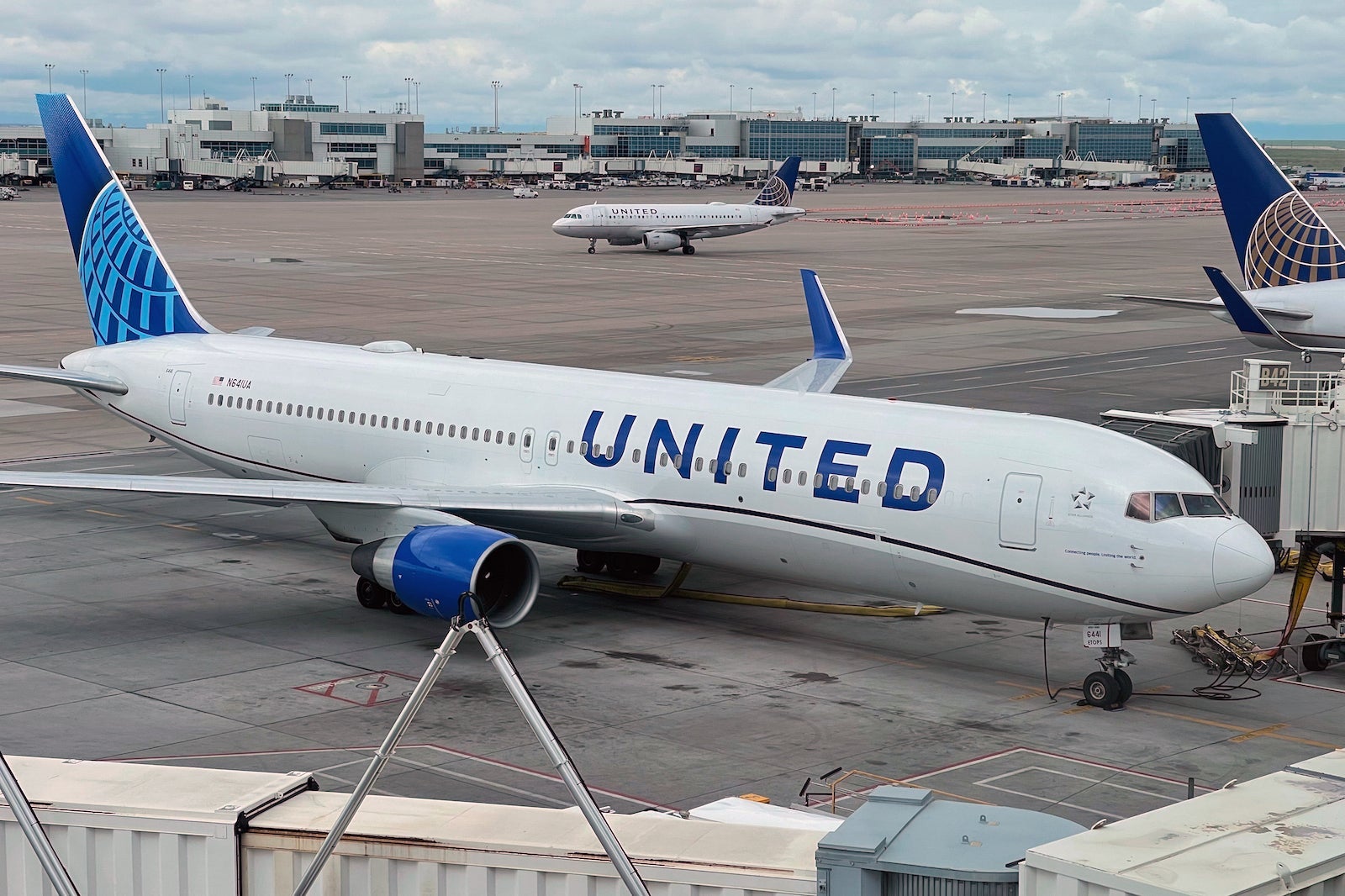
When retrofitting its fleet of 38 Boeing 767-300s, United split the jets into two batches: 24 of them are now "high J" versions (featuring 46 Polaris business-class seats, 22 Premium Plus recliners, 43 Economy Plus seats and 56 economy seats) and 14 of them are in a less premium "standard" configuration that features 30 Polaris pods, 46 Economy Plus seats and 138 economy seats.
Notably missing from the latter batch is a Premium Plus cabin. While United originally planned for this to be a more leisure-focused configuration, there's recently been an appreciable uptick in demand for these upgraded seats.
Instead of letting competitors pick up that demand, United decided last summer to add a Premium Plus cabin to these 14 jets.

And now, just about five months after announcing the retrofit project, this new configuration, internally referred to as the "76Q," is flying. The first retrofitted jet, registered N642UA, has been popping up throughout the United network, and it recently spent a few hours in Newark between flights.
I happened to be at the airport during that downtime and managed to arrange an aircraft tour at the last minute. So, here's what it looks like inside.

Premium Plus on United's retrofitted Boeing 767-300
The star of the show is the new Premium Plus cabin, which is located just behind the last row of Polaris.
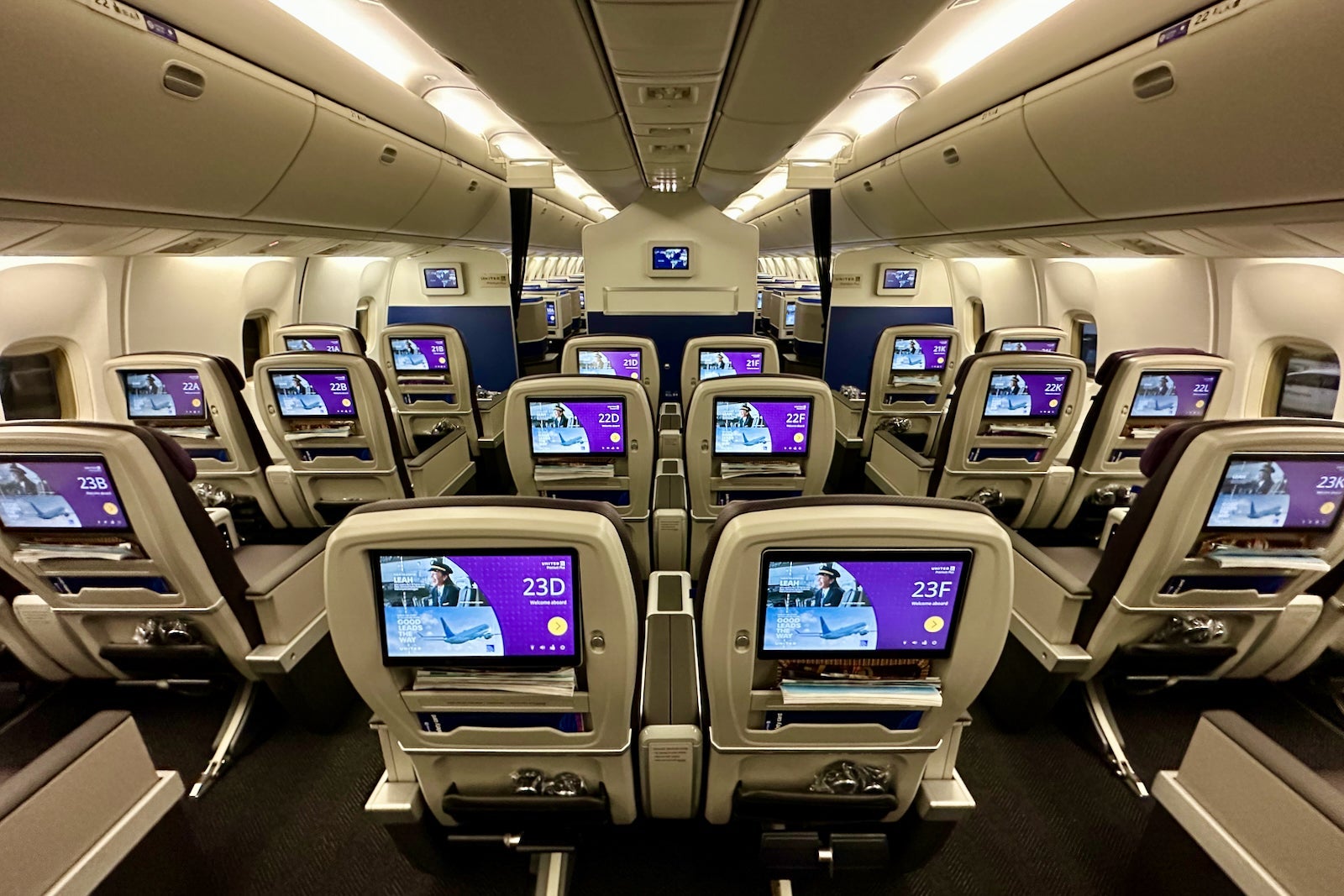
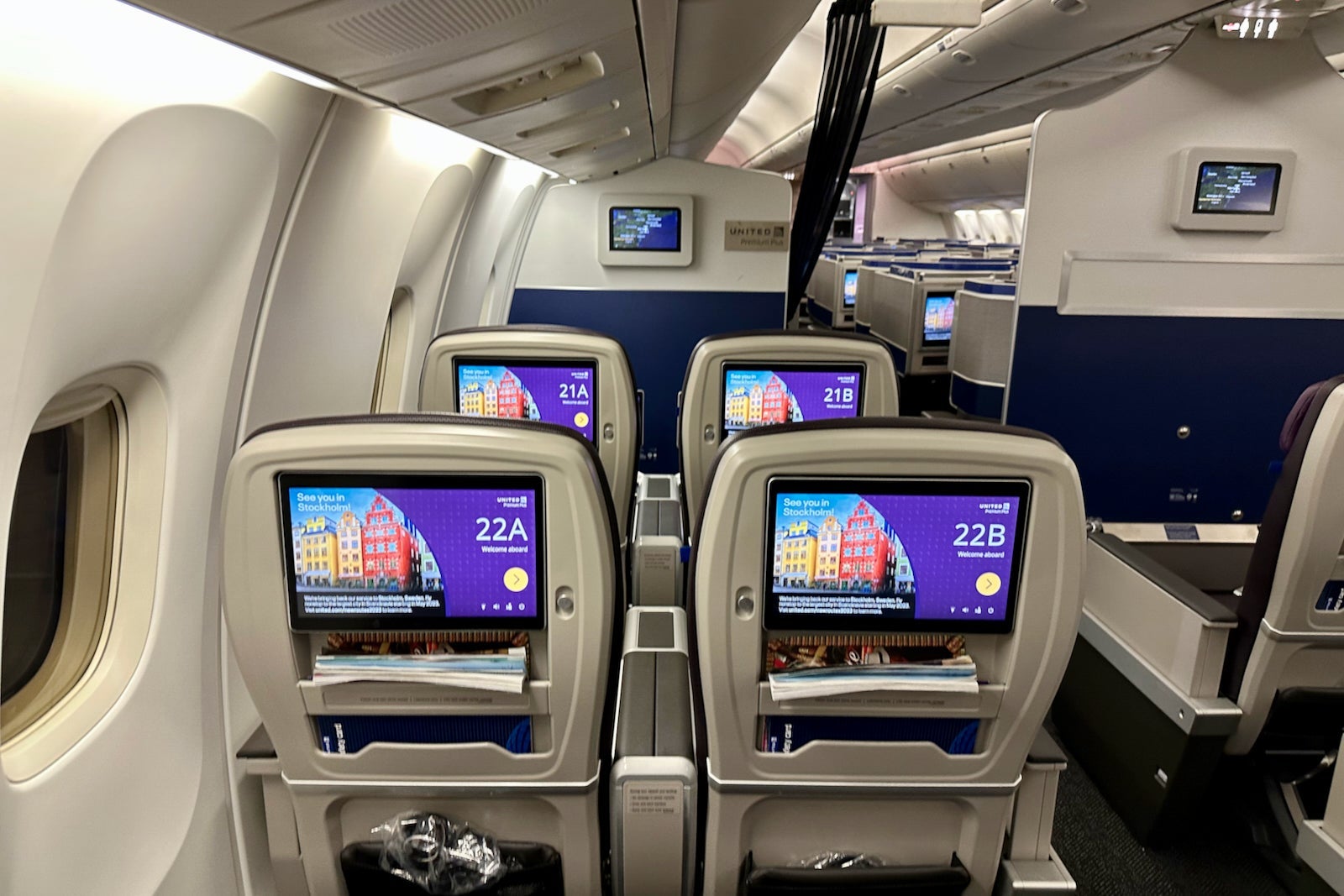
The new 24-seat cabin spans rows 20 through 23 with seats arranged in a standard 2-2-2 layout. There are no middles in this cabin — a perk of flying on the Boeing 767, which isn't wide enough to fit a middle seat as you'd find on some of United's larger wide-bodies, such as the 777 or 787 Dreamliner.

Bulkhead walls separate the new cabin from Polaris and from economy, making for a more private flying experience. Just note that United didn't install curtains between Premium Plus and economy, so it may not feel as exclusive as if you were traveling with a competitor (KLM, for instance).
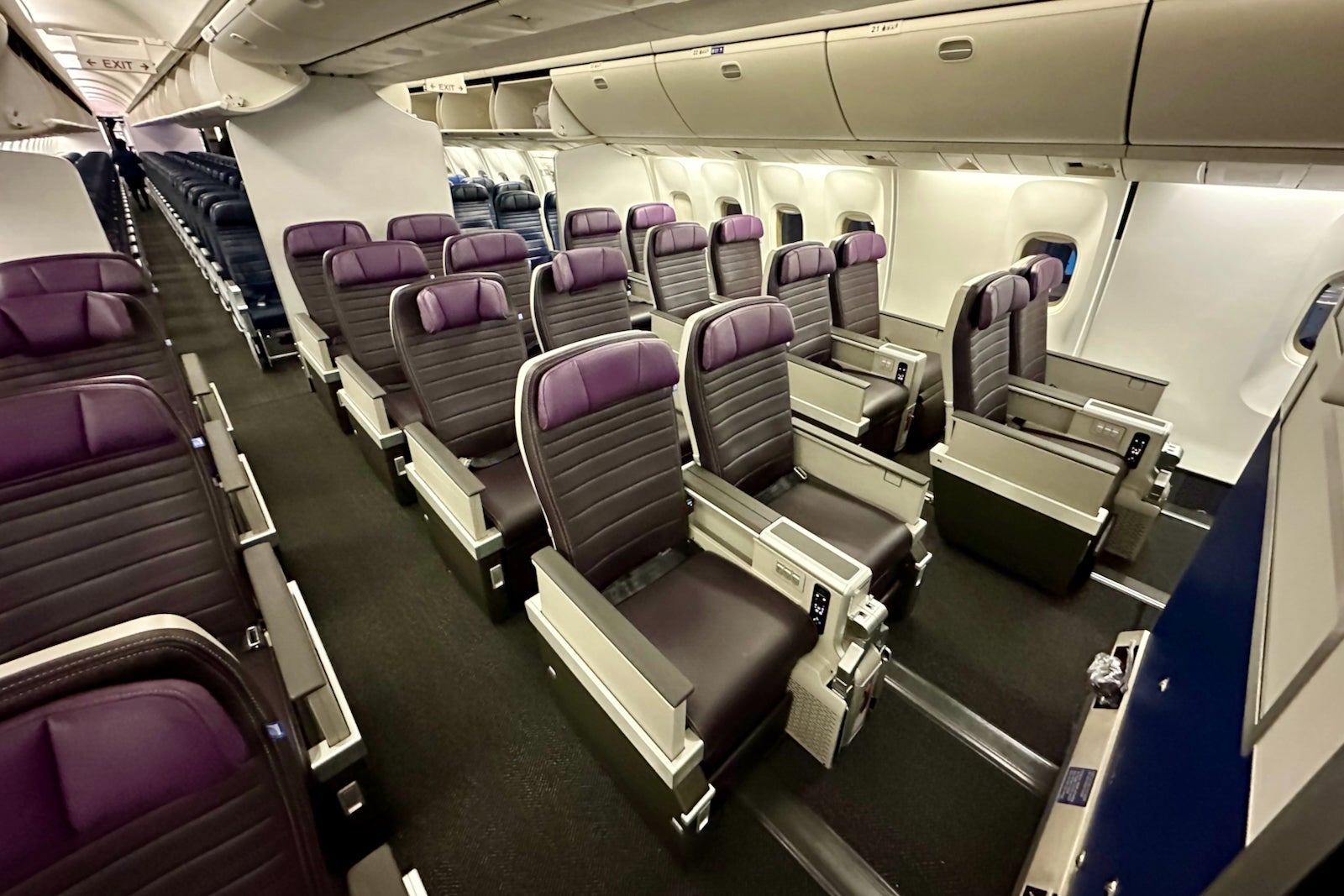
The seats themselves shouldn't be surprising to frequent United travelers. Nothing has changed about the "bones" of these recliners.

They all feature 38 inches of pitch, 6 inches of recline, better padding and other bells and whistles, such as a supportive and adjustable headrest, a legrest, a footrest and a larger 13.3-inch high-definition entertainment screen.

Universal power outlets and USB-A ports are located in the armrest of each seat, and the seatback pockets are larger for additional storage space for your loose items.

A bi-fold tray table pops out of each armrest, and it measures 17 inches wide and 10 1/2 inches long, perfect for a larger device such as a 13.6-inch MacBook Air.

Though the seats may all look the same, they're definitely not all created equally.
For one, rows 20 and 21 are both missing windows, so you may want to avoid those seats if you enjoy looking outside while flying.

The bulkhead row (20) may also be controversial for a few more reasons. These seats don't have a proper footrest, but they do have a sturdy area to rest your feet when fully reclined.

Instead of seatback storage, United installed a small cutout on the bulkhead wall for placing loose items. These cutouts aren't as large as you'd find behind other seats, but at least you don't need to worry about someone reclining into your space if you choose a bulkhead.

Another potential drawback to the bulkhead is that the entertainment screens are stored in the armrest and can't be unlatched during taxi, takeoff or landing. Interestingly, the screens in the bulkhead measure only 11 inches compared to the 13.3-inch screens you'd find elsewhere in the cabin.

Personally, if I were flying on this plane, I'd pick a seat in row 22. This way, I'd avoid the missing window issue in rows 20 and 21, and steer clear of some of the drawbacks of the bulkhead.
I'd also be a row farther away from the economy cabin, which should help minimize the light and noise pollution that you'd likely find in the last row of Premium Plus.
Note that there are only three lavatories located all the way at the back of the aircraft, and they're shared between the 24 premium economy passengers and the 149 economy flyers. I'd imagine that the lines to use the bathroom may get quite long during peak times, such as during initial descent.
Though the "standard" 767-300 configuration had four lavatories shared between all 184 economy passengers, United converted one of the bathrooms into galley space during the Premium Plus retrofits. It's understandable that flight attendants likely need more storage and work space when plating meals for Premium Plus, but it's just unfortunate that this comes at the expense of a lavatory.
Other upgrades on United's Boeing 767-300
While the highlight of the retrofitted Boeing 767-300 is the new Premium Plus cabin, United also made some other updates to the jet while it was in the hangar.

Of course, the new Premium Plus cabin must come at the expense of some other seats. In this case, United removed 14 extra-legroom Economy Plus seats and 25 standard economy seats to make room for the new cabin.

Unfortunately, the 14 extra-legroom seats that've been removed were all in the favorable "couple" arrangement on the sides of the plane. This means that the proportion of extra-legroom middle seats has increased in this refreshed layout.
Fortunately for those looking to redeem miles or upgrades, United left the 10-row, 30-seat Polaris cabin as is, except for one very notable difference: the addition of a new aisle located at the front of the Polaris cabin.

In the old configuration, Polaris passengers needed to play a game of Twister with the flight attendants when trying to maneuver between the two lavatories located at the front of the cabin.


This was especially problematic during meal times, and I've seen crew members get visibly frustrated when passengers disrupt the service flow to use the lavatory.
With this new aisle, travelers can go between each side of the cabin and access both restrooms without needing to interfere with the flight attendants in the galley — a win-win for everyone, and an improvement that United should consider adding to its future cabin configurations.

United also installed new LED passenger reading lights throughout the plane, but it's hard to tell during a ground-based tour how much of an improvement these actually are.
Bottom line
United is going all-in on premium economy with its latest cabin retrofit program on the Boeing 767-300.
Once the rollout is complete in the next few months, every United international wide-body route will offer four onboard experiences: Polaris business class, Premium Plus, Economy Plus and standard economy.

As the airline looks to improve yields, especially in the forward cabins, adding more Premium Plus recliners should help it accomplish this goal.
Unfortunately, that's not necessarily great news for those looking to redeem upgrades. While United still allows two-cabin upgrades from economy directly to Polaris (unlike Delta), those who purchase Premium Plus seats will be prioritized on the standby list above those who buy the cheapest economy tickets.
So if you want to maximize your upgrade chances, you'll need to buy the "purple seats" going forward.
That said, if you do end up flying in Premium Plus on the Boeing 767-300, you'll be in for a treat, especially if you choose the right seat. The 2-2-2 configuration means that there are no middle seats, and the 24-seat cabin feels quite spacious and private.
Now that the entire wide-body fleet is about to feature premium economy, it's time for United to turn its attention to improving the "soft product" — the amenities, food and beverage offerings.
If it does, then reasonably priced Premium Plus upgrades should become a no-brainer for many passengers.
For more about United, be sure to check out:
TPG featured card

at Capital One's secure site
Terms & restrictions apply. See rates & fees.
| 5X miles | Earn 5X miles on hotels, vacation rentals and rental cars booked through Capital One Travel |
| 2X miles | Earn unlimited 2X miles on every purchase, every day |
Pros
- Stellar welcome offer of 75,000 miles after spending $4,000 on purchases in the first three months from account opening. Plus, a $250 Capital One Travel credit to use in your first cardholder year upon account opening.
- You'll earn 2 miles per dollar on every purchase, which means you won't have to worry about memorizing bonus categories
- Rewards are versatile and can be redeemed for a statement credit or transferred to Capital One’s transfer partners
Cons
- Highest bonus-earning categories only on travel booked via Capital One Travel
- LIMITED-TIME OFFER: Enjoy $250 to use on Capital One Travel in your first cardholder year, plus earn 75,000 bonus miles once you spend $4,000 on purchases within the first 3 months from account opening - that’s equal to $1,000 in travel
- Earn unlimited 2X miles on every purchase, every day
- Earn 5X miles on hotels, vacation rentals and rental cars booked through Capital One Travel
- Miles won't expire for the life of the account and there's no limit to how many you can earn
- Receive up to a $120 credit for Global Entry or TSA PreCheck®
- Use your miles to get reimbursed for any travel purchase—or redeem by booking a trip through Capital One Travel
- Enjoy a $50 experience credit and other premium benefits with every hotel and vacation rental booked from the Lifestyle Collection
- Transfer your miles to your choice of 15+ travel loyalty programs
- Top rated mobile app