JetBlue-Spirit merger blocked

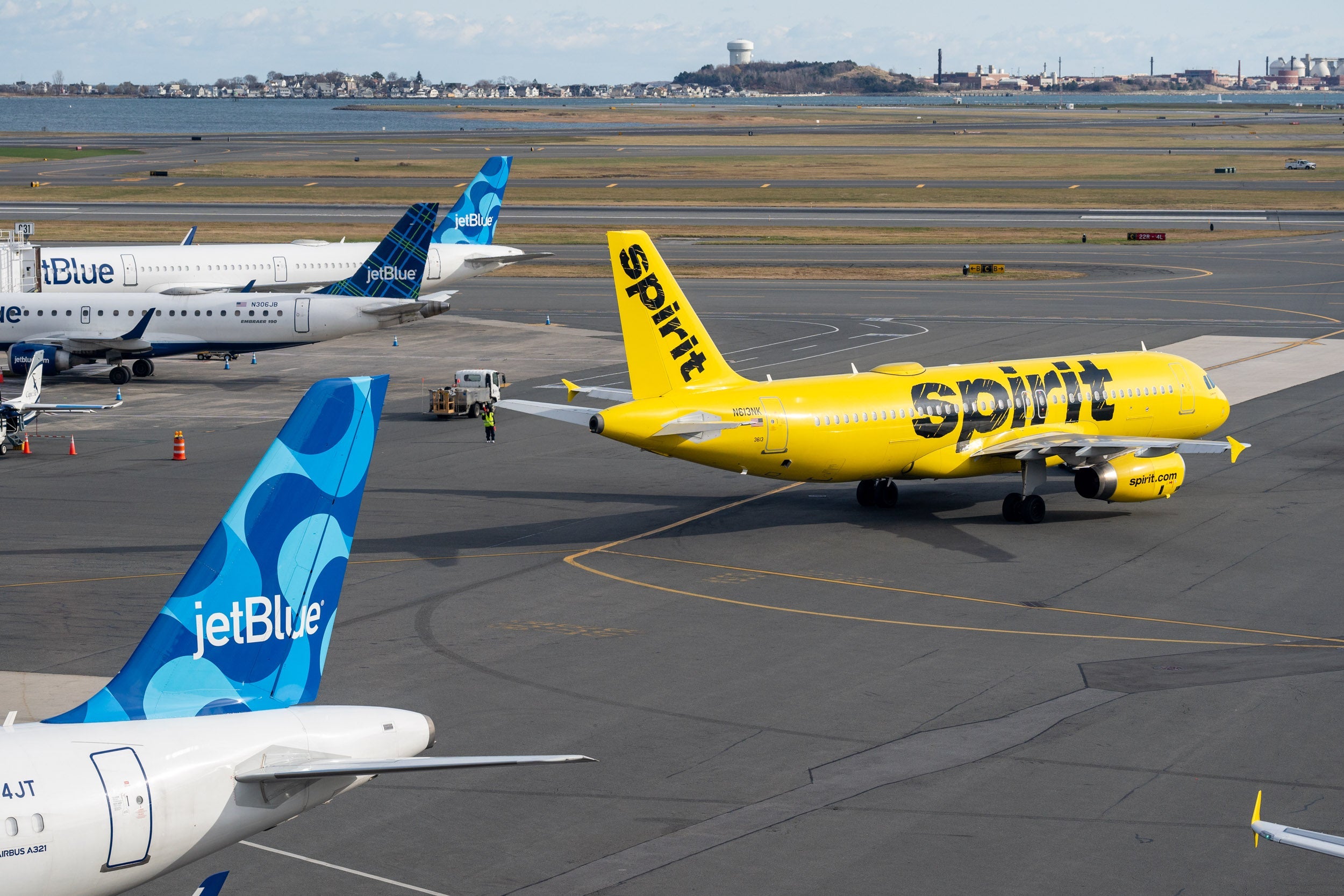
JetBlue's merger with Spirit Airlines was blocked by a federal judge on Tuesday, putting an end to a combination that would have seen JetBlue absorb Spirit and scrap the ultra-low-cost carrier's brand.
In the ruling, Judge William G. Young of the U.S. District Court in Massachusetts found that the merger was anti-competitive, agreeing with a U.S. Department of Justice argument that said the merger violated antitrust laws.
The decision was a major blow to JetBlue, which also saw its Northeast Alliance with American Airlines scrapped in antitrust court in 2023.
JetBlue had argued that it needed Spirit's aircraft and crew members in order to supercharge its growth to a size that would allow it to compete with bigger U.S. carriers.
It was not immediately clear whether JetBlue plans to appeal the decision.
In a joint statement, the two airlines said that they disagreed with the ruling.
"JetBlue's termination of the Northeast Alliance and commitment to significant divestitures have removed any reasonable anti-competitive concerns that the Department of Justice raised," the airlines said. "We are reviewing the court's decision and are evaluating our next steps as part of the legal process."
Share prices for Spirit fell more than 50%, while JetBlue was up more than 5%.
Judge Young's ruling comes more than five weeks after a monthlong trial closed in Boston on Dec. 5.

Throughout the initial bid and the trial, JetBlue argued that by absorbing Spirit, it could double its size and compete more effectively with the four major U.S. airlines — American Airlines, Delta Air Lines, Southwest Airlines and United Airlines — that together control about 80% of the U.S. air travel market.
The DOJ, however, argued that the merger would hurt the most price-sensitive consumers, with Spirit's elimination from the market on some routes causing prices to rise. The department sued in March to stop the merger.
While the DOJ has challenged previous mergers between airlines, many were settled. A series of bankruptcies and industry consolidations that led to the current dynamic with four major U.S. airlines — many of which were ultimately allowed by the DOJ — has created a playing field where smaller entrants must merge to survive and prosper, according to JetBlue's lawyers.
During the trial, JetBlue and Spirit also argued that if Spirit were to stop existing, other ultra-low-cost carriers — such as Frontier Airlines, Allegiant Air, Avelo Airlines and Breeze Airways, among others — would fill the void. During the trial, executives from both airlines testified that Spirit, which has struggled to return to profitability following the onset of the COVID-19 pandemic, cannot continue operating in its current form as an ultra-low-cost carrier. This means that even without the merger, the airline would cease to exist as the market force it is today.
The ultimate question at the heart of the trial boiled down to whether the risk of raising the lowest fares on some routes through Spirit's exit would be worth the potential to lower the average airfare across the broader market by putting more pressure on the major carriers.
The DOJ won a similar antitrust case last year against JetBlue's Northeast Alliance with American Airlines. However, that trial involved one of the four major U.S. airlines and occurred while the Spirit merger was on the table.
TPG featured card

at American Express's secure site
Terms & restrictions apply. See rates & fees.
| 4X | Earn 4X Membership Rewards® points per dollar spent on purchases at restaurants worldwide, on up to $50,000 in purchases per calendar year, then 1X points for the rest of the year. |
| 4X | Earn 4X Membership Rewards® points per dollar spent at US supermarkets, on up to $25,000 in purchases per calendar year, then 1X points for the rest of the year. |
| 5X | Earn 5X Membership Rewards® points on prepaid hotel stays booked through AmexTravel.com or the Amex Travel App™. |
| 3X | Earn 3X Membership Rewards® points on flights booked through AmexTravel.com, the Amex Travel App™, or purchased directly from airlines. |
| 2X | Earn 2X Membership Rewards® points on prepaid car rentals booked through AmexTravel.com or the Amex Travel App™ and cruises booked and paid through AmexTravel.com. |
| 1X | Earn 1X Membership Rewards® point per dollar spent on all other eligible purchases. |
Pros
- Valuable dining and food-related credits
- Flexible rewards with airline and hotel transfer partners
- Multiple travel and purchase protections
- No foreign transaction fees
- Access to Amex Offers for additional savings (enrollment required)
Cons
- Not as useful for those living outside the U.S.
- Some may have trouble using Uber and other dining credits
- You may be eligible for as high as 100,000 Membership Rewards® Points after you spend $8,000 in eligible purchases on your new Card in your first 6 months of Card Membership. Welcome offers vary and you may not be eligible for an offer. Apply to know if you’re approved and find out your exact welcome offer amount – all with no credit score impact. If you’re approved and choose to accept the Card, your score may be impacted.
- Earn 4X Membership Rewards® points per dollar spent on purchases at restaurants worldwide, on up to $50,000 in purchases per calendar year, then 1X points for the rest of the year.
- Earn 4X Membership Rewards® points per dollar spent at US supermarkets, on up to $25,000 in purchases per calendar year, then 1X points for the rest of the year.
- Earn 5X Membership Rewards® points on prepaid hotel stays booked through AmexTravel.com or the Amex Travel App™.
- Earn 3X Membership Rewards® points on flights booked through AmexTravel.com, the Amex Travel App™, or purchased directly from airlines.
- Earn 2X Membership Rewards® points on prepaid car rentals booked through AmexTravel.com or the Amex Travel App™ and cruises booked and paid through AmexTravel.com.
- Earn 1X Membership Rewards® point per dollar spent on all other eligible purchases.
- Pay It® lets you tap in the American Express® App to quickly pay for small purchase amounts throughout the month and still earn rewards the way you usually do. Plan It® gives you the option to split up big purchases into equal monthly payments with a fixed fee. You’ll know upfront exactly how much you’ll pay.
- $120 Dining Credit: Earn up to a total of $10 in statement credits monthly when you pay with the Gold Card at Grubhub (including Seamless), Buffalo Wild Wings, Five Guys, The Cheesecake Factory, and Wonder. This can be an annual savings of up to $120. Enrollment required.
- $100 Resy Credit: Get up to $100 in statement credits each calendar year at over 10,000 qualifying U.S. Resy restaurants after you pay for eligible purchases with the American Express® Gold Card. That’s up to $50 in statement credits semi-annually. Enrollment required.
- $84 Dunkin' Credit: Earn up to $7 in monthly statement credits after you pay with the American Express® Gold Card at U.S. Dunkin’ locations. Enrollment required.
- $120 Uber Cash on Gold: Enjoy up to $120 in Uber Cash annually with your Gold Card. Just add your Card to your Uber account and you'll get $10 in Uber Cash each month to use on orders and rides in the U.S. when you select an Amex Card for your transaction.
- Enjoy complimentary Hertz Five Star® Status benefits like skipping the counter at select locations, adding an additional driver at no additional cost*, and vehicle upgrades**. Benefit enrollment and Hertz Gold+ registration are required. *Additional drivers must meet standard rental qualifications and must be a spouse or domestic partner to qualify as complimentary. Other additional drivers subject to fees. **Benefits are subject to availability and vary by location. Additional Hertz program Terms and Conditions including age restrictions apply.
- Book two nights or more with The Hotel Collection through AmexTravel.com or the Amex Travel App™ and receive a $100* credit towards eligible charges at over 1,400 upscale hotels worldwide. *Eligible charges vary by property.
- Book your travel through the Amex Travel App™ with added peace of mind – backed by American Express® service and support. Only for American Express® Card Members.
- Whenever you need us, we're here. Our Member Services team will ensure you are taken care of. From lost Card replacement to statement questions, we are available to help 24/7.
- No Foreign Transaction Fees.
- Annual Fee is $325.
- Terms Apply.