JetBlue-Spirit merger thwarted? US files lawsuit to block it, citing competition concerns

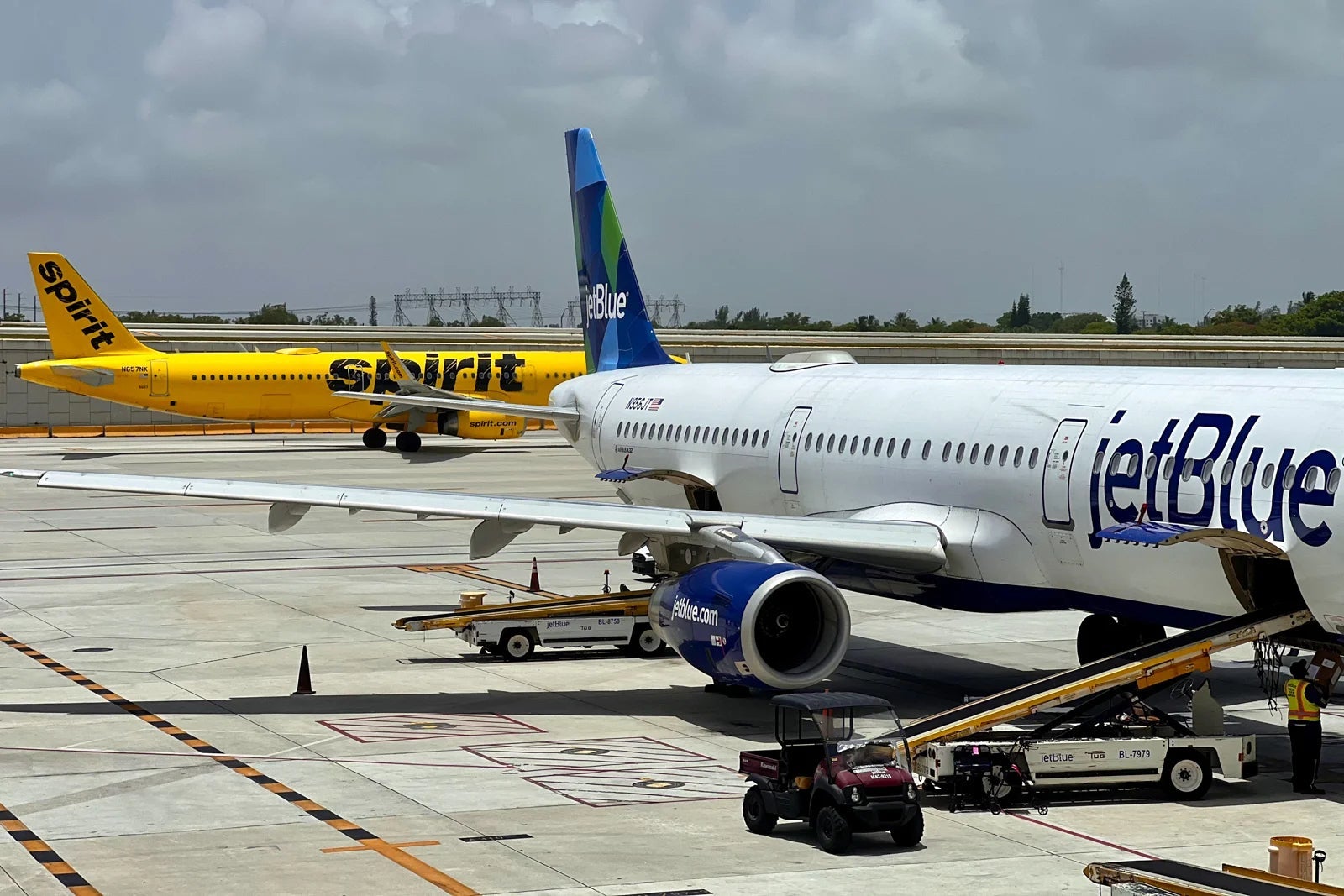
The Department of Justice said it would try to block JetBlue's proposed $3.8 billion acquisition of Spirit Airlines, launching a lawsuit on Tuesday to stave off further consolidation of the airline industry.
The DOJ said it believed that a merger between JetBlue and Spirit would ultimately cause fares to increase, since a combined airline would have fewer seats and wouldn't be able to fully recover from its losses without charging more for airfare.
Since JetBlue planned to absorb Spirit into its own operation, the DOJ argued that it would effectively eliminate the largest ultra-low-cost carrier in the U.S., which has "increased competition and brought low fares to hundreds of routes across the country, making it possible for more Americans — particularly the most cost-conscious — to travel," the lawsuit read.
The merger would have created the fifth-largest airline in the U.S., but the move to block it marks a sharp turn from past precedents in which the government has approved mergers such as American-US Airways, United-Continental, Delta-Northwest and Southwest-AirTran.
""If not blocked, the merger of JetBlue and Spirit would result in higher fares and fewer choices for tens of millions of travelers across the country," said U.S. Attorney General Merrick Garland in a press conference on Tuesday.
Garland also said that, in particular, the merger would leave fewer choices for working-class and middle-class Americans, who may not be willing to spend an exorbitant amount in airfare compared to business travelers.
JetBlue and Spirit argued that they needed to merge in order to compete against the four largest U.S. airlines — Delta Air Lines, American, United and Southwest Airlines — which already dominate about 80% of the U.S. market.
The lawsuit will now put the planned merger on hold indefinitely. JetBlue and Spirit said in a press release on Tuesday that they plan to proceed with the deal and seek to "create a compelling national challenger to the Big Four airlines."
Both JetBlue and Spirit CEOs expressed their disagreement with the DOJ decision, with JetBlue's Robin Hayes reiterating that the merger with Spirit is needed in order to compete in an already heavily consolidated industry.

"There is too much at stake for the DOJ to prevent us from bringing the JetBlue difference to more customers in more markets," Hayes said in a statement.
President Joe Biden's administration has adopted a hawkish stance on antitrust laws, with the DOJ aggressively suing to block mergers between major companies. For example, a judge blocked a merger between publishing giants Simon and Schuster and Penguin Random House after the DOJ filed a lawsuit. The DOJ is also planning to sue Adobe and Figma over their $20 billion merger.
The lawsuit also said JetBlue's takeover of Spirit would stop Spirit's growth, citing evidence that the ultra-low-cost carrier has doubled in size over the past 10 years and was on track to expand even more before the deal.
"Over the next five years Spirit plans to add nonstop service to several routes JetBlue flies today," the lawsuit read. "The acquisition stops this future competition before it starts."
The DOJ is currently attempting to hamper a partnership between JetBlue and American Airlines in Boston and New York, known as the Northeast Alliance. A decision on that partnership is also expected to be released in the near future.
And the DOJ lawsuit also chastises JetBlue's partnership with American, saying the New York-based carrier has "evolved" from fashioning itself as a disrupter to the airline industry with its low fares and amenities to closely aligning itself with the interests of the Big Four airlines through the Northeast Alliance. The lawsuit stated that JetBlue doesn't compete with American on capacity decisions and shares revenue for flights from New York and Boston, and a merger with Spirit would prevent JetBlue from having to compete with another carrier.
"In other words, JetBlue no longer competes with American Airlines on those flights — and if this acquisition happens, Spirit won't either," the lawsuit read.
TPG featured card
at American Express's secure site
Terms & restrictions apply. See rates & fees.
| 4X | Earn 4X Membership Rewards® points per dollar spent on purchases at restaurants worldwide, on up to $50,000 in purchases per calendar year, then 1X points for the rest of the year. |
| 4X | Earn 4X Membership Rewards® points per dollar spent at US supermarkets, on up to $25,000 in purchases per calendar year, then 1X points for the rest of the year. |
| 5X | Earn 5X Membership Rewards® points on prepaid hotel stays booked through AmexTravel.com or the Amex Travel App™. |
| 3X | Earn 3X Membership Rewards® points on flights booked through AmexTravel.com, the Amex Travel App™, or purchased directly from airlines. |
| 2X | Earn 2X Membership Rewards® points on prepaid car rentals booked through AmexTravel.com or the Amex Travel App™ and cruises booked and paid through AmexTravel.com. |
| 1X | Earn 1X Membership Rewards® point per dollar spent on all other eligible purchases. |
Pros
- Valuable dining and food-related credits
- Flexible rewards with airline and hotel transfer partners
- Multiple travel and purchase protections
- No foreign transaction fees
- Access to Amex Offers for additional savings (enrollment required)
Cons
- Not as useful for those living outside the U.S.
- Some may have trouble using Uber and other dining credits
- You may be eligible for as high as 100,000 Membership Rewards® Points after you spend $8,000 in eligible purchases on your new Card in your first 6 months of Card Membership. Welcome offers vary and you may not be eligible for an offer. Apply to know if you’re approved and find out your exact welcome offer amount – all with no credit score impact. If you’re approved and choose to accept the Card, your score may be impacted.
- Earn 4X Membership Rewards® points per dollar spent on purchases at restaurants worldwide, on up to $50,000 in purchases per calendar year, then 1X points for the rest of the year.
- Earn 4X Membership Rewards® points per dollar spent at US supermarkets, on up to $25,000 in purchases per calendar year, then 1X points for the rest of the year.
- Earn 5X Membership Rewards® points on prepaid hotel stays booked through AmexTravel.com or the Amex Travel App™.
- Earn 3X Membership Rewards® points on flights booked through AmexTravel.com, the Amex Travel App™, or purchased directly from airlines.
- Earn 2X Membership Rewards® points on prepaid car rentals booked through AmexTravel.com or the Amex Travel App™ and cruises booked and paid through AmexTravel.com.
- Earn 1X Membership Rewards® point per dollar spent on all other eligible purchases.
- Pay It® lets you tap in the American Express® App to quickly pay for small purchase amounts throughout the month and still earn rewards the way you usually do. Plan It® gives you the option to split up big purchases into equal monthly payments with a fixed fee. You’ll know upfront exactly how much you’ll pay.
- $120 Dining Credit: Earn up to a total of $10 in statement credits monthly when you pay with the Gold Card at Grubhub (including Seamless), Buffalo Wild Wings, Five Guys, The Cheesecake Factory, and Wonder. This can be an annual savings of up to $120. Enrollment required.
- $100 Resy Credit: Get up to $100 in statement credits each calendar year at over 10,000 qualifying U.S. Resy restaurants after you pay for eligible purchases with the American Express® Gold Card. That’s up to $50 in statement credits semi-annually. Enrollment required.
- $84 Dunkin' Credit: Earn up to $7 in monthly statement credits after you pay with the American Express® Gold Card at U.S. Dunkin’ locations. Enrollment required.
- $120 Uber Cash on Gold: Enjoy up to $120 in Uber Cash annually with your Gold Card. Just add your Card to your Uber account and you'll get $10 in Uber Cash each month to use on orders and rides in the U.S. when you select an Amex Card for your transaction.
- Enjoy complimentary Hertz Five Star® Status benefits like skipping the counter at select locations, adding an additional driver at no additional cost*, and vehicle upgrades**. Benefit enrollment and Hertz Gold+ registration are required. *Additional drivers must meet standard rental qualifications and must be a spouse or domestic partner to qualify as complimentary. Other additional drivers subject to fees. **Benefits are subject to availability and vary by location. Additional Hertz program Terms and Conditions including age restrictions apply.
- Book two nights or more with The Hotel Collection through AmexTravel.com or the Amex Travel App™ and receive a $100* credit towards eligible charges at over 1,400 upscale hotels worldwide. *Eligible charges vary by property.
- Book your travel through the Amex Travel App™ with added peace of mind – backed by American Express® service and support. Only for American Express® Card Members.
- Whenever you need us, we're here. Our Member Services team will ensure you are taken care of. From lost Card replacement to statement questions, we are available to help 24/7.
- No Foreign Transaction Fees.
- Annual Fee is $325.
- Terms Apply.