
That's the question as the Department of Justice squares off with JetBlue and Spirit Airlines in federal District court.
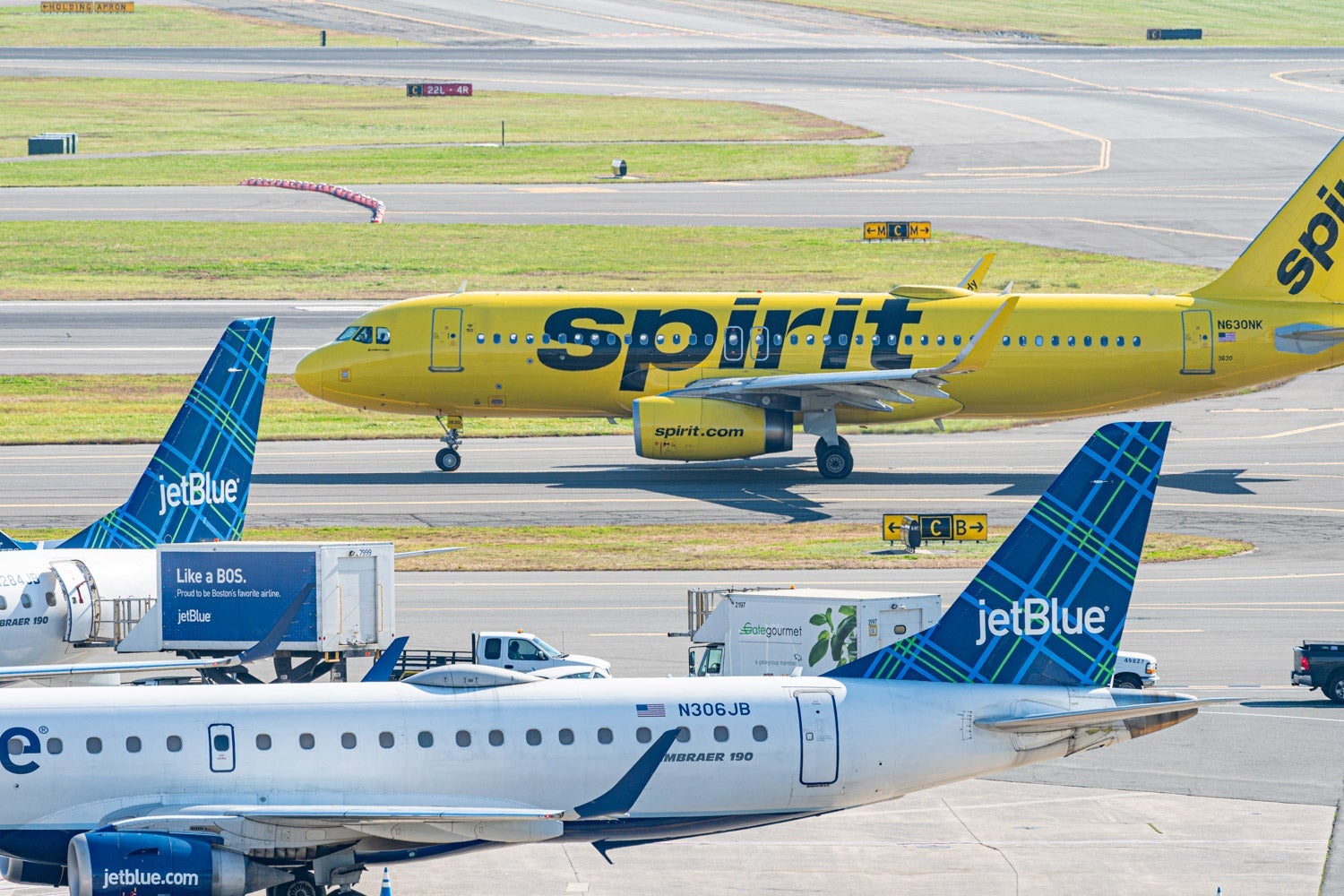
The long-awaited trial over JetBlue and Spirit Airlines' planned merger began on Tuesday in Boston, setting the stage for a showdown that could decide the long-term fates of both airlines.
During opening statements, both the government and the airlines laid out familiar arguments against and for the merger. The DOJ cited internal analyses from JetBlue that found that a combined airline could have fares that were 30% higher in some scenarios, and noted that even if there are only a few routes on which JetBlue and Spirit compete directly, eliminating competition on any routes should be enough to justify blocking the merger.
The government further argued that it was unreasonable to expect other ULCCs like Allegiant to pick up the competitive mantle of Spirit, since those other carriers focus more on unserved markets without direct competition from the legacy carriers.
JetBlue, on the other hand, repackaged an argument similar to the one it presented during the Northeast Alliance (NEA) trial just over a year ago — that the only way JetBlue can achieve enough scale to compete effectively against the "Big 4" airlines would be by acquiring Spirit. By doing so, the combined airline could be more competitive and bring fares down overall across all markets.
As an extra aside, lawyers for the airlines noted that Spirit had suffered increasing financial losses by trying to compete in markets with the "legacy" airlines by using the ultra-low-cost-carrier (ULCC) business model, and likely could neither survive nor compete without a change.
While JetBlue's argument is similar to the one it deployed in last year's NEA trial, which it eventually lost, the scenario now is different. The NEA has been dissolved, and JetBlue isn't talking about partnering with a competitor; it's looking to actively acquire a smaller one with a different business model, effectively doubling its size overnight.
Following opening statements, Spirit Airlines CEO Ted Christie was called by the DOJ as the first witness, wrapping questioning shortly before court was adjourned for the day.
The government's questions centered around Christie's opposition to a JetBlue takeover during early discussions between the airlines, as Spirit's board was pushing for a merger with ULCC competitor Frontier Airlines.
Despite Christie's and the Spirit board's preference, the airline's shareholders were enticed by the higher cash offer made by JetBlue. In an effort to convince them to vote for the Frontier merger instead, Spirit's board sent several communications outlining why federal regulators would likely object to the merger with JetBlue.
In one presentation, the board wrote that "at it's core, the JetBlue proposal represents a high-cost, high-fare airline buying a low-cost, low-fare airline, with half the synergies coming from reduced capacities and increased fares."
Other slides in the presentation offered comments suggesting that "JetBlue has stated it will reduce capacity and raise fares on Spirit routes," along with "Spirit continues to be a check on JetBlue's fares."
Christie dismissed the communications as his views at the time, which he implied had since evolved.
The defense will question Christie on Wednesday morning.
The trial is scheduled to last over 20 business days, with testimony each morning from experts and other executives, including JetBlue CEO Robin Hayes. A decision from Senior District Judge William G. Young is likely to take months.
TPG is reporting from the U.S. District Court in Boston, so stay tuned for the latest on the Spirit-JetBlue trial.