5 reasons we prefer hotel points over free night certificates


Editor's Note
When you sign up for a new hotel credit card, you may be eligible for a sign-up bonus. These sign-up bonuses often consist of a set number of points when you spend a specific amount within a specified time frame. However, occasionally, you may see sign-up bonuses that offer a set number of free nights when you meet specific minimum spending requirements on your new credit card.
Some travelers prefer a sign-up bonus of free night certificates. We prefer to earn hotel points when we sign up for a new card and meet the minimum spending requirements. Here's why.
Free night certificates are worth just 1 night

A free night certificate is what it sounds like: a free night. You'll only get one hotel night for each free night certificate. You need four free night certificates to stay somewhere for four nights.
On the flip side, you can use points for as many nights as you can stretch them into. If you have 35,000 points in your Marriott Bonvoy account and a free night award worth up to 35,000 points, you could redeem either for one night in a room that costs 35,000 points per night.
However, if you find a hotel across the street that costs just 17,500 Marriott points per night, you could use your points for two nights. Meanwhile, your up to 35,000-point free night award would only give you one free night.
Related: 7 of the best hotel credit cards that come with an annual free night
Free night certificates expire sooner

Nearly every airline and hotel program has a points expiration policy. Those whose points never expire are in the minority. However, many programs with expiration policies have a way to extend the life of your points. This could be as simple as earning or redeeming some points in your account or using a cobranded credit card from that program. Thus, you can keep your points for the future if you're not ready to use them now.
On the flip side, free night certificates almost always have expiration dates that usually can't be extended. Many free night certificates expire one year after they are earned, but some expire just six months after you earn them.
This means your free night certificates will almost certainly expire before your points. As such, you may feel pressure to redeem the free nights in your account, even if it's not a very good redemption.

Related: How to get your points and miles back after they expire
Free night certificates are designed for breakage

"Breakage" is a term that refers to benefits designed not to be redeemed for their full value, padding the profits of whoever issues those benefits.
A perfect example of this type of benefit is your monthly Uber credits from American Express. Could these credits be offered as an annual lump sum? Certainly — and it would be much easier for consumers to use the full value of this perk. However, doling the credits out monthly means consumers are less likely to remember to use the funds, less likely to use the full amount and more likely to spend past the free amount.
Free night certificates work similarly. Some people will work hard to maximize their free night certificates, seeking out as much value from them as possible during each redemption. However, most people do not do this.
Many will redeem a free night certificate for less than its full value because it's available, because it's expiring soon or because there aren't any properties available on the desired dates that cost the full value of the certificate. Thus, free night certificates are often redeemed for less than their full value, creating "breakage" that helps loyalty program profits.
Related: When you should redeem free night certificates instead of hotel points
Extra free night perks only apply to points

Marriott Bonvoy, Hilton Honors and IHG One Rewards have a perk where you can get a free night when paying with points for a stay of four or five nights.
With Marriott, you get the least expensive night comped when redeeming points for a stay of five nights or longer. With IHG's fourth night reward, select IHG cardholders pay zero points for every fourth night when redeeming IHG points for a stay of four nights or longer. Also, Hilton deducts the cost of one night from the average cost of five award nights when Hilton elite members redeem Hilton points for a stay of five nights or more.
Unfortunately, these policies don't apply to free night redemptions. You cannot use multiple free night certificates and then receive an extra free night added to your stay.
Related: How to maximize longer hotel stays by using a free night benefit
Points are more flexible

Hotel points are more flexible than free night certificates given that they are less likely to expire, can be used however you see fit and can garner a free night added to your stay with some programs. These are the reasons why we prefer earning points instead of free night certificates as a sign-up bonus.
If you want to stay at a top-end property that costs 50,000 points per night, you can spend 50,000 points to stay there. You could just as easily stay there for a night with a free night certificate worth at least 50,000 points. However, if you want to stretch your points, you could stay at a hotel that costs less than 10,000 points per night. This lets you use your same 50,000 points to pay for five nights — possibly more if that hotel program has a perk where you'll get a fourth or fifth night free when redeeming points.
Sadly, you cannot stretch your free night certificates to be worth more than just one night each.
Example bookings where points go further
To drive home the point, let's look at some recent redemptions we've made where points go further than free night certificates.
Ryan's examples
I love Mexico City, and the Centro Historico is where you should stay on your next trip. If you have a Hilton Amex free night certificate (valid at nearly any Hilton property worldwide), you could redeem it for one night at any of these three properties. You'd likely choose the most expensive option when doing so.
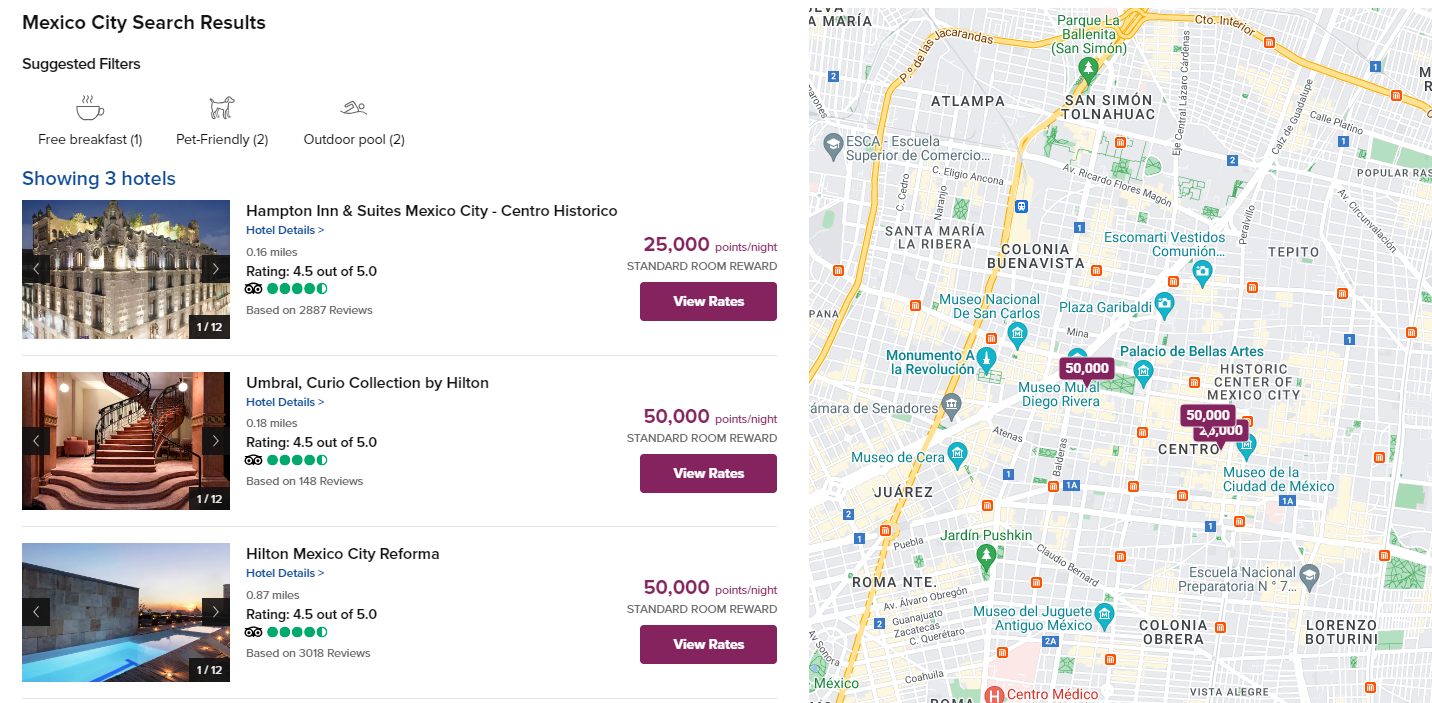
However, paying with points is a different story. If you have 50,000 points, you could get one night at Umbral or the Reforma property. With those same 50,000 points, you could stay two nights at the Hampton Inn & Suites property, which I love due to its great staff and amazing interior.
The same concept applies to your next visit to Shanghai. Consider these two hotels, which are separated by just three subway stops. It takes five minutes to get from one property to the other. If you have a free night certificate with Hyatt, you could spend one night at either property. Points are a different story, though. With the 15,000 points required to stay at the Grand Hyatt Shanghai on the sample night we searched, you could spend three nights at the UrCove Shanghai Lujiazui Expo hotel instead.

Katie's examples
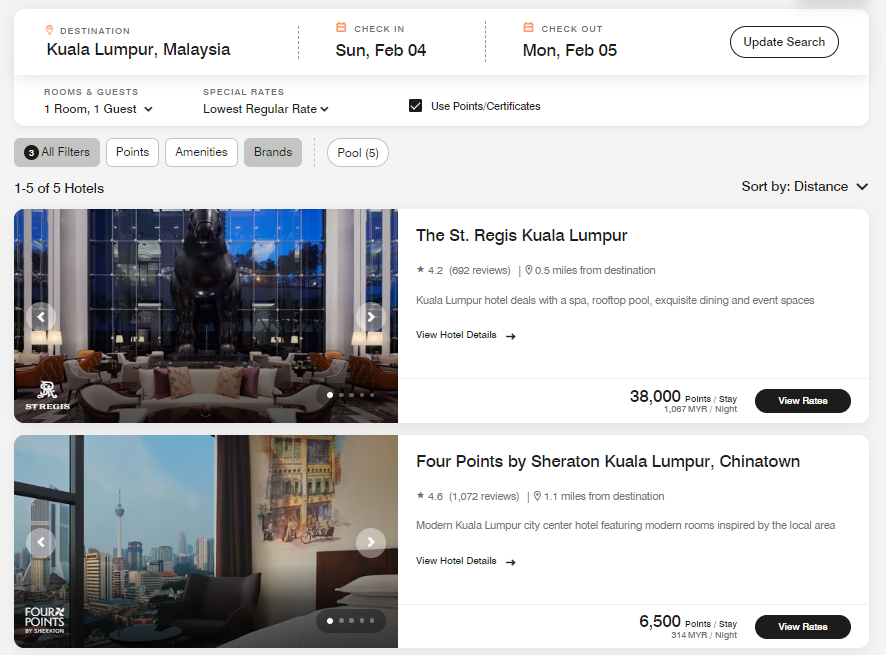
Kuala Lumpur is a city where you can stay at luxury hotels for relatively cheap. Consider the following example in which I could redeem an up to 40,000 point free night award for one night at the St. Regis Kuala Lumpur or Four Points by Sheraton Kuala Lumpur, Chinatown. Alternatively, I could redeem 40,000 points for a night at the St. Regis or at least six nights at the Four Points.
Or let's assume I wanted to redeem IHG points for a stay in Phuket, Thailand. I could redeem an anniversary free night worth up to 40,000 points for one night at any of these three properties. But I could redeem 40,000 points for two to three nights at these hotels.

That's the value of points instead of certificates: You can use the points as you see fit, opting for fewer nights at more expensive properties or more nights at less expensive properties.
Bottom line
We'll choose points over free night certificates any day of the week. Points last longer, are more versatile and can be stretched into more than one free night at a hotel.
The next time you see a credit card offering "free nights" as its sign-up bonus, remember that there are limitations to what you can do with these free night certificates. If you prefer earning points instead of free night certificates like us, consider waiting for an offer to earn points to return before signing up for a new card.
TPG featured card

at Capital One's secure site
Terms & restrictions apply. See rates & fees.
| 5X miles | Earn 5X miles on hotels, vacation rentals and rental cars booked through Capital One Travel |
| 2X miles | Earn unlimited 2X miles on every purchase, every day |
Pros
- Stellar welcome offer of 75,000 miles after spending $4,000 on purchases in the first three months from account opening. Plus, a $250 Capital One Travel credit to use in your first cardholder year upon account opening.
- You'll earn 2 miles per dollar on every purchase, which means you won't have to worry about memorizing bonus categories
- Rewards are versatile and can be redeemed for a statement credit or transferred to Capital One’s transfer partners
Cons
- Highest bonus-earning categories only on travel booked via Capital One Travel
- LIMITED-TIME OFFER: Enjoy $250 to use on Capital One Travel in your first cardholder year, plus earn 75,000 bonus miles once you spend $4,000 on purchases within the first 3 months from account opening - that’s equal to $1,000 in travel
- Earn unlimited 2X miles on every purchase, every day
- Earn 5X miles on hotels, vacation rentals and rental cars booked through Capital One Travel
- Miles won't expire for the life of the account and there's no limit to how many you can earn
- Receive up to a $120 credit for Global Entry or TSA PreCheck®
- Use your miles to get reimbursed for any travel purchase—or redeem by booking a trip through Capital One Travel
- Enjoy a $50 experience credit and other premium benefits with every hotel and vacation rental booked from the Lifestyle Collection
- Transfer your miles to your choice of 15+ travel loyalty programs
- Top rated mobile app