Canadian airlines worry US trade war could dent 'shaky' transborder market

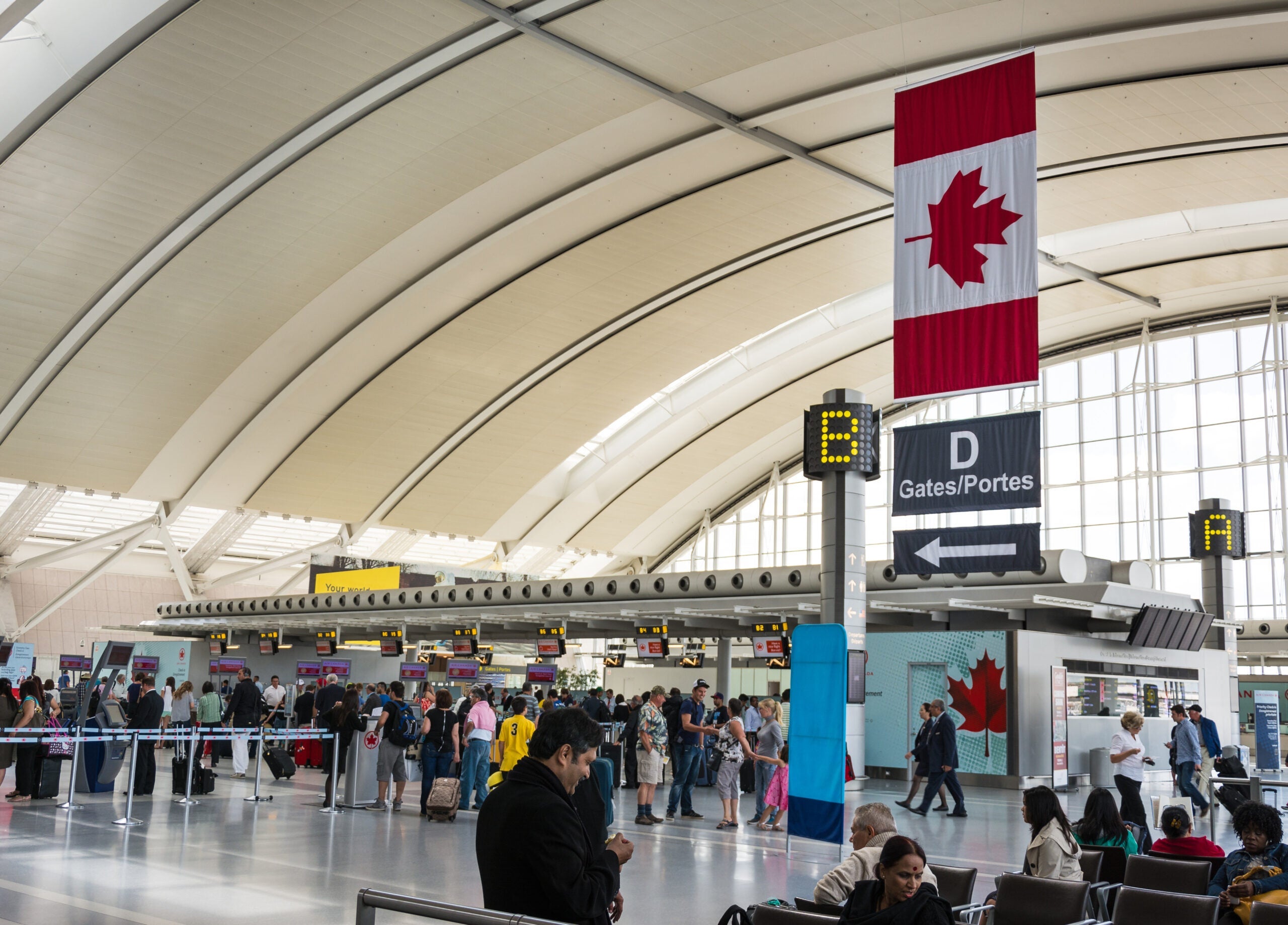
Airlines are watching closely for any sign of changing travel patterns between the U.S. and Canada after President Donald Trump's threat of steep tariffs on Canadian goods prompted outrage among denizens of the Great White North.
"Now is also the time to choose Canada," Canadian Prime Minister Justin Trudeau said in an address to the nation Feb. 2. "It might mean changing your summer vacation plans to stay here in Canada."
While Trump's tariffs were called off at the eleventh hour, they are only on hold for 30 days. That leaves the door open for further disruptions to U.S.-Canada travel.
That threat has sent shockwaves through the travel industry. The U.S. Travel Association warned that a 10% drop in Canadian visitors could result in as much as $2.1 billion in lost spending at American businesses.
"There's definitely softness the last couple of weeks," Frank Satusky, director of network strategy at Porter Airlines, said at the Routes Americas conference in Nassau, Bahamas, last week. "There's a lot of frustration in Canada."
Air Canada's vice president of planning and scheduling, Alexandre Lefèvre, described the transborder market as "shaky," adding that the airline does not see any "immediate slowdown" in travel demand.
Neither Air Canada nor Porter has any immediate plans to pull back on its U.S. schedule. The former has already unveiled new service to Jacksonville International Airport (JAX) this year and the latter to New York's LaGuardia Airport (LGA).
Any extended travel demand weakness, however, could prove challenging for airlines.
Air Canada is the largest airline in the market — and the most exposed to fluctuations in travel demand — with a nearly 43% share of the 9.3 million seats between the U.S. and Canada in the first quarter, schedule data from aviation analytics firm Cirium shows. Air Canada's share rises to 54% when including joint venture partner United Airlines; the two airlines coordinate schedules and fares on transborder routes.

WestJet is the second largest in the market with a 17% share of seats, and Porter is fourth with a 9% share.
A representative of WestJet at Routes declined to comment.
Complicating the situation is the weak Canadian dollar relative to the U.S. currency. The decline inflates the cost of a trip for anyone exchanging the Canadian currency.
"The weak Canadian dollar is impacting demand," Lefèvre said. The airline has made some schedule "reductions on the margins" as a result of the currency situation.
To offset the foreign exchange challenge, airlines can sell more seats in the U.S. That's easy for American carriers that already primarily carry U.S. travelers on flights to Canada. The proposition is more challenging for Canadian airlines that cater primarily to their local market.
Air Canada, however, has a leg up on boosting U.S. sales. First, its partner United handles sales in the country, which gives Air Canada access to a broad and deep pool of travelers, both leisure and corporate. Second, the airline carries a significant number of Americans on its flights across the border and on to Europe and Asia via connections in Montreal, Toronto and Vancouver, British Columbia.
Air travel that begins in one country, involves a flight connection or stopover in another country and ends in a third country is called a "sixth-freedom" trip.
Air Canada is already the largest foreign airline in the U.S. with flights to 50 airports and, as Lefèvre said at Routes, it plans to add as many as 15 more American cities to its map in the next few years. That expansion is fueled by the airline's sixth-freedom strategy.
"We need to offer more connectivity," Lefèvre said. "We need to offer more dots on the map."
Related reading:
TPG featured card
at American Express's secure site
Terms & restrictions apply. See rates & fees.
| 4X | Earn 4X Membership Rewards® points per dollar spent on purchases at restaurants worldwide, on up to $50,000 in purchases per calendar year, then 1X points for the rest of the year. |
| 4X | Earn 4X Membership Rewards® points per dollar spent at US supermarkets, on up to $25,000 in purchases per calendar year, then 1X points for the rest of the year. |
| 5X | Earn 5X Membership Rewards® points on prepaid hotel stays booked through AmexTravel.com or the Amex Travel App™. |
| 3X | Earn 3X Membership Rewards® points on flights booked through AmexTravel.com, the Amex Travel App™, or purchased directly from airlines. |
| 2X | Earn 2X Membership Rewards® points on prepaid car rentals booked through AmexTravel.com or the Amex Travel App™ and cruises booked and paid through AmexTravel.com. |
| 1X | Earn 1X Membership Rewards® point per dollar spent on all other eligible purchases. |
Pros
- Valuable dining and food-related credits
- Flexible rewards with airline and hotel transfer partners
- Multiple travel and purchase protections
- No foreign transaction fees
- Access to Amex Offers for additional savings (enrollment required)
Cons
- Not as useful for those living outside the U.S.
- Some may have trouble using Uber and other dining credits
- You may be eligible for as high as 100,000 Membership Rewards® Points after you spend $8,000 in eligible purchases on your new Card in your first 6 months of Card Membership. Welcome offers vary and you may not be eligible for an offer. Apply to know if you’re approved and find out your exact welcome offer amount – all with no credit score impact. If you’re approved and choose to accept the Card, your score may be impacted.
- Earn 4X Membership Rewards® points per dollar spent on purchases at restaurants worldwide, on up to $50,000 in purchases per calendar year, then 1X points for the rest of the year.
- Earn 4X Membership Rewards® points per dollar spent at US supermarkets, on up to $25,000 in purchases per calendar year, then 1X points for the rest of the year.
- Earn 5X Membership Rewards® points on prepaid hotel stays booked through AmexTravel.com or the Amex Travel App™.
- Earn 3X Membership Rewards® points on flights booked through AmexTravel.com, the Amex Travel App™, or purchased directly from airlines.
- Earn 2X Membership Rewards® points on prepaid car rentals booked through AmexTravel.com or the Amex Travel App™ and cruises booked and paid through AmexTravel.com.
- Earn 1X Membership Rewards® point per dollar spent on all other eligible purchases.
- Pay It® lets you tap in the American Express® App to quickly pay for small purchase amounts throughout the month and still earn rewards the way you usually do. Plan It® gives you the option to split up big purchases into equal monthly payments with a fixed fee. You’ll know upfront exactly how much you’ll pay.
- $120 Dining Credit: Earn up to a total of $10 in statement credits monthly when you pay with the Gold Card at Grubhub (including Seamless), Buffalo Wild Wings, Five Guys, The Cheesecake Factory, and Wonder. This can be an annual savings of up to $120. Enrollment required.
- $100 Resy Credit: Get up to $100 in statement credits each calendar year at over 10,000 qualifying U.S. Resy restaurants after you pay for eligible purchases with the American Express® Gold Card. That’s up to $50 in statement credits semi-annually. Enrollment required.
- $84 Dunkin' Credit: Earn up to $7 in monthly statement credits after you pay with the American Express® Gold Card at U.S. Dunkin’ locations. Enrollment required.
- $120 Uber Cash on Gold: Enjoy up to $120 in Uber Cash annually with your Gold Card. Just add your Card to your Uber account and you'll get $10 in Uber Cash each month to use on orders and rides in the U.S. when you select an Amex Card for your transaction.
- Enjoy complimentary Hertz Five Star® Status benefits like skipping the counter at select locations, adding an additional driver at no additional cost*, and vehicle upgrades**. Benefit enrollment and Hertz Gold+ registration are required. *Additional drivers must meet standard rental qualifications and must be a spouse or domestic partner to qualify as complimentary. Other additional drivers subject to fees. **Benefits are subject to availability and vary by location. Additional Hertz program Terms and Conditions including age restrictions apply.
- Book two nights or more with The Hotel Collection through AmexTravel.com or the Amex Travel App™ and receive a $100* credit towards eligible charges at over 1,400 upscale hotels worldwide. *Eligible charges vary by property.
- Book your travel through the Amex Travel App™ with added peace of mind – backed by American Express® service and support. Only for American Express® Card Members.
- Whenever you need us, we're here. Our Member Services team will ensure you are taken care of. From lost Card replacement to statement questions, we are available to help 24/7.
- No Foreign Transaction Fees.
- Annual Fee is $325.
- Terms Apply.