American will reduce staffing on flights to cut costs

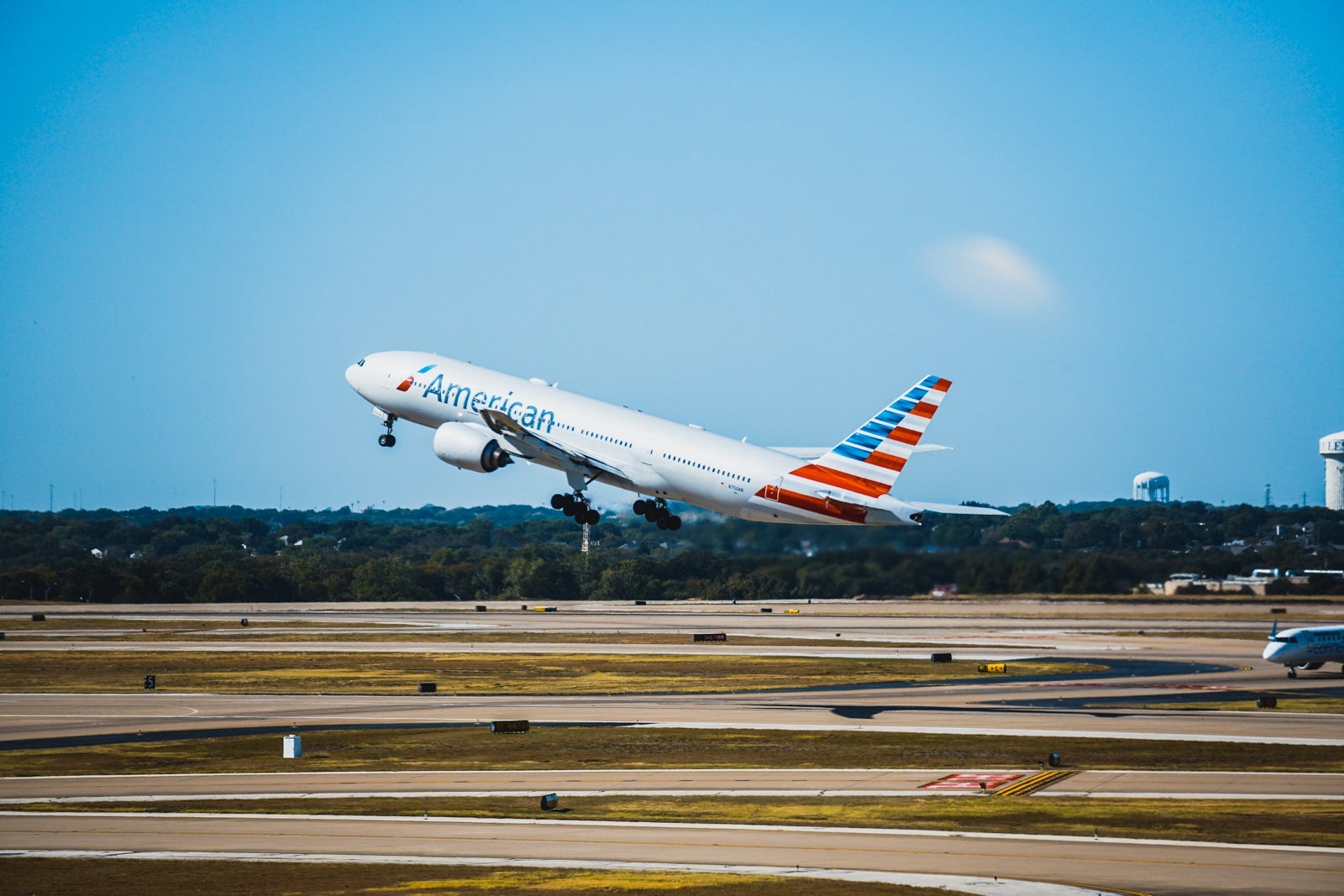
If you take a long-haul flight with American Airlines after Oct. 1, there will be fewer flight attendants on-hand to respond to your call button.
In a memo to the airline's employees distributed on Wednesday, Jill Surdek, American's senior vice president of flight service said that the airline is expecting to have significantly more staff on the payroll than it needs to support its planned schedule this fall.
Sign up for the free daily TPG newsletter for more aviation news.
"We expect to have an overage of between 7,000 and 8,000 flight attendants this fall," she wrote. Overall the airline expects to be "overstaffed" by about 20,000 people by later this year.
Surdek added that the airline won't necessarily furlough thousands of flight attendants, but she said American is looking for other ways to reduce its staffing.
Related: American tries to avoid the 'old airline playbook' on furloughs even as it shrinks.
One effort such involves cutting the number of flight attendants on widebody aircraft and A321T-operated services.
Doing so, she said, will make the airline more cost-effective as demand for international flights remains low. The exact plans are outlined below.
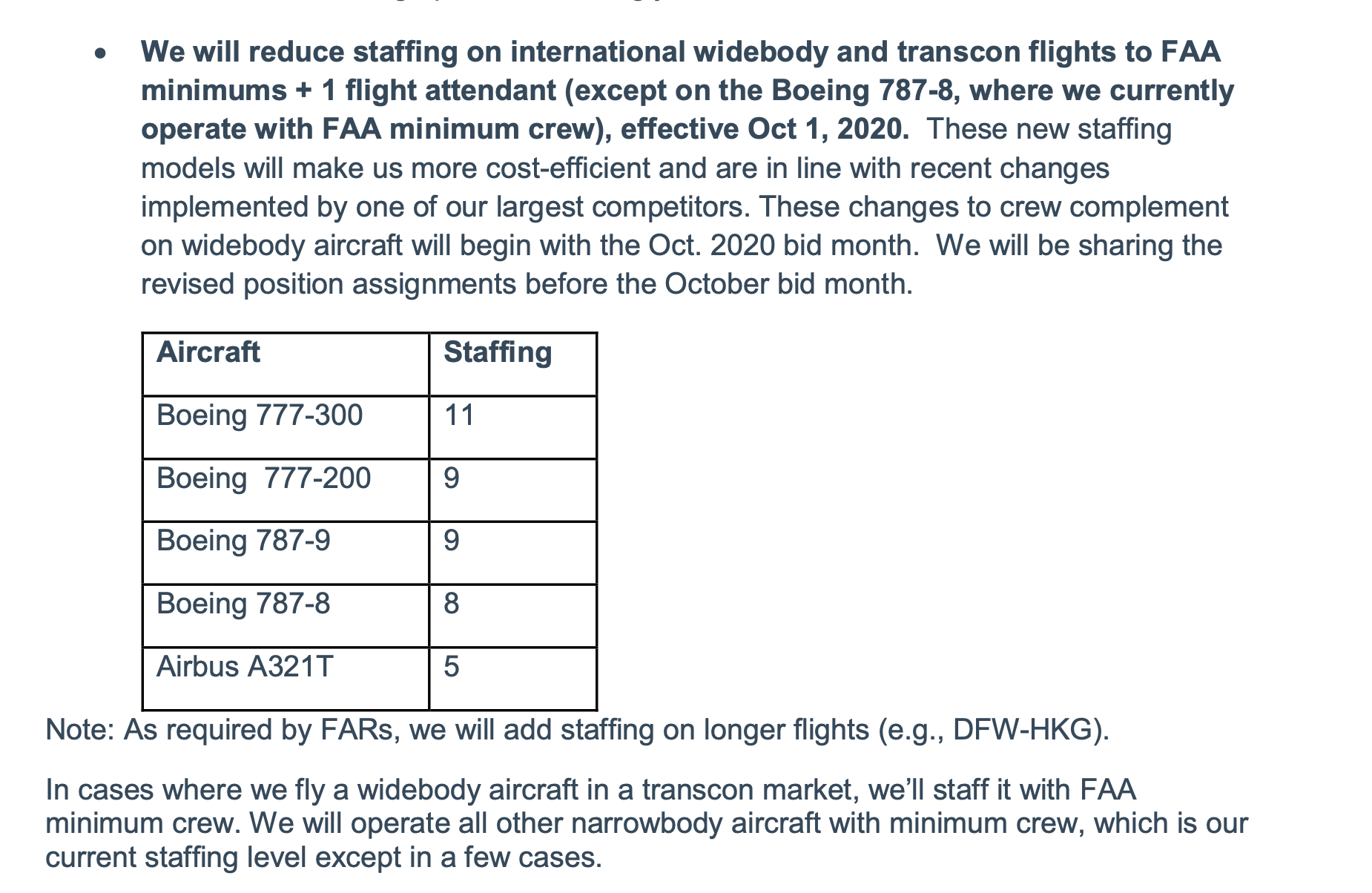
According to American, the changes to flight staffing are allowed by the current cabin crew contracts.

The Association of Professional Flight Attendants (APFA), which represents American's cabin crews, said it opposes the new policy nevertheless.
"We're not obviously in support of the reduction," Paul Hartshorn, Jr., an APFA spokesman, said in an interview with TPG.
"The staffing that we have today is what we're trying to preserve and it's not even as good as it was 15 years ago," he added. "From a safety perspective alone, we're not interested in eroding staffing."
Hartshorn said APFA and a number of other unions are pushing for the payroll protection provisions of the CARES Act to be extended so jobs can be protected and flight attendants can remain on airlines' payrolls (and off unemployment) so they're ready to serve again when ticket sales rebound.
Related: Health officials criticize American Airlines for not blocking middle seats.
While the flight crew reduction may sound like a bad thing for passenger service as well, it may ultimately not be as noticeable as it may seem on paper, at least not in the immediate future if travel demand stays suppressed.
"Most long-haul flights are not fully booked," said Henry Harteveldt, president of Atmosphere Research, a travel industry analysis firm. "Between the cutbacks in what American is doing on the planes in meal and beverage service and the lighter than average passenger loads, I don't think the passenger experience will suffer that dramatically."
Harteveldt added that passengers in the pointy end of the plane are the most likely to notice changes, but he said no one should expect inflight service today or in the near future to mirror what it was before the COVID-19 pandemic.
Review: American Airlines Flagship First class from Dallas to Hong Kong on the 777-300ER
"This is definitely not the time to fly if you're expecting a lavish, highly-attentive onboard experience in long-haul first class or business class because it's just not something that can be safely provided," he said.
While the changes may be disappointing to passengers, Harteveldt added that they make good business sense in the current environment.
Read more: American removes capacity caps, increases health safety measures.
"It doesn't make any sense for any airline to put 10 flight attendants on a long-haul widebody flight" at a time when many of them are only flying around 50% full. "Logically, I understand this," he added. "American, as a business, wants to reduce losses and if possible break even or make a profit in a very challenging business environment."
Related: Airline complaints soared 1,500% in April as flyers vented about refunds.
American is hardly the only airline preparing for staffing changes either. In June, Delta warned that it may furlough up to 2,500 pilots. Across the industry, airlines are getting leaner as demand for travel remains suppressed and the road to recovery looks uncertain.
Editor's note: This story was originally published on July 2, 2020. It has been updated to include comments from the Association of Professional Flight Attendants.
TPG featured card
at American Express's secure site
Terms & restrictions apply. See rates & fees.
| 4X | Earn 4X Membership Rewards® points per dollar spent on purchases at restaurants worldwide, on up to $50,000 in purchases per calendar year, then 1X points for the rest of the year. |
| 4X | Earn 4X Membership Rewards® points per dollar spent at US supermarkets, on up to $25,000 in purchases per calendar year, then 1X points for the rest of the year. |
| 5X | Earn 5X Membership Rewards® points on prepaid hotel stays booked through AmexTravel.com or the Amex Travel App™. |
| 3X | Earn 3X Membership Rewards® points on flights booked through AmexTravel.com, the Amex Travel App™, or purchased directly from airlines. |
| 2X | Earn 2X Membership Rewards® points on prepaid car rentals booked through AmexTravel.com or the Amex Travel App™ and cruises booked and paid through AmexTravel.com. |
| 1X | Earn 1X Membership Rewards® point per dollar spent on all other eligible purchases. |
Pros
- Valuable dining and food-related credits
- Flexible rewards with airline and hotel transfer partners
- Multiple travel and purchase protections
- No foreign transaction fees
- Access to Amex Offers for additional savings (enrollment required)
Cons
- Not as useful for those living outside the U.S.
- Some may have trouble using Uber and other dining credits
- You may be eligible for as high as 100,000 Membership Rewards® Points after you spend $8,000 in eligible purchases on your new Card in your first 6 months of Card Membership. Welcome offers vary and you may not be eligible for an offer. Apply to know if you’re approved and find out your exact welcome offer amount – all with no credit score impact. If you’re approved and choose to accept the Card, your score may be impacted.
- Earn 4X Membership Rewards® points per dollar spent on purchases at restaurants worldwide, on up to $50,000 in purchases per calendar year, then 1X points for the rest of the year.
- Earn 4X Membership Rewards® points per dollar spent at US supermarkets, on up to $25,000 in purchases per calendar year, then 1X points for the rest of the year.
- Earn 5X Membership Rewards® points on prepaid hotel stays booked through AmexTravel.com or the Amex Travel App™.
- Earn 3X Membership Rewards® points on flights booked through AmexTravel.com, the Amex Travel App™, or purchased directly from airlines.
- Earn 2X Membership Rewards® points on prepaid car rentals booked through AmexTravel.com or the Amex Travel App™ and cruises booked and paid through AmexTravel.com.
- Earn 1X Membership Rewards® point per dollar spent on all other eligible purchases.
- Pay It® lets you tap in the American Express® App to quickly pay for small purchase amounts throughout the month and still earn rewards the way you usually do. Plan It® gives you the option to split up big purchases into equal monthly payments with a fixed fee. You’ll know upfront exactly how much you’ll pay.
- $120 Dining Credit: Earn up to a total of $10 in statement credits monthly when you pay with the Gold Card at Grubhub (including Seamless), Buffalo Wild Wings, Five Guys, The Cheesecake Factory, and Wonder. This can be an annual savings of up to $120. Enrollment required.
- $100 Resy Credit: Get up to $100 in statement credits each calendar year at over 10,000 qualifying U.S. Resy restaurants after you pay for eligible purchases with the American Express® Gold Card. That’s up to $50 in statement credits semi-annually. Enrollment required.
- $84 Dunkin' Credit: Earn up to $7 in monthly statement credits after you pay with the American Express® Gold Card at U.S. Dunkin’ locations. Enrollment required.
- $120 Uber Cash on Gold: Enjoy up to $120 in Uber Cash annually with your Gold Card. Just add your Card to your Uber account and you'll get $10 in Uber Cash each month to use on orders and rides in the U.S. when you select an Amex Card for your transaction.
- Enjoy complimentary Hertz Five Star® Status benefits like skipping the counter at select locations, adding an additional driver at no additional cost*, and vehicle upgrades**. Benefit enrollment and Hertz Gold+ registration are required. *Additional drivers must meet standard rental qualifications and must be a spouse or domestic partner to qualify as complimentary. Other additional drivers subject to fees. **Benefits are subject to availability and vary by location. Additional Hertz program Terms and Conditions including age restrictions apply.
- Book two nights or more with The Hotel Collection through AmexTravel.com or the Amex Travel App™ and receive a $100* credit towards eligible charges at over 1,400 upscale hotels worldwide. *Eligible charges vary by property.
- Book your travel through the Amex Travel App™ with added peace of mind – backed by American Express® service and support. Only for American Express® Card Members.
- Whenever you need us, we're here. Our Member Services team will ensure you are taken care of. From lost Card replacement to statement questions, we are available to help 24/7.
- No Foreign Transaction Fees.
- Annual Fee is $325.
- Terms Apply.