Why does Washington's Reagan National Airport have a 'perimeter'?

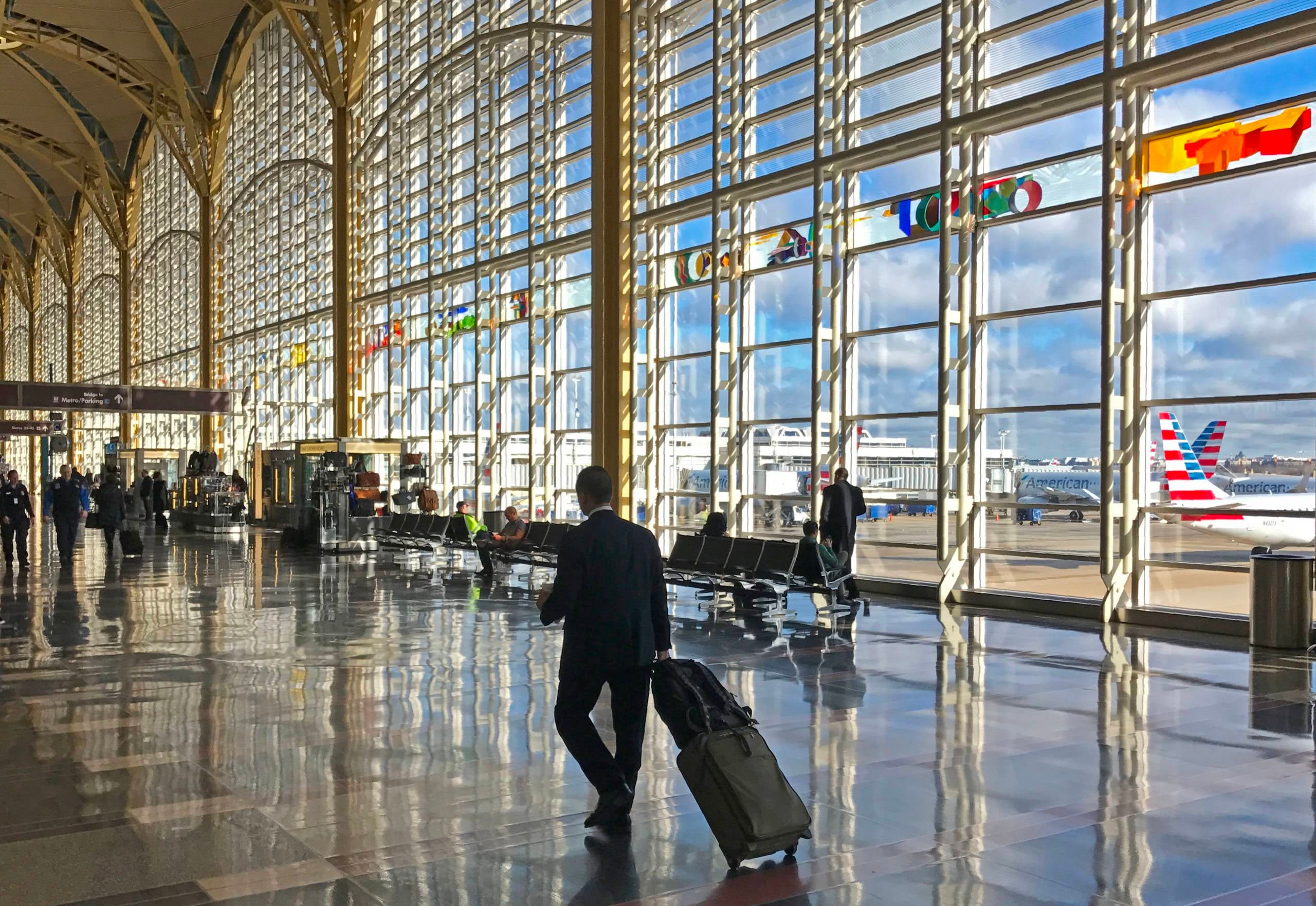
Scan the departure board at Ronald Reagan Washington National Airport any random Tuesday and you may notice something — very few of the airport's hundreds of flights are bound for cities west of Dallas or Minneapolis.
Washington National (DCA) has the distinction of being one of just two U.S. airfields, the other being New York LaGuardia (LGA), with a "perimeter," or restriction on how far an airline can fly nonstop from the airport. The limit has been in place for more than half a century with its roots in efforts to reduce congestion at the dawn of the jet age.
Flights from Washington National are limited to 1,250 miles. However, since 2000, federal authorities have granted airlines 40 "perimeter exemptions" — or 20 daily round-trip flights, since one exemption is good for either a takeoff or landing. Today, Alaska Airlines, American Airlines, Delta Air Lines, Frontier Airlines, JetBlue Airways, Southwest Airlines and United Airlines all hold exemptions for service to destinations further afield, including Los Angeles (LAX), Seattle (SEA) and even San Juan (SJU) in Puerto Rico.
Today, the perimeter continues as part of the two-airport system maintained by National operator the Metropolitan Washington Airports Authority (MWAA). The authority considers National a "regional" facility — with regional defined as the Eastern and Midwest U.S. — with its larger sibling Washington Dulles International Airport (IAD) the authority's growing, long-haul gateway.
Sign up for the free daily TPG newsletter for more airline news!
Jet-age congestion
The perimeter at Washington National, contrary to the popular narrative, was only partially to boost the then-relatively new Dulles airport when it was implemented in 1966.
The reason for the perimeter was to alleviate congestion at National after the introduction of jet aircraft that April. The airport was the exclusive domain of propeller-driven aircraft, like the Lockheed Constellation, until the U.S. Federal Aviation Administration allowed airlines to begin flying BAC 1-11s, Boeing 727s, Caravelles or Douglas DC-9s to National on April 24.
However, passenger numbers at National soared with the introduction of jets, which were mostly larger than the propeller aircraft they replaced, prompting calls for the FAA to address the congestion.

"Since [the FAA] opened National to smaller jetliners April 24, traffic there has mushroomed, taxing beyond capacity the terminal, its parking lots and the patience of its patrons," The Washington Post reported in June 1966, less than two months after the first jets landed at the field.
William McKee, administrator of the FAA in 1966, first proposed a strict 500-mile perimeter that July. But many airlines — and Congressional representatives — balked at the limit, saying it was too close to Washington. A compromise set the perimeter at 650 miles, with exemptions for flights to seven cities less than 1,000 miles from the nation's capital. That was implemented on Sept. 1, 1966.
Related: Why the American Airlines Shuttle continues rear-door deplaning in Boston, Washington
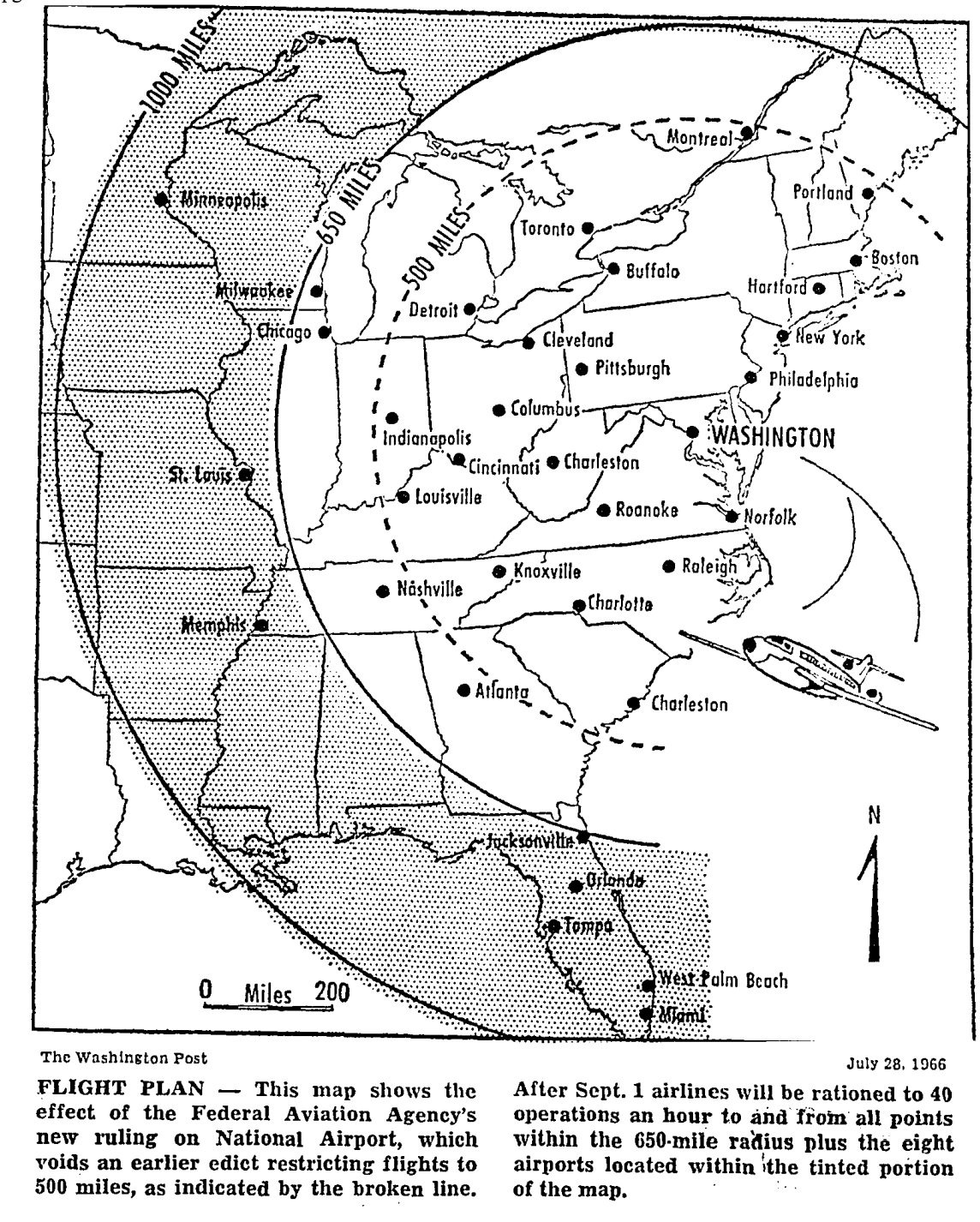
Throughout the debate, the perimeter was acknowledged as a way to ensure National remained a short- or medium-haul airport with Dulles as the Washington region's main long-haul airport. However, the final rule that combined the first slot controls at National with the 650-mile perimeter was aimed primarily at reducing congestion at the close-in airport.
"The perimeter solution [was] proposed by ten of the thirteen airlines serving Washington National Airport as an effective way of solving the congestion problem," said McKee in a letter to Congress dated July 27, 1966 published in the Congressional Record.
It is worth noting that had the FAA, or Congress, wanted to promote Dulles they could have mandated airlines fly to the airport. At the time, all interstate air routes were regulated, giving the government the authority to force airlines to move flights to Dulles from National.
Instead, as McKee noted in a letter to then-Senator Peter Dominick from Colorado in May 1966, the perimeter simply ensured that all "international and long-haul domestic services" operated from Dulles and Baltimore's Friendship, now Baltimore/Washington (BWI), airports -- and not from National.
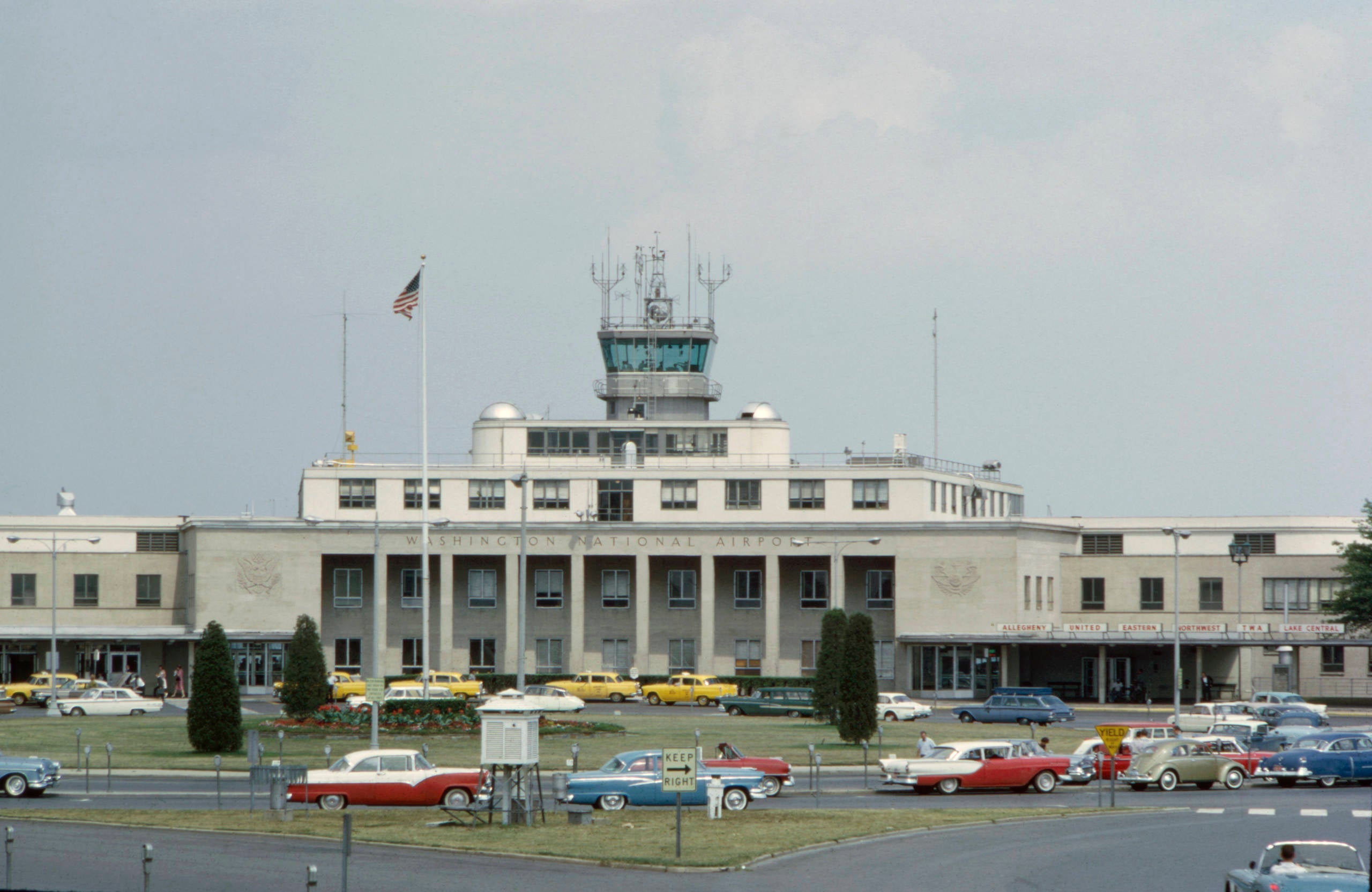
National's perimeter has been extended twice since 1966. It was moved to 1,000 miles in 1981, and to its current 1,250 miles in 1986. The last extension was driven by then-Speaker of the House representative Jim Wright, whose North Texas district was adjacent to American's headquarters at Dallas/Fort Worth International Airport (DFW) — an airport that, at 1,192 miles, was outside of the 1,000-mile limit.
Following the 1986 perimeter expansion, American added nonstop flights between Dallas/Fort Worth and Washington National to its map that December. The carrier is the largest at National today, with plans to fly larger jets with more seats from the airport beginning in 2021 when an under construction new concourse is due to open.
Congressional exemptions
The perimeter at Washington National did not change again until after the new North Terminal, today known as "Terminal B/C," opened at the airport in 1997. The late Sen. John McCain, in a letter published in The Washington Post that September, called for a review of the limit that he argued stifled competition.
View this post on Instagram
"[The rule] comes at the expense of air travelers in the Washington area and throughout the country who deserve the opportunity to fly nonstop outside the artificial perimeter," wrote McCain. "Reforming barriers to competition will not increase noise nor compromise safety, and would result in lower fares to travelers using National."
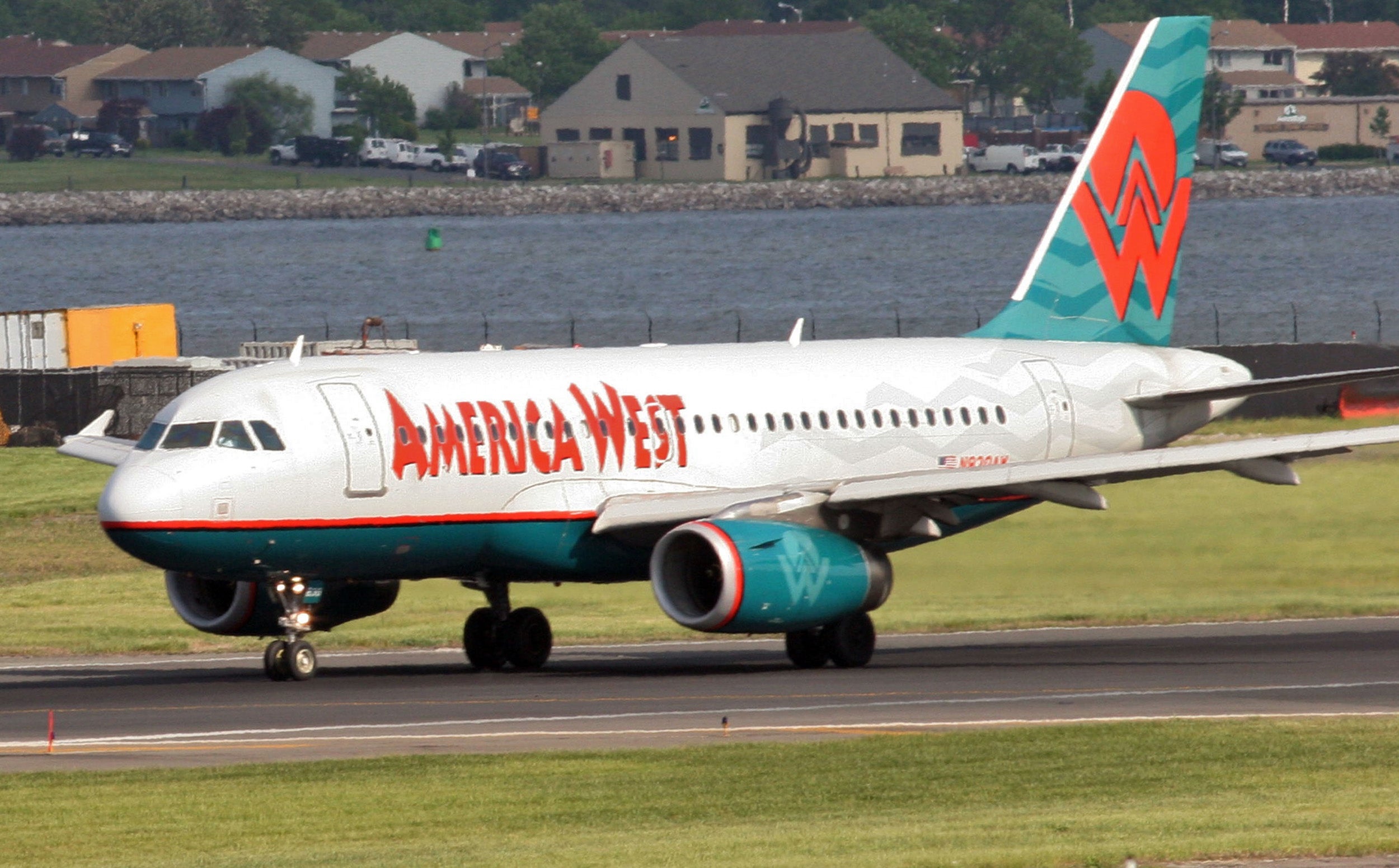
While McCain was unsuccessful in getting the perimeter removed, he did succeed in creating the first exemptions to the 1,250-mile limit. Former America West Airlines — based in McCain's homestate of Arizona — landed three of the six new exemptions for one flight to Las Vegas (PHX) and two to Phoenix (PHX). Frontier, and former National Airlines and Trans World Airlines took one each for new flights to Denver (DEN), Las Vegas and Los Angeles, respectively.
Another six exemptions were created in 2003, plus eight more in 2012, for the total of 20 that exist today.
Future changes
The fate of Washington National's perimeter remains in the hands of Congress. As recently as December 2018, outgoing Virginia representative David Brat introduced legislation to remove the limit, calling it a "relic that belongs in the past."
Other recent efforts to change the perimeter have included extending it to 1,425 miles, or just far enough to allow for nonstop flights to Austin (AUS) and San Antonio (SAT).
"A key purpose of the statute establishing the 1,250-mile perimeter at Reagan National is assuring balance of D.C.'s two-airport system," MWAA spokesperson Christina Saull told TPG, citing the ability to grow at Dulles that does not exist at National. "[MWAA] is committed to maintaining the balance of the two-airport system and strongly opposes any changes to the Reagan National perimeter rule."
The future of the perimeter, despite the strong words of MWAA and the support of the Washington region's congressional delegation, will depend on what the shifting winds of Congress bring.
Related: Washington Dulles vs. Reagan National: Which airport should I use?
The current "beyond perimeter" destinations offered by airlines from DCA are:
- Alaska Airlines: Los Angeles, Portland (Oregon), San Francisco, Seattle
- American Airlines: Las Vegas, Los Angeles, Phoenix
- Delta Air Lines: Los Angeles, Salt Lake City
- Frontier Airlines: Denver
- JetBlue: San Juan (Puerto Rico)
- Southwest Airlines: Austin
- United Airlines: Denver, San Francisco
The story has been updated to better reflect the role of Dulles in the implementation of the perimeter at Washington National.
TPG featured card
at American Express's secure site
Terms & restrictions apply. See rates & fees.
| 4X | Earn 4X Membership Rewards® points per dollar spent on purchases at restaurants worldwide, on up to $50,000 in purchases per calendar year, then 1X points for the rest of the year. |
| 4X | Earn 4X Membership Rewards® points per dollar spent at US supermarkets, on up to $25,000 in purchases per calendar year, then 1X points for the rest of the year. |
| 5X | Earn 5X Membership Rewards® points on prepaid hotel stays booked through AmexTravel.com or the Amex Travel App™. |
| 3X | Earn 3X Membership Rewards® points on flights booked through AmexTravel.com, the Amex Travel App™, or purchased directly from airlines. |
| 2X | Earn 2X Membership Rewards® points on prepaid car rentals booked through AmexTravel.com or the Amex Travel App™ and cruises booked and paid through AmexTravel.com. |
| 1X | Earn 1X Membership Rewards® point per dollar spent on all other eligible purchases. |
Pros
- Valuable dining and food-related credits
- Flexible rewards with airline and hotel transfer partners
- Multiple travel and purchase protections
- No foreign transaction fees
- Access to Amex Offers for additional savings (enrollment required)
Cons
- Not as useful for those living outside the U.S.
- Some may have trouble using Uber and other dining credits
- You may be eligible for as high as 100,000 Membership Rewards® Points after you spend $8,000 in eligible purchases on your new Card in your first 6 months of Card Membership. Welcome offers vary and you may not be eligible for an offer. Apply to know if you’re approved and find out your exact welcome offer amount – all with no credit score impact. If you’re approved and choose to accept the Card, your score may be impacted.
- Earn 4X Membership Rewards® points per dollar spent on purchases at restaurants worldwide, on up to $50,000 in purchases per calendar year, then 1X points for the rest of the year.
- Earn 4X Membership Rewards® points per dollar spent at US supermarkets, on up to $25,000 in purchases per calendar year, then 1X points for the rest of the year.
- Earn 5X Membership Rewards® points on prepaid hotel stays booked through AmexTravel.com or the Amex Travel App™.
- Earn 3X Membership Rewards® points on flights booked through AmexTravel.com, the Amex Travel App™, or purchased directly from airlines.
- Earn 2X Membership Rewards® points on prepaid car rentals booked through AmexTravel.com or the Amex Travel App™ and cruises booked and paid through AmexTravel.com.
- Earn 1X Membership Rewards® point per dollar spent on all other eligible purchases.
- Pay It® lets you tap in the American Express® App to quickly pay for small purchase amounts throughout the month and still earn rewards the way you usually do. Plan It® gives you the option to split up big purchases into equal monthly payments with a fixed fee. You’ll know upfront exactly how much you’ll pay.
- $120 Dining Credit: Earn up to a total of $10 in statement credits monthly when you pay with the Gold Card at Grubhub (including Seamless), Buffalo Wild Wings, Five Guys, The Cheesecake Factory, and Wonder. This can be an annual savings of up to $120. Enrollment required.
- $100 Resy Credit: Get up to $100 in statement credits each calendar year at over 10,000 qualifying U.S. Resy restaurants after you pay for eligible purchases with the American Express® Gold Card. That’s up to $50 in statement credits semi-annually. Enrollment required.
- $84 Dunkin' Credit: Earn up to $7 in monthly statement credits after you pay with the American Express® Gold Card at U.S. Dunkin’ locations. Enrollment required.
- $120 Uber Cash on Gold: Enjoy up to $120 in Uber Cash annually with your Gold Card. Just add your Card to your Uber account and you'll get $10 in Uber Cash each month to use on orders and rides in the U.S. when you select an Amex Card for your transaction.
- Enjoy complimentary Hertz Five Star® Status benefits like skipping the counter at select locations, adding an additional driver at no additional cost*, and vehicle upgrades**. Benefit enrollment and Hertz Gold+ registration are required. *Additional drivers must meet standard rental qualifications and must be a spouse or domestic partner to qualify as complimentary. Other additional drivers subject to fees. **Benefits are subject to availability and vary by location. Additional Hertz program Terms and Conditions including age restrictions apply.
- Book two nights or more with The Hotel Collection through AmexTravel.com or the Amex Travel App™ and receive a $100* credit towards eligible charges at over 1,400 upscale hotels worldwide. *Eligible charges vary by property.
- Book your travel through the Amex Travel App™ with added peace of mind – backed by American Express® service and support. Only for American Express® Card Members.
- Whenever you need us, we're here. Our Member Services team will ensure you are taken care of. From lost Card replacement to statement questions, we are available to help 24/7.
- No Foreign Transaction Fees.
- Annual Fee is $325.
- Terms Apply.