What happens if your pilots can’t retract the landing gear after takeoff?

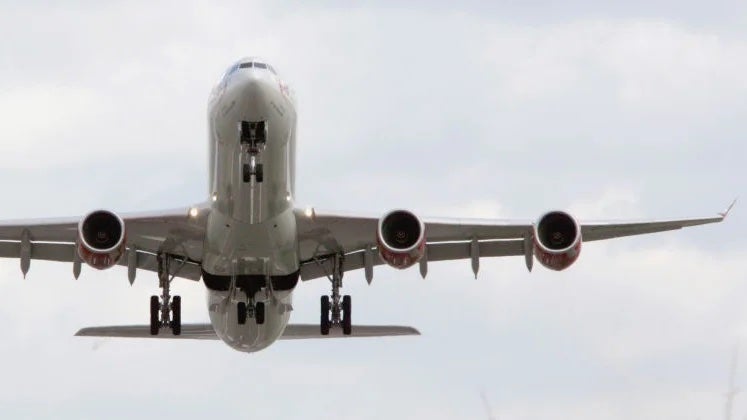
Many of us are familiar with the sensation of the takeoff run. The increased noise from the engines as the pilots start to power up is shortly followed by the rapidly increasing pitch and whine as they increase to takeoff thrust.
The thud-thud-thud of the nose wheel over the runway lights quickens as the speed increases before the rear of the aircraft sits lower, the nose rises into the air and the aircraft soars from the ground.
Just a few moments later, there's an increase in airframe noise as the gear bay doors open; a whirring of the hydraulics; a firm thump as the wheels retract into the aircraft and then the smooth quiet as the bay doors close again.
Just another normal takeoff.
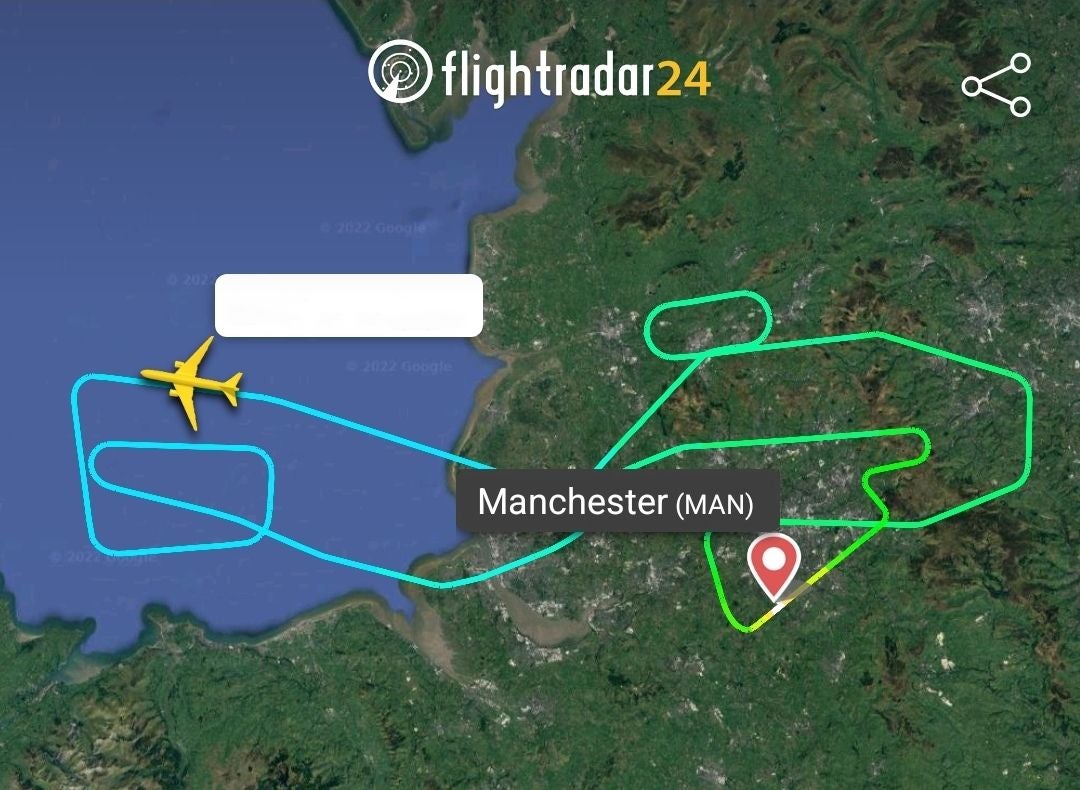
However, this week the crew of an A350 just airborne from Manchester, England, bound for Hong Kong, found out that their takeoff wasn't like the hundreds, if not thousands of takeoffs they'd done before. On selecting the gear lever to the up position, the landing gear didn't retract.
Images from Flightradar24 show the aircraft taking up a holding pattern to the north of the city and out over the Irish Sea before safely landing back at Manchester around 90 minutes later.
What could cause this to happen and what could the pilots be doing? Why didn't they just turn the aircraft around and land immediately?
As with all technical aspects of flying, there's a lot more going on behind the locked flight deck door than you might expect.
[table-of-contents /]

What should happen
Upon reaching takeoff speed (Vr) the pilot flying gently but progressively pulls back on the controls. This action deflects the elevators on the horizontal stabilizer just under the tail up into the airflow, pushing the rear of the aircraft down. This in turn raises the nose into the air.
As the speed of the plane increases — combined with the new angle of the airflow passing over the wings — the lift generated by the wings reaches a critical point where the aircraft can leave the ground.
As this happens, the pilot then retracts the landing gear to improve the aerodynamics of the aircraft. Before doing so, the pilot must be absolutely certain that it's safe to do so. To check, we use two different instruments.
First is the Instantaneous Vertical Speed Indicator, or IVSI. This instrument uses changes in air pressure to inform pilots whether the aircraft is climbing or descending. As an aircraft leaves the ground, the IVSI shows the rate of climb in feet per minute. A positive indication here shows the aircraft is climbing.
However, there can be some lag in the IVSI, so the most effective way to confirm the airplane is climbing is by using the altimeter.
Once it's confirmed that the altimeter is increasing, the co-pilot (Pilot Monitoring — PM) indicates this to the pilot (Pilot Flying — PF) by saying "positive rate." This is the cue for the PF to confirm and ask for the landing gear to be retracted.
Related: Airplane math: What pilots need to know for takeoff
At this point, the PM confirms the request and moves the landing gear lever to the up position. This simple lever — shaped like a wheel — begins the process of opening the gear bay doors, retracting the wheels and closing the landing gear doors.
Unless there's a problem.
Gear disagree
The first indication the crew would have of a problem would have been shortly after moving the gear lever to the up position. On the 787 (with which I'm more familiar than the A350), the aircraft system alerts us with a "GEAR DISAGREE" message. This means that the actual gear position disagrees with the landing gear lever position.
Understandably this will come as a slight shock so it's imperative that the PF continues to fly the aircraft safely and does not get distracted from the task at hand. It would most certainly be a good idea to engage the autopilot at this point, instructing the aircraft to follow the programmed flight path and freeing up the mental capacity to deal with the upcoming troubleshooting.
How fast and where should we go?
At this point, a good pilot will consider their speed. All aircraft have a maximum speed limit at which they can fly with the gear down. On the 787 this is a little over 310 mph. Also, flying with the gear down at high speed is incredibly noisy.
Depending on the stage of flight, the aircraft will be at different speeds. If it's just after takeoff, it will be just above the takeoff speed. If it's a few minutes later, the aircraft may be accelerating to a speed where the flaps can be retracted.
Therefore, it's important for the pilots to take a few moments at this stage to think about the speed and what they want to do about it.
Do they want to keep it slow and keep the aircraft climbing or do they wait until the aircraft is accelerating and adjust for the "flaps up" speed? There is no one size fits all answer, it's down to the crew's judgment.
In its simplest form, flying with the gear down is not much of a problem. We do the very same for several minutes on the approach to landing. As a result, there's no immediate rush to deal with it. But by flying around with the gear down, the aircraft is far less aerodynamic. This results in increased fuel burn — potentially up to double the normal rate.
This reduces the climb rate and continuing to our destination with the gear down is highly unlikely. Therefore, it's good to establish the aircraft in a holding pattern near the airport where the crew can run the checklists and come up with a plan.
Once the aircraft is flying safely with the autopilot engaged, the crew can then run the checklist.
Diagnosing the problem
On the 787, with the gear stuck down, the checklist helps ascertain the position of the three sets of landing gear — the two main sets and the nose set. All three could be stuck down, or maybe one could have retracted and the other two have not or some combination of this.
Whatever the combination, we need to determine whether we can land on all three landing gear. If not, what combination will we have?
If all three are stuck down, there's no problem. However, the most likely scenario is that the two main gears retracted and the nose gear hasn't. Why is this? It all comes back to what happens on the ground, specifically when the plane leaves the gate.
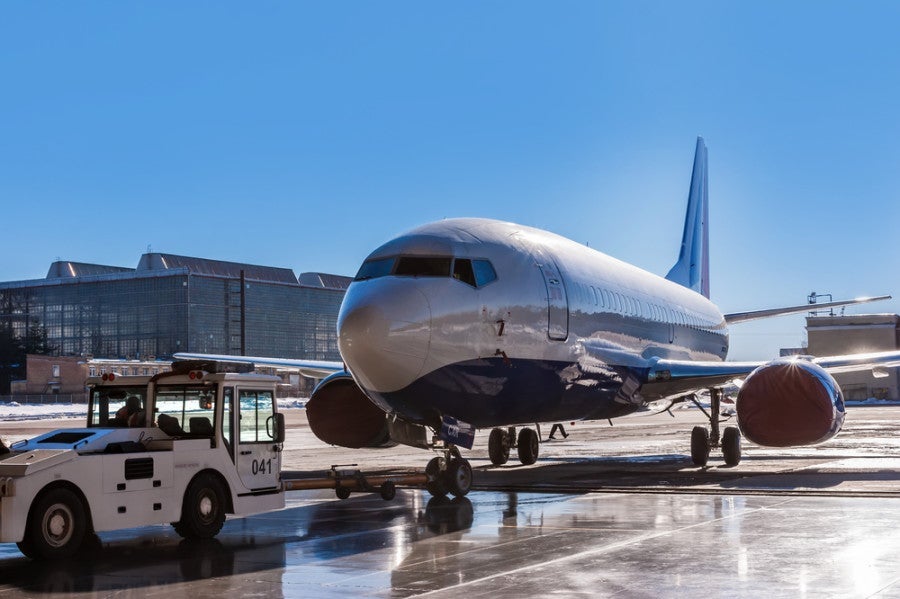
In order to move back from the gate, we require a pushback tug. These either attach a towbar to the nosewheel or actually lift the nosewheel off the ground, before pushing the aircraft back onto the taxiway.
Before attaching to the aircraft, the ground operatives insert a small pin into a slot in the nose gear. This stops the nose wheel from inadvertently retracting while the aircraft is being pushed back. Once the pushback is complete, the crew removes the pin and shows it to the pilots to confirm it has been removed, before walking clear of the aircraft.
If for some reason the ground operative forgets to remove the pin and the crew fails to notice the memo on their screens as they taxi away, a problem is brewing.
Once airborne, when they attempt to retract the gear, the two main gears retract normally. However, the nose gear, inhibited by the pin, will not move. The only way to solve this problem is to land the aircraft, remove the pin and try again.
Coming up with a plan
Before landing, pilots must consider a few things, the most important one being the weight of the aircraft.
All aircraft have published weight limitations, as determined by the manufacturer. This ensures that they are never overloaded and remain within the safe flight envelope of the airframe. One of these weights is the maximum landing weight (MLW).
Getting airborne for a long flight such as that between Manchester and Hong Kong, the aircraft will carry a considerable amount of fuel. So much so that the aircraft weight could be higher than the MLW.
While it's possible to land above MLW in a serious emergency, on its own, the landing gear being stuck down doesn't fall into this bracket. Therefore, the crew will want to reduce the aircraft's weight to its MLW before making their approach to land.
Related: How to find out everything you ever wanted to know about the plane you're flying on
To do this, they could just fly around in circles waiting for the fuel to be used up. This is what smaller aircraft, such as the A320, would do as the difference between their maximum takeoff weight (MTOW) and the MLW is quite small.
However, on larger aircraft built for long-haul, the difference can be quite large, owing to the amount of fuel needed for these longer flights.
As a result, aircraft such as the A350 and B787 have a fuel jettison system that allows pilots to rapidly empty fuel from the tanks to reduce the aircraft weight to the MLW as quickly as possible.
Jettisoning fuel
If the crew decides to jettison fuel, they will inform air traffic control (ATC). Each country has its own rules on jettisoning fuel and as a result, the aircraft may be moved to a certain area and altitude before the fuel is dumped.
The environmental aspects of fuel dumping have been closely studied by the United States Air Force. For the most part, if fuel is jettisoned above 5,000 to 6,000 feet, it will completely vaporize before reaching the ground.
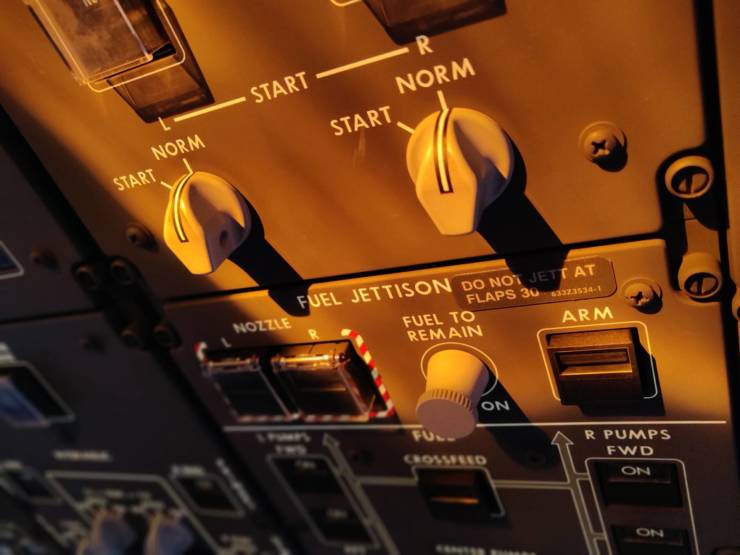
Boeing recommends that fuel jettisoning should be done above these altitudes whenever possible. That said, there is no restriction on jettisoning fuel at lower altitudes if the flight crew deems it necessary.
By following the fuel jettison checklist, the crew can reduce the aircraft weight down to the MLW or, if they need to for landing performance reasons, to an even lower weight.
Related: What is jet fuel, and how does it work?
With all this done, they are now in a position to make their approach to land.
Bottom line
The inability to retract the landing gear after takeoff is more of an inconvenience than an emergency. Even though it may initially come as a shock to the crew, taking a few moments to carefully think about how to fly the aircraft in this non-normal situation is key.
This ensures they don't get drawn into dealing with the problem while the aircraft is still close to the ground and, potentially worse, heading toward high terrain. Effective use of autopilot will reduce the workload, allowing them to diagnose the problem.
Even though the likely cause is not removing the locking pin after pushback, the crew must consider all possibilities before making their decision.
Continuing the flight to the destination with any part of the landing still extended is highly unlikely so a return landing is the most probable outcome. Of course, this comes at great cost both in time lost and fuel wasted as part of any jettison process but safety always comes first.
It may be somewhat embarrassing to return with this problem, but it's far more embarrassing to run out of fuel as a result of deciding to continue the flight.
Photo by Tim Ockenden PA Images/Getty Images.
TPG featured card

at Capital One's secure site
Terms & restrictions apply. See rates & fees.
| 5X miles | Earn 5X miles on hotels, vacation rentals and rental cars booked through Capital One Travel |
| 2X miles | Earn unlimited 2X miles on every purchase, every day |
Pros
- Stellar welcome offer of 75,000 miles after spending $4,000 on purchases in the first three months from account opening. Plus, a $250 Capital One Travel credit to use in your first cardholder year upon account opening.
- You'll earn 2 miles per dollar on every purchase, which means you won't have to worry about memorizing bonus categories
- Rewards are versatile and can be redeemed for a statement credit or transferred to Capital One’s transfer partners
Cons
- Highest bonus-earning categories only on travel booked via Capital One Travel
- LIMITED-TIME OFFER: Enjoy $250 to use on Capital One Travel in your first cardholder year, plus earn 75,000 bonus miles once you spend $4,000 on purchases within the first 3 months from account opening - that’s equal to $1,000 in travel
- Earn unlimited 2X miles on every purchase, every day
- Earn 5X miles on hotels, vacation rentals and rental cars booked through Capital One Travel
- Miles won't expire for the life of the account and there's no limit to how many you can earn
- Receive up to a $120 credit for Global Entry or TSA PreCheck®
- Use your miles to get reimbursed for any travel purchase—or redeem by booking a trip through Capital One Travel
- Enjoy a $50 experience credit and other premium benefits with every hotel and vacation rental booked from the Lifestyle Collection
- Transfer your miles to your choice of 15+ travel loyalty programs
- Top rated mobile app