Higher airfares for solo passengers? What you can do to avoid paying extra

Could flying as a solo traveler really cost you more than traveling with a friend, spouse or family member?
In recent weeks, a report from the travel website Thrifty Traveler found a handful of major U.S. airlines often charge a higher fare for passengers traveling alone than those flying in a group of two or more.
After running hundreds of airfare searches, the investigation found that these pricing tactics were common (though not widespread) on one-way domestic bookings with the three largest U.S. carriers: Delta Air Lines, United Airlines and, in particular, American Airlines.
Bargain hunting: When is the best time to book flights for the cheapest airfare?
While TPG has not independently verified the reporting, we have found similar examples of one-way flights being priced higher for solo travelers than bookings that include multiple passengers.
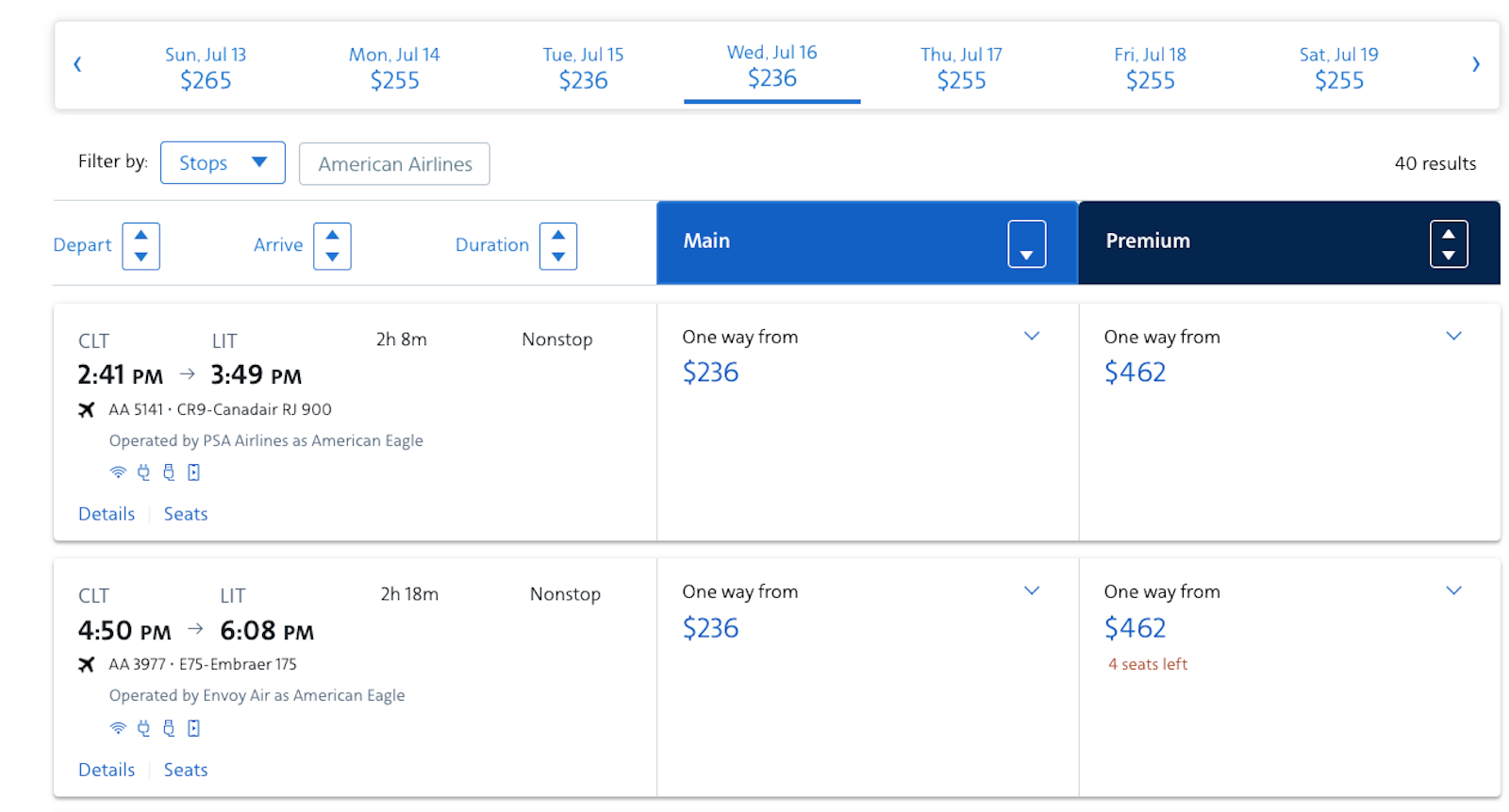
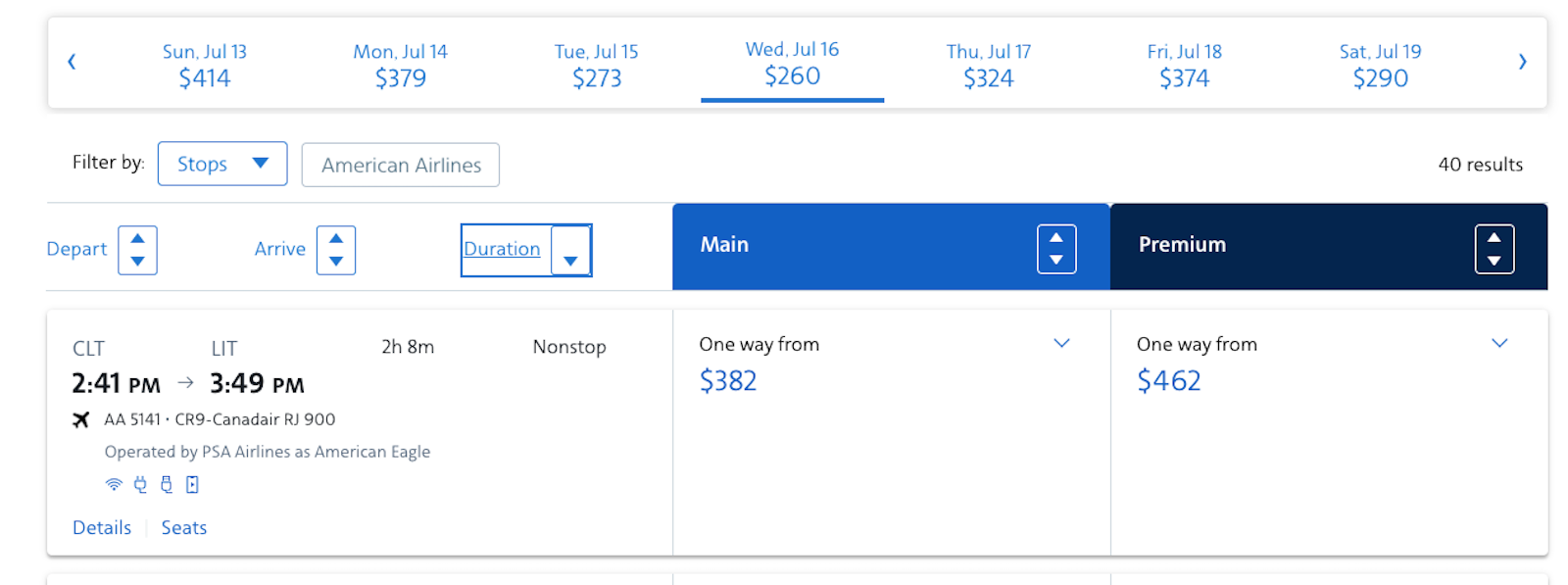
Here's one example: a July flight on American from Charlotte Douglas International Airport (CLT) to Little Rock's Bill and Hillary Clinton National Airport (LIT).
A two-person booking would cost $236 per person for a nonstop flight.
But if you're traveling alone, prices start at $260 — and that's for a nine-hour itinerary that includes a layover.
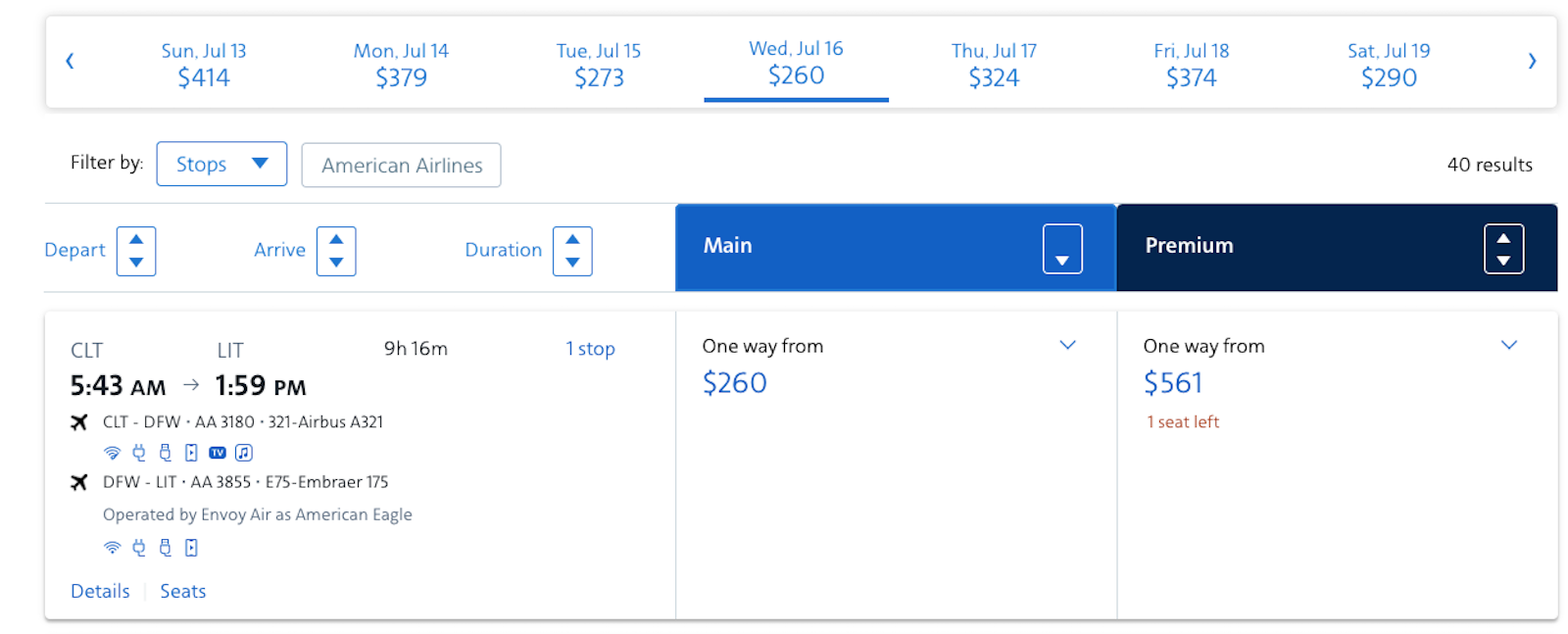
To fly nonstop, you'd have to fork over a whopping $382 — a 61% premium for the solo traveler.

What are airlines saying?
So far, airlines have remained mum on the subject.
American and United have not commented.
Delta told TPG such pricing tactics are not new to the airline or the industry, but declined to comment further.
What's really happening?
So what's really going on?
I took that question to top airfare experts, who offered a few theories.
The 'Costco' theory
One borrows the logic of bulk pricing, straight off the shelves at Costco.
"If I'm going to, say, for example, Buffalo Wild Wings, I'm paying less per wing if I buy 18 wings as opposed to if I'm buying a dozen wings," said Kerry Tan, professor of economics at Loyola University's Sellinger School of Business and Management, whose research focuses on airlines and revenue management. "So it could be a quantity discount story."
Simply put: Buying two tickets is still more expensive than buying one, but the per-ticket cost is lower.
Targeting possible business travelers
More likely, though, the experts we talked to concurred, is that carriers are seemingly blocking discounts from travelers who might possibly be flying on their company's dime.
"This is the job of the airline: trying to [see] how much you are willing to pay for the ticket," said Ahmed Abdelghany, associate dean at Embry-Riddle Aeronautical University, formerly of United. "Is it a price-sensitive guy who's paying from his own pocket, which is a leisure traveler, or, no, he's a corporate traveler?"
Former American Airlines CEO Doug Parker, who retired in 2022, pointed out that booking a trip that included a "Saturday stay" used to be a way to score a lower fare, separating the likely vacationer from the road warrior, a rule that once was a hard-and-fast truism of airfare pricing.
"You could sit next to somebody who paid $1,000 for a ticket could be sitting right next to somebody who paid $200 for a ticket," Parker said, speaking this week on the Airlines Confidential podcast. "What you're seeing now is the new way airlines have figured out to address this issue."
Swift backlash
Of course, not everyone who flies by themselves is a business traveler.
There are a number of reasons a passenger might fly solo beyond a work trip, whether they're visiting family or meeting up with a friend somewhere. And they likely wouldn't be thrilled at the prospect of paying a higher fare.
In fact, the uncovering of these apparent pricing tactics has fueled backlash in recent weeks.
"Stop this nonsense, because you are going to force regulation," TPG founder Brian Kelly urged airlines in a video shared on social media.
View this post on Instagram
He joined a chorus of other voices reacting the same way and questioning airlines' pricing transparency.
Airline tech gets more sophisticated
But there's little reason to think that more elaborate pricing tactics will end anytime soon.
While opening-and-closing fare buckets and algorithm-driven pricing have been around for decades, airlines invested historic sums of money into upgrading their tech in recent years and their systems are far more sophisticated today than ever before.
Delta, for one, recently announced it's expanding its menu of fare types to include nearly a dozen choices, each with its own combination of bags, seats and services that are either included (or not) depending on what you pick.
The Atlanta-based carrier in November also revealed it started using artificial intelligence to price a small portion of its fares.
"With more advanced technology, and with more passenger history, I think airlines are becoming better able at estimating passengers' willingness to pay," Tan said. "I'm sure you've heard of the idea of dynamic pricing. This may be another aspect to how airlines are more successfully pricing from a dynamic standpoint."
What can solo travelers do to save money?
So what should solo travelers do?
For starters, check multiple airlines before booking.
Shop around
While higher prices for solo travelers are certainly out there, it's far from a lock that you'll encounter this when you're looking to book.
We always suggest using a comparison site like Google Flights to check fares across a wide range of airlines before booking directly with your carrier of choice.
Check prices for 1 and 2 passengers
That said, it may be wise to run searches on your preferred itinerary to make sure you're not paying a higher price as an individual traveler than you would in a group. If you do encounter this tactic, you may want to try another airline.
Book a round trip (or use points!)
Thrifty Traveler's report found round-trip bookings didn't generally see the same price fluctuations between one- and multi-passenger bookings. The same was true with award bookings, so using your miles is always an option (just consult our monthly valuations to ensure you're getting the most value out of your hard-earned points).
Read more: Getting started with points, miles and credit cards to travel
Be flexible
One of the top rules of finding cheap flights is to be as flexible as you can.
While work, school and life schedules can make this easier said than done, the more airlines, airports, travel dates and departure times you're open to, the better chance you'll have at grabbing the lowest fare.
Book a changeable fare
Many of the largest U.S. airlines have dropped change fees on full-fare economy tickets, so if you can't avoid a higher fare as a solo traveler, you might try booking an itinerary you can later change — or cancel and rebook — if the price later drops.
You may not get a full refund, but you can typically put the fare difference toward a future trip.
Just note, this tactic generally won't work with basic economy fares, and can be trickier (though not impossible, these days) with the budget airlines.
What about booking a trip for two and then canceling?
Finally, what about booking a trip for two travelers and then canceling your companion's booking later?
Tread carefully.
Airlines have historically not taken kindly to crafty tactics surrounding booking flight segments you don't intend to fly, as recent controversies over so-called "skiplagging" have shown.
At a minimum, I'd suggest against using this tactic frequently.
Related reading:
- When is the best time to book flights for the cheapest airfare?
- The best airline credit cards
- What exactly are airline miles, anyway?
- 6 real-life strategies you can use when your flight is canceled or delayed
- Maximize your airfare: The best credit cards for booking flights
- The best credit cards to reach elite status
- What are points and miles worth? TPG's monthly valuations
TPG featured card

at American Express's secure site
Terms & restrictions apply. See rates & fees.
| 3X | Earn 3X Miles on Delta purchases. |
| 1X | Earn 1X Miles on all other eligible purchases. |
Pros
- Delta SkyClub access when flying Delta
- Annual companion ticket for travel on Delta (upon renewal)
- Ability to earn MQDs through spending
- Various statement credits for eligible purchases
Cons
- Steep annual fee of $650
- Other Delta cobranded cards offer superior earning categories
- Earn 100,000 Bonus Miles after you spend $6,000 or more in purchases with your new Card within the first 6 months of Card Membership and an additional 25,000 bonus miles after you make an additional $3,000 in purchases on the Card within your first 6 months, starting from the date that your account is opened. Offer Ends 04/01/2026.
- Delta SkyMiles® Reserve American Express Card Members receive 15 Visits per Medallion® Year to the Delta Sky Club® when flying Delta and can unlock an unlimited number of Visits after spending $75,000 in purchases on your Card in a calendar year. Plus, you’ll receive four One-Time Guest Passes each Medallion Year so you can share the experience with family and friends when traveling Delta together.
- Enjoy complimentary access to The Centurion® Lounge in the U.S. and select international locations (as set forth on the Centurion Lounge Website), Sidecar by The Centurion® Lounge in the U.S. (see the Centurion Lounge Website for more information on Sidecar by The Centurion® Lounge availability), and Escape Lounges when flying on a Delta flight booked with the Delta SkyMiles® Reserve American Express Card. § To access Sidecar by The Centurion® Lounge, Card Members must arrive within 90 minutes of their departing flight (including layovers). To access The Centurion® Lounge, Card Members must arrive within 3 hours of their departing flight. Effective July 8, 2026, during a layover, Card Members must arrive within 5 hours of the connecting flight.
- Receive $2,500 Medallion® Qualification Dollars with MQD Headstart each Medallion Qualification Year and earn $1 MQD for each $10 in purchases on your Delta SkyMiles® Reserve American Express Card with MQD Boost to get closer to Status next Medallion Year.
- Enjoy a Companion Certificate on a Delta First, Delta Comfort, or Delta Main round-trip flight to select destinations each year after renewal of your Card. The Companion Certificate requires payment of government-imposed taxes and fees of between $22 and $250 (for itineraries with up to four flight segments). Baggage charges and other restrictions apply. Delta Basic experiences are not eligible for this benefit.
- $240 Resy Credit: When you use your Delta SkyMiles® Reserve American Express Card for eligible purchases with U.S. Resy restaurants, you can earn up to $20 each month in statement credits. Enrollment required.
- $120 Rideshare Credit: Earn up to $10 back in statement credits each month after you use your Delta SkyMiles® Reserve American Express Card to pay for U.S. rideshare purchases with select providers. Enrollment required.
- Delta SkyMiles® Reserve American Express Card Members get 15% off when using miles to book Award Travel on Delta flights through delta.com and the Fly Delta app. Discount not applicable to partner-operated flights or to taxes and fees.
- With your Delta SkyMiles® Reserve American Express Card, receive upgrade priority over others with the same Medallion tier, product and fare experience purchased, and Million Miler milestone when you fly with Delta.
- Earn 3X Miles on Delta purchases and earn 1X Miles on all other eligible purchases.
- No Foreign Transaction Fees. Enjoy international travel without additional fees on purchases made abroad.
- $650 Annual Fee.
- Apply with confidence. Know if you're approved for a Card with no impact to your credit score. If you're approved and you choose to accept this Card, your credit score may be impacted.
- Terms Apply.
- See Rates & Fees