A classically trained journalist, Caroline Tanner covers news and travel for TPG. She is a dual-journalism graduate of Mizzou and Northwestern.
October 8, 2024 • 8 min read
The cards we feature here are from partners who compensate us when you are approved through our site, and this may impact how or where these products appear. We don't cover all available credit cards, but our analysis, reviews, and opinions are entirely from our editorial team. Terms apply to the offers listed on this page. Please view our advertising policy and product review methodology for more information.Editorial disclaimer: Opinions expressed here are the author's alone, not those of any bank, credit card issuer, airline or hotel chain, and have not been reviewed, approved or otherwise endorsed by any of these entities.
Comments
By commenting, you agree to our Community Guidelines to help create a positive space for conversation. The responses below are not provided or commissioned by the bank advertiser, our partners, or The Points Guy (“TPG”). They have not been reviewed, approved, or otherwise endorsed by any of these parties. All responses are submitted by individual contributors, and neither the bank advertiser, our partners, nor TPG are responsible for ensuring that all posts and/or questions are answered.
Related stories
Quick summary
Renting a car with a debit card is possible but often involves extra requirements such as additional deposits, multiple forms of identification and proof of insurance.
Policies for debit card rentals vary by company and location, so it's important to confirm details with your chosen branch in advance.
Debit card users may face restrictions on age, vehicle type and travel boundaries, and may be subject to credit checks or required to show return travel documentation.
Using a credit card to rent a car generally provides a smoother process, added insurance protections and access to loyalty perks.
What to consider
Debit card rentals can require deposits ranging from $200 to $850, depending on location and vehicle class.
Some rental companies set higher minimum age requirements or limit out-of-state travel and vehicle selection for debit card users.
Prepaid cards are not accepted for car rentals, and additional documentation may be needed at nonairport locations.
What you'll miss from the article
A detailed comparison of insurance coverage types and elite status perks available when renting with different payment methods.
Generated by AI with support from our editorial team.
Update: Some offers mentioned below are no longer available. View the current offers here.
If you are an elder millennial like myself and have lived in walkable cities since graduating from college, you may have never rented a car before.
I used Kyte three years ago, but before last month, I had never booked a car rental under my name.
Since I was relatively unfamiliar with the ins and outs of renting a car, I was surprised to learn that major rental car companies do not make it easy to use a debit card to rent a car.
Here's what you need to know if you want to use a debit card to rent a car.
Extra requirements to use a debit card
To start, know that the rules about renting a car with a debit card vary by both company and location, so you should call the specific rental car location and company you're hoping to use to verify their policy ahead of time.
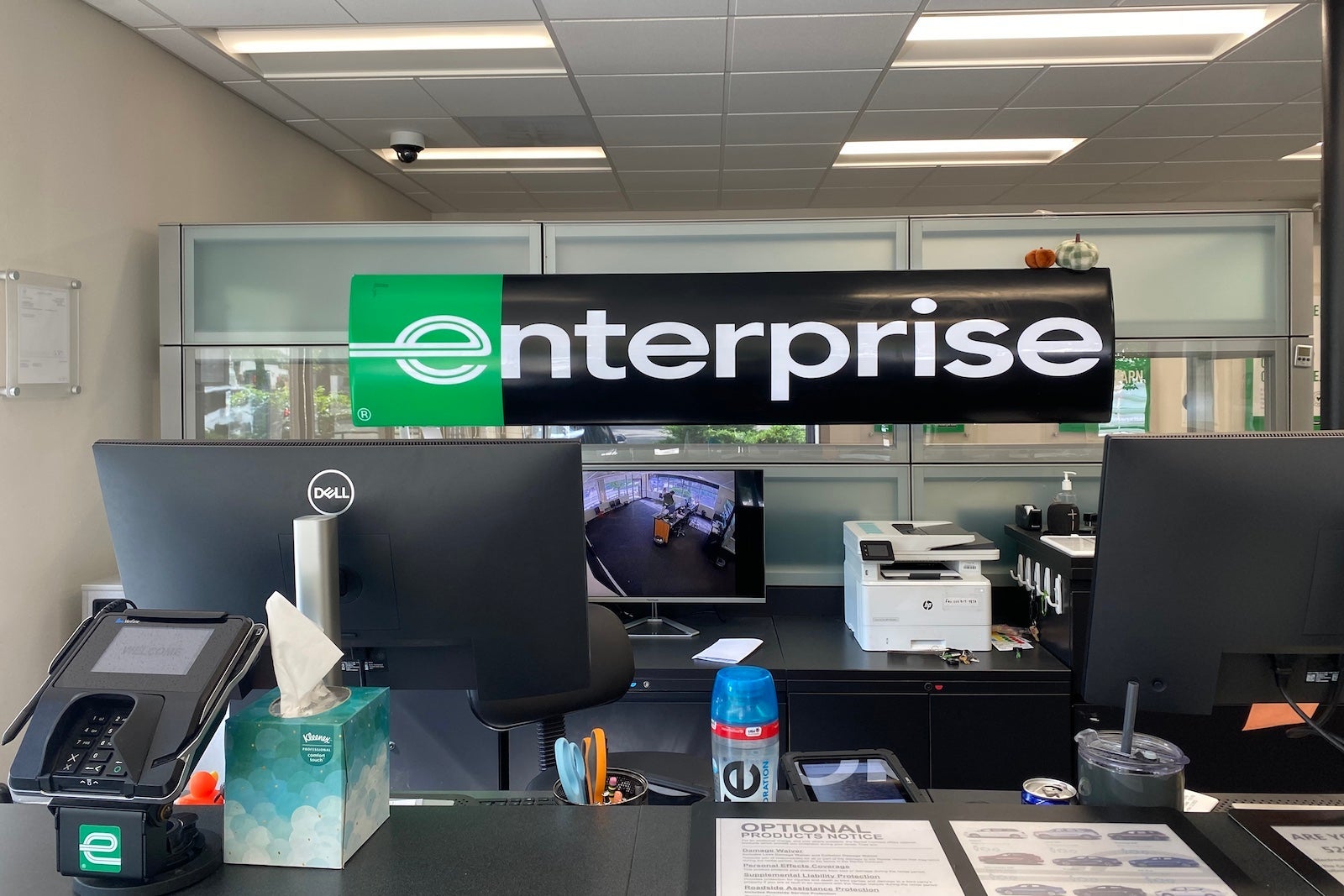
I wish I had done that rather than find out we would not be able to use a debit card to get a car at Enterprise's Seattle Lake City office.
Most major rental car companies, including Enterprise, Hertz and Budget, require at least one of the following to use a debit card:
An additional deposit
Multiple forms of identification beyond your driver's license, such as a passport or utility bill
Proof of insurance
For example, Enterprise charges debit card users a deposit of $200 to $850 at the time of rental to "account for Renter potentially incurring additional amounts owed under the rental contract." The deposit amount varies based on the rental location and vehicle class.
CAROLINE TANNER/THE POINTS GUY
Additionally, Enterprise requires debit card users at most nonairport locations to meet the following conditions:
The name and address shown on the renter’s driver’s license must match their current home address.
A renter's address must be within 50 miles of the renting branch, or the renter’s driver’s license must be from the same state where the rental branch is located.
Renters must present a utility bill with no past-due balance or disconnect notice.
Renters must present one of the following items: a cellular phone bill, paycheck or original declaration page from an active auto insurance policy. The bills must be the original bill, dated within the previous 30 days and have an address that matches the renter’s current home address.
Unless you knew about these policies beforehand, you will probably not have these documents on you during a trip. And even if you do have them with you, the extra paperwork can still make the overall process cumbersome.
You might have to jump through some more hoops, too, including undergoing a credit check before renting, and you might be required to show proof of a return ticket at some rental car companies' airport locations. It might go without saying, but rental companies will not accept prepaid cards either.
Additional restrictions: Age, location, car type
Although you can generally rent a car in the U.S. at age 21 by paying an additional “young driver” fee, some companies have upped the age for debit card rentals to 25. In addition to age, some companies prohibit debit card users from driving a rental car out of state and also restrict the types of vehicles they are eligible to rent.
More reasons to use a credit card to rent a car
As you've probably gathered by now, rental car companies do not make it easy to use a debit card. Renting a car by credit card can be more practical for a few other reasons, too.
Using the right card ensures your rental car is protected should something go wrong, such as theft, damage, injury and potential loss of life. Credit cards also generally provide higher coverage amounts than the policies offered by the rental car company. Just note that most cards offer secondary insurance for rental cars, meaning your primary coverage will be applied first.
Secondary insurance only kicks in after other types of insurance, such as travel insurance or personal car insurance, have been used. After that, secondary insurance is applied to cover any remaining expenses to be paid, such as deductibles on those other policies. Both types of insurance offer maximum coverage amounts, so be sure that the amount at least meets the total value of the car you're renting.
People with a United Club℠ Card (see rates and fees) get complimentary Avis President's Club status, which includes free upgrades of two car classes, guaranteed car availability when booking at least 24 hours in advance and expedited rental service.
Best credit cards to use to rent a car
UNIVERSAL IMAGES GROUP/GETTY IMAGES
Some of the best travel rewards cards provide car rental insurance with a collision damage waiver when you use the card to book a rental. This waiver can cover rental car accidents, theft or damage.
The following cards offer primary car rental insurance on most rentals while also offering earnings for travel purchases, making them great cards to use for rental cars:
Chase Sapphire Reserve® (see rates and fees)
Chase Sapphire Preferred® Card (see rates and fees)
Capital One Venture X Rewards Credit Card
Ink Business Preferred® Credit Card (see rates and fees)
Ink Business Cash® Credit Card (see rates and fees)
Ink Business Unlimited® Credit Card (see rates and fees)
Several of our favorite travel cards can earn you points or miles when you book car rentals through credit card travel portals, including:
Chase Sapphire Reserve: 8 points per dollar spent on all purchases through Chase Travel℠
Chase Sapphire Preferred: 2 points per dollar spent on travel purchases
Capital One Venture X: 10 miles per dollar spent on hotels and rental cars booked through Capital One Travel
Capital One Venture Rewards Credit Card: 5 miles per dollar spent on hotels, vacation rentals and rental cars booked through Capital One Travel
For Amex cards: Eligibility and benefit level varies by card. Not all vehicle types or rentals are covered, and geographic restrictions apply. Terms, conditions and limitations apply. Visit americanexpress.com/benefitsguide for details. Policies are underwritten by AMEX Assurance Company. Coverage is offered through American Express Travel Related Services Company, Inc.
Bottom line
ADAMKAZ/GETTY IMAGES
While it's possible to rent a car using a debit card, the process is much more complicated, and you don't get the perks of using a credit card, including the possibility of earning bonus points and miles.
Therefore, we recommend using one of the above credit cards to make the most of renting a car. Doing so will give you the security of knowing you have insurance while allowing you to earn points or miles for your purchase.
For Capital One products listed on this page, some of the benefits may be provided by Visa® or Mastercard® and may vary by product. See the respective Guide to Benefits for details, as terms and exclusions apply.
By commenting, you agree to our Community Guidelines to help create a positive space for conversation. The responses below are not provided or commissioned by the bank advertiser, our partners, or The Points Guy (“TPG”). They have not been reviewed, approved, or otherwise endorsed by any of these parties. All responses are submitted by individual contributors, and neither the bank advertiser, our partners, nor TPG are responsible for ensuring that all posts and/or questions are answered.