Skip to content

How Windy Does It Have to Be Before Planes Can't Take Off?

Feb. 25, 2019
5 min read
Lufthansa 747-8 JFK tower
How Windy Does It Have to Be Before Planes Can't Take Off?
The cards we feature here are from partners who compensate us when you are approved through our site, and this may impact how or where these products appear. We don’t cover all available credit cards, but our analysis, reviews, and opinions are entirely from our editorial team. Terms apply to the offers listed on this page. Please view our advertising policy and product review methodology for more information.

Severe winds have been gusting across New England and the mid-Atlantic, causing flight delays and even cancellations. At New York-JFK, pilots and airlines received this data to review during their preflight preparations:
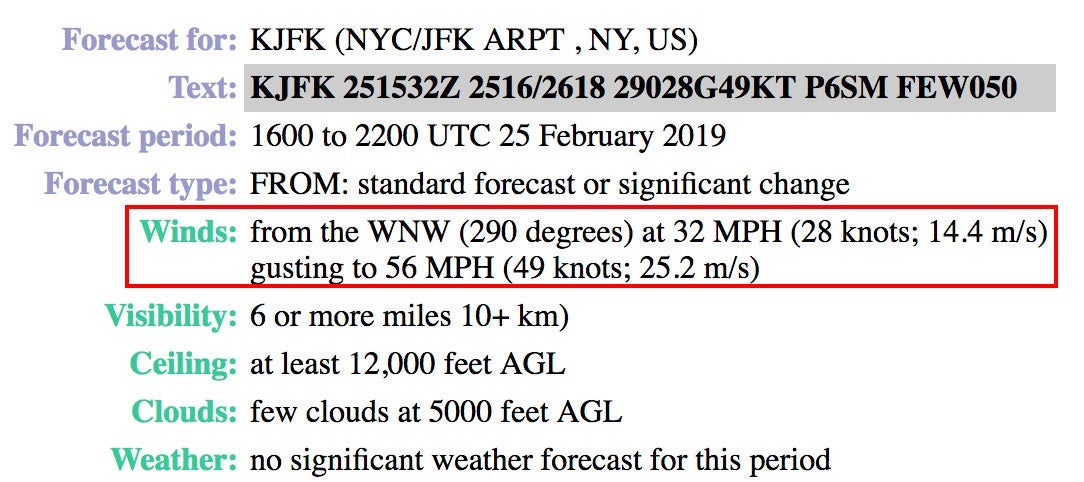
METAR information for New York-JFK. Image via AviationWeather.gov, modified by author.

The output shows plenty of visibility, blue skies and no thunderstorms (or snowstorms, for that matter). However, it's a touch windy, with gusts up to 56 miles per hour. That's going to stir up all sorts of dust and trash on the New York City streets. But for our pilots and their aircraft? It all depends on the aircraft — and the direction of the wind.

It's the Crosswinds That Pilots Look for  

The real issue with wind isn't the speed of the wind per se — it's the component of the wind that's blowing across the runway in use. Planes like to take off into the wind, because it's the only thing in aviation that's free and provides lift. When air flows over the wings, flight happens, and the wind helps with that during take off.

Runways are designed and built to point into the so-called "prevailing wind," as determined by studies observing the wind in a particular area. You'll notice that at Los Angeles (LAX), every runway is pointing toward or away from the ocean. At Chicago-O'Hare (ORD), there are enough runways for air traffic control to adjust to many possible wind orientations.

Mother Nature, however, doesn't really care. She'll put the wind any which way, and in most cases at an angle to the centerline of the runway. The angle formed between the wind and the runway centerline is defined as crosswind. And there are limits to that component, as well as to tailwinds.

Every aircraft has its own stated crosswind limitations. The Boeing 737, for example, has a maximum crosswind component of 35 knots if the runway is perfectly dry, or 15 knots if the runway is wet. The larger Boeing 777 has a maximum crosswind component of 38 knots. This doesn't necessarily mean that the pilots and airport operations teams will decide to get underway if the winds are at those limits or close to them; airlines may very well impose lower crosswind limitations below the stated manufacturer's limits.

Airports, too can impose limitations. One widely-cited airport is London City Airport (LCY). There, the runway is only around 100 feet wide, compared to 150 or 200 feet at JFK. Accordingly, the maximum acceptable crosswind component is 25 knots.

"These calculations are performed on the airplane in our flight management system," a commercial pilot for a US carrier told TPG in an email.

"We have limitations on the aircraft that can’t be exceeded. For instance, we have a limitation on my airplane that our maximum takeoff and landing tailwind component can’t exceed 10 knots. We have one for [instrument approaches in low visibility] in which the maximum crosswind component is 15 knots," the pilot said.

Daily Newsletter
Reward your inbox with the TPG Daily newsletter
Join over 700,000 readers for breaking news, in-depth guides and exclusive deals from TPG’s experts

"So, we input the weather and runway condition into the computer for the specific runway we plan to land on and the computer will come back with our landing speeds and the wind component for the runway. If it exceeds our limitations, then we don’t attempt the approach or takeoff."

Calculating Limitations 
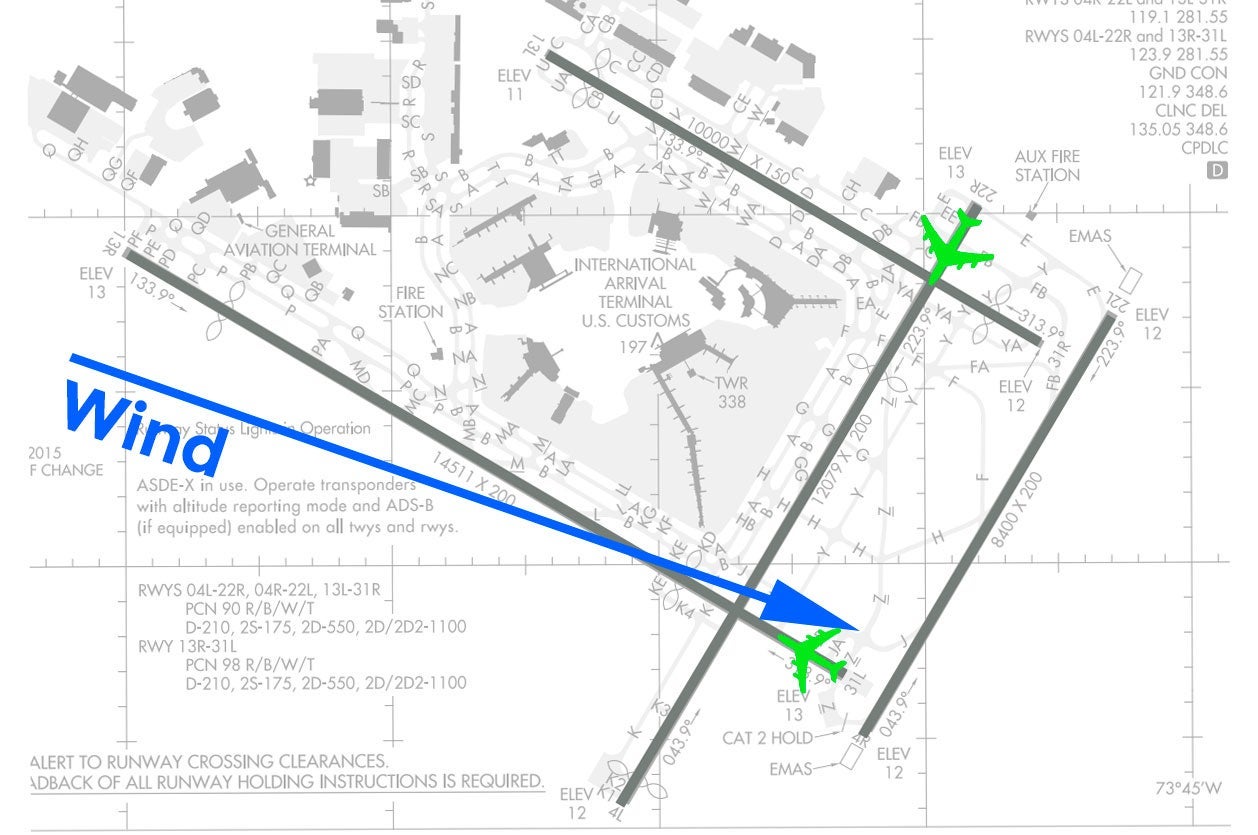
JFK Airport diagram, modified by author. North is up.

At JFK on Monday, at the time of this writing, the wind is coming from 290 degrees, and the runway in use for takeoffs is oriented to 310 degrees. (Without getting too much into the detail, the wind is displayed as a true heading, whereas the runway is oriented to a magnetic heading But I digress.)

Ignoring the gust factor for a moment, the headwind is 18 knots and the crosswind component is 10 knots. Even adding a gust factor of 49 knots — which is substantial — only 13 knots of that wind is part of a crosswind. The rest is just Mother Nature giving our aircraft more lift, more or less blowing straight down the runway. Our plane sitting at the approach end to runway 31L, at the end of the blue arrow, is ready to roll.

Now, let's say runways 31L and the parallel 31R were shut down for some reason, and the only available runway for takeoffs was runway 22R — where you see the second plane waiting to take off. That aircraft faces a crosswind component of 26 knots and a headwind of two knots — the wind is almost perpendicular and blowing hard. If you add the gust factor bringing this up to 49 knots, the cross wind component jumps to 36 knots, exceeding the limitations of the aircraft and likely far exceeding the limitations of the airline.

And what about even windier conditions?

Aircraft do have an additional limitation in terms of wind, and that is to open or close the aircraft passenger and cargo doors. Typically, the wind should not exceed 45 knots.

So why are so many New York City airports facing wind delays today? This is likely due to safety concerns for ground crew.

Mike Arnot is the founder of Boarding Pass NYC, a New York-based travel brand, and a private pilot who flies with a maximum crosswind component of only a few knots.

TPG featured card

Best for dining at restaurants
TPG Editor‘s Rating
4 / 5
Go to review
Apply for American Express® Gold Card
at American Express's secure site

Rewards

1 - 4X points

Intro offer

As High As 100,000 points. Find Out Your Offer.

Annual Fee

$325

Recommended Credit

Excellent to Good

Why We Chose It

There’s a lot to love about the Amex Gold. It’s a fan favorite thanks to its fantastic bonus-earning rates at restaurants worldwide and at U.S. supermarkets. If you’re hitting the skies soon, you’ll also earn bonus Membership Rewards points on travel. Paired with up to $120 in Uber Cash annually (for U.S. Uber rides or Uber Eats orders, card must be added to Uber app and you can redeem with any Amex card), up to $120 in annual dining statement credits to be used with eligible partners, an up to $84 Dunkin’ credit each year at U.S. Dunkin Donuts and an up to $100 Resy credit annually, there’s no reason that foodies shouldn’t add the Amex Gold to their wallet. These benefits alone are worth more than $400, which offsets the $325 annual fee on the Amex Gold card. Enrollment is required for select benefits. (Partner offer)

Pros

  • 4 points per dollar spent on dining at restaurants worldwide and U.S. supermarkets (on the first $50,000 in purchases per calendar year; then 1 point per dollar spent thereafter and $25,000 in purchases per calendar year; then 1 point per dollar spent thereafter, respectively)
  • 3 points per dollar spent on flights booked directly with the airline or with amextravel.com
  • Packed with credits foodies will enjoy
  • Solid welcome bonus

Cons

  • Not as useful for those living outside the U.S.
  • Some may have trouble using Uber and other dining credits
  • You may be eligible for as high as 100,000 Membership Rewards® Points after you spend $6,000 in eligible purchases on your new Card in your first 6 months of Card Membership. Welcome offers vary and you may not be eligible for an offer. Apply to know if you’re approved and find out your exact welcome offer amount – all with no credit score impact. If you’re approved and choose to accept the Card, your score may be impacted.
  • Earn 4X Membership Rewards® points per dollar spent on purchases at restaurants worldwide, on up to $50,000 in purchases per calendar year, then 1X points for the rest of the year.
  • Earn 4X Membership Rewards® points per dollar spent at US supermarkets, on up to $25,000 in purchases per calendar year, then 1X points for the rest of the year.
  • Earn 3X Membership Rewards® points per dollar spent on flights booked directly with airlines or on AmexTravel.com.
  • Earn 2X Membership Rewards® points per dollar spent on prepaid hotels and other eligible purchases booked on AmexTravel.com.
  • Earn 1X Membership Rewards® point per dollar spent on all other eligible purchases.
  • $120 Uber Cash on Gold: Add your Gold Card to your Uber account and get $10 in Uber Cash each month to use on orders and rides in the U.S. when you select an American Express Card for your transaction. That’s up to $120 Uber Cash annually. Plus, after using your Uber Cash, use your Card to earn 4X Membership Rewards® points for Uber Eats purchases made with restaurants or U.S. supermarkets. Point caps and terms apply.
  • $84 Dunkin' Credit: With the $84 Dunkin' Credit, you can earn up to $7 in monthly statement credits after you enroll and pay with the American Express® Gold Card at U.S. Dunkin' locations. Enrollment is required to receive this benefit.
  • $100 Resy Credit: Get up to $100 in statement credits each calendar year after you pay with the American Express® Gold Card to dine at U.S. Resy restaurants or make other eligible Resy purchases. That's up to $50 in statement credits semi-annually. Enrollment required.
  • $120 Dining Credit: Satisfy your cravings, sweet or savory, with the $120 Dining Credit. Earn up to $10 in statement credits monthly when you pay with the American Express® Gold Card at Grubhub, The Cheesecake Factory, Goldbelly, Wine.com, and Five Guys. Enrollment required.
  • Explore over 1,000 upscale hotels worldwide with The Hotel Collection and receive a $100 credit towards eligible charges* with every booking of two nights or more through AmexTravel.com. *Eligible charges vary by property.
  • No Foreign Transaction Fees.
  • Annual Fee is $325.
  • Terms Apply.
Apply for American Express® Gold Card
at American Express's secure site
Terms & restrictions apply. See rates & fees
Best for dining at restaurants
TPG Editor‘s Rating
4 / 5
Go to review

Rewards Rate

4XEarn 4X Membership Rewards® points per dollar spent on purchases at restaurants worldwide, on up to $50,000 in purchases per calendar year, then 1X points for the rest of the year.
4XEarn 4X Membership Rewards® points per dollar spent at US supermarkets, on up to $25,000 in purchases per calendar year, then 1X points for the rest of the year.
3XEarn 3X Membership Rewards® points per dollar spent on flights booked directly with airlines or on AmexTravel.com.
2XEarn 2X Membership Rewards® points per dollar spent on prepaid hotels and other eligible purchases booked on AmexTravel.com.
1XEarn 1X Membership Rewards® point per dollar spent on all other eligible purchases.
  • Intro Offer

    As High As 100,000 points. Find Out Your Offer.
  • Annual Fee

    $325
  • Recommended Credit

    Excellent to Good

Why We Chose It

There’s a lot to love about the Amex Gold. It’s a fan favorite thanks to its fantastic bonus-earning rates at restaurants worldwide and at U.S. supermarkets. If you’re hitting the skies soon, you’ll also earn bonus Membership Rewards points on travel. Paired with up to $120 in Uber Cash annually (for U.S. Uber rides or Uber Eats orders, card must be added to Uber app and you can redeem with any Amex card), up to $120 in annual dining statement credits to be used with eligible partners, an up to $84 Dunkin’ credit each year at U.S. Dunkin Donuts and an up to $100 Resy credit annually, there’s no reason that foodies shouldn’t add the Amex Gold to their wallet. These benefits alone are worth more than $400, which offsets the $325 annual fee on the Amex Gold card. Enrollment is required for select benefits. (Partner offer)

Pros

  • 4 points per dollar spent on dining at restaurants worldwide and U.S. supermarkets (on the first $50,000 in purchases per calendar year; then 1 point per dollar spent thereafter and $25,000 in purchases per calendar year; then 1 point per dollar spent thereafter, respectively)
  • 3 points per dollar spent on flights booked directly with the airline or with amextravel.com
  • Packed with credits foodies will enjoy
  • Solid welcome bonus

Cons

  • Not as useful for those living outside the U.S.
  • Some may have trouble using Uber and other dining credits
  • You may be eligible for as high as 100,000 Membership Rewards® Points after you spend $6,000 in eligible purchases on your new Card in your first 6 months of Card Membership. Welcome offers vary and you may not be eligible for an offer. Apply to know if you’re approved and find out your exact welcome offer amount – all with no credit score impact. If you’re approved and choose to accept the Card, your score may be impacted.
  • Earn 4X Membership Rewards® points per dollar spent on purchases at restaurants worldwide, on up to $50,000 in purchases per calendar year, then 1X points for the rest of the year.
  • Earn 4X Membership Rewards® points per dollar spent at US supermarkets, on up to $25,000 in purchases per calendar year, then 1X points for the rest of the year.
  • Earn 3X Membership Rewards® points per dollar spent on flights booked directly with airlines or on AmexTravel.com.
  • Earn 2X Membership Rewards® points per dollar spent on prepaid hotels and other eligible purchases booked on AmexTravel.com.
  • Earn 1X Membership Rewards® point per dollar spent on all other eligible purchases.
  • $120 Uber Cash on Gold: Add your Gold Card to your Uber account and get $10 in Uber Cash each month to use on orders and rides in the U.S. when you select an American Express Card for your transaction. That’s up to $120 Uber Cash annually. Plus, after using your Uber Cash, use your Card to earn 4X Membership Rewards® points for Uber Eats purchases made with restaurants or U.S. supermarkets. Point caps and terms apply.
  • $84 Dunkin' Credit: With the $84 Dunkin' Credit, you can earn up to $7 in monthly statement credits after you enroll and pay with the American Express® Gold Card at U.S. Dunkin' locations. Enrollment is required to receive this benefit.
  • $100 Resy Credit: Get up to $100 in statement credits each calendar year after you pay with the American Express® Gold Card to dine at U.S. Resy restaurants or make other eligible Resy purchases. That's up to $50 in statement credits semi-annually. Enrollment required.
  • $120 Dining Credit: Satisfy your cravings, sweet or savory, with the $120 Dining Credit. Earn up to $10 in statement credits monthly when you pay with the American Express® Gold Card at Grubhub, The Cheesecake Factory, Goldbelly, Wine.com, and Five Guys. Enrollment required.
  • Explore over 1,000 upscale hotels worldwide with The Hotel Collection and receive a $100 credit towards eligible charges* with every booking of two nights or more through AmexTravel.com. *Eligible charges vary by property.
  • No Foreign Transaction Fees.
  • Annual Fee is $325.
  • Terms Apply.