The FAA has a plan to reduce delays at New York airports this summer — here's what it means for travelers

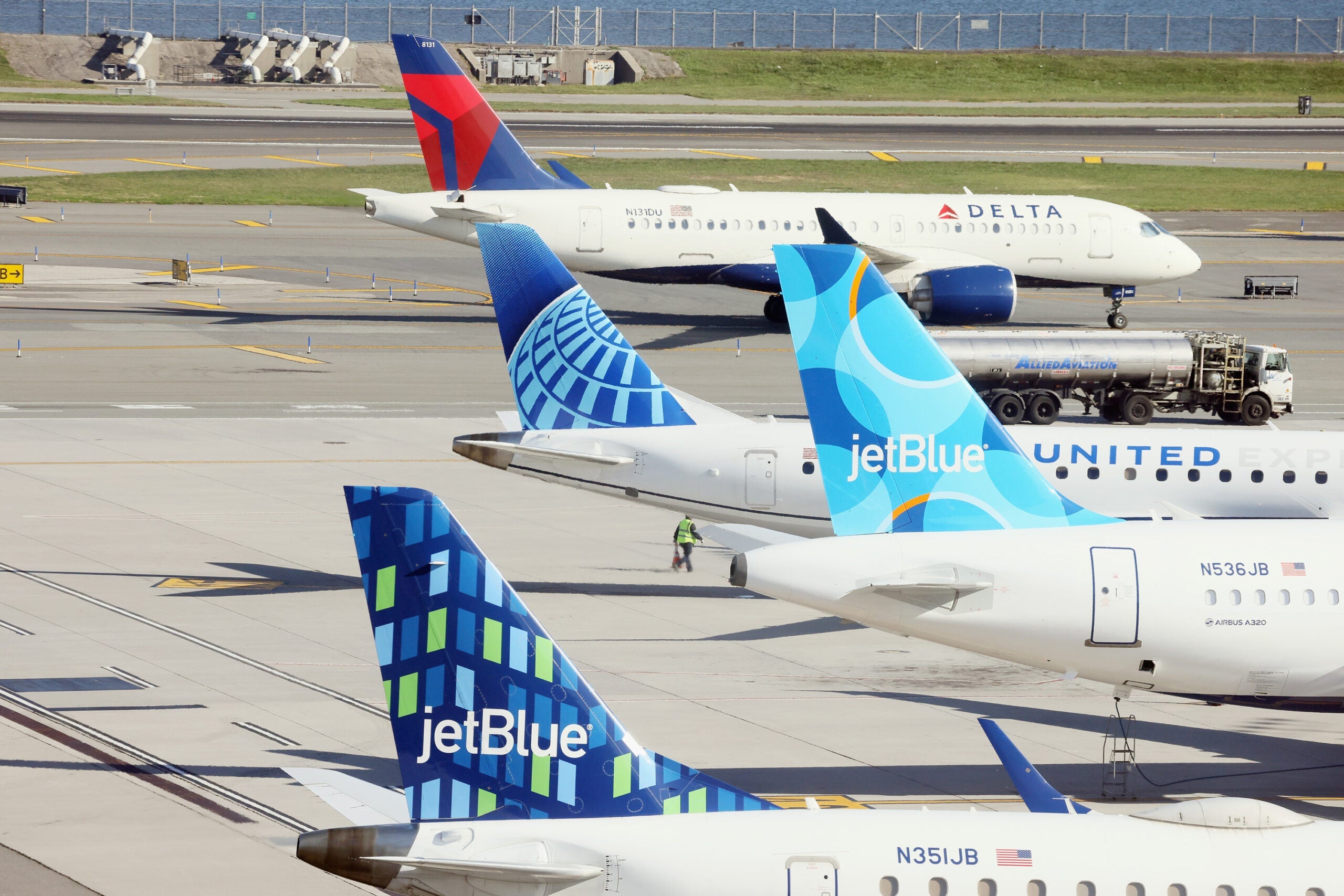
A change to a longstanding Federal Aviation Administration policy may help clear up congestion in the skies over New York City this summer. It will mitigate delays and help airlines better handle thunderstorms and mechanical issues. However, that might come at the expense of a greater flight choice.
The FAA said this week that it would allow airlines to reduce the number of flights they operate from certain "slot-controlled" airports over the summer without permanently surrendering the valuable takeoff and landing slots. The agency cited ongoing shortages of air traffic controllers, which contributed to delays throughout last summer.
How do airport 'slots' work?
"Slots" are essentially "rights" for an airline to operate at certain high-volume airports. Each slot an airline possesses gives it the right to operate one takeoff or landing. A "slot pair" refers to one arrival and one departure slot. The slot system regulates air traffic flow and prevents dangerous overcrowding at airports. It also prevents anti-competitive entrenchment by carriers.
In the U.S., there are three slot-controlled airports: John F. Kennedy International Airport (JFK), LaGuardia Airport (LGA) and Ronald Reagan Washington National Airport (DCA).
A fourth — Newark Liberty International Airport (EWR) — is considered "schedule controlled" instead. This is a similar system with several minor differences. Unless an airport builds a new runway or otherwise finds a way to increase capacity — further optimizing air traffic control patterns, for instance — the number of slots is finite, and all slots are governed by the FAA.
Understanding slots: The little-understood government rule that allows airlines to dominate certain airports
To prevent airlines from hoarding slots that they don't actually plan to use in order to shoulder out the competition, the FAA enforces a "use it or lose it" rule. Airlines must use each slot at least 80% of the time. Otherwise, the FAA can revoke the slot and give it to another airline.
Voluntary slot returns to combat air traffic control short-staffing
Because of the 80% rule, airlines typically make full use of their slots, occasionally leasing them to other airlines if they can't find a valuable use for them. During slow periods or market changes, airlines have been known to operate unprofitable or unnecessary flights just to avoid losing slots that they expect to need at a later point. This practice is sometimes referred to as "squatting" on slots.
For instance, an airline might run 16 daily flights between a pair of cities like New York and Washington, even though there may only be enough demand to fill 10 flights per day.

The FAA said that it expects airlines to operate roughly 7% more flights to and from New York this summer compared to last year.
Meanwhile, the New York-area air traffic control facility is only staffed at 54% of its ideal level. (Nationally, federal air traffic control centers average roughly 81% of optimal staffing levels, the agency said.) The agency plans to reassign control of the busy airspace around Newark to a control facility in Philadelphia to reduce the workload on the overtaxed New York facility. Still, that shift will not be complete until after the summer.
The combination of more flights and an overtaxed air traffic control center is projected to increase delays by 45%. This would have cascading ripple effects through the entire country's airspace.
Related: American Airlines forgot it had landing slots at JFK. Then it lost some of them
To avoid that, the agency said it would give airlines the flexibility to consolidate flight frequencies — which could involve using larger planes for some of the flights — without worrying about losing slots.
Under the plan, airlines could voluntarily shelve up to 10% of their slots from May 15 through Sept. 15, the FAA said. The agency set an April 30 deadline for airlines to choose whether to take advantage of the program.
DCA is included in the program because airlines will likely choose to consolidate flights between New York-area airports and Washington, the FAA said.
How will the slot waiver affect summer travel?
Ideally, if the major airlines can consolidate enough flights and frequencies to maximize the FAA's waiver, the airspace above New York will be less congested this summer. Both airlines and air traffic controllers will have an easier time getting things back on track after unavoidable disruptions like thunderstorms.
However, it could potentially mean that airlines cut frequencies or entire routes that travelers have come to rely on.
Both Delta Air Lines and United Airlines said they would try to return 10% of their slots for the summer while consolidating operations. The airlines said they would upgauge flights to larger aircraft as much as possible and proactively work to accommodate any customers affected by the changes. They also said that, to whatever extent possible, they would use their freed-up DCA slots to fly to destinations other than New York for the summer.
"We are prepared to do our part," Delta chief of operations John Laughter wrote to the FAA in a March 21 letter.
In a letter dated March 22, American Airlines wrote that it was still assessing whether or not to seek the waiver. The letter said the carrier recognized that scaling back its New York operations would "improve airspace conditions and the customer experience in the broader New York region, which has nationwide benefits."
But it's hard to predict which specific scheduled flights will be affected, according to Henry Harteveldt, a travel and airline industry analyst and founder of Atmosphere Research.
"I think the airlines will look to cut flights where they have a reasonable level of frequency and where perhaps cutting one or two flights may not affect their competitiveness and would also not inconvenience passengers too much," Harteveldt said.
Additionally, Harteveldt said that airlines would likely cut routes that have typically performed poorly.
Slots and competition: Anti-competitive or pro-consumer? American, JetBlue square off with DOJ in antitrust trial
"Airlines have already shown that they're willing to drop certain markets altogether because of high operating costs," he said. "But these are flights to destinations where the profitability performance, or the contribution to airlines' overall traffic and system revenue, is marginal."
The potential good news for travelers living in or flying to smaller markets in the U.S. is that carriers won't likely want to eliminate service as part of the waiver, at least to the extent possible, Harteveldt said.
"I think the airlines are going to try to find the right balance here," he said. "And if you're running seven or eight or more flights a day from one of these airports to another destination, maybe dropping some of those flights is better than dropping flights to a regional destination where you may be their only air service, or where there may be other factors to consider."
With airlines' proposals to the FAA due April 30, it will likely be at least a few weeks before changes are reflected in the airlines' published schedules. TPG frequently reports on airline schedule changes, so check back in the coming weeks as the slot waivers are finalized.
TPG featured card
at American Express's secure site
Terms & restrictions apply. See rates & fees.
| 4X | Earn 4X Membership Rewards® points per dollar spent on purchases at restaurants worldwide, on up to $50,000 in purchases per calendar year, then 1X points for the rest of the year. |
| 4X | Earn 4X Membership Rewards® points per dollar spent at US supermarkets, on up to $25,000 in purchases per calendar year, then 1X points for the rest of the year. |
| 5X | Earn 5X Membership Rewards® points on prepaid hotel stays booked through AmexTravel.com or the Amex Travel App™. |
| 3X | Earn 3X Membership Rewards® points on flights booked through AmexTravel.com, the Amex Travel App™, or purchased directly from airlines. |
| 2X | Earn 2X Membership Rewards® points on prepaid car rentals booked through AmexTravel.com or the Amex Travel App™ and cruises booked and paid through AmexTravel.com. |
| 1X | Earn 1X Membership Rewards® point per dollar spent on all other eligible purchases. |
Pros
- Valuable dining and food-related credits
- Flexible rewards with airline and hotel transfer partners
- Multiple travel and purchase protections
- No foreign transaction fees
- Access to Amex Offers for additional savings (enrollment required)
Cons
- Not as useful for those living outside the U.S.
- Some may have trouble using Uber and other dining credits
- You may be eligible for as high as 100,000 Membership Rewards® Points after you spend $8,000 in eligible purchases on your new Card in your first 6 months of Card Membership. Welcome offers vary and you may not be eligible for an offer. Apply to know if you’re approved and find out your exact welcome offer amount – all with no credit score impact. If you’re approved and choose to accept the Card, your score may be impacted.
- Earn 4X Membership Rewards® points per dollar spent on purchases at restaurants worldwide, on up to $50,000 in purchases per calendar year, then 1X points for the rest of the year.
- Earn 4X Membership Rewards® points per dollar spent at US supermarkets, on up to $25,000 in purchases per calendar year, then 1X points for the rest of the year.
- Earn 5X Membership Rewards® points on prepaid hotel stays booked through AmexTravel.com or the Amex Travel App™.
- Earn 3X Membership Rewards® points on flights booked through AmexTravel.com, the Amex Travel App™, or purchased directly from airlines.
- Earn 2X Membership Rewards® points on prepaid car rentals booked through AmexTravel.com or the Amex Travel App™ and cruises booked and paid through AmexTravel.com.
- Earn 1X Membership Rewards® point per dollar spent on all other eligible purchases.
- Pay It® lets you tap in the American Express® App to quickly pay for small purchase amounts throughout the month and still earn rewards the way you usually do. Plan It® gives you the option to split up big purchases into equal monthly payments with a fixed fee. You’ll know upfront exactly how much you’ll pay.
- $120 Dining Credit: Earn up to a total of $10 in statement credits monthly when you pay with the Gold Card at Grubhub (including Seamless), Buffalo Wild Wings, Five Guys, The Cheesecake Factory, and Wonder. This can be an annual savings of up to $120. Enrollment required.
- $100 Resy Credit: Get up to $100 in statement credits each calendar year at over 10,000 qualifying U.S. Resy restaurants after you pay for eligible purchases with the American Express® Gold Card. That’s up to $50 in statement credits semi-annually. Enrollment required.
- $84 Dunkin' Credit: Earn up to $7 in monthly statement credits after you pay with the American Express® Gold Card at U.S. Dunkin’ locations. Enrollment required.
- $120 Uber Cash on Gold: Enjoy up to $120 in Uber Cash annually with your Gold Card. Just add your Card to your Uber account and you'll get $10 in Uber Cash each month to use on orders and rides in the U.S. when you select an Amex Card for your transaction.
- Enjoy complimentary Hertz Five Star® Status benefits like skipping the counter at select locations, adding an additional driver at no additional cost*, and vehicle upgrades**. Benefit enrollment and Hertz Gold+ registration are required. *Additional drivers must meet standard rental qualifications and must be a spouse or domestic partner to qualify as complimentary. Other additional drivers subject to fees. **Benefits are subject to availability and vary by location. Additional Hertz program Terms and Conditions including age restrictions apply.
- Book two nights or more with The Hotel Collection through AmexTravel.com or the Amex Travel App™ and receive a $100* credit towards eligible charges at over 1,400 upscale hotels worldwide. *Eligible charges vary by property.
- Book your travel through the Amex Travel App™ with added peace of mind – backed by American Express® service and support. Only for American Express® Card Members.
- Whenever you need us, we're here. Our Member Services team will ensure you are taken care of. From lost Card replacement to statement questions, we are available to help 24/7.
- No Foreign Transaction Fees.
- Annual Fee is $325.
- Terms Apply.