
Every major U.S. airline now requires a face-covering be worn during flight. Some carriers have extended the requirement to the end-to-end travel journey — from check-in to baggage claim.
More recently, most carriers have stepped up enforcement of their mask policies, too. American and Southwest won't let anyone board without a mask, even if you have a valid medical condition that precludes you from wearing one. Plus, those carriers require masks for everyone above the age of two.
Delta, on the other hand, requires a pre-flight medical screening with the airline's doctors to determine if you qualify for an exemption. And young children are exempt from the mask requirement.
Sign up for the free daily TPG newsletter for more airline news!
But until now, airlines haven't defined what exactly constitutes a face-covering. As long as your preferred mask covers your nose and mouth, you'll satisfy the requirement. (Of course, our favorite masks are the TPG-branded ones.)
But as of Saturday, July 25, not every type of mask will fly with Delta.
Specifically, the carrier will no longer allow flyers to wear masks with exhaust valves. Per an update to the Delta mask policy, "Any mask with an exhaust valve is not approved as an acceptable face mask for customers traveling on any Delta operated flight."

As a Delta spokesperson further explains,
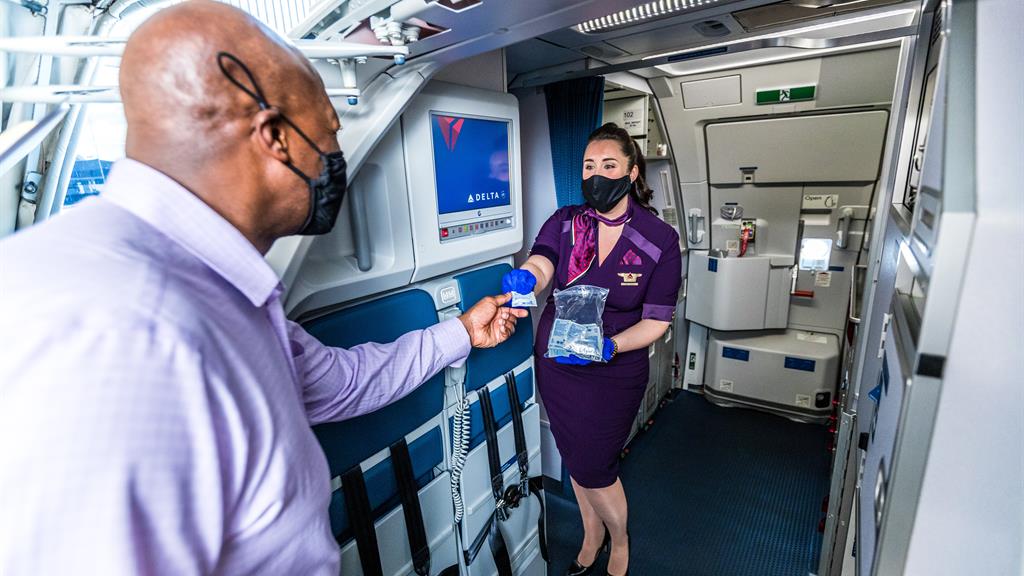
The latest guidance, informed by the many conversations we are having with health officials and other experts, is that face coverings and masks without vents work best for everyone’s safety. Delta has plenty of complimentary masks without vents for our customers at airports who may need one.
Some masks, such as the industrial N95 respirators, have valves that emit exhaust from the mask. These face-coverings protect the person wearing it, but don't help protect others around you.
Related: Your guide to the best face masks for flying
As Zach Honig, TPG's Editor at Large illustrates below, the exhaust from the mask flows freely into the environment, which doesn't help protect others from your sneezes or coughs.
Delta's move to ban these types of masks makes sense — and will hopefully be adopted by other carriers soon.
Planes are tight spaces. Even with hospital-grade HEPA filters, the mask policy helps limit the spread of respiratory droplets that can carry the coronavirus. But by wearing a mask with a built-in valve, flyers could unintentionally be spreading the virus to others.
Related: Everything you need to know about airplane HEPA filters
If you plan to fly with Delta (or any other carrier really), you should avoid wearing this type of mask. If you don't have a suitable alternative, you won't be allowed to fly with Delta.
Delta's also been enforcing the policy quite strictly. It's banned over 120 flyers for failure to abide by the policy. These flyers placed on the no-fly list won't be able to board a Delta flight for the duration of the mask requirement.
In addition, as of July 29, Delta will require all passengers to complete a health acknowledgment form before check-in that includes a question about whether you're going to wear a mask throughout the end-to-end travel journey.
Related: Delta's banned more than 100 passengers for not wearing masks
Masks are just one of the many steps Delta's taking to promote a safe environment onboard. It’s capping the capacity of its flights, cleaning planes at each turn and modifying inflight service protocols. In fact, the Atlanta-based carrier's overall response to the coronavirus has truly been the best in the industry. TPG awarded Delta with the award for the best U.S. airline of 2020 based on its response.
And today's move further highlights that Delta's not taking any chances with onboard safety.