Delta's premium-revenue focus means it could soon get harder to snag a free upgrade — but cheaper to buy one


Delta doesn't want you to get a free upgrade.
That's not to say the airline wants its loyal elite passengers crammed into a middle seat in the back of the plane. Instead, it wants to see its frequent flyers — the road warriors who chase the next level of status for benefits like extra legroom and last-minute free upgrades — pay to fly up front.
The challenge: How to make that happen without pricing people out.
That's the message that Delta delivered during its annual investor's day event in New York last week. Airlines typically use the investor days to detail their performance over the past year, share insights gleaned from the rapidly changing air travel market, and discuss the company's plan for the coming years.
How Delta views its premium seats was one of the more interesting topics to arise from this year's event.
It's not just the road warriors Delta wants to buy those first-class seats, however. It's also a new segment that grew markedly during the pandemic, particularly over the last year.
"What is so interesting is that consumer high-value leisure actually grew during the pandemic," Delta president Glen Hauenstein said. "So, when you look at this and say consumer travel demand is 100% restored, what's leading that ... is high-value leisure."
Part of the strategy, which Delta began to plot in 2011, is to essentially hook customers on the added space and service. Seventy percent of customers who fly in a premium seat will buy a premium ticket again in the future, Hauenstein said. That can add up to billions of dollars in new revenue streams.
"When we add the component of domestic and international high-value leisure — and this is, of course, revenue that we didn't have in 2019," Hauenstein said, "and you put those together, that's about $2 billion to $3 billion of additional high-value leisure travel that is now in our base."

That $2 billion to $3 billion comes from purchases of things like first- and business-class tickets, premium economy or extra-legroom coach seats, upgrades and lounge access. It's counted separately from the ancillary revenue associated with standard coach seats (like checked bag fees).
About 33% of the airline's revenue will come from premium products this year, Hauenstein said, compared to 24% in 2014. By 2024, Delta estimates that share to reach 36%.
"This has been a huge evolution for us," Hauenstein said.
The airline also wants business travelers to pay up for better seats. While business class remains out of the question for many companies, premium economy on long-haul flights presents a decent option.
Aside from that, many companies are considering more generous travel policies in order to attract talent, Bastian and Hauenstein said.
More: A Suite Ride to China: Delta One on the Brand-New A330-900neo
"I think you're seeing in this very tight labor market is that companies who are hiring people who they know will be traveling quite often realize that to attract top talent, they have to make their products more competitive," Hauenstein said.
Bastian said that by pricing strategically, the airline can increase the number of customers who buy up to a premium fares class – and change from decades past where first class was sometimes several times more expensive. "[Y]ou don't see the step change, massive retail changes that we used to have in the first structure, they're reachable," he added.
Already, the airline has seen success with premium economy, which it brands as Premium Select. It's currently available on about 40% of Delta's international flights, Hauenstein said, and consistently sees load factors in the 70%-to-80% range.
The key is making sure that while premium prices are high enough to differentiate the products and produce strong yields, they're still reasonable enough for individuals and companies to be willing to pay them.
For premium economy, for instance, that's meant about double the average coach fare, Hauenstein said.
As it finds that balance, that means Delta will continue to see more of its premium seats sell ahead of time — which could also mean that fewer are available as upgrades, even for top-tier elites.
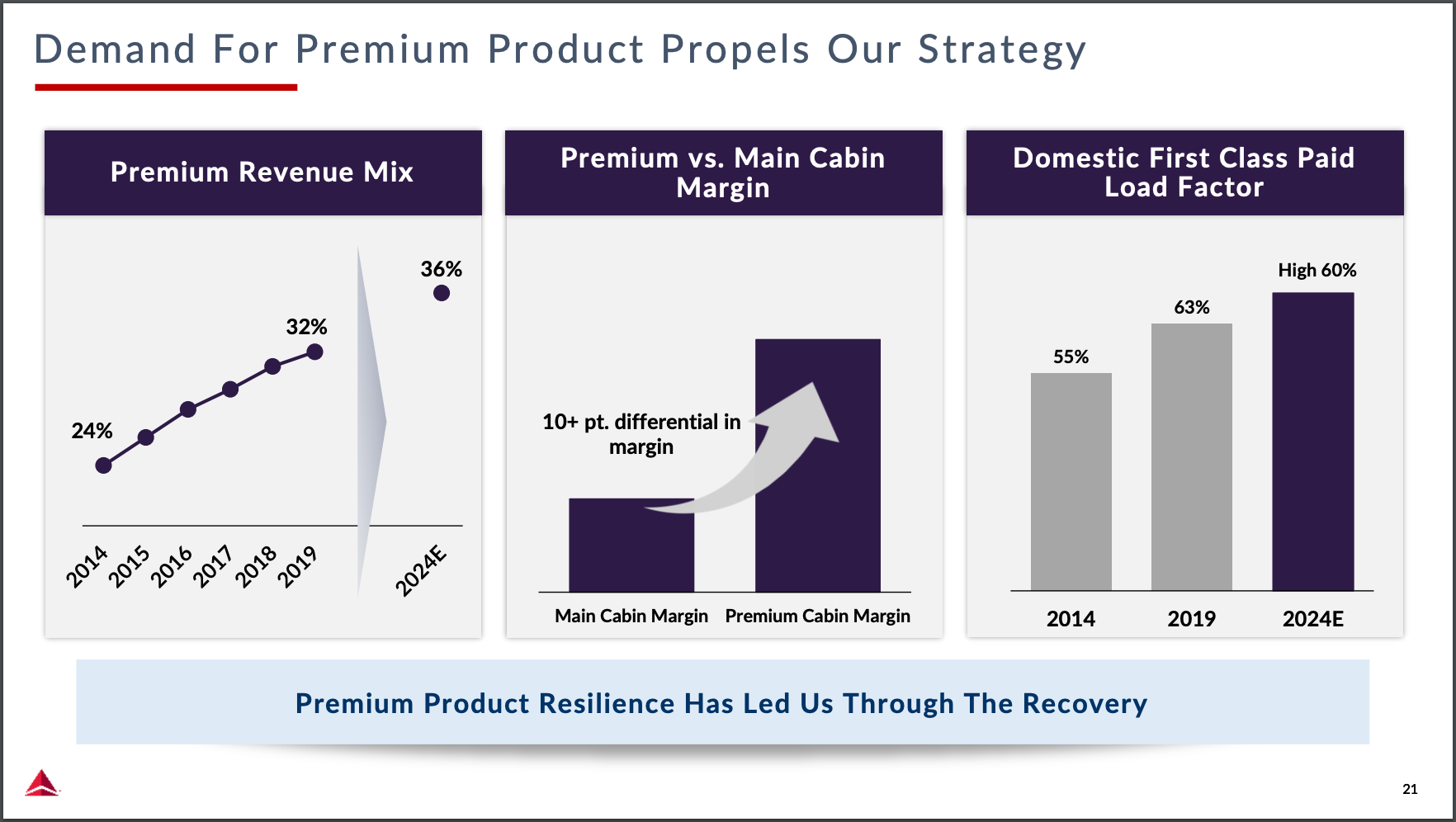
In 2019, the last full year before the pandemic, Delta saw paid load factors averaging 63% in its domestic first class cabins, up from 55% in 2014 and just 13% in 2011. That means that 37% of seats, on average, were left available for upgrades.
By 2024, Delta estimates load factors in the high-60% range, which would mean as few as 30% of seats available as upgrades.
The good news for elites, Hauenstein said, is that the airline plans to add premium seats to its aircraft, meaning the overall number of seats available will increase.
Plus, in the airline's ideal scenario, passengers could look into paying for an upgrade — either using cash or miles — and find that it's not as expensive as they expected.
The airline has already seen over the last several years that passengers hoping to sit up front who found "better price points and more ability to see what products they were buying were happy to pay to confirm their seat at time of purchase," rather than playing what Hauenstein referred to as "the great lottery" for upgrades.
Still, free upgrades remain a valuable perk that the airline uses to attract and retain its top spenders, so it will have to balance the push for premium with the risk of driving those customers to a competitor, which may have lower yields, but may also have more open first class seats.
TPG featured card

at Capital One's secure site
Terms & restrictions apply. See rates & fees.
| 5X miles | Earn 5X miles on hotels, vacation rentals and rental cars booked through Capital One Travel |
| 2X miles | Earn unlimited 2X miles on every purchase, every day |
Pros
- Stellar welcome offer of 75,000 miles after spending $4,000 on purchases in the first three months from account opening. Plus, a $250 Capital One Travel credit to use in your first cardholder year upon account opening.
- You'll earn 2 miles per dollar on every purchase, which means you won't have to worry about memorizing bonus categories
- Rewards are versatile and can be redeemed for a statement credit or transferred to Capital One’s transfer partners
Cons
- Highest bonus-earning categories only on travel booked via Capital One Travel
- LIMITED-TIME OFFER: Enjoy $250 to use on Capital One Travel in your first cardholder year, plus earn 75,000 bonus miles once you spend $4,000 on purchases within the first 3 months from account opening - that’s equal to $1,000 in travel
- Earn unlimited 2X miles on every purchase, every day
- Earn 5X miles on hotels, vacation rentals and rental cars booked through Capital One Travel
- Miles won't expire for the life of the account and there's no limit to how many you can earn
- Receive up to a $120 credit for Global Entry or TSA PreCheck®
- Use your miles to get reimbursed for any travel purchase—or redeem by booking a trip through Capital One Travel
- Enjoy a $50 experience credit and other premium benefits with every hotel and vacation rental booked from the Lifestyle Collection
- Transfer your miles to your choice of 15+ travel loyalty programs
- Top rated mobile app