How to avoid long lines at US Customs in 11 coronavirus 'screener airports'

Update: Some offers mentioned below are no longer available. View the current offers here.
The deadly Wuhan coronavirus has been rapidly spreading around the world, with more than 24,000 confirmed cases and nearly 500 fatalities. Last week, the World Health Organization declared it a global emergency — and governments are taking serious precautions to keep it from escalating further.
In the U.S., all flights from China are being routed into 11 "screener airports," as per Matador Network. They include:
- San Francisco International Airport (SFO)
- Seattle-Tacoma International Airport (SEA)
- Daniel K. Inouye International Airport (HNL)
- Chicago O'Hare International Airport (ORD)
- Houston's George Bush Intercontinental Airport (IAH)
- Dallas-Fort Worth International Airport (DFW)
- Hartsfield-Jackson Atlanta International Airport (ATL)
- Detroit Metropolitan Wayne County Airport (DTW)
- John F. Kennedy International Airport (JFK)
- Newark Liberty International Airport (EWR)
- Washington Dulles International Airport (IAD)
Related: Listen to what experts have to say about traveling during the coronavirus outbreak
At these airports, CDC health officials are asking travelers about symptoms and places they've visited, as well as taking their temperatures. If a traveler is suspected of having contracted the virus, they will be transported to a predesignated facility for further screening. This could take anywhere from a couple of hours to an entire day, as testing requires specimens to be collected and sent to the CDC.
A spokesperson for CBP told TPG, "CBP identifies arriving travelers [from Hubei province or mainland China] and refers to CDC – they conduct the enhanced health screening in a location isolated from the general public."
If you've traveled to the Hubei province — home to the city of Wuhan, where the virus originated — in the last 14 days, you'll be under a mandatory quarantine for two weeks, Matador Network adds. The select travelers who do not display any symptoms during the screening process will be given a card with further information on what to do and who to contact if they do develop any of the symptoms, such as fever, cough or shortness of breath.
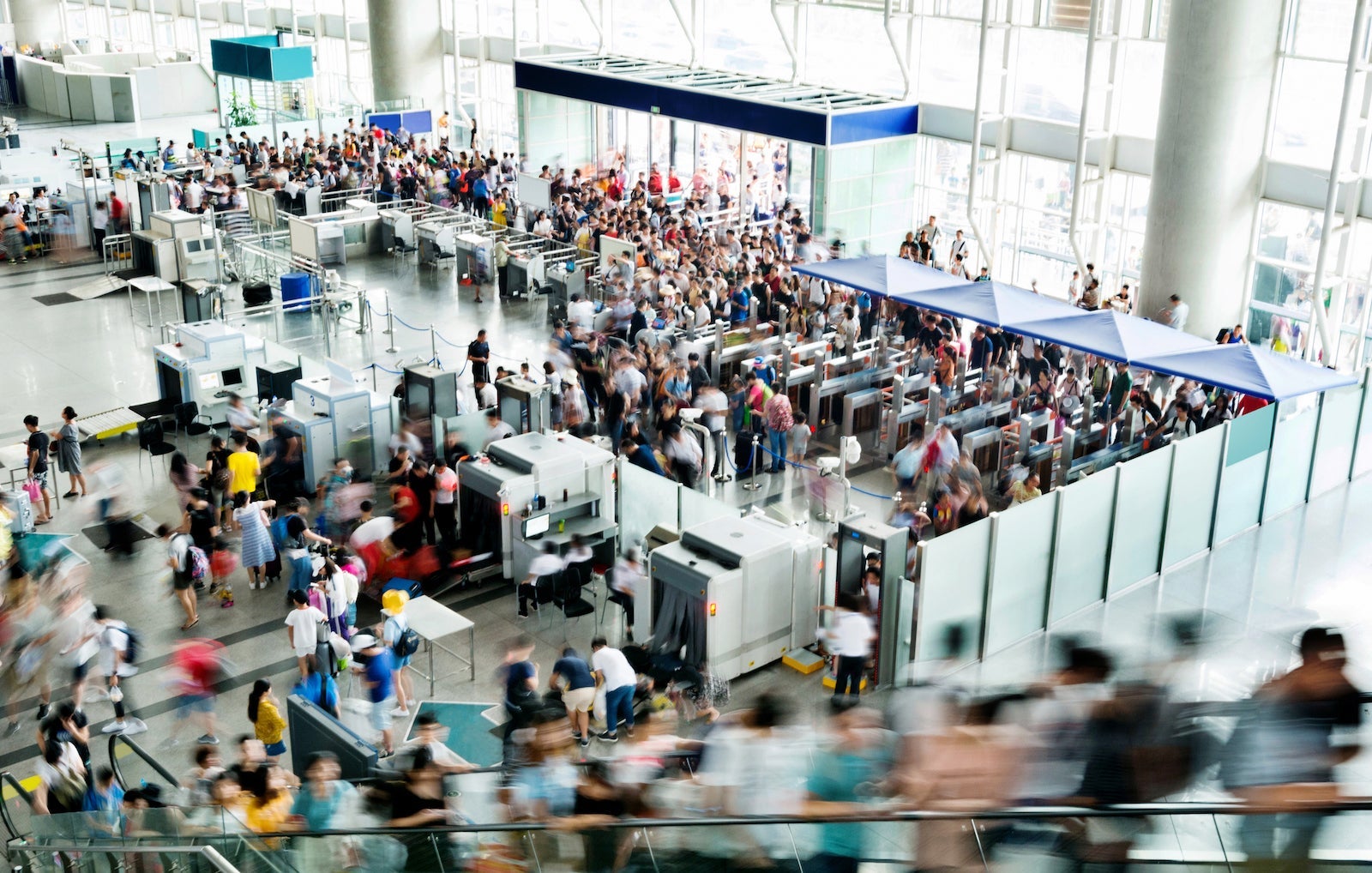
Reports are now surfacing that there are some pretty long wait times at the aforementioned screener airports. Some passengers are claiming wait times of more than six hours.

The CPB contested this, though, adding "there were weather delays on Saturday [at SFO] resulting in multiple flights arriving at one time, but no one saw anything approaching six hours or more waits."
We dug into the data to gather the average maximum wait times for U.S. citizens at these 11 designated airports from Jan 20. to Feb 3.. Here's what we found:
- SFO: 71.5 minutes
- SEA: 38.5 minutes
- HNL: 34.0 minutes
- ORD: 40.2 minutes
- IAH: 49.2 minutes
- DFW: 37.5 minutes
- ATL: 27.1 minutes
- DTW: 32.0 minutes
- JFK: 46.4 minutes
- EWR: 39.0 minutes
- IAD: 21.9 minutes
As a comparison, here are the average maximum wait times before the coronavirus outbreak, between Dec. 1–15:
- SFO: 55.8 minutes
- SEA: 30.4 minutes
- HNL: 29.4 minutes
- ORD: 31.5 minutes
- IAH: 45.7 minutes
- DFW: 33.5 minutes
- ATL: 28.4 minutes
- DTW: 31.4 minutes
- JFK: 37.7 minutes
- EWR: 34.2 minutes
- IAD: 24.4 minutes
Nine out of the 11 screener airports are experiencing longer average maximum wait times than they were before the coronavirus outbreak, except for Atlanta and Washington-Dulles. Additionally, San Francisco had the biggest wait time increase.
Related: Is it safe to travel to Asia? Complete guide to traveling during the coronavirus outbreak
Of course, these are average wait times and can vary depending on the time of day, weather and location. Bottom line? Be prepared.
One way to do so is by using Global Entry.
If you're not familiar with Global Entry, it's a program from U.S. Customs and Border Protection that gives you expedited entry back into the U.S. You have to be preapproved as well as a low-risk traveler. Once you're a member of the program, you can enter your information through automatic kiosks at these airports and clear U.S. customs in minutes instead of hours. Better yet, enrollment in the program also gives you access to TSA PreCheck. It's a game-changer for frequent and even casual travelers alike.
As scheduling your interview with Global Entry can take a few months, you'll want to take advantage of the Enrollment on Arrival service. With it, you can get Global Entry upon arrival at 53 airports throughout the U.S. — including at all of the 11 aforementioned "screener airports." Keep in mind, though, that you'll still have to apply ahead of time — you're just completing your interview on arrival.
Global Entry costs $100 for a five-year membership but, depending on which credit card you have, you might be able to get it for free. Cards such as the Chase Sapphire Reserve, The Platinum Card® from American Express and Capital One Venture Rewards Credit Card all give you an application fee credit (up to $100).
Mobile Passport can also be a handy option to skirt these long lines, as well.
This program can be used at 26 airports (and three seaports). Eligible travelers can download the Mobile Passport app to generate a digital version of the required customs form instead of filling it out by hand. Then, a CBP officer scans the QR code on your Mobile Passport digital receipt, and you'll be on your way. Mobile Passport requires users to submit the passport form every time they enter the country.
While the basic paperless functionality is still available for free, users now have to pay $15 per year to use their smartphone camera to scan and store passport information.
Related: Why you can't use both Mobile Passport and Global Entry at the same time
Either way, you have options to safely bypass the long wait times, all while keeping in line with government and health protocols.
TPG featured card

at Capital One's secure site
Terms & restrictions apply. See rates & fees.
| 5X miles | Earn 5X miles on hotels, vacation rentals and rental cars booked through Capital One Travel |
| 2X miles | Earn unlimited 2X miles on every purchase, every day |
Pros
- Stellar welcome offer of 75,000 miles after spending $4,000 on purchases in the first three months from account opening. Plus, a $250 Capital One Travel credit to use in your first cardholder year upon account opening.
- You'll earn 2 miles per dollar on every purchase, which means you won't have to worry about memorizing bonus categories
- Rewards are versatile and can be redeemed for a statement credit or transferred to Capital One’s transfer partners
Cons
- Highest bonus-earning categories only on travel booked via Capital One Travel
- LIMITED-TIME OFFER: Enjoy $250 to use on Capital One Travel in your first cardholder year, plus earn 75,000 bonus miles once you spend $4,000 on purchases within the first 3 months from account opening - that’s equal to $1,000 in travel
- Earn unlimited 2X miles on every purchase, every day
- Earn 5X miles on hotels, vacation rentals and rental cars booked through Capital One Travel
- Miles won't expire for the life of the account and there's no limit to how many you can earn
- Receive up to a $120 credit for Global Entry or TSA PreCheck®
- Use your miles to get reimbursed for any travel purchase—or redeem by booking a trip through Capital One Travel
- Enjoy a $50 experience credit and other premium benefits with every hotel and vacation rental booked from the Lifestyle Collection
- Transfer your miles to your choice of 15+ travel loyalty programs
- Top rated mobile app