Allegiant is planning a joint-venture with a Mexican budget carrier; Here’s how it will work


When ultra-low-cost carriers Allegiant and Viva Aerobus announced plans in December to form a joint venture, it was not quite clear what that would look like for customers.
Other joint ventures, like the one between Delta and Aeromexico, or between American and British Airways, see the airlines coordinate on overlapping routes, plan networks around multi-airline connections.
But Allegiant and Viva Aerobus, a low-cost carrier based in Mexico, have no overlapping routes.
In fact, their networks are remarkably distinct. Allegiant focuses on low-cost flights within the U.S., while Viva offers cheap flights between the U.S. and Mexico, as well as within Mexico itself.
Both airlines intend for their flights to be point-to-point, meaning no stops or connections, and the airlines have absolutely zero overlap on their route maps. That begs the question: why the joint venture?
At the annual Routes Americas conference this week in San Antonio, Viva Aerobus CEO Juan Carlos Zuazua shared a few more details of the coming joint venture (which still must be approved by each country's regulators).
"Once we get approval, we're going to be able to coordinate a lot of our network decisions and our growth decisions between Mexico and the U.S.," Zuazua told TPG after an appearance on a conference panel. "Not only from north to south, but also from south to north."
Allegiant does not currently offer service to Mexico or any other international destination. Even if it began to operate internationally, the difficult logistics of selling tickets in a foreign currency would likely mean it would focus entirely on U.S.-originating passengers at first — similar to Southwest.
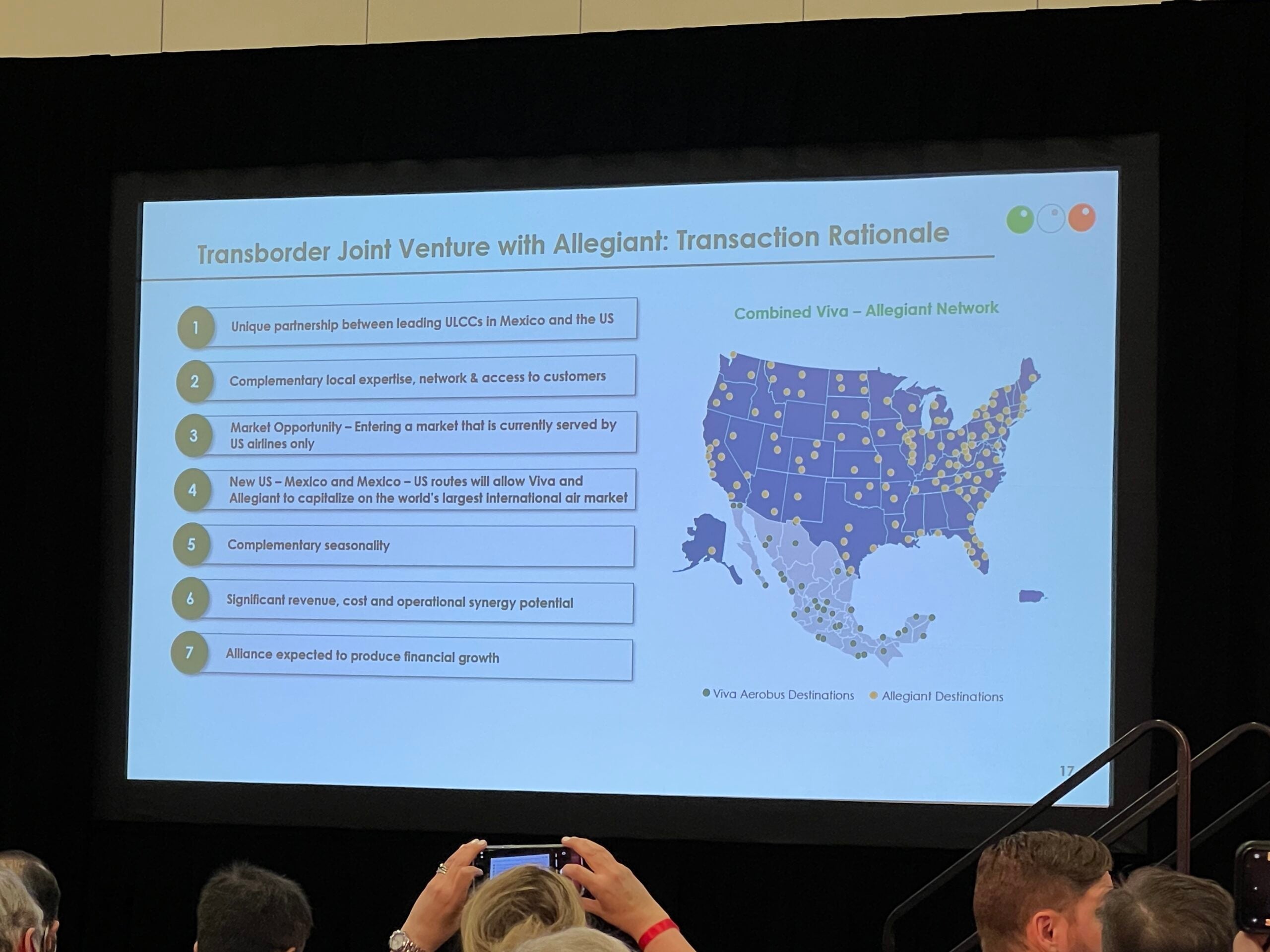
Zuazua noted that unlike other joint ventures, including Delta-Aeromexico, the Allegiant-Viva tie-up would not plan for connecting passengers — both airlines would stay true to their point-to-point business models.

"We're not connecting traffic," Zuazua said. "That can be an option, but it's not a priority. Our priority is connecting [markets] on a point-to-point market basis."
Instead, the idea is expanding service and sharing profitability, he said.
"The idea is to create a new market, a market that doesn't exist," Zuazua said, thinking of hypothetical cases. "For example [San Antonio] is a big city, and you can only get service to Cancun. You can't fly to Los Cabos, etc. We could have connectivity, two flights a week, perhaps."
Still, this seems like something that Viva Aerobus could do on its own. If Allegiant doesn't offer connecting passengers from other cities, or start flying to Mexico on its own, what's the point of the partnership? If Allegiant gets to share in the U.S.-Mexico profits, what does Viva get?
In essence, distribution, according to Henry Harteveldt, an airline and travel industry analyst and founder of Atmosphere Research.
Related: Frontier, Spirit announce blockbuster merger that would create giant ultra-low-cost airline
"Allegiant has a massive customer database and Viva will benefit through the co-marketing with Allegiant," Harteveldt said. "For Allegiant, this gives them instant access to one of the most popular leisure destinations for U.S. travelers at very little risk and very little expense."
Allegiant can help sell service to Mexico, operated by Viva, without having to commit aircraft and crews to an international operation. In exchange, it can share in the profits.
"You know Allegiant will be studying the results of this very carefully. And undoubtedly, if they see that this works well, I expect we'll see Allegiant announce its own flights from the U.S. to Mexico," coordinated with Viva, Harteveldt added.
And of course, there's another benefit: this gives Allegiant another tool to compete after the Spirit-Frontier merger, which was announced more than two months after the joint venture with Viva Aerobus.
TPG featured card
at American Express's secure site
Terms & restrictions apply. See rates & fees.
| 4X | Earn 4X Membership Rewards® points per dollar spent on purchases at restaurants worldwide, on up to $50,000 in purchases per calendar year, then 1X points for the rest of the year. |
| 4X | Earn 4X Membership Rewards® points per dollar spent at US supermarkets, on up to $25,000 in purchases per calendar year, then 1X points for the rest of the year. |
| 5X | Earn 5X Membership Rewards® points on prepaid hotel stays booked through AmexTravel.com or the Amex Travel App™. |
| 3X | Earn 3X Membership Rewards® points on flights booked through AmexTravel.com, the Amex Travel App™, or purchased directly from airlines. |
| 2X | Earn 2X Membership Rewards® points on prepaid car rentals booked through AmexTravel.com or the Amex Travel App™ and cruises booked and paid through AmexTravel.com. |
| 1X | Earn 1X Membership Rewards® point per dollar spent on all other eligible purchases. |
Pros
- Valuable dining and food-related credits
- Flexible rewards with airline and hotel transfer partners
- Multiple travel and purchase protections
- No foreign transaction fees
- Access to Amex Offers for additional savings (enrollment required)
Cons
- Not as useful for those living outside the U.S.
- Some may have trouble using Uber and other dining credits
- You may be eligible for as high as 100,000 Membership Rewards® Points after you spend $8,000 in eligible purchases on your new Card in your first 6 months of Card Membership. Welcome offers vary and you may not be eligible for an offer. Apply to know if you’re approved and find out your exact welcome offer amount – all with no credit score impact. If you’re approved and choose to accept the Card, your score may be impacted.
- Earn 4X Membership Rewards® points per dollar spent on purchases at restaurants worldwide, on up to $50,000 in purchases per calendar year, then 1X points for the rest of the year.
- Earn 4X Membership Rewards® points per dollar spent at US supermarkets, on up to $25,000 in purchases per calendar year, then 1X points for the rest of the year.
- Earn 5X Membership Rewards® points on prepaid hotel stays booked through AmexTravel.com or the Amex Travel App™.
- Earn 3X Membership Rewards® points on flights booked through AmexTravel.com, the Amex Travel App™, or purchased directly from airlines.
- Earn 2X Membership Rewards® points on prepaid car rentals booked through AmexTravel.com or the Amex Travel App™ and cruises booked and paid through AmexTravel.com.
- Earn 1X Membership Rewards® point per dollar spent on all other eligible purchases.
- Pay It® lets you tap in the American Express® App to quickly pay for small purchase amounts throughout the month and still earn rewards the way you usually do. Plan It® gives you the option to split up big purchases into equal monthly payments with a fixed fee. You’ll know upfront exactly how much you’ll pay.
- $120 Dining Credit: Earn up to a total of $10 in statement credits monthly when you pay with the Gold Card at Grubhub (including Seamless), Buffalo Wild Wings, Five Guys, The Cheesecake Factory, and Wonder. This can be an annual savings of up to $120. Enrollment required.
- $100 Resy Credit: Get up to $100 in statement credits each calendar year at over 10,000 qualifying U.S. Resy restaurants after you pay for eligible purchases with the American Express® Gold Card. That’s up to $50 in statement credits semi-annually. Enrollment required.
- $84 Dunkin' Credit: Earn up to $7 in monthly statement credits after you pay with the American Express® Gold Card at U.S. Dunkin’ locations. Enrollment required.
- $120 Uber Cash on Gold: Enjoy up to $120 in Uber Cash annually with your Gold Card. Just add your Card to your Uber account and you'll get $10 in Uber Cash each month to use on orders and rides in the U.S. when you select an Amex Card for your transaction.
- Enjoy complimentary Hertz Five Star® Status benefits like skipping the counter at select locations, adding an additional driver at no additional cost*, and vehicle upgrades**. Benefit enrollment and Hertz Gold+ registration are required. *Additional drivers must meet standard rental qualifications and must be a spouse or domestic partner to qualify as complimentary. Other additional drivers subject to fees. **Benefits are subject to availability and vary by location. Additional Hertz program Terms and Conditions including age restrictions apply.
- Book two nights or more with The Hotel Collection through AmexTravel.com or the Amex Travel App™ and receive a $100* credit towards eligible charges at over 1,400 upscale hotels worldwide. *Eligible charges vary by property.
- Book your travel through the Amex Travel App™ with added peace of mind – backed by American Express® service and support. Only for American Express® Card Members.
- Whenever you need us, we're here. Our Member Services team will ensure you are taken care of. From lost Card replacement to statement questions, we are available to help 24/7.
- No Foreign Transaction Fees.
- Annual Fee is $325.
- Terms Apply.