Alaska Airlines consolidates routes, adds tag flights to maintain service to all its destinations


Alaska Airlines is going back to the future to maintain its route network, dusting off the old strategy of tagging 12 destinations together to maintain service to all of its cities as the novel coronavirus pandemic takes a bite out of demand.
The carrier will end nonstop service between its Seattle (SEA) base and six cities: Baltimore/Washington (BWI); Charleston, South Carolina (CHS); Columbus, Ohio (CMH); Helena, Montana (HLN); Houston Bush Intercontinental (IAH) and Santa Barbara, California (SBA), from April 10 through April 30, Alaska spokesperson Ray Lane told TPG.
The six cities will instead be served one-stop from Seattle as tags on six other routes:
- Baltimore/Washington via Pittsburgh (PIT)
- Charleston via Raleigh/Durham (RDU)
- Columbus via Minneapolis/St. Paul (MSP)
- Helena via Kalispell, Montana (FCA)
- Houston via Dallas/Fort Worth (DFW)
- Santa Barbara via San Luis Obispo, California (SBP)
Get Coronavirus travel updates. Stay on top of industry impacts, flight cancellations, and more.
"Our team worked to solve a unique challenge of providing service to as many communities as possible, as efficiently as possible," Lane said. "A tag flight is beneficial because it streamlines the use of our resources – aircraft, fuel and crews – to serve more destinations."
Tag routes are nothing new for Alaska. The airline operates a so-called "milk run" from Seattle to Anchorage (ANC) with stops in several small communities in southern part of the state of Alaska. In addition, the carrier used tag routes when it first expanded south along the West Coast in the 1980s, for example it added service to Burbank (BUR) via Portland, Oregon (PDX) in 1981.
The streamlined approach to maintaining service also allows Alaska to meet the requirements of the CARES Act, or the government aid package that includes the airlines. The bill requires airlines to maintain service to all of their U.S. destinations determined reasonable by the Department of Transportation as a condition of accepting any of the $50 billion in aid.
Carriers are allowed to offer as little as one weekly flight depending on their prior schedule, according to the DOT. In addition, they have the option of serving destinations in either their summer or winter schedule.

Related: Airlines will have to meet these schedule requirements to get coronavirus aid
Alaska has applied for some of the $25 billion in staff compensation grants available under the CARES Act. Raymond James analysts estimate the airline could receive around $1 billion in funds, which would help extend the nearly seven months of available cash in its bank accounts.
The carrier will reduce capacity by 80% in both April and May, the airline said in a securities filing on April 6. The cuts are in response to an at least 80% drop in demand for air travel.
As part of the capacity cuts, Alaska has parked more than 25 aircraft, according to Atmosphere Research data. Some Airbus jets have been stored in Greensboro, North Carolina (GSO).
Related: Alaska Airlines extends elite status, companion certificate validity due to coronavirus
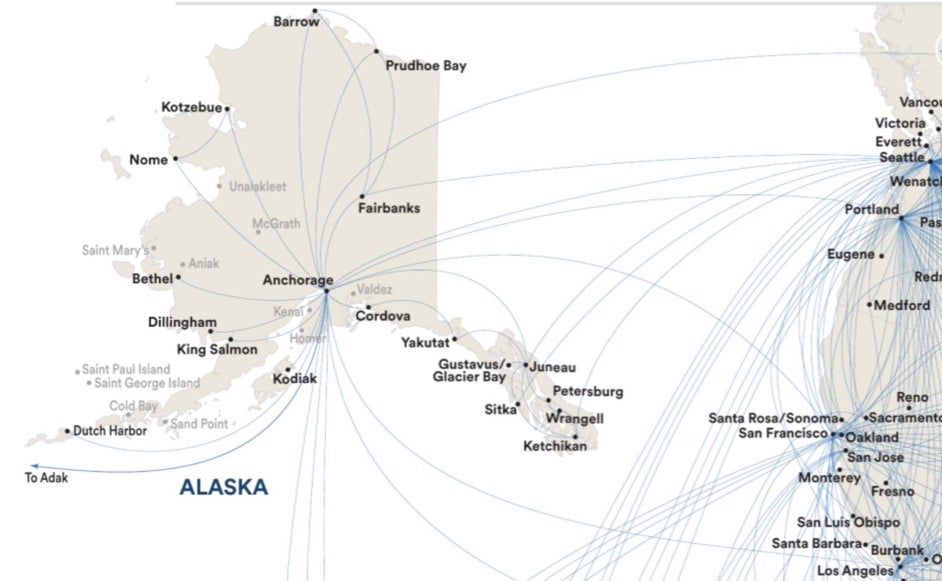
While consolidating some routes in the contiguous U.S., Alaska continues to serve all of its destination in the state of Alaska. The airline provides vital air service around the state, including to many communities that have no other connections to the outside world.
The commitment follows the bankruptcy of RavnAir, the largest regional airline in the state, on April 5. RavnAir shut down after bookings plummeted up to 90% and operating funds needed until CARES Act money becomes available dried up, the carrier said in its Chapter 11 filing. The Anchorage-based airline hopes to secure funds under the aid package that will allow it to resume flying.
In response to RavnAir's bankruptcy, Alaska Airlines has committed to serving several communities in its namesake state. It will maintain flights to Kodiak (ADK), begin seasonal service to Dillingham (DLG) and King Salmon (AKN) earlier than its originally planned June start. It's also working to add flights to Cold Bay (CDB). All of the cities would be served from Alaska's Anchorage hub and replace service previously offered by RavnAir.
"We believe these are important steps that Alaska Airlines can take to support the infrastructure of the state of Alaska and ensure the people and communities of the state remain connected during this incredibly challenging time," said Alaska CEO Brad Tilden.
RavnAir is the third U.S. regional carrier to shut down as travelers stay home to slow the spread of COVID-19. Both Compass Airlines and Trans States Airlines will or have closed their doors completely as business has dried up.
Related: How long will US airlines' cash last? Between 4 months and a year
TPG featured card
at American Express's secure site
Terms & restrictions apply. See rates & fees.
| 4X | Earn 4X Membership Rewards® points per dollar spent on purchases at restaurants worldwide, on up to $50,000 in purchases per calendar year, then 1X points for the rest of the year. |
| 4X | Earn 4X Membership Rewards® points per dollar spent at US supermarkets, on up to $25,000 in purchases per calendar year, then 1X points for the rest of the year. |
| 5X | Earn 5X Membership Rewards® points on prepaid hotel stays booked through AmexTravel.com or the Amex Travel App™. |
| 3X | Earn 3X Membership Rewards® points on flights booked through AmexTravel.com, the Amex Travel App™, or purchased directly from airlines. |
| 2X | Earn 2X Membership Rewards® points on prepaid car rentals booked through AmexTravel.com or the Amex Travel App™ and cruises booked and paid through AmexTravel.com. |
| 1X | Earn 1X Membership Rewards® point per dollar spent on all other eligible purchases. |
Pros
- Valuable dining and food-related credits
- Flexible rewards with airline and hotel transfer partners
- Multiple travel and purchase protections
- No foreign transaction fees
- Access to Amex Offers for additional savings (enrollment required)
Cons
- Not as useful for those living outside the U.S.
- Some may have trouble using Uber and other dining credits
- You may be eligible for as high as 100,000 Membership Rewards® Points after you spend $8,000 in eligible purchases on your new Card in your first 6 months of Card Membership. Welcome offers vary and you may not be eligible for an offer. Apply to know if you’re approved and find out your exact welcome offer amount – all with no credit score impact. If you’re approved and choose to accept the Card, your score may be impacted.
- Earn 4X Membership Rewards® points per dollar spent on purchases at restaurants worldwide, on up to $50,000 in purchases per calendar year, then 1X points for the rest of the year.
- Earn 4X Membership Rewards® points per dollar spent at US supermarkets, on up to $25,000 in purchases per calendar year, then 1X points for the rest of the year.
- Earn 5X Membership Rewards® points on prepaid hotel stays booked through AmexTravel.com or the Amex Travel App™.
- Earn 3X Membership Rewards® points on flights booked through AmexTravel.com, the Amex Travel App™, or purchased directly from airlines.
- Earn 2X Membership Rewards® points on prepaid car rentals booked through AmexTravel.com or the Amex Travel App™ and cruises booked and paid through AmexTravel.com.
- Earn 1X Membership Rewards® point per dollar spent on all other eligible purchases.
- Pay It® lets you tap in the American Express® App to quickly pay for small purchase amounts throughout the month and still earn rewards the way you usually do. Plan It® gives you the option to split up big purchases into equal monthly payments with a fixed fee. You’ll know upfront exactly how much you’ll pay.
- $120 Dining Credit: Earn up to a total of $10 in statement credits monthly when you pay with the Gold Card at Grubhub (including Seamless), Buffalo Wild Wings, Five Guys, The Cheesecake Factory, and Wonder. This can be an annual savings of up to $120. Enrollment required.
- $100 Resy Credit: Get up to $100 in statement credits each calendar year at over 10,000 qualifying U.S. Resy restaurants after you pay for eligible purchases with the American Express® Gold Card. That’s up to $50 in statement credits semi-annually. Enrollment required.
- $84 Dunkin' Credit: Earn up to $7 in monthly statement credits after you pay with the American Express® Gold Card at U.S. Dunkin’ locations. Enrollment required.
- $120 Uber Cash on Gold: Enjoy up to $120 in Uber Cash annually with your Gold Card. Just add your Card to your Uber account and you'll get $10 in Uber Cash each month to use on orders and rides in the U.S. when you select an Amex Card for your transaction.
- Enjoy complimentary Hertz Five Star® Status benefits like skipping the counter at select locations, adding an additional driver at no additional cost*, and vehicle upgrades**. Benefit enrollment and Hertz Gold+ registration are required. *Additional drivers must meet standard rental qualifications and must be a spouse or domestic partner to qualify as complimentary. Other additional drivers subject to fees. **Benefits are subject to availability and vary by location. Additional Hertz program Terms and Conditions including age restrictions apply.
- Book two nights or more with The Hotel Collection through AmexTravel.com or the Amex Travel App™ and receive a $100* credit towards eligible charges at over 1,400 upscale hotels worldwide. *Eligible charges vary by property.
- Book your travel through the Amex Travel App™ with added peace of mind – backed by American Express® service and support. Only for American Express® Card Members.
- Whenever you need us, we're here. Our Member Services team will ensure you are taken care of. From lost Card replacement to statement questions, we are available to help 24/7.
- No Foreign Transaction Fees.
- Annual Fee is $325.
- Terms Apply.