Airlines ask DOT to suspend flights to more US airports, small cities fare worst

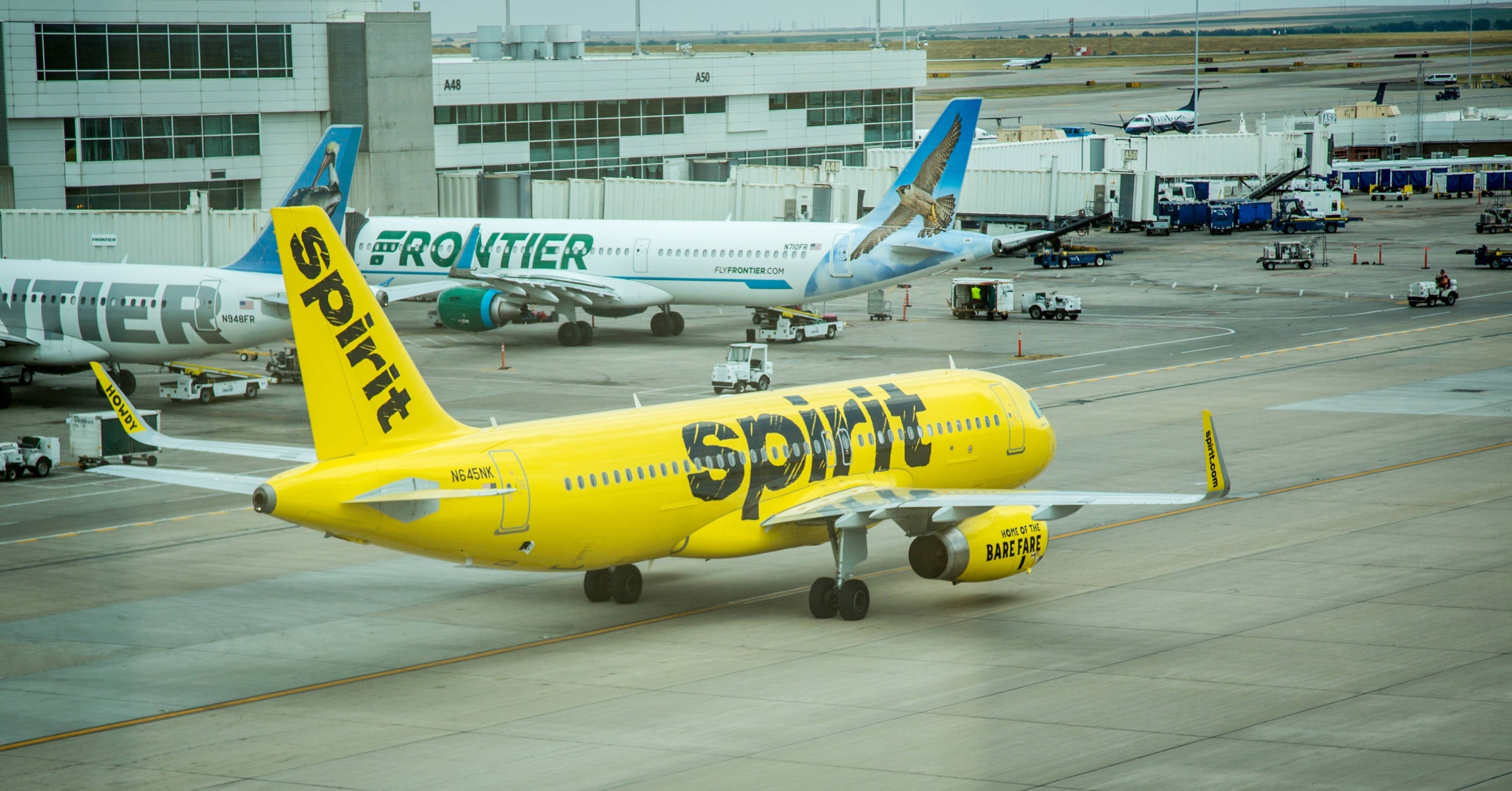
U.S. airlines have jumped en mass for a slice of the $25 billion in grants available to cover staff compensation during the novel coronavirus pandemic even as the strings to taking the funds continue to be ironed out.
One of those strings is a requirement that recipients continue air service to all of the U.S. destinations on their maps. The government aid, part of the $2 trillion CARES Act coronavirus stimulus package, requires airlines fly to all of the airports deemed "reasonable and practicable" by the Department of Transportation.
The DOT has given airlines some leeway. Carriers can opt to maintain service based on either their summer or winter schedule, and they are allowed to consolidate service at one airport in large metropolitan regions where they serve multiple airports, like in the Los Angeles or New York areas.
Carriers must receive a waiver from the DOT for any other cities that they want to suspend service amid the COVID-19 crisis.
Get Coronavirus travel updates. Stay on top of industry impacts, flight cancellations, and more.
Alaska Airlines, Delta Air Lines, Frontier Airlines, Hawaiian Airlines, JetBlue Airways, Spirit Airlines and United Airlines had each sought to suspend service to airports as of midday on April 13. The rationale for these applications range from allowing seasonal flights to begin as planned in May or June, to airport closures or proximity to other airports.
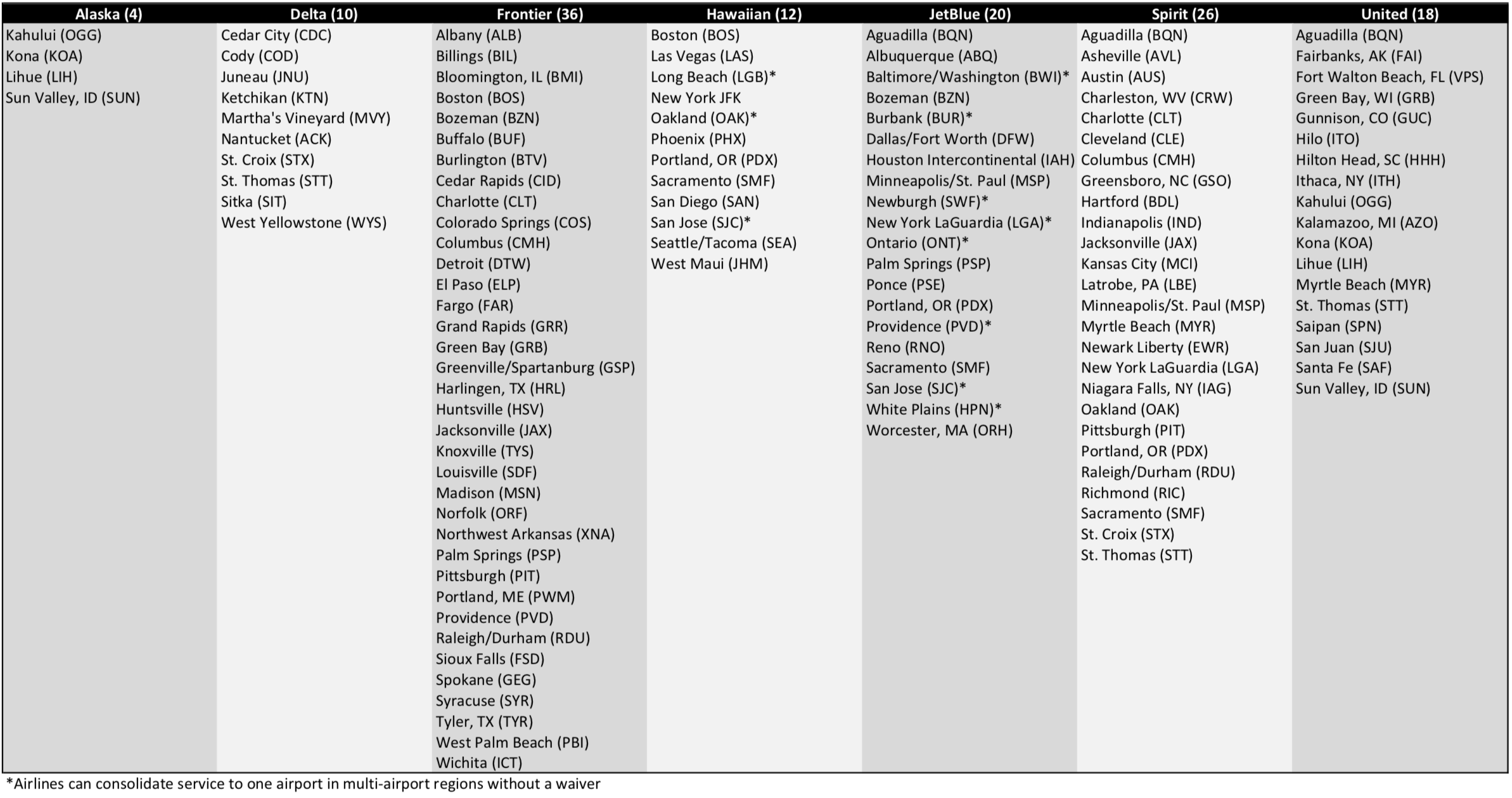
Of the 126 waivers sought by the airlines, 61% would suspend service to the country's smallest airports, or those that handle roughly less than one million passengers annually, a TPG analysis finds. The applications range from Delta's request for a waiver for Cedar City (CDC), Utah — where previously planned runway work has closed the facility until July — to Spirit's request to halt flights to Latrobe (LBE), Pennsylvania, due to the airport's proximity to Pittsburgh International Airport (PIT).
Just over 22% of the waivers were for what the DOT classifies as medium-sized airports. These include Alaska's service to Kahului (OGG) on Maui, and JetBlue's flights to Albuquerque (ABQ) and Sacramento (SMF).
Related: JetBlue among first US airlines to seek waivers to suspend flights to 12 cities

Only nearly 17% of the waiver requests were for service to the country's 25 largest airports. These include JetBlue's decision to suspend flights to Baltimore/Washington (BWI) in favor of serving the Washington, D.C., area via Washington Reagan National (DCA) — a move that is technically allowed without a waiver under the DOT's rules. Another example is Hawaiian's request to suspend flights to Boston Logan (BOS) as the airline's namesake islands are essentially closed for business.
"While Hawaiian maintains lifeline air service connections to critical mainland points, serving the full breadth of Hawaiian's pre-COVID-19 network is neither reasonable nor practicable," Honolulu-based Hawaiian said in its April 19 application. "Expanded services are neither warranted by traveler demand nor welcome by the State of Hawaii."
The number of waivers includes multiple airline applications for the same airport. For example, Bozeman (BZN), Montana, is counted twice in separate requests from both Frontier and JetBlue.
Related: At least 9 US airlines have applied for CARES Act grants
Small airports hit hardest
Regardless of how many waiver requests were filed for any given airport, it comes as little surprise that the country's smallest airports are hit the hardest. The DOT has the difficult job of determining what is essential service to keep these airports — places like Charleston (CRW), West Virginia, and Ithaca (ITH), New York — connected to the national air transport system.
Does Spirit really need to connect Charleston, West Virginia, to Orlando (MCO) when there are fewer people flying daily than since the 1950s?
The Transportation Security Administration (TSA) reported screening just 90,510 people on Sunday, March 12 — just 4% of the number who passed through checkpoints across America on the same weekday a year ago.
View this post on Instagram
Air service to small communities has frequently suffered after past industry crises. A widely cited 2013 study by William Swelbar and Michael Wittman at MIT found that from 2007 to 2012, America's smaller airports lost 21.3% of their scheduled flights in the fallout from the Great Recession. This is more than twice the 8.8% of flights that the country's largest airports lost over the same period.
What Swelbar and Wittman found, though, was history repeating. Airlines culled capacity after 9/11, keeping most domestic destinations but often by serving them with 50-seat regional jets instead of mainline aircraft with more than double the number of seats, like the Boeing 737, as Continental Airlines did.
Of course, once an airline suspends service to a market there is always the question of whether they will resume flights.
Related: How will airlines rebuild their route maps after the coronavirus?
Where flight suspensions might make sense
Some waivers make sense. Take Delta and United's requests to begin planned seasonal service as scheduled in May or June, instead of within a week of receipt of CARES Act funds. The national air system gains little from flights to Martha's Vineyard (MVY) — an almost entirely summer, leisure destination — getting flights two months early in the middle of a pandemic.
The same could be said of the waiver applications for airports where the local government has asked airlines to stop flying. For example, the government in Puerto Rico has closed the Aguadilla (BQN) and Ponce (PSE) airports to restrict the spread of COVID-19, prompting JetBlue, Spirit and United all to seek waivers for some or all of these airports.
Then there are the airports that were already closed before the coronavirus landed on U.S. shores, like Cedar City. In this case, Brett Snyder in the Cranky Coronavirus Daily Update put it best: "If the DOT denies this one, then all hope is lost."
Related: JetBlue consolidating flights in New York, Los Angeles and 3 more big cities
TPG featured card
at American Express's secure site
Terms & restrictions apply. See rates & fees.
| 4X | Earn 4X Membership Rewards® points per dollar spent on purchases at restaurants worldwide, on up to $50,000 in purchases per calendar year, then 1X points for the rest of the year. |
| 4X | Earn 4X Membership Rewards® points per dollar spent at US supermarkets, on up to $25,000 in purchases per calendar year, then 1X points for the rest of the year. |
| 5X | Earn 5X Membership Rewards® points on prepaid hotel stays booked through AmexTravel.com or the Amex Travel App™. |
| 3X | Earn 3X Membership Rewards® points on flights booked through AmexTravel.com, the Amex Travel App™, or purchased directly from airlines. |
| 2X | Earn 2X Membership Rewards® points on prepaid car rentals booked through AmexTravel.com or the Amex Travel App™ and cruises booked and paid through AmexTravel.com. |
| 1X | Earn 1X Membership Rewards® point per dollar spent on all other eligible purchases. |
Pros
- Valuable dining and food-related credits
- Flexible rewards with airline and hotel transfer partners
- Multiple travel and purchase protections
- No foreign transaction fees
- Access to Amex Offers for additional savings (enrollment required)
Cons
- Not as useful for those living outside the U.S.
- Some may have trouble using Uber and other dining credits
- You may be eligible for as high as 100,000 Membership Rewards® Points after you spend $8,000 in eligible purchases on your new Card in your first 6 months of Card Membership. Welcome offers vary and you may not be eligible for an offer. Apply to know if you’re approved and find out your exact welcome offer amount – all with no credit score impact. If you’re approved and choose to accept the Card, your score may be impacted.
- Earn 4X Membership Rewards® points per dollar spent on purchases at restaurants worldwide, on up to $50,000 in purchases per calendar year, then 1X points for the rest of the year.
- Earn 4X Membership Rewards® points per dollar spent at US supermarkets, on up to $25,000 in purchases per calendar year, then 1X points for the rest of the year.
- Earn 5X Membership Rewards® points on prepaid hotel stays booked through AmexTravel.com or the Amex Travel App™.
- Earn 3X Membership Rewards® points on flights booked through AmexTravel.com, the Amex Travel App™, or purchased directly from airlines.
- Earn 2X Membership Rewards® points on prepaid car rentals booked through AmexTravel.com or the Amex Travel App™ and cruises booked and paid through AmexTravel.com.
- Earn 1X Membership Rewards® point per dollar spent on all other eligible purchases.
- Pay It® lets you tap in the American Express® App to quickly pay for small purchase amounts throughout the month and still earn rewards the way you usually do. Plan It® gives you the option to split up big purchases into equal monthly payments with a fixed fee. You’ll know upfront exactly how much you’ll pay.
- $120 Dining Credit: Earn up to a total of $10 in statement credits monthly when you pay with the Gold Card at Grubhub (including Seamless), Buffalo Wild Wings, Five Guys, The Cheesecake Factory, and Wonder. This can be an annual savings of up to $120. Enrollment required.
- $100 Resy Credit: Get up to $100 in statement credits each calendar year at over 10,000 qualifying U.S. Resy restaurants after you pay for eligible purchases with the American Express® Gold Card. That’s up to $50 in statement credits semi-annually. Enrollment required.
- $84 Dunkin' Credit: Earn up to $7 in monthly statement credits after you pay with the American Express® Gold Card at U.S. Dunkin’ locations. Enrollment required.
- $120 Uber Cash on Gold: Enjoy up to $120 in Uber Cash annually with your Gold Card. Just add your Card to your Uber account and you'll get $10 in Uber Cash each month to use on orders and rides in the U.S. when you select an Amex Card for your transaction.
- Enjoy complimentary Hertz Five Star® Status benefits like skipping the counter at select locations, adding an additional driver at no additional cost*, and vehicle upgrades**. Benefit enrollment and Hertz Gold+ registration are required. *Additional drivers must meet standard rental qualifications and must be a spouse or domestic partner to qualify as complimentary. Other additional drivers subject to fees. **Benefits are subject to availability and vary by location. Additional Hertz program Terms and Conditions including age restrictions apply.
- Book two nights or more with The Hotel Collection through AmexTravel.com or the Amex Travel App™ and receive a $100* credit towards eligible charges at over 1,400 upscale hotels worldwide. *Eligible charges vary by property.
- Book your travel through the Amex Travel App™ with added peace of mind – backed by American Express® service and support. Only for American Express® Card Members.
- Whenever you need us, we're here. Our Member Services team will ensure you are taken care of. From lost Card replacement to statement questions, we are available to help 24/7.
- No Foreign Transaction Fees.
- Annual Fee is $325.
- Terms Apply.