Airbus is learning from geese to boost aircraft performance

The travel world — and the world as a whole — would look entirely different if it weren't for our feathered flying friend, the bird. Wilbur and Orville Wright drew inspiration from birds, and nature aided their understanding of essential concepts, like airflow and lift.
Even today, aircraft manufacturers continue to fall back on ornithology in an attempt to further improve efficiency, to reduce carbon emissions, increase aircraft range and — of course — curb fuel costs to save airlines money. At the Dubai Air Show on Monday, Airbus shared the news that it's made notable progress in trimming fuel consumption by following the travel patterns of geese.
The manufacturer's latest biomimetics venture, dubbed fello'fly, is said to reduce fuel usage by 5%-10% per trip. It entails multiple aircraft flying in a formation of sorts — not unlike the "V" shape observed in flocks of geese. Essentially, a "follower" aircraft will take advantage of the smooth rising air created by the wake of a "leader," as visualized below.
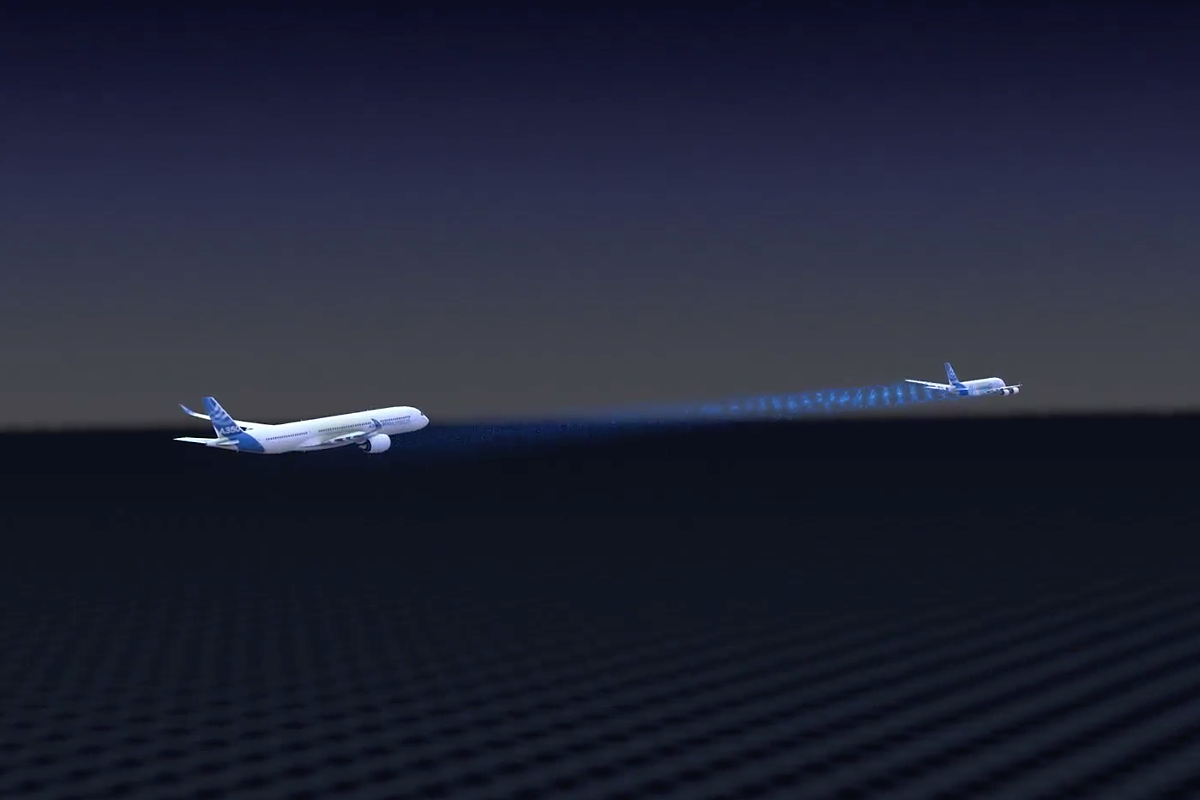
The concept is sound in theory, but successful execution faces many challenges. First, both aircraft need to be traveling in the same direction, maintaining distance and altitude. That may be achievable when traveling from the same city to Europe through the Organized Track System (OTS), for example, but even then, departures would need to be coordinated, and both aircraft would need to be similar — an Airbus A350 flies more efficiently at a higher altitude and speed than a Boeing 757, for example.
Airlines and manufacturers would need to get Air Traffic Control (ATC) to play ball, too, which could prove especially difficult. New York City-area airports often end up having aircraft circle for extended periods even on mild days, so it may be challenging to argue that reducing emissions is a top priority for the FAA.
Even so, Airbus is planning to test the concept with a pair of A350s next year, and the company is targeting a "controlled Entry-Into-Service (EIS)" by the middle of the next decade. If Airbus gets its way, we could see fello'fly passenger flights by 2025.

TPG featured card

at Capital One's secure site
Terms & restrictions apply. See rates & fees.
| 5X miles | Earn 5X miles on hotels, vacation rentals and rental cars booked through Capital One Travel |
| 2X miles | Earn unlimited 2X miles on every purchase, every day |
Pros
- Stellar welcome offer of 75,000 miles after spending $4,000 on purchases in the first three months from account opening. Plus, a $250 Capital One Travel credit to use in your first cardholder year upon account opening.
- You'll earn 2 miles per dollar on every purchase, which means you won't have to worry about memorizing bonus categories
- Rewards are versatile and can be redeemed for a statement credit or transferred to Capital One’s transfer partners
Cons
- Highest bonus-earning categories only on travel booked via Capital One Travel
- LIMITED-TIME OFFER: Enjoy $250 to use on Capital One Travel in your first cardholder year, plus earn 75,000 bonus miles once you spend $4,000 on purchases within the first 3 months from account opening - that’s equal to $1,000 in travel
- Earn unlimited 2X miles on every purchase, every day
- Earn 5X miles on hotels, vacation rentals and rental cars booked through Capital One Travel
- Miles won't expire for the life of the account and there's no limit to how many you can earn
- Receive up to a $120 credit for Global Entry or TSA PreCheck®
- Use your miles to get reimbursed for any travel purchase—or redeem by booking a trip through Capital One Travel
- Enjoy a $50 experience credit and other premium benefits with every hotel and vacation rental booked from the Lifestyle Collection
- Transfer your miles to your choice of 15+ travel loyalty programs
- Top rated mobile app