How Do American and United Basic Economy Compare to Low-Cost Carrier Fares?


Last Tuesday, both American Airlines and United Airlines began selling Basic Economy fares. In their announcements and promotion of these products, both airlines put the focus solely on price. United's Basic Economy is targeted toward "customers who may be more price-sensitive," while American Airlines is focusing on those who "don't fly very often and ... care more about price than about features." So, now that these Basic Economy fares are on sale, how are these airlines doing at competitively pricing this new bare-bones form of their tickets? Spoiler alert: not very well.
American Airlines
American Airlines has launched Basic Economy fares on 10 routes for flights starting March 1. Low-cost carriers (LCCs) offer service on eight of the same routes, and the other two have LCC competition from nearby airports. What can we expect from American's pricing of Basic Economy? Well, back in January 2017 during the investor conference call, management went on record to tell investors that:
...the main cabin product and the Basic product ... share the same inventory. So we are always going to have both products available for our customers. But we will continue to match the ultra low-cost carrier pricing with our Basic product
Let's check to see how they're doing with this so far:
| New Orleans (MSY)-Philadelphia (PHL) | Frontier | $90 | $136 | 51% |
|---|---|---|---|---|
Orlando (MCO)-Charlotte (CLT) | Frontier | $81 | $117 | 45% |
CLT-PHL | Frontier | $82 | $98 | 19% |
Miami (MIA)-PHL | Frontier | $58 | $84 | 45% |
Dallas (DFW)-PHL | Spirit | $81 | $113 | 40% |
DFW-Tampa (TPA) | Spirit | $66 | $121 | 83% |
BWI-DFW | Spirit | $79 | $118 | 49% |
MIA-TPA | Spirit (*FLL-TPA) | $54 | $70 | 29% |
Fort Lauderdale (FLL)-PHL | Spirit | $78 | $95 | 22% |
MIA-MSY | Spirit (*FLL-MSY) | $71 | $122 | 72% |
Sample: Lowest one-way nonstop fares for every date from March 1-April 30. Fares were only included in the average fare if both American Airlines Basic Economy and a low-cost competitor fare were available for a particular date. Data gathered February 24.
Sometimes AA isn't anywhere close to the LCCs' pricing on these routes:
| MSY-PHL | Frontier | March 3 | $38 | $152 | $192 |
|---|---|---|---|---|---|
MCO-CLT | Frontier | April 1 | $51 | $162 | $182 |
CLT-PHL | Frontier | May 1 | $18 | $134 | $154 |
MIA-PHL | Frontier | March 4 | $33 | $101 | $121 |
DFW-PHL | Spirit | March 20 | $60 | $134 | $154 |
DFW-TPA | Spirit | April 3 | $49 | $139 | $159 |
BWI-DFW | Spirit | March 8 | $50 | $149 | $169 |
MIA-TPA | Spirit (*FLL-TPA) | March 8 | $42 | $78 | $98 |
FLL-PHL | Spirit | April 12 | $41 | $132 | $147 |
MIA-MSY | Spirit (*FLL-MSY) | March 22 | $38 | $121 | $141 |
For instance, here's one fairly extreme example between Charlotte (CLT) and Philadelphia (PHL), where AA is charging over seven times more for its Basic Economy fares (and yes, we confirmed that the $134 AA fare is a Basic Economy fare):

United Airlines
United Airlines also put its Basic Economy product on sale on Tuesday. The carrier is launching its Basic product for flights starting April 18 on seven routes solely into/out of Minneapolis (MSP). Five of the seven routes are directly served by low-cost carriers Frontier, Spirit and/or Sun Country. For the other two routes, there's LCC service into nearby airports. Unlike with AA, we haven't seen United's management make any claims that it's going to match the LCCs. But United's Basic Economy fares are the most restrictive of the legacy airlines and are the closest to mirroring the LCC experience, so it's fair to compare the fares:

| MSP-Chicago (ORD) | Spirit | $66 | $86 | 31% |
|---|---|---|---|---|
MSP-Denver (DEN) | Frontier, Spirit and Sun Country | $55 | $102 | 85% |
MSP-Houston (IAH) | Spirit | $105 | $299 | 185% |
MSP-Los Angeles (LAX) | Spirit and Sun Country | $111 | $156 | 40% |
MSP-Newark (EWR) | Sun Country (*MSP-JFK) | $157 | $194 | 23% |
MSP-San Francisco (SFO) | Sun Country | $181 | $185 | 2% |
MSP-Washington, D.C. (IAD) | Spirit (*MSP-BWI) | $73 | $157 | 115% |
Sample: Lowest one-way nonstop fares for every date from April 18-May 31. Fares were only included in the average fare if both United Basic Economy and a low-cost competitor fare were available for a particular date. Data gathered February 24.
Similar to American Airlines, United is having some major disconnects between its Basic Economy pricing and the low-cost carriers' pricing on certain dates:
| MSP-ORD | Spirit | May 3 | $40 | $84 | $99 |
|---|---|---|---|---|---|
MSP-DEN | Spirit & Frontier | May 22 | $43 | $112 | $132 |
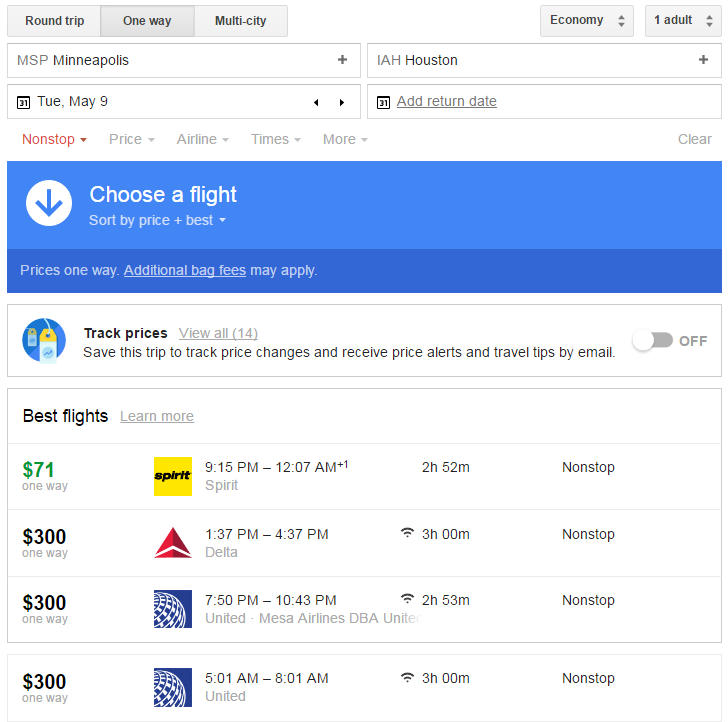
MSP-IAH | Spirit | May 9 | $65 | $299 | $319 |
MSP-LAX | Spirit | May 1 | $84 | $164 | $189 |
MSP-EWR | Sun Country (*MSP-JFK) | May 14 | $156 | $243 | $263 |
MSP-SFO | Sun Country | May 29 | $173 | $279 | $304 |
MSP-IAD | Spirit (*MSP-BWI) | May 25 | $69 | $256 | $276 |
The most shocking of these disconnects is between Minneapolis (MSP) and Houston (IAH):
Analysis
Both American and United have indicated that they need to introduce Basic Economy fares to compete with their low-cost carrier competition. AA made an outright statement to its investors that it'd match low-cost carriers with Basic Economy fares. Doing so makes sense. In theory, the experience is comparable between Basic Economy and low-cost carriers. It's true that you'll generally get more legroom, in-flight entertainment and free drinks on the legacy carriers. However, you're guaranteed to board last and get the last seat assignments. Since everyone is in a similar situation on the LCCs, you're more likely to get a window or aisle seat.
However, since starting to sell Basic Economy fares this week, both American and United have done a terrible job so far of aligning their prices with the LCCs. In some cases, the legacies are charging over seven times as much for their Basic Economy product as the LCCs. Of the 353 dates with comparable data, AA is matching the LCC pricing on just 35 and beating the LCC on just 23. That leaves 295 dates where the LCC is still underselling AA. United is similar: 33 matching dates, 12 cheaper dates and 244 more-expensive dates.
| Dates Basic Economy Matches LCC Pricing | 35 | 33 |
|---|---|---|
Dates Basic Economy Is Cheaper Than LCC | 23 | 12 |
Dates Basic Economy Is More Expensive Than LCC | 295 | 244 |
Looking at these fares so far, the data indicates that American and United haven't rolled out Basic Economy to compete with the LCCs. Instead, it seems the motivation is to raise additional revenue by nudging travelers to pay even more for non-Basic fares. In fact, American Airlines is telling its investors just that in its just-released annual report:
We have recently instituted, and intend to institute in the future, changes to our business model to increase revenues and offset costs. These measures include premium economy service, basic economy service and charging separately for services that had previously been included within the price of a ticket and increasing other pre-existing fees.
Note that there's no mention of implementing these new services to better compete with low-cost carriers. The focus is entirely on increasing revenues and offsetting costs.
Bottom Line
While airlines are free to set pricing however they feel is best for the company, we want to call out both American and United for generally pricing not even close to the low-cost carriers. If the true reason for implementing Basic Economy is competition, American Airlines and United Airlines need to lower their Basic Economy fares to better match LCC pricing. Otherwise, it's clear that Basic Economy is just a move to increase prices for the same product as before.
TPG featured card

at Capital One's secure site
Terms & restrictions apply. See rates & fees.
| 5X miles | Earn 5X miles on hotels, vacation rentals and rental cars booked through Capital One Travel |
| 2X miles | Earn unlimited 2X miles on every purchase, every day |
Pros
- Stellar welcome offer of 75,000 miles after spending $4,000 on purchases in the first three months from account opening. Plus, a $250 Capital One Travel credit to use in your first cardholder year upon account opening.
- You'll earn 2 miles per dollar on every purchase, which means you won't have to worry about memorizing bonus categories
- Rewards are versatile and can be redeemed for a statement credit or transferred to Capital One’s transfer partners
Cons
- Highest bonus-earning categories only on travel booked via Capital One Travel
- LIMITED-TIME OFFER: Enjoy $250 to use on Capital One Travel in your first cardholder year, plus earn 75,000 bonus miles once you spend $4,000 on purchases within the first 3 months from account opening - that’s equal to $1,000 in travel
- Earn unlimited 2X miles on every purchase, every day
- Earn 5X miles on hotels, vacation rentals and rental cars booked through Capital One Travel
- Miles won't expire for the life of the account and there's no limit to how many you can earn
- Receive up to a $120 credit for Global Entry or TSA PreCheck®
- Use your miles to get reimbursed for any travel purchase—or redeem by booking a trip through Capital One Travel
- Enjoy a $50 experience credit and other premium benefits with every hotel and vacation rental booked from the Lifestyle Collection
- Transfer your miles to your choice of 15+ travel loyalty programs
- Top rated mobile app