Why Award Flights From or Through the UK are Anything But Free


One of the biggest misconceptions about award travel is that all your flights are completely free. If you've been collecting and spending points and miles for a while, you know that this is far from true. Today, TPG Senior Points & Miles Correspondent Nick Ewen takes a look at the notoriously high taxes on flights originating in the UK.
Just a few weeks ago, I received an email from a good friend who is finalizing a trip to see another friend in Cape Town, South Africa. She was looking to book a one-way flight using her American miles but was confused about the pricing of these awards:
"Nick! I need your help. I just went on to buy my one-way flight home from London, and it is listed at 20,000 miles BUT they also want over $300 in taxes?!? This flight is for Saturday Jan 9th from LHR--> PHL. Is this normal? This is on the AA website. I have already purchased my one-way to London on AA and it was 20,000 miles and $5? Can you please help!"
Unfortunately for my friend, American's website was spot on. So today, I want to go through why you'll need to fork over a large amount of cash when traveling out of the UK.
There are many of moving parts to this equation, but in simplest terms, there are three main sources of added fees to award tickets that depart from or travel through the UK:
- Government-imposed duties
- Airport fees
- Carrier-impossed surcharges
It's essential to understand the difference between these so you'll know exactly what to expect the next time you redeem miles for a flight that leaves from the UK.

1. Air Passenger Duty (APD)
The first charge is imposed by the government. The United Kingdom Air Passenger Duty went into effect on November 1, 1994, and you can read complete details on the UK government's Excise Notice 550. It's actually charged to any aircraft operator who flies paying passengers out of a UK airport, but commercial airlines will pass it on to the customers at the time of booking. The amount for which you're responsible is based on two factors: your class of travel and the distance you're flying. Here's a chart with that information:
Destination Bands | Economy Class | Premium Economy, Business or First Class |
|---|---|---|
Band A (0 to 2,000 miles) | £13 (~$20) | £26 (~$40) |
Band B (Over 2,000 miles) | £73 (~$111) | £146 (~$222) |
Fortunately, these charges are not imposed on infants without a seat, nor are they applied to children age 11 or younger traveling in the economy cabin (as of May 1, 2015). Starting March 1, 2016, this waiver will be extended to children under the age of 16. However, all passengers with an assigned seat traveling in premium economy, business or first class are responsible for paying the APD.
The first component of the formula (travel class) is relatively straightforward. If you're flying in economy, you'll pay the lower amount. If you're booking in premium economy, business or first class, you'll pay the higher amount.

The distance aspect of the formula is a bit more complicated. For starters, any itinerary that originates in the UK will incur some APD, regardless of the final destination. This includes itineraries with solely domestic flights, those with a domestic flight connecting to an international flight and all international flights.
However, to determine how much you'll pay, it isn't as simple as figuring out how long your flight is out of the UK, nor is it calculated by using the total distance you travel. Instead, it's based on the distance between London and the capital city of your final destination on the ticket after you complete all connecting flights. If that distance is 2,000 miles or fewer, you'll fit into Band A. Anything more than 2,000 miles will be subject to the higher fees in Band B. You can find a complete list of these cities in Appendix 1 of the above linked page.
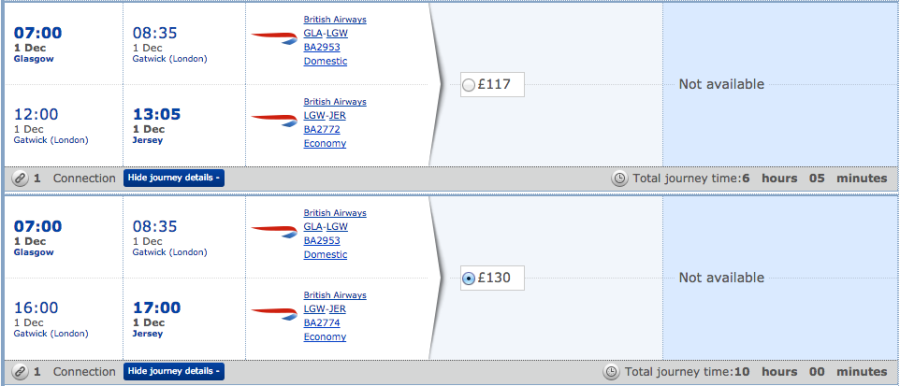
The UK government generally views flights as "connected" (its term) for the purposes of determining APD if the connecting flight leaves within six hours for domestic flights or 24 hours for international flights. As a result, a flight from Glasgow to Jersey (via London) would incur an additional fee of £13 if the connection is longer than six hours, since your itinerary is treated as two separate departures from the country:
Meanwhile, a flight from Glasgow to Amsterdam (via London) would only incur an additional APD if you stop in London for more than 24 hours.
This 24-hour rule is also used when connecting in other countries. Let's say you wanted to fly from London to Beijing. If you build in a stopover of more than 24 hours in just about any city in Europe, you'll wind up paying the lower (Band A) APD. However, if your connecting flight leaves within 24 hours (or you connect in the Middle East or Asia), you'll get hit with the higher amount.
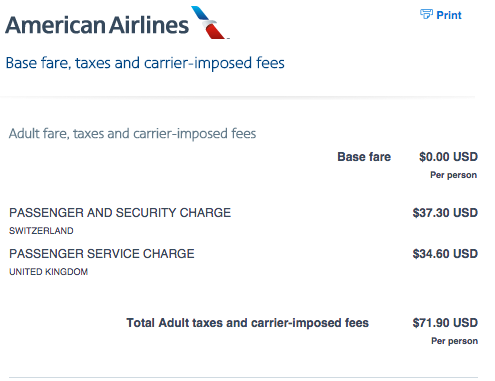
Unfortunately, you may find yourself paying APD on some flights that start in other countries and connect through the UK as well. The key benchmark is that six-hour connection rule. For example, if you used American miles to fly from Zurich to Edinburgh (via London) with a short layover, you'd pay ~$72 in taxes & fees:
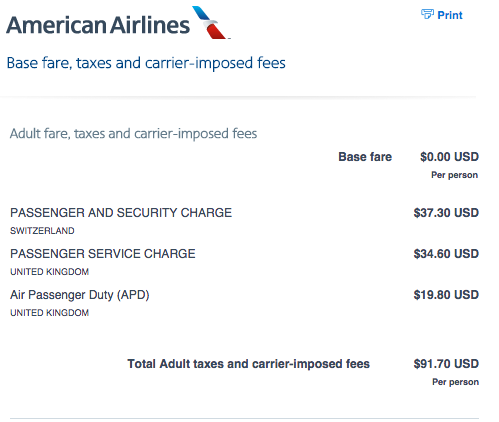
However, if that layover was extended to more than six hours, you'd then become subject to the APD:
For complete details on all of the ins and outs of the Air Passenger Duty, be sure to check out the Excise Notice 550 page on the UK government's website.
2. Passenger Service Charge
The second added fee to flights departing from or connecting through the UK is a charge for departing from or transiting through British airports. You're required to pay this on all tickets that originate in the UK, as well as all itineraries that connect through a UK airport. Again, this isn't an added surcharge by the airline. Airports actually charge airlines for the facilities used by their passengers, and like the APD, these costs are then passed on to customers.
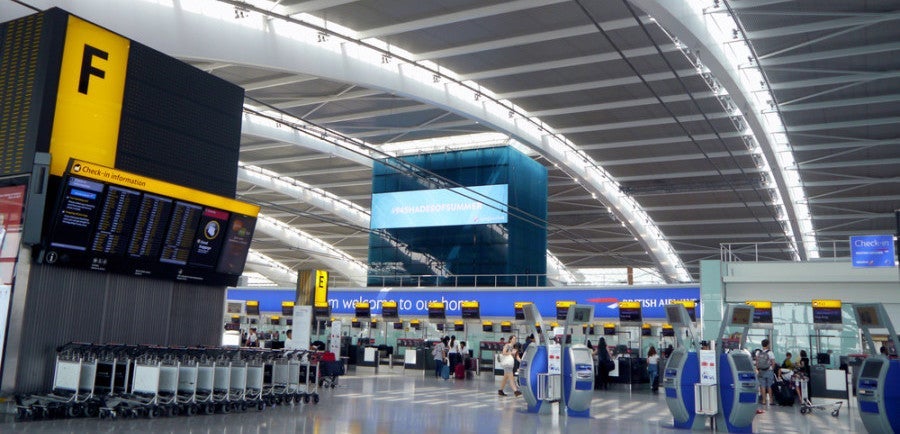
The nice thing is that these charges are constant across all classes of travel, so you won't get gouged for booking a premium award. However, these charges vary significantly depending on the airport, destination and routing, and I couldn't find a comprehensive list anywhere (here's the corresponding page of the UK Civil Aviation Authority — as you can see, it's essentially useless).
Here's a sample of what you'd pay for nonstop flights to the US from various UK airports:
Departure Airport | Passenger Service Charge |
|---|---|
London-Heathrow | £42.06 (~$64) |
London-Gatwick | £12.66 (~$19) |
Manchester | £15.70 (~$24) |
Edinburgh | £13.45 (~$20) |
Glasgow | £12.80 (~19) |
Belfast | £17.70 (~$27) |
As you can see, London-Heathrow is the biggest offender, but you'll still pay close to $20 when traveling out of all other airports.
Things get a bit more confusing with connecting flights. Let's go back to my friend's flight from London-Heathrow to Philadelphia on January 9. For the nonstop flight, she'd incur a £42.06 Passenger Service Charge, or roughly $64. However, if she were connecting to that flight, the charges are different:
- From Edinburgh: £43.34 (~$66)
- From Manchester: £43.52 (~$66)
- From Amsterdam: €42.98 (~$48)
Even from the less-trafficked airports like Gatwick and Glasgow, the Passenger Service Charge can still be a decent chunk of change (especially compared with flights originating in the US).
3. Carrier-imposed charges
The third and final category of additional charges (and most nefarious, I might add) consists of fees imposed by the individual carrier. These could be related to anything, but the most common type of fees added by carriers are fuel surcharges. This is not specific to the UK, such as the previous two categories, as many frequent flyer programs will charge these fees for award tickets on a variety of airlines. However, the two main British-flagged carriers (British Airways and Virgin Atlantic) are two of the worst offenders out there.
Let's stick with my friend's example above. On January 9, there are three nonstop flights from London-Heathrow to Philadelphia bookable with American miles. One is operated by American while the other two are operated by British Airways. Here are the fuel surcharges added to the flights on British Airways metal:
- Economy: $124.30
- Business or First: $205.20
If you book the flights on American metal, you avoid these fees entirely (though you'll still need to pay the APD and Passenger Service Charge).

Virgin Atlantic is neck-and-neck with British Airways when it comes to these additional costs. Here are the fuel surcharges it adds to a one-way award ticket from London-Heathrow to New York-JFK:
- Economy and Premium Economy: £81.50 (~$124)
- Upper Class: £134.50 (~$204)
What makes matters even worse is that these charges apply not only to flights out of the UK, British Airways and Virgin Atlantic tack them on to all award flights.
Back in December, TPG reader Donald asked about these charges, wondering how British Airways justified these fees given the declining price of oil. Unfortunately, there isn't really any rationale from the consumer point of view. If they were honestly tied to the price of jet fuel, we would see more carriers following Qantas' lead and cutting these as the price of oil drops. Sadly, that isn't the case, as carriers like British Airways and Virgin Atlantic have recognized the additional revenue these charges generate on award tickets while simultaneously decreasing the revenue they need to report on paid tickets. A win-win for the airlines is a lose-lose for consumers.
Fortunately, there are ways to avoid these onerous fees, so be sure to check out Jason Steele's post on avoiding fuel surcharges on award tickets from last year for complete details.

Bottom Line
The points and miles hobby can be an incredibly rewarding one, but for those of you who think we travel the world for free, think again! Government taxes, airport fees and carrier-imposed surcharges can take a big bite out of your bank account when booking award flights, and flights involving the UK are among the worst offenders in this regard. Although you can get creative with avoiding fuel surcharges, the Air Passenger Duty and Passenger Service Charge you pay for departing from or transiting through a British airport are here to stay, at least for the time being.
What are your thoughts on these charges?
TPG featured card

at Capital One's secure site
Terms & restrictions apply. See rates & fees.
| 5X miles | Earn 5X miles on hotels, vacation rentals and rental cars booked through Capital One Travel |
| 2X miles | Earn unlimited 2X miles on every purchase, every day |
Pros
- Stellar welcome offer of 75,000 miles after spending $4,000 on purchases in the first three months from account opening. Plus, a $250 Capital One Travel credit to use in your first cardholder year upon account opening.
- You'll earn 2 miles per dollar on every purchase, which means you won't have to worry about memorizing bonus categories
- Rewards are versatile and can be redeemed for a statement credit or transferred to Capital One’s transfer partners
Cons
- Highest bonus-earning categories only on travel booked via Capital One Travel
- LIMITED-TIME OFFER: Enjoy $250 to use on Capital One Travel in your first cardholder year, plus earn 75,000 bonus miles once you spend $4,000 on purchases within the first 3 months from account opening - that’s equal to $1,000 in travel
- Earn unlimited 2X miles on every purchase, every day
- Earn 5X miles on hotels, vacation rentals and rental cars booked through Capital One Travel
- Miles won't expire for the life of the account and there's no limit to how many you can earn
- Receive up to a $120 credit for Global Entry or TSA PreCheck®
- Use your miles to get reimbursed for any travel purchase—or redeem by booking a trip through Capital One Travel
- Enjoy a $50 experience credit and other premium benefits with every hotel and vacation rental booked from the Lifestyle Collection
- Transfer your miles to your choice of 15+ travel loyalty programs
- Top rated mobile app