Disneyland unlikely to reopen anytime soon -- here's why


It's no secret that Florida's and California's approaches to reopening during the COVID-19 pandemic have been as different as east and west could be. Theme parks have felt that difference as much as, if not more than, any other type of business.
While Walt Disney World in Orlando, Florida reopened this past July after four months of closure, Disneyland in Anaheim, California has been waiting three additional months for its turn -- and it doesn't seem that the gates will reopen anytime soon.
Yesterday, California health officials finally released the state's long-awaited theme park reopening guidelines. If Disneyland had any hopes of 2020 reopening, those hopes have probably been dashed with those announcements.
Sign up for the free daily TPG newsletter for more travel news, tips and advice.
Unless something radically changes, Disneyland will likely have to wait quite a bit longer for its Orange County home to hit the metrics required for theme park reopening, perhaps well into 2021. Many other larger theme parks in the state like Universal Hollywood, Legoland California, and Sea World San Diego are in a similar boat.
Here's a look at why we don't expect Disneyland to be allowed to reopen for quite some time.

Understanding California's Blueprint for a Safer Economy
Before understanding California's theme park guideline specifics, it's important to understand the state's general economic reopening framework. Back in August 2020, California's Governor Gavin Newsom unveiled the Blueprint for a Safer Economy.
This plan creates four colored tiers based on virus spread -- purple (widespread risk), red (substantial risk), orange (moderate risk), and yellow (minimal risk). Counties are assigned to one of these risk tiers based upon their COVID-19 case rates per 100,000 residents and their overall test positivity rate.
More recently, the state added a health equity metric to the calculus to ensure that counties were adequately testing their most at-risk populations. This may sound like nitty-gritty info but stick with me as it is very related to the gates of Disneyland reopening -- or staying shut.

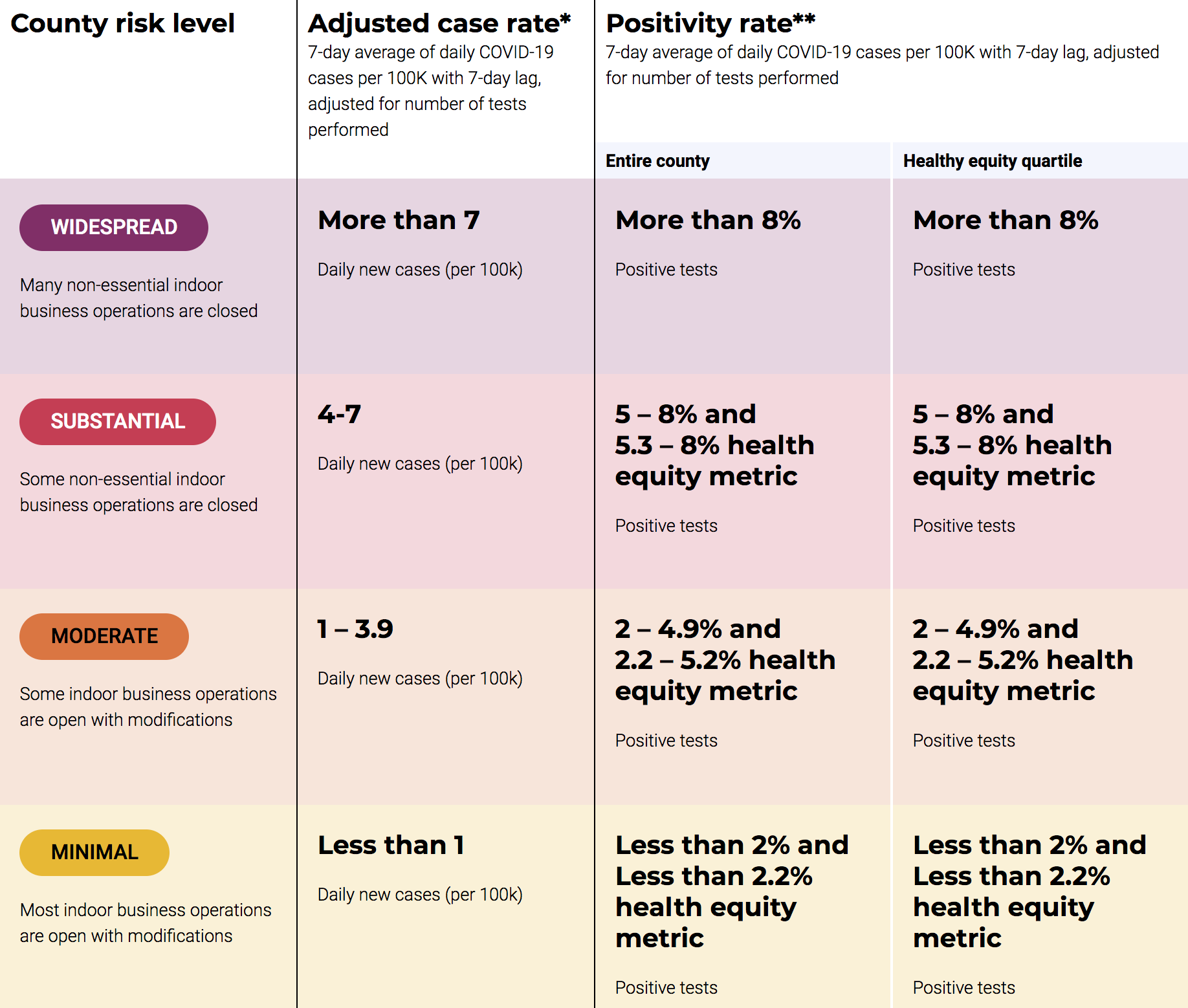
As a county moves down through the tiers, more businesses are allowed to reopen and with increasing capacity.
To use restaurants as an example, only outdoor dining and takeout are permitted when a county is in the purple tier. At red, counties can reopen indoor dining at 25% capacity. Restaurants can further increase indoor capacity to 50% capacity when their county moves to orange.
Related: A state-by-state reopening travel guide
California's new theme park guidelines
Uniti now, theme parks had not even been given a place in this colored tier system. These businesses were left entirely in the dark when trying to target opening dates and potential operating restrictions. California's theme park guidelines released yesterday finally placed theme parks in the colored tier framework.
The guidelines distinguish between smaller local theme parks and the bigger players like Disneyland and Universal.
Smaller theme parks are defined as ones with an operating capacity of no more than 15,000 guests. These parks may reopen outdoor attractions only when their home county is in the orange (moderate) tier. Capacity is set at 25% or 500 people, whichever is less, and the theme parks are only permitted to admit guests who reside in the same county.
In contrast, larger theme parks must wait until their home county is in the lowest risk yellow tier before reopening at all.
While guests at these large theme parks won't be limited based upon residence, park capacity will be limited to 25%. While that capacity is likely in line with Disney World is doing right now, the main reopening problem lies with the tier in which Disneyland's home county resides.
Disneyland is located in Orange County, and the OC is currently classified in the red tier.
That means that in order for Disneyland to reopen, Orange County must move down not one, but two tiers. As you may imagine, movement between the tiers is not swift or easy. Counties must first maintain the metrics to move down a tier for two full weeks before moving. They can move down again no sooner than three weeks later. That means the very best-case scenario for a Disneyland reopening could like this:
- Tuesday, October 27: OC posts numbers to meet the orange tier requirements
- Tuesday, November 10: OC moves to orange tier, begins to post numbers to meet yellow tier requirements
- Tuesday, December 1: OC can move to yellow tier
But that's just the on-paper perfect-case scenario that could happen if the case numbers could really start to go down quickly.
Given real-world variables and realities, when will Disneyland actually reopen?
Even under the best real-world scenario, a 2020 reopening seems all but certainly off the table with yesterday's announcements. On top of that, Disney has always indicated it will likely need at least several weeks after being cleared to reopen to bring back and re-train cast members.
Related: What to expect at a reopened Disney World hotel

And of course, all of this depends on Orange County being able to decrease its COVID numbers. And unfortunately, Orange County's most recent statistics from earlier this week are trending in an upward direction. Orange County residents and businesses will have to work together and really increase their vigilance to get numbers down enough for large theme parks to resume operations.
Practically speaking, very few California counties have managed to control COVID cases enough to move into the yellow tier.
Until just this week, only rural and sparsely populated counties made that grade. San Francisco County is the first urban county to make the move to the yellow tier just yesterday. But San Francisco is unique in its geographic size, wealth, and demographics.
Whether other larger urban counties can match San Francisco's success before a vaccine is widely distributed is very much an open question. Orange County's Public Health Officer Clayton Chau has gone on record to state that he thinks his county may well be unable to meet this tier requirement until the summer of 2021.
Related: Disney Parks revenue down $3.5 billion
Responses to the theme park guidelines
As might be expected, Disney has not warmly received these guidelines.
In recent weeks, Disney has begun to openly challenging the state. The Chairman of Disney Parks, Experiences & Products Josh D'Amaro partially blamed Disney's recent layoffs of 28,000 employees on the economic uncertainty created by California's failure to lift restrictions on Disneyland. A few days later on October 1, Bob Iger, the Chairman of the Walt Disney Company, resigned from Governor Newsom's coronavirus task force. Relations between the Governor's office and Disney officials have been deteriorating for some time.
Disney's reaction to the new California theme park guidelines came in a similar pointed fashion.
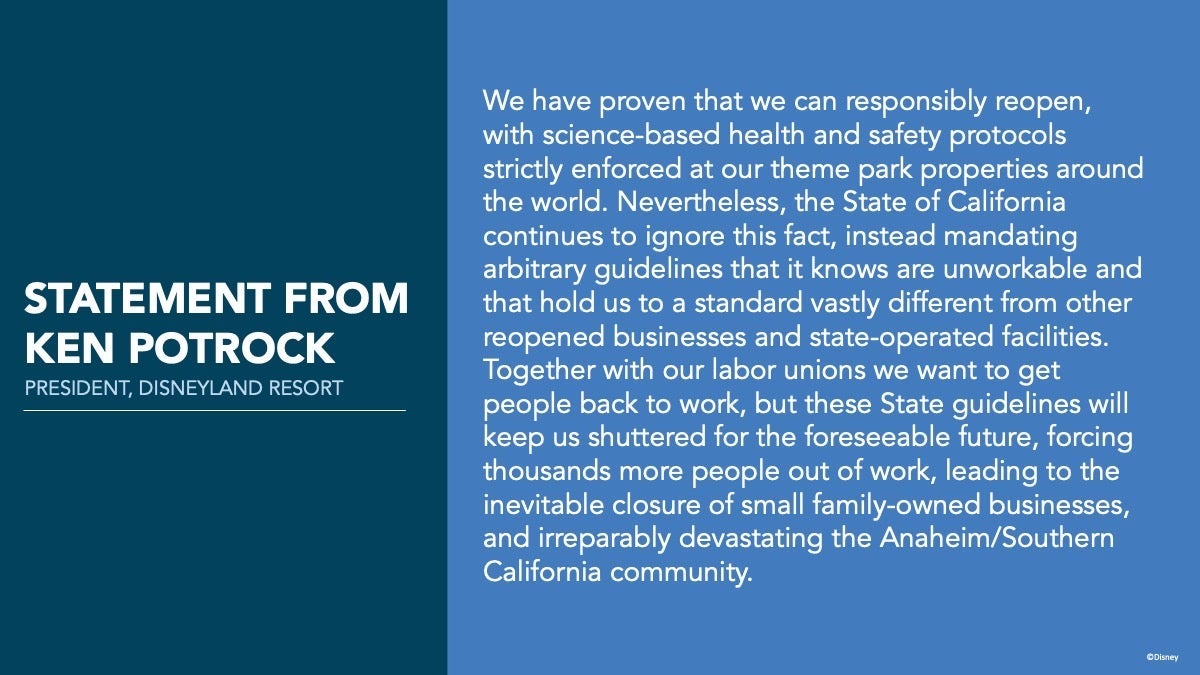
Disneyland's president Ken Potrock criticized the state's position as being unworkable and harmful economically to the region, as follows:
Disneyland has a number of allies taking a similar position in criticizing these new guidelines. Disneyland's major unions had already gone on record with their commitment to reopening under the orange tier just the day before the theme park guidelines were released.
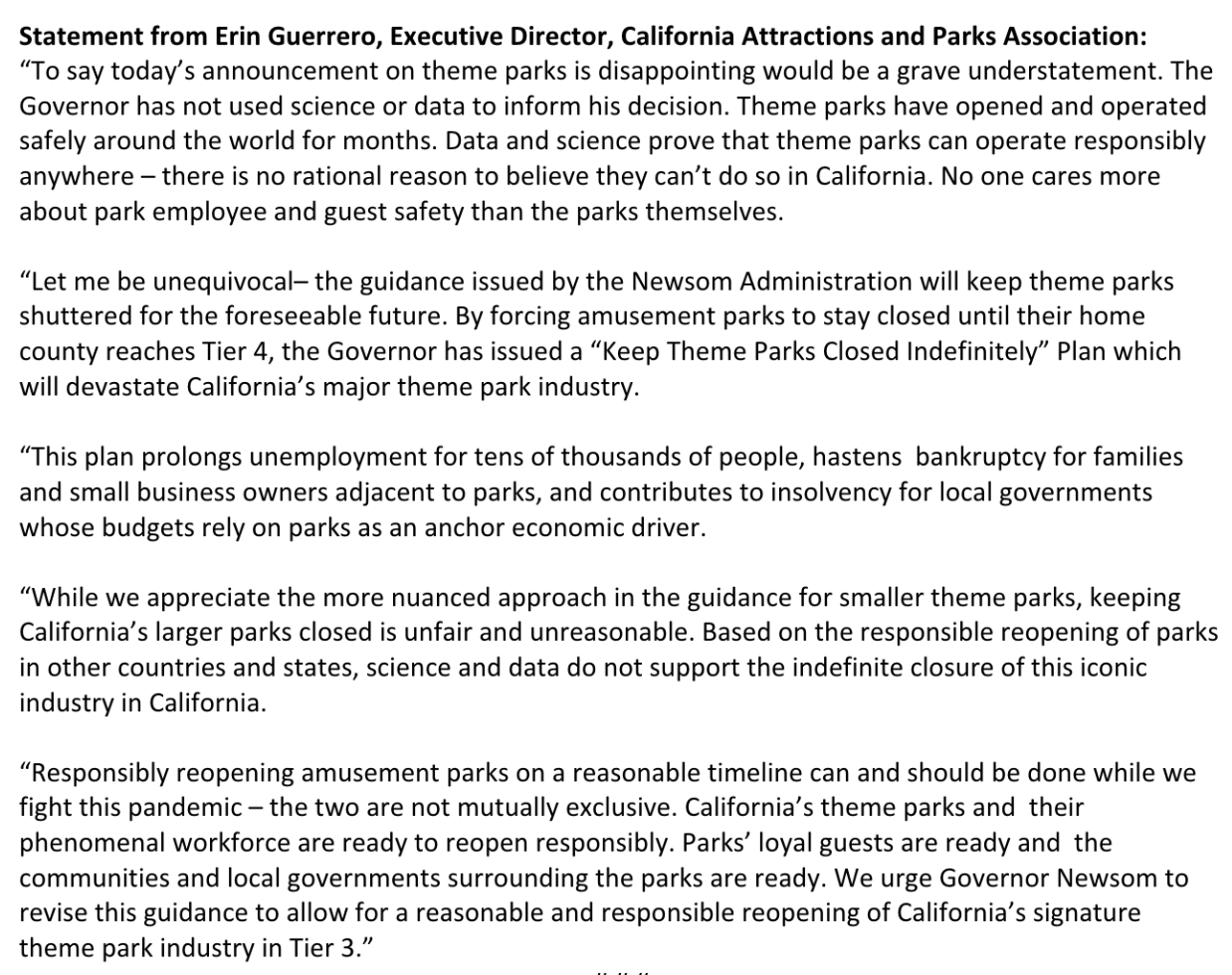
California's theme parks have banded together to issue a joint statement by the California Attractions and Parks Association, with individual statements from Disneyland, Cedar Fair (operator of California's Great America, Knott's Berry Farm, and Gilroy Gardens), Six Flags Magic Mountain, and Legoland California. The organization's executive director states:
Anaheim and Orange County government officials have also joined these theme parks in expressing their ongoing disappointment and concern, largely for the further economic uncertainty this decision brings for the local economy and residents.
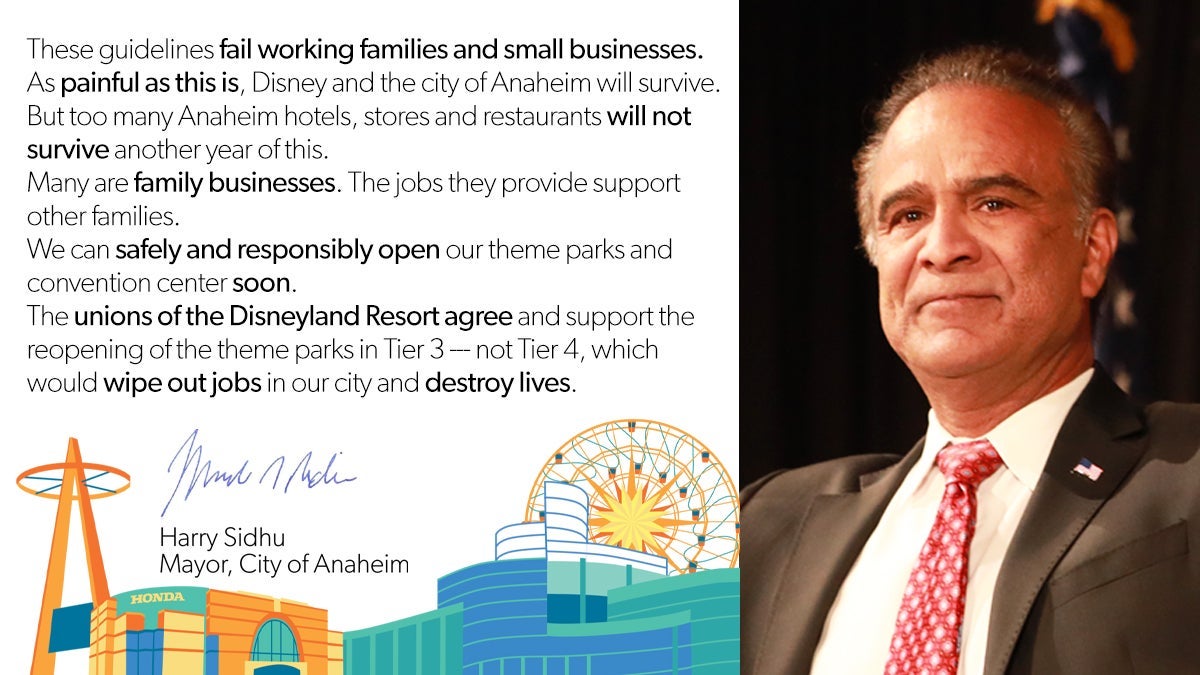
Anaheim's Mayor echoed the Disneyland unions' preference for a reopening in the orange tier:
What comes next for Disneyland and California theme parks?
With both sides pretty deeply entrenched, it seems likely this issue is far from settled. Whether further negotiations between Disneyland and state officials are even on the table as a near-term possibility is highly unclear.
Many are wondering whether Disney and other theme parks are considering legal action against the Governor. Many businesses in other sectors have already filed litigation contesting the equitability and constitutionality of the state's reopening framework.
And while naturally, this announcement is likely disappointing to would-be Disneyland guests who are more than ready to put on their face masks and again enter the "Happiest Place on Earth", there are also thousands of people whose jobs and businesses rely on Disneyland being open who's future now hangs in the balance.
For anyone in the U.S. looking for a Disney-fix in 2020, Disney World in Florida is looking like the only option.
TPG featured card

at Capital One's secure site
Terms & restrictions apply. See rates & fees.
| 5X miles | Earn 5X miles on hotels, vacation rentals and rental cars booked through Capital One Travel |
| 2X miles | Earn unlimited 2X miles on every purchase, every day |
Pros
- Stellar welcome offer of 75,000 miles after spending $4,000 on purchases in the first three months from account opening. Plus, a $250 Capital One Travel credit to use in your first cardholder year upon account opening.
- You'll earn 2 miles per dollar on every purchase, which means you won't have to worry about memorizing bonus categories
- Rewards are versatile and can be redeemed for a statement credit or transferred to Capital One’s transfer partners
Cons
- Highest bonus-earning categories only on travel booked via Capital One Travel
- LIMITED-TIME OFFER: Enjoy $250 to use on Capital One Travel in your first cardholder year, plus earn 75,000 bonus miles once you spend $4,000 on purchases within the first 3 months from account opening - that’s equal to $1,000 in travel
- Earn unlimited 2X miles on every purchase, every day
- Earn 5X miles on hotels, vacation rentals and rental cars booked through Capital One Travel
- Miles won't expire for the life of the account and there's no limit to how many you can earn
- Receive up to a $120 credit for Global Entry or TSA PreCheck®
- Use your miles to get reimbursed for any travel purchase—or redeem by booking a trip through Capital One Travel
- Enjoy a $50 experience credit and other premium benefits with every hotel and vacation rental booked from the Lifestyle Collection
- Transfer your miles to your choice of 15+ travel loyalty programs
- Top rated mobile app