JetBlue Card review: No annual fee, but also few perks



Editor's Note
JetBlue Card overview
No-annual-fee airline cards typically don't come with many perks, and the JetBlue Card is no exception. However, with no foreign transaction fees, discounts on inflight purchases and bonus earnings on three spending categories, it's still a decent option for occasional JetBlue travelers. Card rating*: ⭐⭐⭐
*Card Rating is based on the opinion of TPG's editors and is not influenced by the card issuer.
While JetBlue has historically been a smaller airline in the U.S. than the likes of American, Delta and United, the New York City-based carrier is making moves to cement itself as a major player. And with free snacks, free Wi-Fi and a reputation for customer-centric service, JetBlue has a lot going for it.
When it comes to credit cards, there are two JetBlue flavors: the no-annual-fee JetBlue card, with a recommended credit score of 670, and the $99-annual-fee JetBlue Plus card.
I'm going to dive into the no-annual-fee JetBlue Card to see if it's the right fit for you.
The information for the JetBlue Card and JetBlue Plus Card has been collected independently by The Points Guy. The card details on this page have not been reviewed or provided by the card issuer.
JetBlue Card pros and cons
| Pros | Cons |
|---|---|
|
|
JetBlue Card welcome offer
First, the good news is that there is a welcome bonus on this card.
However, the bad news is that the current bonus is modest at best: 10,000 bonus points after spending $1,000 on purchases in the first 90 days.
According to TPG's December 2024 valuations that peg TrueBlue points at 1.3 cents apiece, the bonus is worth just $130.

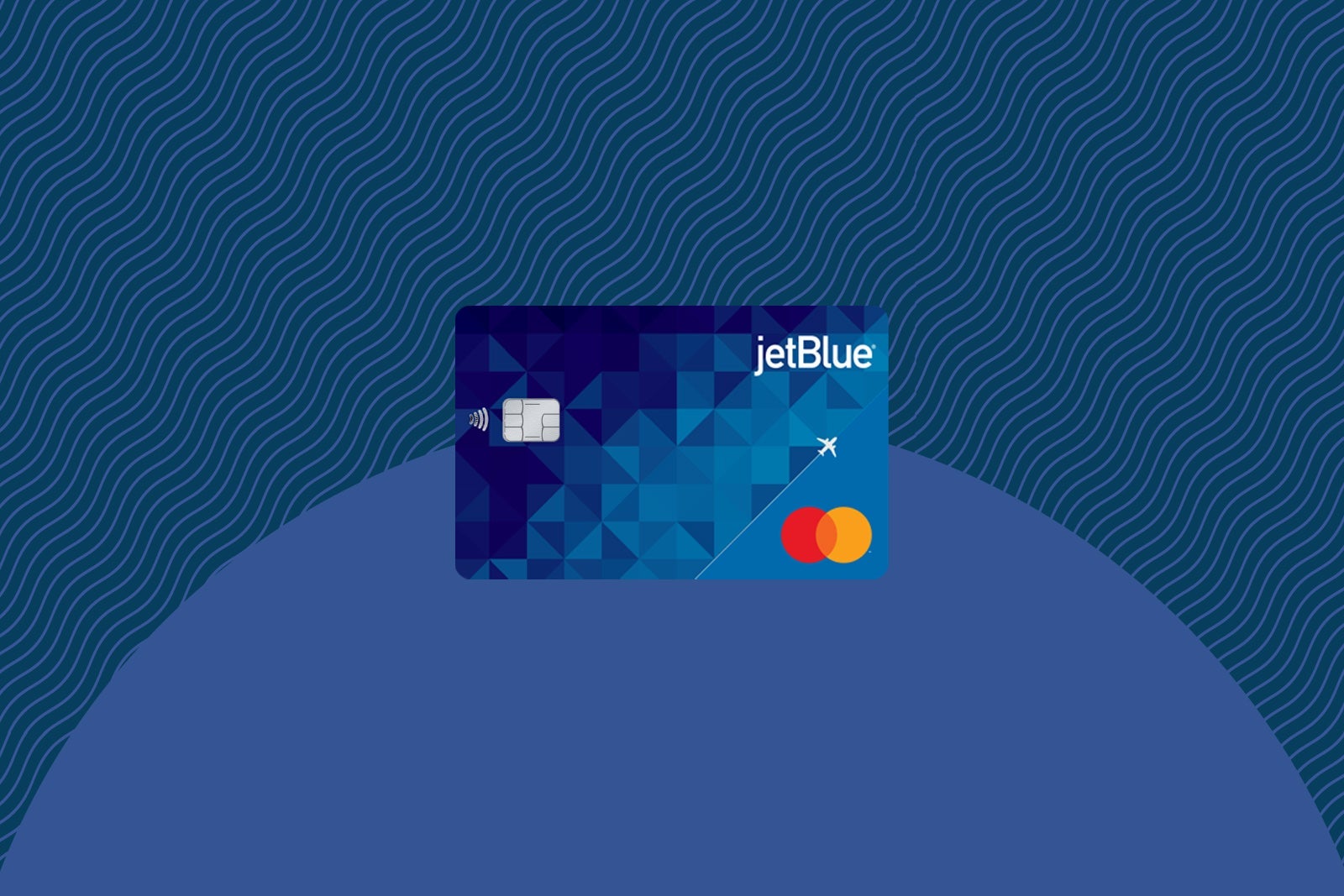
Again, JetBlue's other credit card option — the JetBlue Plus card — is a much more compelling option if a generous welcome bonus is what you're after.
JetBlue Card benefits
The JetBlue Card's list of perks and benefits is fairly slim, which is unsurprising for a no-annual-fee card.
One of the top advantages of this card is a 50% inflight savings on food and beverage purchases when you use the card to pay.

Additionally, the JetBlue card has no foreign transaction fees, $0 fraud liability protection and the ability to pool points with family and friends. This feature can help you attain award tickets more easily, making it a nice perk to have on a no-annual-fee card.
Earning points on the JetBlue Card
On the earning side, you'll get 3 TrueBlue points per dollar on JetBlue purchases, 2 points per dollar on restaurants and grocery stores and 1 point per dollar on everything else.

Based on our December 2024 valuations, that equals a 3.9% return on JetBlue spending, 2.6% on dining and groceries and 1.3% on everything else. For comparison, the JetBlue Plus Card offers twice as many points on JetBlue purchases.
It's also worth noting that as a TrueBlue member, you'll earn at least 2 base points per dollar on JetBlue flights booked directly on top of the 3 points you'll earn through the card.
Related: Complete guide to earning points in the JetBlue TrueBlue program
Redeeming points on the JetBlue Card
The TrueBlue program is revenue-based, meaning your points have a (mostly) fixed value.
That means you can redeem points for any seat, including JetBlue Mint seats, across JetBlue's entire route network and get a fairly consistent value from your points. The more a flight costs in cash, the more it will cost in points.

If you're like TPG credit cards editor Emily Thompson and love simplicity, this can be a benefit. Still, there typically aren't ways to get outsize value from your TrueBlue points — unlike other programs that use award charts or have dynamic award pricing.
Transferring points with the JetBlue Card
JetBlue partners with a handful of different airlines, but currently, you can only redeem TrueBlue points on four of them: Cape Air, Etihad Airways, Hawaiian Airlines and Qatar Airways.

Additionally, while you can't redeem TrueBlue points for hotels or rental cars, you can redeem them for discounts on JetBlue Vacations.
Which cards compete with the JetBlue Card?
Several general travel cards compete with the JetBlue Card, including:
- If you want more perks: The JetBlue Plus Card has a $99 annual fee and benefits like the first checked bag free, a 5,000-point bonus every cardmember anniversary year and more. You can also use the card's Points Payback feature to redeem points for a statement credit of up to $1,000 annually. To learn more, read our full review of the JetBlue Plus.
- If you prefer Capital One: The Capital One Venture Rewards Credit Card earns 5 miles per dollar on hotels, vacation rentals and rental cars booked through Capital One Travel and 2 miles per dollar on all purchases for a reasonable $95 annual fee. To learn more, read our full review of the Capital One Venture Rewards Credit Card.
- If you prefer Chase: The Chase Sapphire Preferred® Card (see rates and fees) has a $95 annual fee and earns 5 points per dollar on travel booked through Chase Travel℠, 3 points per dollar on dining and 2 points per dollar on all travel not booked through Chase Travel. To learn more, read our full review of the Sapphire Preferred.
For additional options, check out our full list of the top travel rewards cards.
Related: Chase Sapphire Preferred vs. Capital One Venture Rewards
Is the JetBlue Card worth it?
The JetBlue Card is a decent, albeit uninspiring, product for occasional JetBlue flyers who want to avoid an annual fee. However, most JetBlue loyalists will want to skip this card in favor of the JetBlue Plus Card. Even with an annual fee, the JetBlue Plus Card's list of more valuable benefits makes it the superior option.
Bottom line
If you want to earn JetBlue points without paying an annual fee, the JetBlue Card is a way to do so. Still, most JetBlue loyalists will get far more value from the JetBlue Plus Card instead.
Plus, keep in mind that you can also transfer points to JetBlue from most of the major transferable points programs, meaning you can rack up JetBlue points without having either of the JetBlue cards.
Related: JetBlue TrueBlue program: Earn and redeem points, transfer partners and more
TPG featured card

at Capital One's secure site
Terms & restrictions apply. See rates & fees.
| 5X miles | Earn 5X miles on hotels, vacation rentals and rental cars booked through Capital One Travel |
| 2X miles | Earn unlimited 2X miles on every purchase, every day |
Pros
- Stellar welcome offer of 75,000 miles after spending $4,000 on purchases in the first three months from account opening. Plus, a $250 Capital One Travel credit to use in your first cardholder year upon account opening.
- You'll earn 2 miles per dollar on every purchase, which means you won't have to worry about memorizing bonus categories
- Rewards are versatile and can be redeemed for a statement credit or transferred to Capital One’s transfer partners
Cons
- Highest bonus-earning categories only on travel booked via Capital One Travel
- LIMITED-TIME OFFER: Enjoy $250 to use on Capital One Travel in your first cardholder year, plus earn 75,000 bonus miles once you spend $4,000 on purchases within the first 3 months from account opening - that’s equal to $1,000 in travel
- Earn unlimited 2X miles on every purchase, every day
- Earn 5X miles on hotels, vacation rentals and rental cars booked through Capital One Travel
- Miles won't expire for the life of the account and there's no limit to how many you can earn
- Receive up to a $120 credit for Global Entry or TSA PreCheck®
- Use your miles to get reimbursed for any travel purchase—or redeem by booking a trip through Capital One Travel
- Enjoy a $50 experience credit and other premium benefits with every hotel and vacation rental booked from the Lifestyle Collection
- Transfer your miles to your choice of 15+ travel loyalty programs
- Top rated mobile app