There are a few things people warn you about when you travel: keep your money and your passport close, never leave your luggage unattended and make sure to get up and move around on long-haul flights.
As a travel editor, I’ve heard it all — mostly from the mouths of concerned friends and family members. But nonetheless, I've always taken the advice with a grain of salt. After all, I’ve worked in travel media for half a decade, and have written many articles offering that same advice to readers.
Unlike many travelers, I get excited (not stressed), when I enter an airport. I don’t at all mind living out of a suitcase, and long flights — even a previous 18-hour odyssey to Kenya — don’t bother me in the slightest.
Though I’m definitely not a nervous traveler, there is one thing that has always terrified me: the possibility of developing Deep Vein Thrombosis, or DVT.
My colleagues and I have had extensive conversations about the matter, discussing the likelihood of it actually happening to one of us. We always suppressed the concern, noting that DVT mostly affects travelers with preexisting conditions, or passengers who don’t move at all during flights of eight hours or more. Armed with this knowledge, I always try to stretch before a flight, pedal my feet every once in a while and take a walk or two to the lavatory while at altitude. But still, the concern about getting a blood clot on a flight has always loomed in the back of my mind.
And three weeks ago, that fear became a reality.
Let me pause here to share a few things you should know about me: I’m 29 years old, healthy, active — and a serious champ at sleeping on airplanes.
On a recent trip to Iceland, I managed to doze for most of the flight there, and landed rested and ready for adventure. My friends and I spent a week exploring the island nation, including five days backpacking across the country’s Snæfellsnes Peninsula and Landmannalauger trail. We climbed up and over volcanoes, craters and mountains. We bathed in hot springs and marveled at Iceland's strange, striking landscape. Simply put, it was an amazing trip — but utterly exhausting.
On the overnight flight home from Iceland's Keflavík International Airport (KEF) to New York City (JFK), I quickly settled into my not-so-spacious WOW Air seat and, once again, fell asleep. This time, unfortunately, it landed me in the emergency room.
As usual I woke up to the “prepare for landing” announcement, some six hours later. I uncrossed my legs and stretched my feet out under the seat in front of me. I immediately noticed that my calves were a bit sore. For a split second, I thought it might be a blood clot, though I quickly dismissed it as a flare-up of paranoia. After all, I reasoned, I had just hiked around Iceland, and it would make sense for my legs to ache.
When we began our descent, I starting to feel a little funny, and thought I might be dehydrated. I gulped some water and got up to use the restroom. My seat was next to the wing, so I had to walk about half the length of the plane to get to the lav. As I did, I began to get very hot and dizzy. I quickly sat down in an empty seat in the front row and asked the flight attendant for an orange juice.
Because we were on WOW Air, of course, the flight attendant first asked me for my credit card. I quickly told her I didn’t have it on me and asked if I could — please and thank you — pay later, because I felt like I was going to pass out. She obliged.
Things started to go fuzzy around me I drank the juice with shaky hands. After about 15 minutes I began to recover, and headed back to my seat for landing. (Come to think of it, I never did pay for that OJ.)
A little freaked out but feeling better, I deplaned and headed for customs. As I walked through the airport I noticed my left leg was now really hurting. I looked at one of my friends and said, “I must have pulled my calf when we were hiking,” and then continued on my way. We headed home, but the pain became increasingly more severe.
Our flight landed on a Monday, and I spent the next two days dismissing my calf pain as a pulled muscle. But the pain intensified. It felt as though I had a charley horse in my leg. By Thursday I was limping and fidgeting in meetings, trying without success to get comfortable. When I got home that evening I told my boyfriend, Jim, about the pain, and how it was getting worse. He leaned down to massage my leg and as he pressed down, I jumped, and immediately started crying.
It. Hurt. So. Bad.
Jim asked if it could be something else, and I let the scary thought of a blood clot resurface. I told him I was probably being neurotic, but maybe, just maybe...
Like any good millennials would do (I hate that we fall into that category, but here we are), we Googled the symptoms for a blood clot. The list was as follows:
Swelling — no.
Redness — no.
Severe calf pain — yes.
Worsening pain — yes.
Recently immobile or on a plane — yes.
Damn.
It was around 11:00pm, but we decided it was worth going to the ER. After a blood test, a shot of blood thinner and an ultrasound, doctors confirmed I had indeed developed a blood clot in the deep veins of my calf. Otherwise known as (you can probably guess where this is going) deep vein thrombosis.
I stayed in the hospital for monitoring to make certain the clot didn’t move to my lungs or to my heart. After a while I was sent home with a month's worth of blood thinners, directions to stay active and a long lists of X-rays and tests I had to endure to determine the cause — and to make sure there wasn’t some underlying condition that had triggered the clot.
After a battery of tests and an appointment with a hematologist, it was determined, thankfully, that there was no underlying condition. I had simply fallen asleep so deeply with my legs crossed on the plane that I didn’t move enough, and a clot formed. A freak accident, if you will.
“We look to see if it was provoked or unprovoked. In this case, it was provoked,” my doctor (who prefers to remain anonymous) told me during a follow-up. He cited the nap on the plane as the culprit, and went on to explain that DVT can occur even after just four hours of immobility.
You’re probably thinking what I was: “But wait, don’t we sleep for more than four hours at a time? How come we don’t get blood clots every night?” The answer is that our bodies naturally move around during sleep. When we are confined to a small space, such as a car or a cramped airplane seat, our bodies don’t have that freedom.
So how can you prevent this from happening? My doctor had a few suggestions.
Exercise at your seat
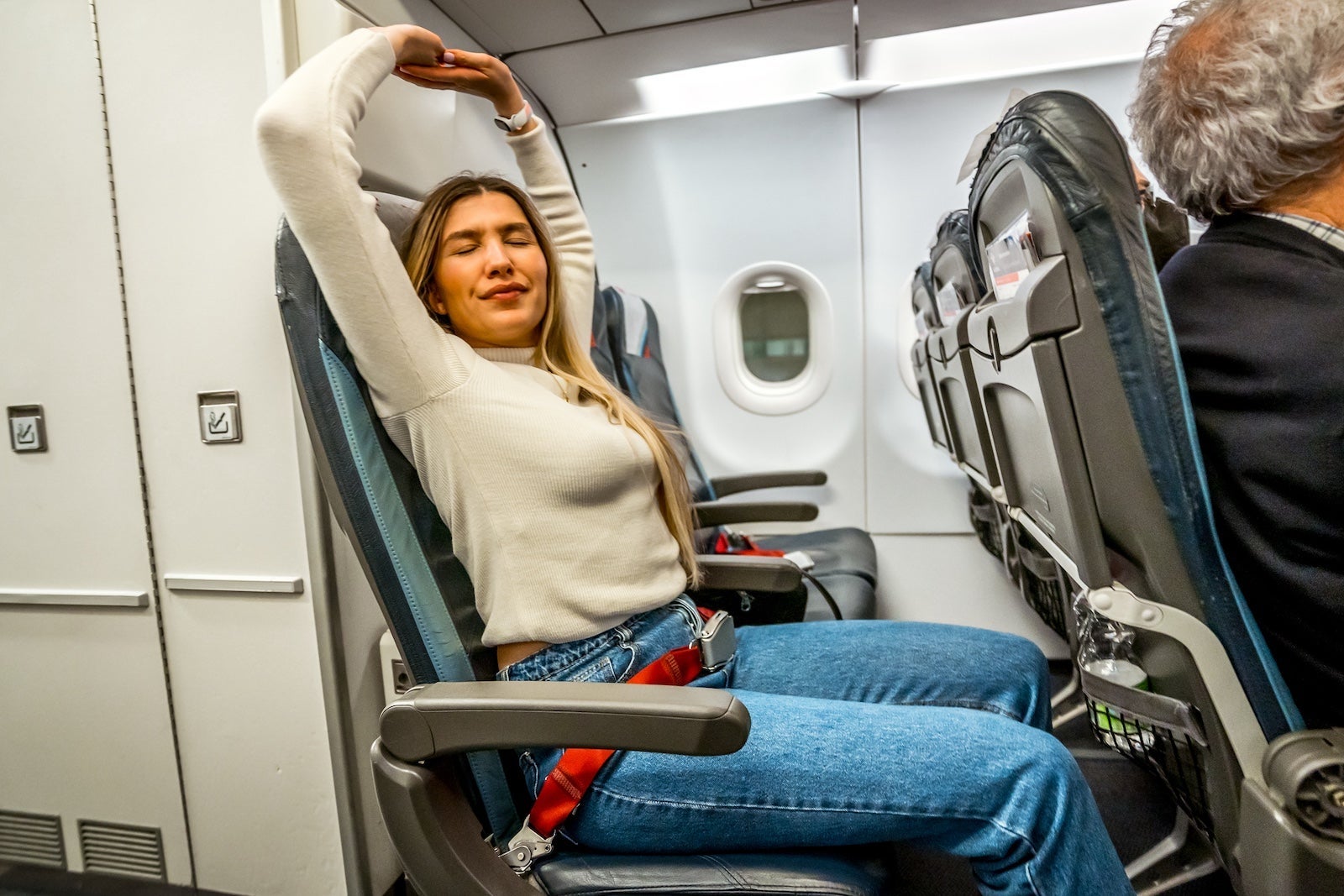
Whether you’re in first class or in economy, roll your ankles regularly and pedal your feet back and forth a dozen or so times each. This will get the blood flowing again, and circulate the blood that can pool in your lower legs back up through your veins.
Get up every hour
They say the length of time during which a blood clot can actually develop is much shorter than most people think — approximately four hours of immobility is when your risk increases. Get up every hour to stretch your legs. Take a walk to the lav. Even the short stroll down the aisle will help keep the blood flowing.
Familiarize yourself with the symptoms
The greatest danger associated with a blood clot in your leg is that it can dislodge and move to your heart or lungs, causing life-threatening conditions. Take a minute to memorize the symptoms of DVT (swelling, redness, pain), and if you think you could have a clot, seek medical attention immediately to prevent additional complications.