What is pickleball on cruises? Here's which lines are jumping on the growing trend

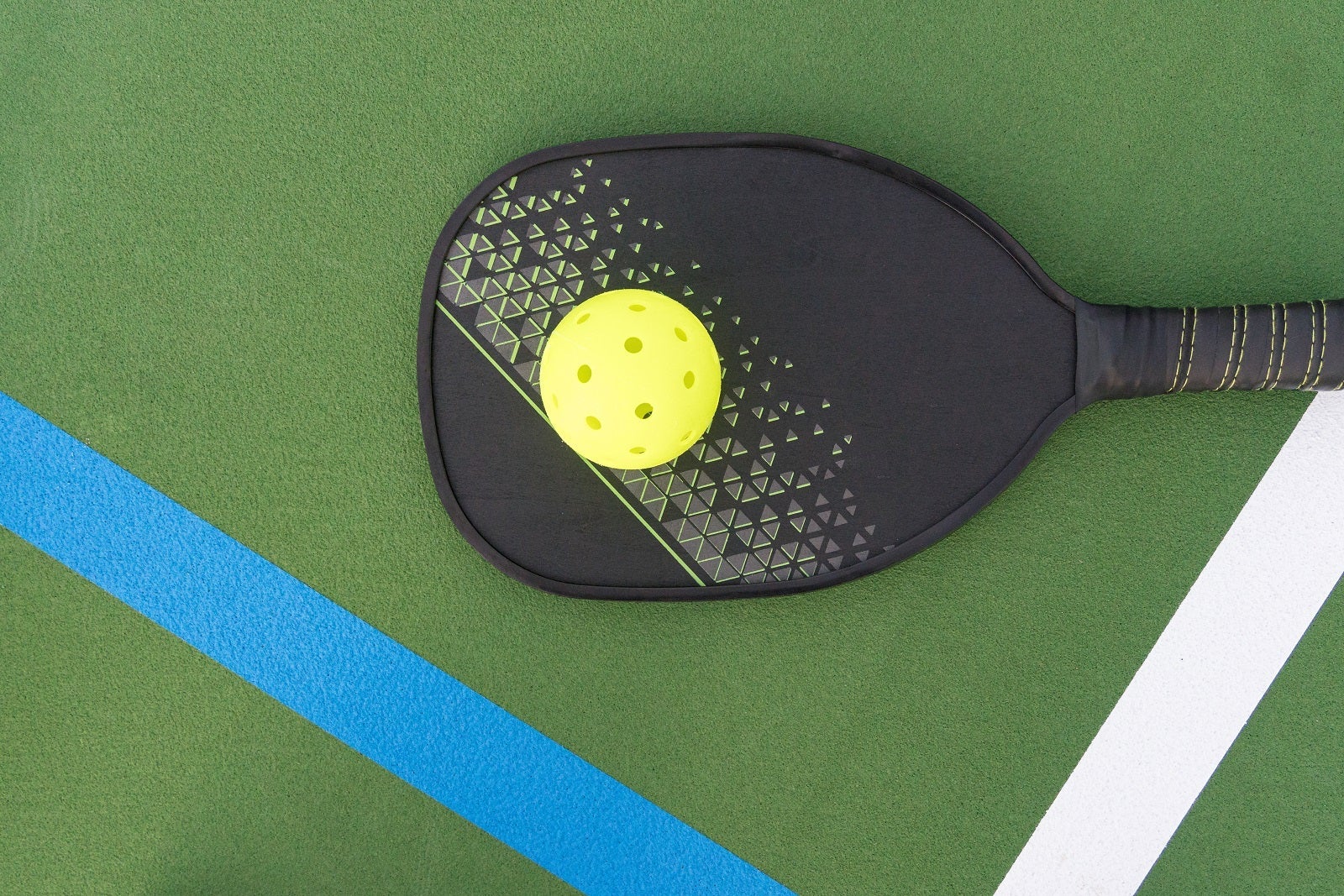
Whenever someone mentions pickleball, I immediately have flashbacks to high school gym class, when I spent many an afternoon smacking a Wiffle ball across the room with a paddle. The first time I played it, I hypothesized that our teacher had simply made it up to keep us busy, but as it turns out, pickleball has been around since the 1960s.
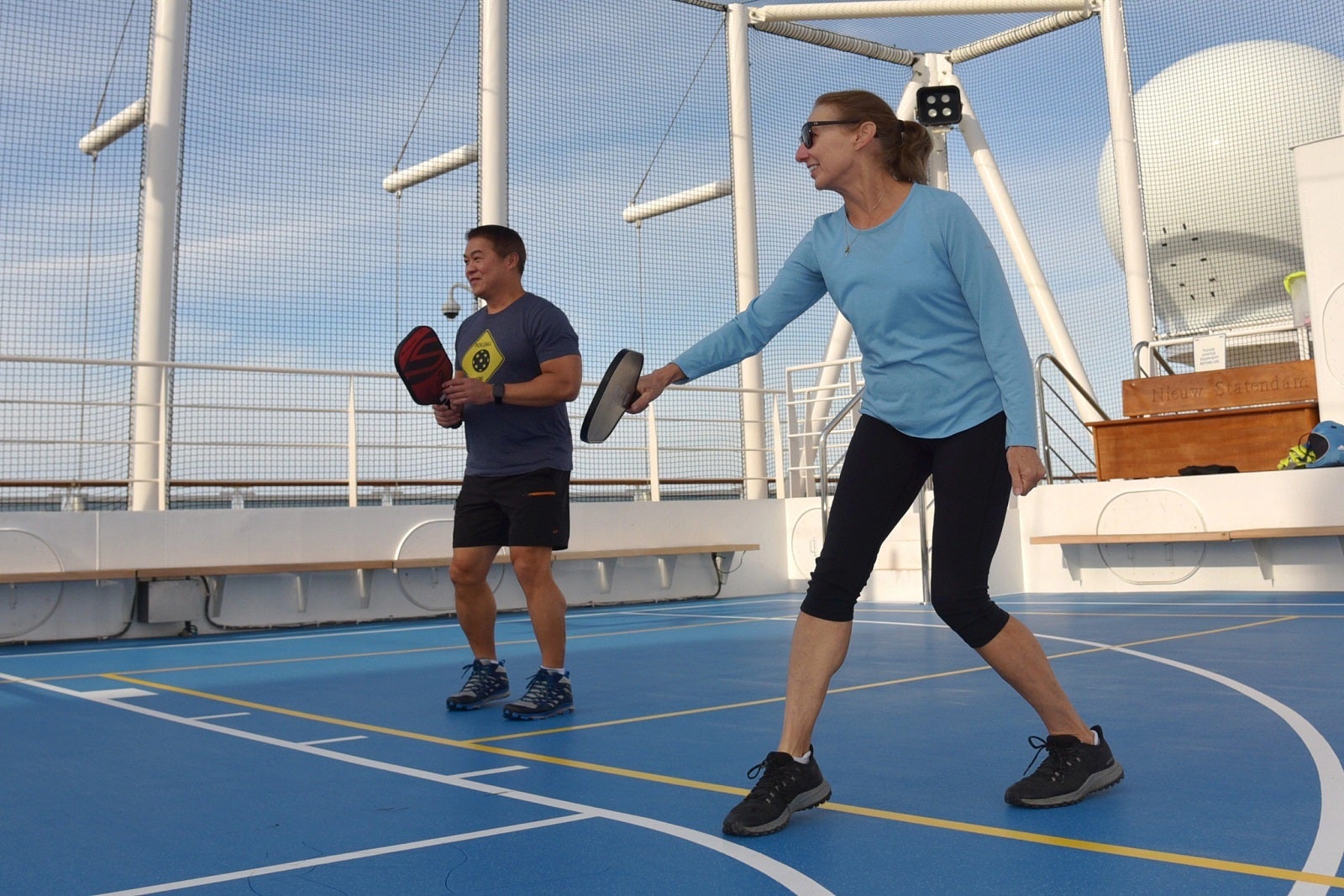
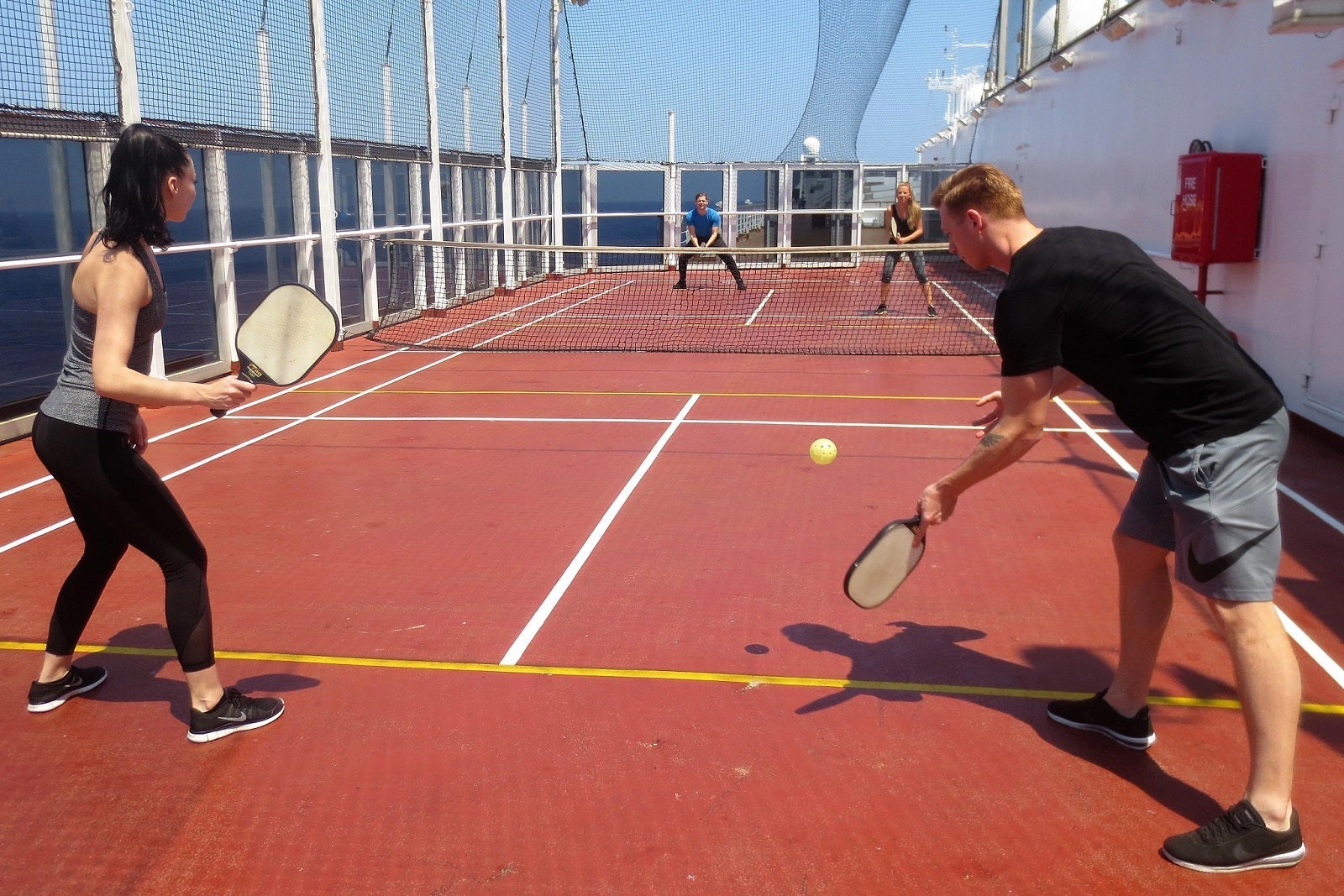
Now, cruise ship pickleball is on the upswing, with several lines offering dedicated pickleball courts, scheduled times for play and even onboard lessons and equipment sales.
If you're curious about this new athletic craze, which appeals to players of all ages and ability levels, you've come to the right place. I'll tell you all you need to know and help you find a cruise ship where you can volley on your next voyage.
What is pickleball?
Pickleball, explained loosely as a hybrid of badminton and tennis, was created by a U.S. congressman in the summer of 1965 when his family and several house guests were bored and couldn't find badminton equipment. Instead, they lowered the net they had and used Ping-Pong paddles, thereby creating a brand-new sport.
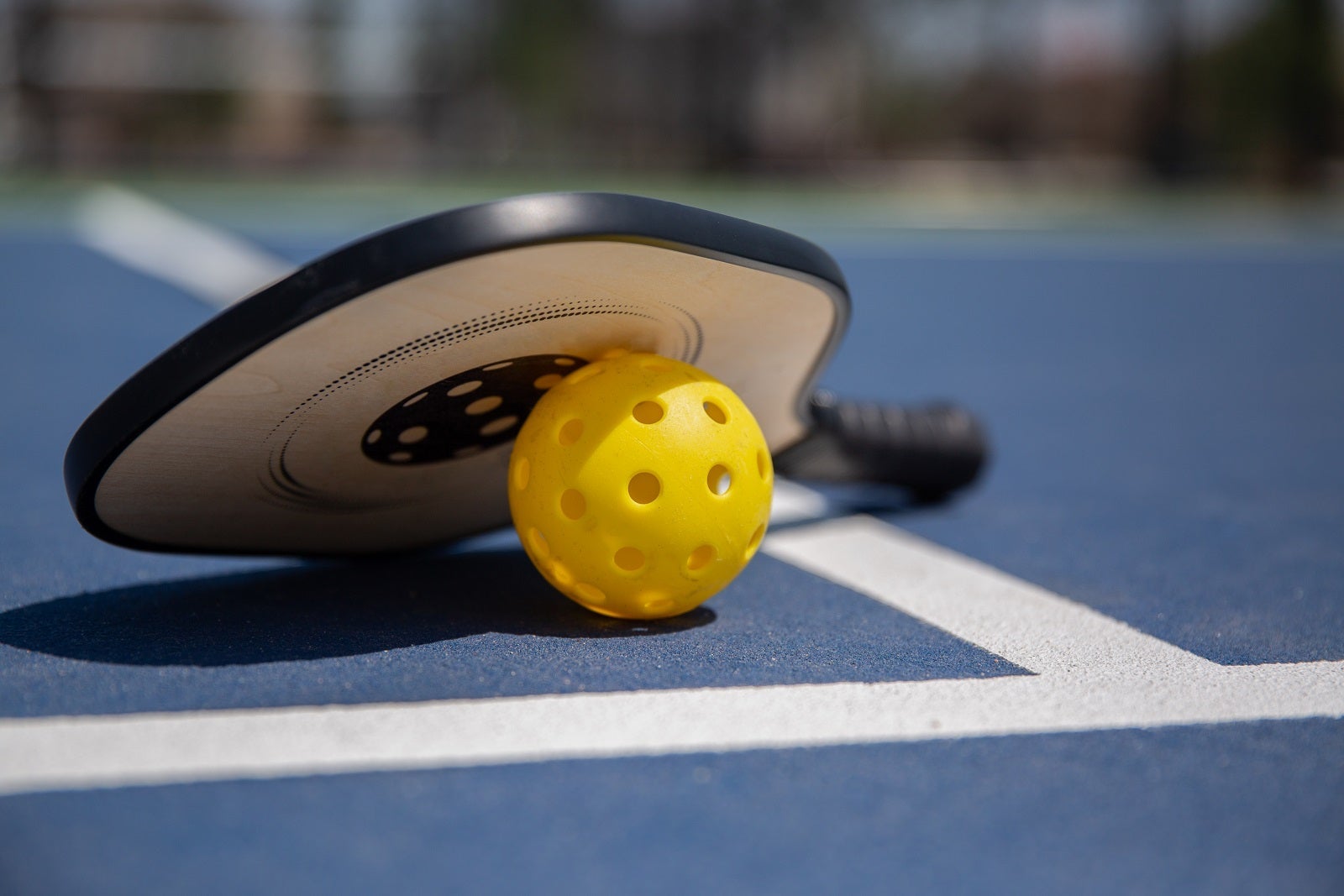
It employs a similar concept of using paddles to hit an object — in this case, a plastic polymer ball with holes in it — over a net that's low to the ground, unlike what you'd find in badminton, and shorter than what's used for tennis.
The game can be played one-on-one, but matches are usually conducted two-against-two, with members of the same team standing on the same side of the net. The ball is volleyed back and forth until a fault is committed, determining whether the serving team receives a point or must rotate servers.
Pickleball cruises
Which cruise ships have pickleball courts? With pickleball's recent spike in popularity — big names like Mark Cuban, Gary Vaynerchuk, Drew Brees, LeBron James and Tom Brady are owners of professional pickleball teams — it's unsurprising that cruise lines want in on the action.
The most notable is Holland America, which has offered pickleball on its ships for years, proving that it was ahead of the curve. In late 2022, it became the official cruise line of the Professional Pickleball Association, which annually hosts one of two major pickleball tour competitions in the U.S.
"Pickleball has become immensely popular among travel and leisure business categories because it is uniquely accessible, compatible with a variety of brands, and transcends a wide spectrum of age groups and lifestyles," said Connor Pardoe, commissioner and CEO of the PPA Tour, in a statement from Holland America.

As part of the partnership, the line has added brand-new pickleball courts to all the vessels in its fleet. It now also sells PPA equipment in its onboard shops, and its fitness staff offers beginner lessons to anyone hoping to learn how to play.
Other lines have also realized the value of adding pickleball to their lists of activities. Currently, many of the major cruise lines' ships offer some version of it on their existing basketball courts, but others have added official pickleball courts to some vessels. Lines that offer pickleball on their ships include:
- AmaWaterways.
- Carnival Cruise Line.
- Celebrity Cruises.
- Holland America.
- MSC Cruises.
- Norwegian Cruise Line.
- Princess Cruises.
- Regent Seven Seas Cruises.
- Royal Caribbean.
- Virgin Voyages.
Some specific ships where you can find pickleball opportunities include Carnival Conquest (dedicated court) and most other Carnival ships; Celebrity Beyond, Celebrity Apex, Celebrity Constellation, Celebrity Eclipse, Celebrity Equinox, Celebrity Infinity, Celebrity Millennium, Celebrity Solstice and Celebrity Summit; MSC Meraviglia, MSC World Europa and MSC Euribia; and Norwegian Prima.
The soon-to-debut MSC World America and Norwegian Viva will have pickleball courts as well.
You can also play on Princess Cruises' Enchanted Princess, Sky Princess and Discovery Princess; Regent Seven Seas Cruises' Seven Seas Explorer, Seven Seas Splendor and soon-to-debut Seven Seas Grandeur; many of Royal Caribbean's newest, largest ships, including Oasis of the Seas, Allure of the Seas, Symphony of the Seas, Odyssey of the Seas, Harmony of the Seas, Anthem of the Seas, Wonder of the Seas, Liberty of the Seas, Freedom of the Seas and several others; and Virgin Voyages' Valiant Lady.
Additionally, AmaWaterways' AmaMagna is the first river cruise ship to offer a dedicated pickleball court for passengers.
How to play pickleball
Pickleball rules are fairly simple, with the most complicated parts pertaining to who serves and from which side of the court. Below is a summarized overview provided by USA Pickleball, which governs professional pickleball play in the U.S. (For complete rules, check out the official rulebook of USA Pickleball.)
The serve
- The server's arm must be moving in an upward arc when the ball is struck.
- Paddle contact with the ball must not be made above the waist level.
- The head of the paddle must not be above the highest part of the wrist at contact.
- A "drop serve" is also permitted, in which case none of the elements above apply.
- At the time the ball is struck, the server's feet may not touch the court or outside the imaginary extension of the sideline or centerline and at least one foot must be behind the baseline on the playing surface or the ground behind the baseline.
- The serve is made diagonally crosscourt and must land within the confines of the opposite diagonal court.
- Only one serve attempt is allowed per server.
Serving sequence
- Both players on the serving doubles team have the opportunity to serve and score points until they commit a fault.*
- The first serve of each side out is made from the right/even court.
- If a point is scored, the server switches sides and the server initiates the next serve from the left/odd court.
- As subsequent points are scored, the server continues switching back and forth until a fault is committed, and the first server loses the serve.
- When the first server loses the serve, the partner then serves from their correct side of the court (except for the first service sequence of the game*).
- The second server continues serving until his or her team commits a fault and loses the serve to the opposing team.
- Once the service goes to the opposition (at side out), the first serve is from the right/even court and both players on that team have the opportunity to serve and score points until their team commits two faults.
- In singles, the server serves from the right/even court when his or her score is even and from the left/odd when the score is odd.
*At the beginning of each new game, only one partner on the serving team has the opportunity to serve before faulting, after which the service passes to the receiving team.
Scoring
- Points are scored only by the serving team.
- Games are normally played to 11 points, requiring a win by 2 points.
- Tournament games may be to 15 or 21 points, requiring a win by 2 points.
- When the serving team's score is even (0, 2, 4, 6, 8, 10), the player who was the first server in the game for that team will be in the right/even court when serving or receiving; when odd (1, 3, 5, 7, 9), that player will be in the left/odd court when serving or receiving.
Two-bounce rule
- When the ball is served, the receiving team must let it bounce before returning, and then the serving team must let it bounce before returning, thus two bounces.
- After the ball has bounced once in each team's court, both teams may either volley the ball (hit the ball before it bounces) or play it off a bounce (ground stroke).
- The two-bounce rule eliminates the serve and volley advantage and extends rallies.
Line calls
- A ball contacting any part of any line, except the non-volley zone line on a serve, is considered "in."
- A serve contacting the non-volley zone line is short and a fault.
Non-volley zone
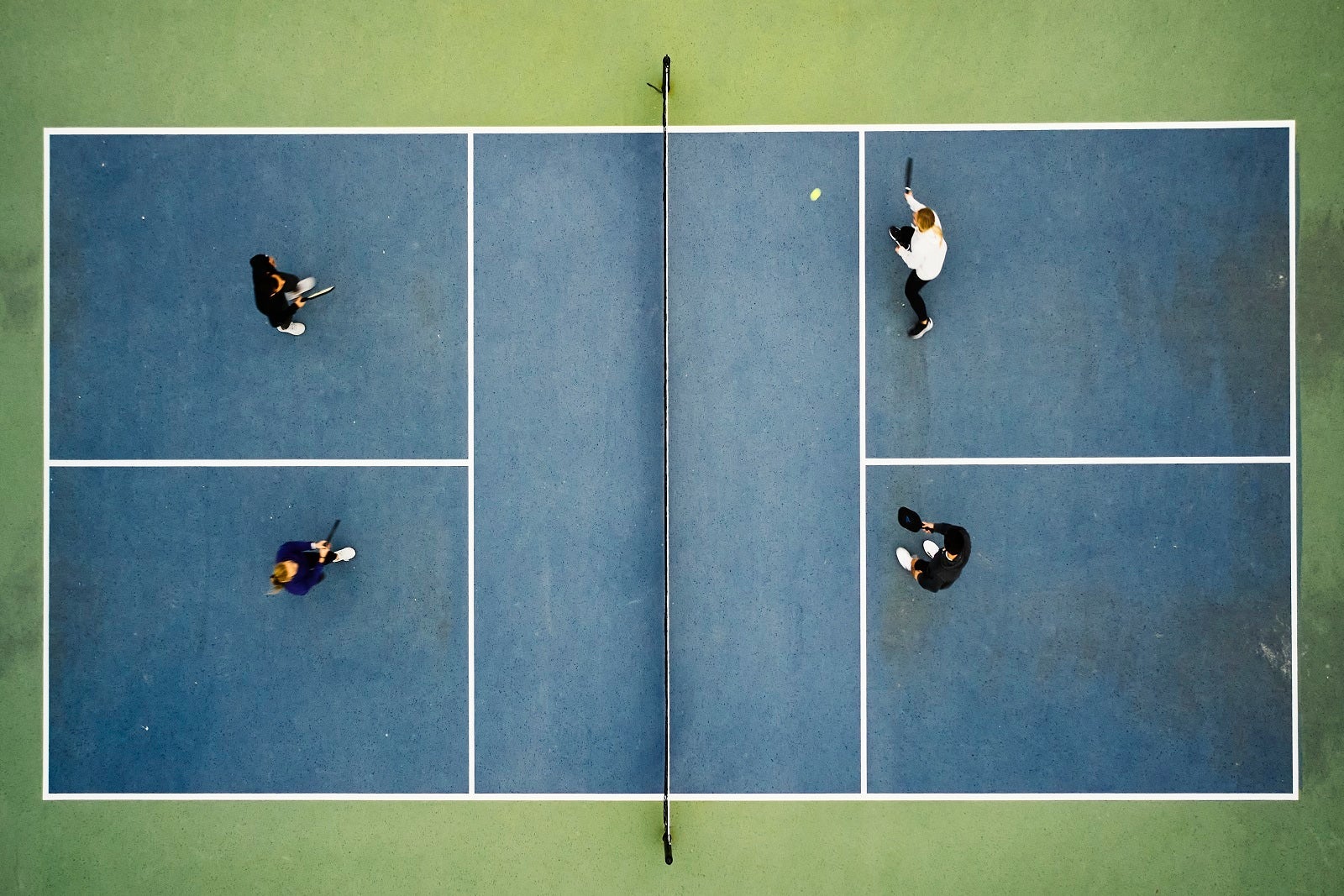
- The non-volley zone is the court area within 7 feet on both sides of the net.
- Volleying is prohibited within the non-volley zone. This rule prevents players from executing smashes from a position within the zone.
- It is a fault if, when volleying a ball, the player steps on the non-volley zone, including the line and/or when the player's momentum causes them or anything they are wearing or carrying to touch the non-volley zone, including the associated lines.
- It is a fault if, after volleying, a player is carried by momentum into or touches the non-volley zone, even if the volleyed ball is declared dead before this happens.
- A player may legally be in the non-volley zone any time other than when volleying a ball.
- The non-volley zone is commonly referred to as "the kitchen."
Faults
- A fault is any action that stops play because of a rule violation.
- A fault by the receiving team results in a point for the serving team.
- A fault by the serving team results in the server's loss of serve or side out.
Determining the serving team
- Any fair method (such as a coin flip) can be used to determine which player or team has first choice of side, service or receive.
Bottom line
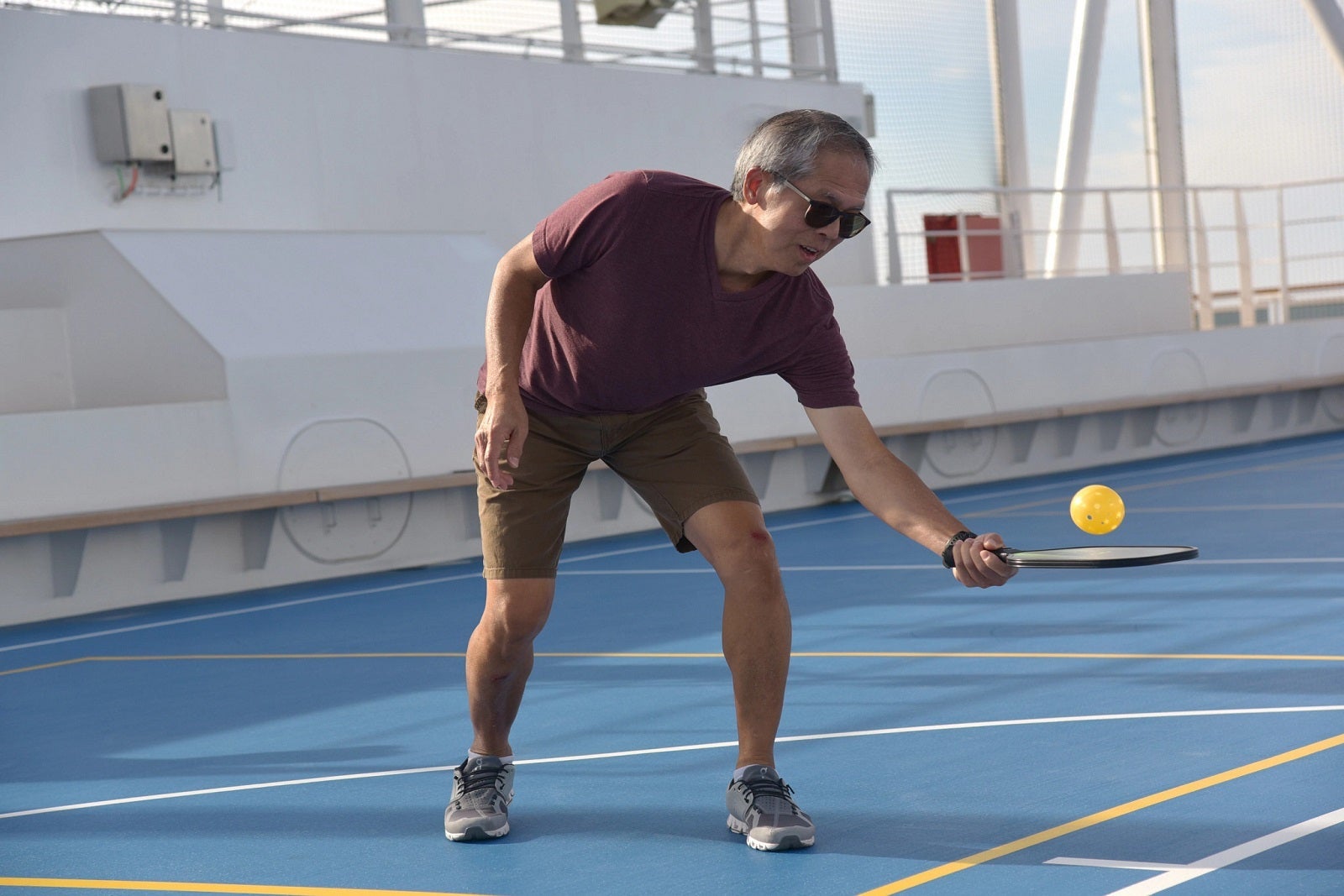
Whether you're already a fan of pickleball or hoping to keep up with the latest trends by giving it a try for the first time on your next cruise, there are plenty of vessels that offer everything from courts and equipment to beginner-level lessons.
Have more cruise questions? TPG has answers:
- Packing for a cruise? These items aren't allowed on board
- Man overboard: cruise ship overboards and how they happen
- What is baked Alaska, and why is it paraded around cruise ships?
- What are the largest cruise ships in the world?
- Gentlemen hosts: These men cruise to make sure single ladies have a great time
- What is the Jones Act and how does it impact cruise ships?
- What is a lido deck on a cruise ship?
- What's a cruise cabin guarantee and will it save you money?
- What's the difference between a cruise ship concierge and a butler?
TPG featured card

at Capital One's secure site
Terms & restrictions apply. See rates & fees.
| 5X miles | Earn 5X miles on hotels, vacation rentals and rental cars booked through Capital One Travel |
| 2X miles | Earn unlimited 2X miles on every purchase, every day |
Pros
- Stellar welcome offer of 75,000 miles after spending $4,000 on purchases in the first three months from account opening. Plus, a $250 Capital One Travel credit to use in your first cardholder year upon account opening.
- You'll earn 2 miles per dollar on every purchase, which means you won't have to worry about memorizing bonus categories
- Rewards are versatile and can be redeemed for a statement credit or transferred to Capital One’s transfer partners
Cons
- Highest bonus-earning categories only on travel booked via Capital One Travel
- LIMITED-TIME OFFER: Enjoy $250 to use on Capital One Travel in your first cardholder year, plus earn 75,000 bonus miles once you spend $4,000 on purchases within the first 3 months from account opening - that’s equal to $1,000 in travel
- Earn unlimited 2X miles on every purchase, every day
- Earn 5X miles on hotels, vacation rentals and rental cars booked through Capital One Travel
- Miles won't expire for the life of the account and there's no limit to how many you can earn
- Receive up to a $120 credit for Global Entry or TSA PreCheck®
- Use your miles to get reimbursed for any travel purchase—or redeem by booking a trip through Capital One Travel
- Enjoy a $50 experience credit and other premium benefits with every hotel and vacation rental booked from the Lifestyle Collection
- Transfer your miles to your choice of 15+ travel loyalty programs
- Top rated mobile app