JT is a location-independent digital nomad traveling 250,000+ miles each year with his wife Katie.
April 22, 2019 • 13 min read
The cards we feature here are from partners who compensate us when you are approved through our site, and this may impact how or where these products appear. We don't cover all available credit cards, but our analysis, reviews, and opinions are entirely from our editorial team. Terms apply to the offers listed on this page. Please view our advertising policy and product review methodology for more information.Editorial disclaimer: Opinions expressed here are the author's alone, not those of any bank, credit card issuer, airline or hotel chain, and have not been reviewed, approved or otherwise endorsed by any of these entities.
Comments
By commenting, you agree to our Community Guidelines to help create a positive space for conversation. The responses below are not provided or commissioned by the bank advertiser, our partners, or The Points Guy (“TPG”). They have not been reviewed, approved, or otherwise endorsed by any of these parties. All responses are submitted by individual contributors, and neither the bank advertiser, our partners, nor TPG are responsible for ensuring that all posts and/or questions are answered.
Related stories
Quick summary
American Airlines' new Airbus A321neo first-class cabin debuted in April 2019, featuring five rows of domestic first-class seats, slightly increasing the number of premium seats compared to other models.
The seats offer 37 inches of pitch and are similar to those found in other recent American Airlines domestic and premium economy cabins, with some ergonomic updates like a seatback tablet holder and wider bathrooms.
Inflight entertainment screens are not provided, but high-speed satellite Wi-Fi and streaming options are available for personal devices.
Service during the inaugural flight was attentive, but the review notes that experiences may vary on non-inaugural flights.
What to consider
The lack of a bulkhead between first and economy in the last row may reduce privacy and comfort for some passengers.
Only one bathroom serves up to 20 first-class passengers, but it is wider than those in economy or on other aircraft models.
No inflight entertainment screens are installed; passengers must use their own devices to access streaming content.
What you'll miss from the article
A detailed comparison of seat comfort, amenities and service nuances between the A321neo and other American Airlines domestic first-class products.
Generated by AI with support from our editorial team.
Update: Some offers mentioned below are no longer available. View the current offers here.
[Note: While TPG's policy is not to alert the airline that we are reviewing a flight, American Airlines representatives checked and discovered that I was booked on the inaugural flight. So the airline was aware I'd be on this flight.]
That feature came in handy when AA changed its A321neo inaugural schedule. Amex Travel was able to drop the LAX-PHX leg and rebook me on the new flights from Phoenix to Orlando and then back to Los Angeles via Phoenix. While that was my method of changing flights, passengers without the Business Centurion card aren't out of luck. AA's contract of carriage allows for free cancellation or no-fee rerouting for equipment changes.
As I was following AA's first A321neo in its first day of service, I had less than a half hour from arrival in Orlando until the boarding of next flight. So, I didn't get a chance to experience much of the typical ground experience during my layover.
Upon stepping into the terminal, I was happy to discover that there was an Admirals Club located right next to the gate from which I was both arriving and departing. I handed over my Citi® / AAdvantage® Executive World Elite Mastercard® (I'm an authorized user thanks to another TPG employee) and was welcomed into the club.
Turns out, I wasn't the only one looking for a place to pass the time before a flight. The lounge was completely packed. I passed up an opportunity to try the "cheeseburger chowder," opting instead for a snack from the simple cold buffet. And since there were no empty tables, I settled for sharing a table with a fellow traveler.
Perhaps due to the crowds, I wasn't able to connect to the lounge's Wi-Fi network. So I needed to rely on using my cellphone's hot spot to get some work done.
As American Airlines doesn't alert passengers when a flight is boarding via text message or app push notification, I made sure to set an alarm to make sure to get back to the gate in time for boarding. Boarding started right on time for this flight.
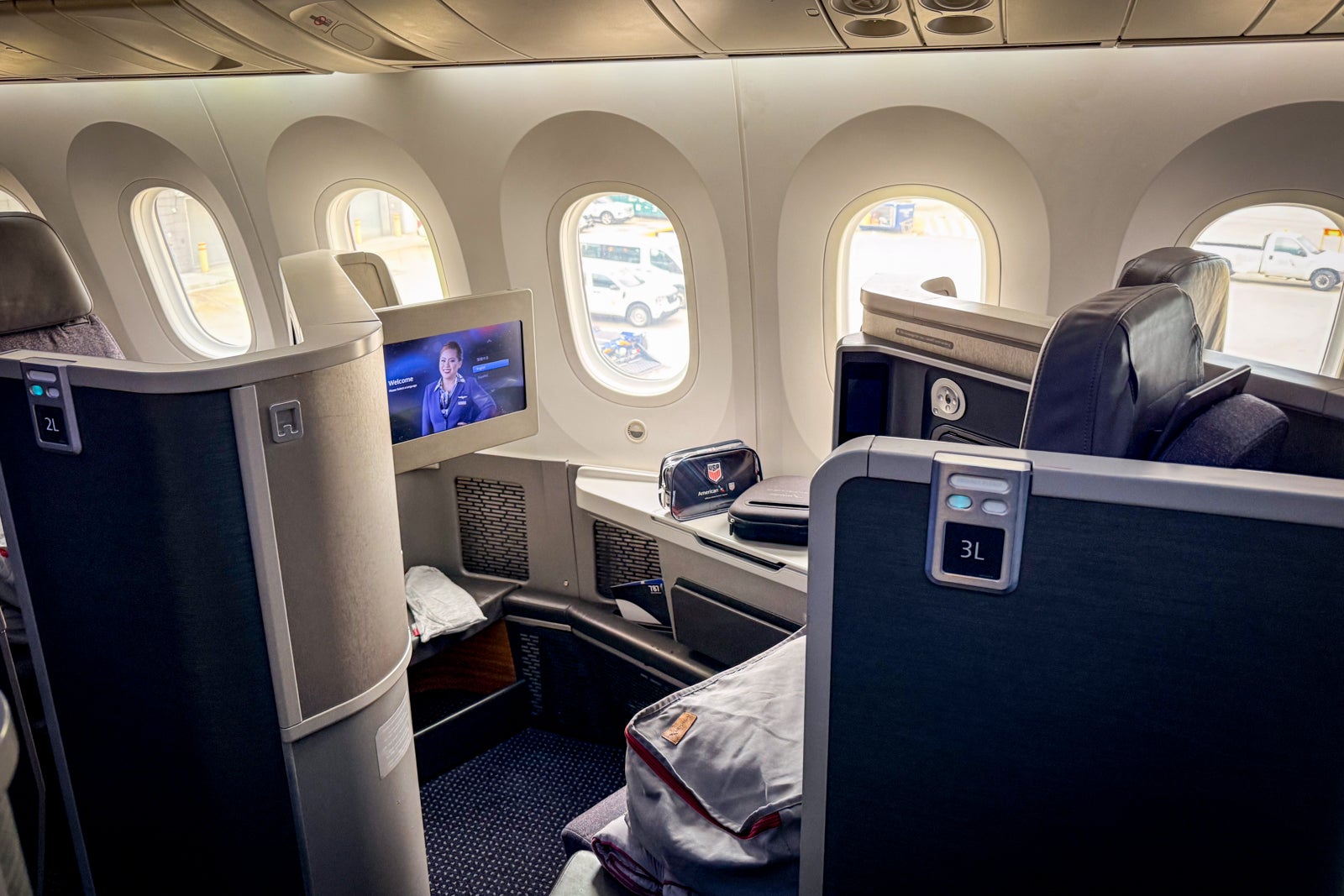
First class on American Airlines' A321neo is configured with the new normal for AA domestic first class. These seats are based on the B/E Aerospace MiQ seat, which made their debut on American Airlines as premium economy seats on AA's international fleet -- starting with the Boeing 787-9 in October 2016.
American Airlines premium economy on Boeing 787-9. Photo by JT Genter / The Points Guy
American bucked its tendency to cut business-class seats on its aircraft with the arrangement of its A321neo. Though all other AA A321s have four rows of domestic first-class seats, AA installed five rows on its A321neo.
Seat pitch on this new aircraft measures 37 inches -- the same as what you'd find in first on AA's 737 MAX, Project Oasis 737-800, and 1 inch less than what you'll find in premium economy on AA's international fleet. AA's other A321s range from 36 inches of pitch on legacy US Airways planes to 39 inches of pitch on legacy American Airlines aircraft.
The seats recline around 4 inches. Combined with the tighter pitch, it all felt a little cramped when I was trying to work on my laptop. The headrest could be folded in from each side to cradle my head or neck.
Each of the aisle seats is handicapped-accessible by lowering the aisle armrest. That is done by pulling on the lever on the bottom front of the armrest. The tray table extends out from the outside armrests -- the aisle armrest for aisle seats and window armrest for window seats.
Again on this flight, I noticed multiple passengers struggling to figure out how to extend the tray table. So that you're not one of these on your flight, here's how it works: Pull up on the tray table release. This will spring the table upward, and you can pull it up and out the rest of the way.
The bifold tray table extends to 19 inches by 10.5 inches. These seats are set up with two different shared drink holders: a 6-by-6 inch depressed drink surface and an extendable drink tray measuring 6.5 inches by 5 inches.
Someone else in my row and I learned the hard way that you shouldn't pick a seat in the last row of the cabin, as there's no bulkhead in between first and economy. It is great, however, for economy passengers who want to have 40 inches of pitch and to be able to store their bags under the first-class seats in front of them.
However, it can be bad for those sitting in the last row of first class. The passengers behind us on this flight would grab the back of our seat to help pull themselves up and to stabilize themselves as they climbed over their seatmates. As we found, these slimline seats are far too flimsy to stay stationary under that stress.
After a few bouts of individualized turbulence, someone in my row let off steam by ranting to me for minutes about the awful setup of this cabin and the "loss of compartmentalization" that it had due to the lack of a bulkhead.
There's just one bathroom at the front of the cabin for the up to 20 first-class passengers -- and any economy passengers who want to come up to use it. The first-class bathroom measures 34 inches from wall to wall. That's an entire half foot wider than the economy bathrooms that measure 28 inches wide.
Those who've experienced the micro-bathrooms on AA's 737 MAX or Project Oasis 737-800 will be glad to know that the A321neo first-class bathroom is 5 inches wider (34 versus 29 inches), and the economy bathroom is 4 inches wider (28 versus 24 inches) than on the 737 MAX and Project Oasis 737-800 aircraft.
Citing obsolescence, cost and weight, American Airlines has decided to ditch inflight-entertainment screens on its domestic fleet. None of the new Boeing 737 MAXes, Project Oasis Boeing 737-800s or new Airbus A321neo aircraft are being fitted with an IFE screen in any cabin.
On the 737 MAX and Project Oasis 737-800s, there's no tablet holder built into the seatback on first-class seats. Instead, only a small tablet kickstand extends out of the armrest.
Seatback of AA 737 MAX first class seat. Photo by JT Genter / The Points Guy
That's something that AA changed for its Airbus A321neo. In addition to the tray-table kickstand, there's a tablet holder built into the seatback.
Each seat has a universal power outlet located in the storage well under the middle armrest, but its recessed location made it for me hard to power devices that used larger plugs or plugs that had sharp angles.
Power outlet in premium economy on an American Airlines' 777-200 illustrating the problem I've had with this outlet location in the past.
As someone who doesn't travel with a tablet -- and as someone who notices that few passengers do -- this lack of IFE screens was a big strike against the A321neo's inflight-entertainment score. However, for those who have a tablet or use their phone or laptop and know how to connect to the inflight entertainment, there were plenty of options. In April 2019, American Airlines is streaming 162 movies, 239 TV episodes and 12 channels of live TV for free through the ViaSat Wi-Fi system.
AA's Airbus A321neo aircraft are entering service with high-speed, satellite-based ViaSat Wi-Fi. This is my favorite of the three different Wi-Fi providers that the airline uses, as you can be connected gate to gate and it's truly high-speed, with the download speed faster than at many hotels.
Gogo monthly subscribers don't need to worry about paying extra. On the Wi-Fi landing page, there's a link for Gogo subscribers to log in with their Gogo account and access the ViaSat system for free. While it does take an extra step to log in, it's great that AA brokered a deal between the two providers to make a relatively seamless experience.
I was pleasantly surprised for this AA crew to start the flight on the right foot by offering all 20 first-class passengers their choice of a predeparture beverage. Once in the air, passengers received warm nuts and their choice of another beverage.
Around one and a half hours after departure, the meals were served. Service started from the front of the cabin and worked back, with flight attendants making sure that passengers were all set with the meal, a drink and bread before moving back to the next row. That meant that those of us in the last row didn't get our meals for a while.
The meals were introduced as either a breast of chicken with mushroom sauce or a vegetarian three-bean chili with polenta cake, which the flight attendant said smelled delicious. The taste wasn't as great as the smell, but the main was a solid meal for a domestic first-class product. It was served with a nice fresh corn-and-feta-cheese side and a kale salad. The slightly stale roll was the disappointment of the meal.
After the meal tray was collected, I stepped back into the bathroom and then into economy to take a few more measurements. While I was in the back chatting up one of the AA A321neo crew members who was instrumental in the certification flights for this new aircraft type, I missed dessert service. No worries, though. The first-class flight attendant noticed when I got back and came back to offer a cup of strawberry ice cream.
This section comes with a big caveat: We typically don't do full reviews of inaugural flights, especially when we've received early boarding to be able to take clean photos of the cabin. Between the excitement of the inaugural flight and being outed as a member of the media, this can lead to a very different experience than what a typical flyer would get.
I experienced great service in economy on the outbound flight from Phoenix to Orlando, and it was even better in first class. Flight attendants checked in on passengers often to make sure drinks were topped off, and meal trays were cleared away quickly.
Meal orders were taken with a cheery attitude. As I know meal selections can be limited on AA flights, I'll often volunteer when ordering to take a secondary choice if I'm ambivalent about the options. This flight was the first time that a flight attendant has genuinely expressed appreciation for the offer.
Even the pilots helped make this feel like a special flight. The captain made a announcement before pushback introducing passengers to the new plane and noting that this was the second revenue flight of this airplane.
Although I knew that this was a special crew for the inaugural flights, I still left this flight optimistic that AA flight attendants might be turning a corner. That dream was crushed on my next flight from Phoenix to Los Angeles, which featured a more typical experience from the AA cabin crew, from sour greetings to abandoning service completely after a couple of minutes of light turbulence during the climb.
However, consistent doesn't necessarily mean that it's good. I'll still take an old legacy American Airlines domestic first-class product any day over a new 737 MAX, A321neo or retrofitted 737 first-class product. After all, the legacy AA first-class seats have more pitch, more seat padding and a decent chance at getting an inflight-entertainment screen.
But for the new normal, there are some ways that this product is marginally better than the 737 MAX or 737-800. The fifth row of first-class seats means that the A321neo has one of the best first-to-economy ratios in the domestic fleet. The seatback tablet holder allows passengers to continue watching the IFE during meals or while using a laptop. More overhead bin space is a definite plus. The significantly wider bathrooms are relieving. And the A321neo's cabin width is wider than the 737's, giving passengers marginally more space.
By commenting, you agree to our Community Guidelines to help create a positive space for conversation. The responses below are not provided or commissioned by the bank advertiser, our partners, or The Points Guy (“TPG”). They have not been reviewed, approved, or otherwise endorsed by any of these parties. All responses are submitted by individual contributors, and neither the bank advertiser, our partners, nor TPG are responsible for ensuring that all posts and/or questions are answered.