Here’s what Thanksgiving foods you can bring in your carry-on and what has to be checked

Editor's Note
For a lot of Thanksgiving travelers and hosts, there's a mutual, perhaps unwritten, agreement: The out-of-town guests travel, and the hosts handle the cooking.
For plenty of others, though, it's not quite so straightforward. This means you're likely to see a fellow passenger toting a turkey or pie this next week while preparing to board the flight home for the holiday.
And, of course, we expect to see plenty of passengers flying with leftovers on their way home; last year, the Sunday after Thanksgiving was the busiest day ever at U.S. airports.
So, with Friday, Nov. 21, marking the unofficial start of the Thanksgiving travel rush, it's a good time to review what's in and what's out (namely, what you can carry on and what needs to be checked) as you head to the airport.
"It's weird, but sometimes we will see turkeys at security checkpoints," former Transportation Security Administration spokesperson Mark Howell told me a couple of years ago.
More products from the Thanksgiving table passing through security checkpoints also means the TSA can expect to see a much more eclectic assortment of carry-on items. Screening is no small task, as the staff prepares to see millions of travelers over the coming days.
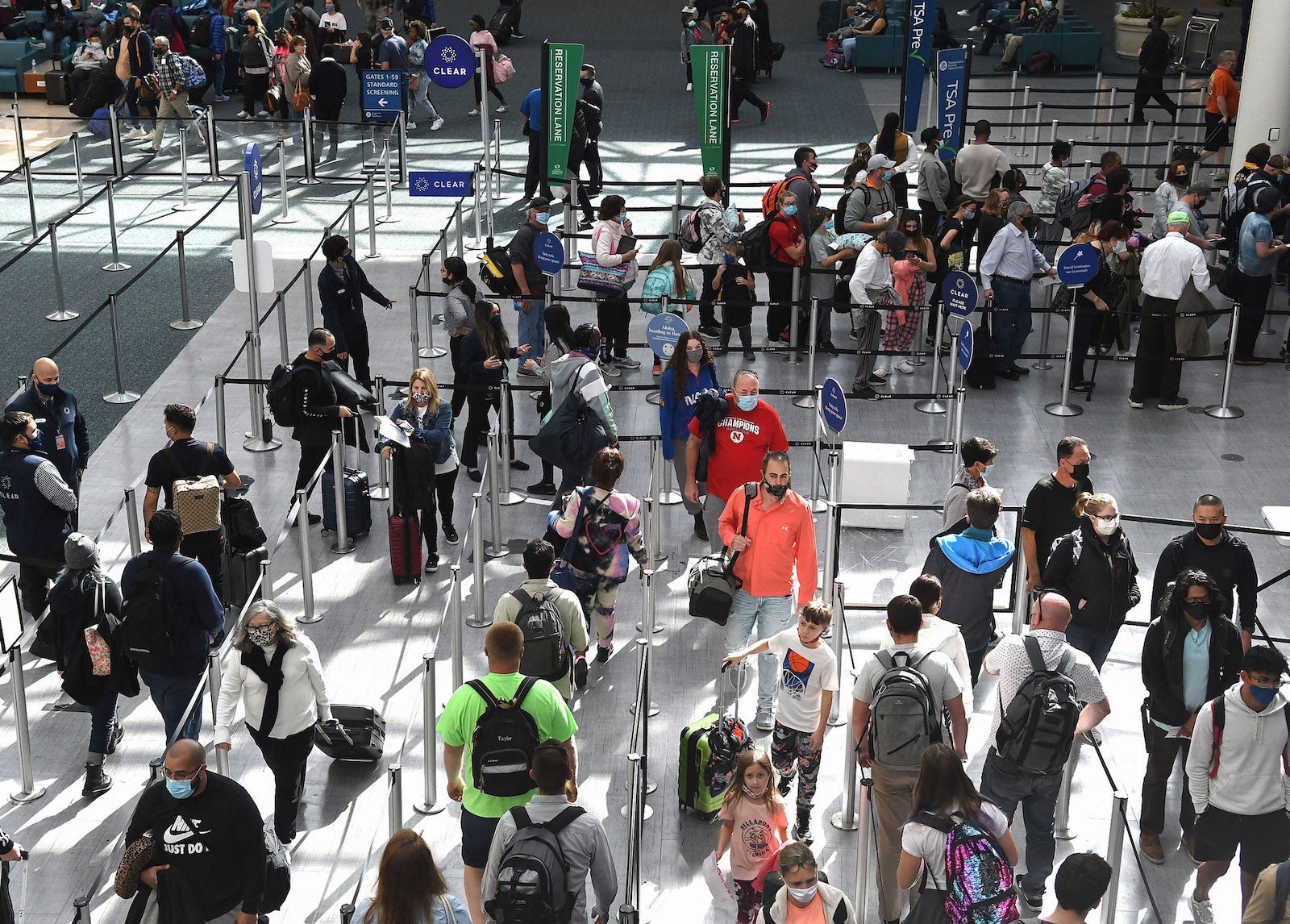
If you're among the travelers hoping to do a little meal prep at home before flying, there are some things you need to know — whether you'll be waiting in the standard line (arrive early, if so) or heading to the TSA PreCheck line.
3-1-1 applies, as always
As is always the case, the TSA's 3-1-1 rule governs what can and can't come on the plane. It means that each liquid you bring through a checkpoint must be in a 3.4-ounce or smaller container, all containers must be placed in one clear quart-size plastic bag, and each passenger is only allowed one plastic bag.
Even on a normal travel day, the prohibited items pile up — quite literally — in plastic bins near checkpoints.

Most travelers know they can't bring a huge bottle of sunscreen in their carry-on luggage. However, the composition of Thanksgiving entrees and side dishes can get a bit confusing when it comes to 3-1-1.
Related: When will the TSA's 3-1-1 liquids policy end?
Bringing Thanksgiving food on a plane
Let's start with the obvious here: You have to follow the 3-1-1 rule whether you're bringing on a mini bottle of toothpaste or your family's famous Thanksgiving side dish.
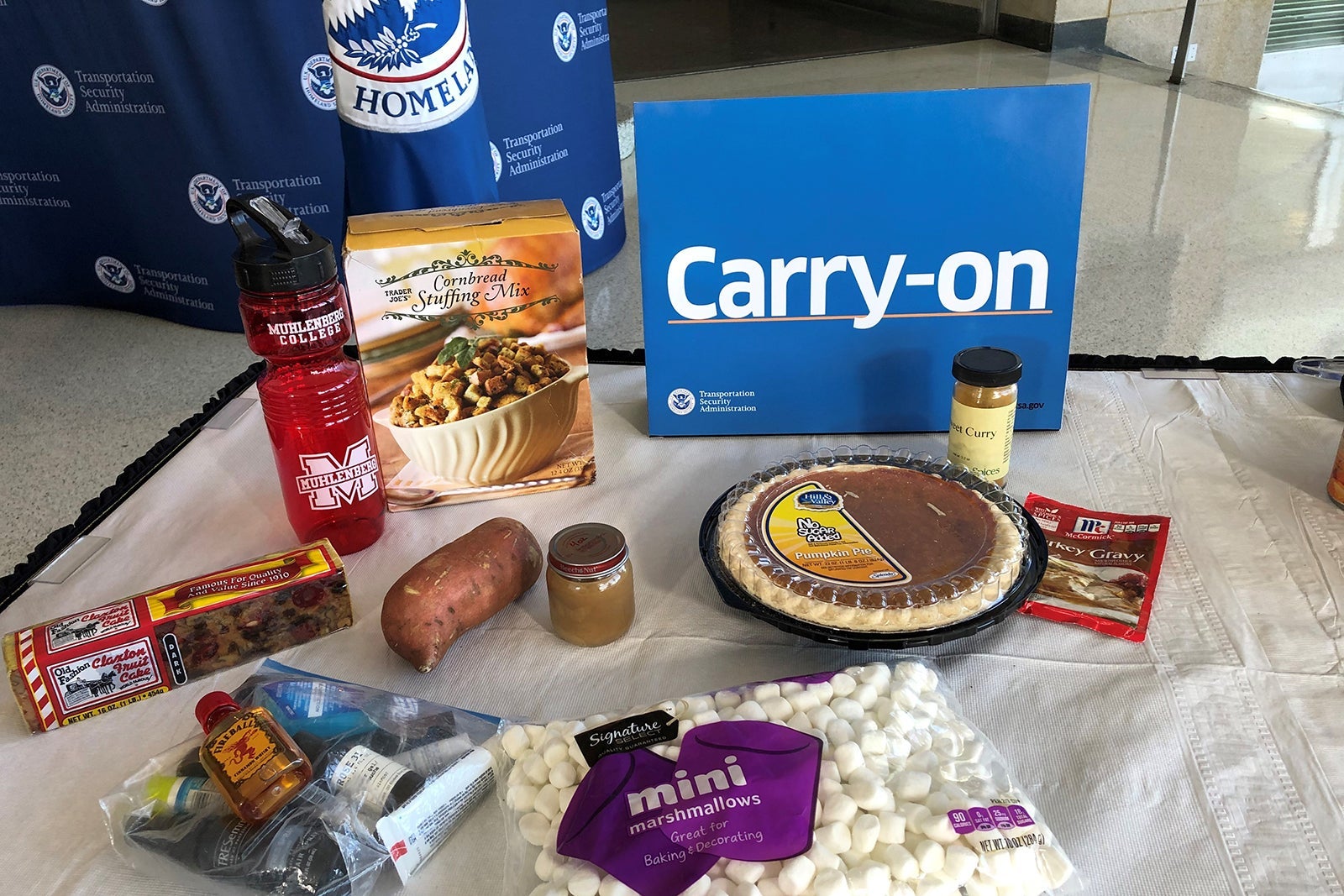
"Your solid food, your cakes and pies are going to be OK," Howell explained.
That means you're good to bring a turkey, ham, chicken or something similar. Just keep in mind that the U.S. Department of Agriculture advises that you give special attention to packing and storing perishables.
We say "special attention" because the steps you take to ensure your food stays cold through your journey can become a common pitfall.
Any ice packs you use must stay frozen as you make your way through the checkpoint.
That goes for that frozen turkey you bought at the grocery store, too.
"Sometimes, if it's half melted, and there's liquid in there, there's an issue," Howell said. You'll want to leave it in the freezer right up until you leave for the airport, in that case.
On the other hand, stuffing, macaroni and cheese, casseroles, pies, pastries, and fresh fruits and vegetables are generally safe bets to bring through the checkpoint.
Items you can't bring
With many other classic holiday dishes, you'll want to consider the ingredients before you try to carry them on. In some cases, it's a pretty obvious "no-go."
"If you can pump it, pour it, spray it or spread it and it's more than 3.4 ounces, then it should go in your checked bag," Howell said.
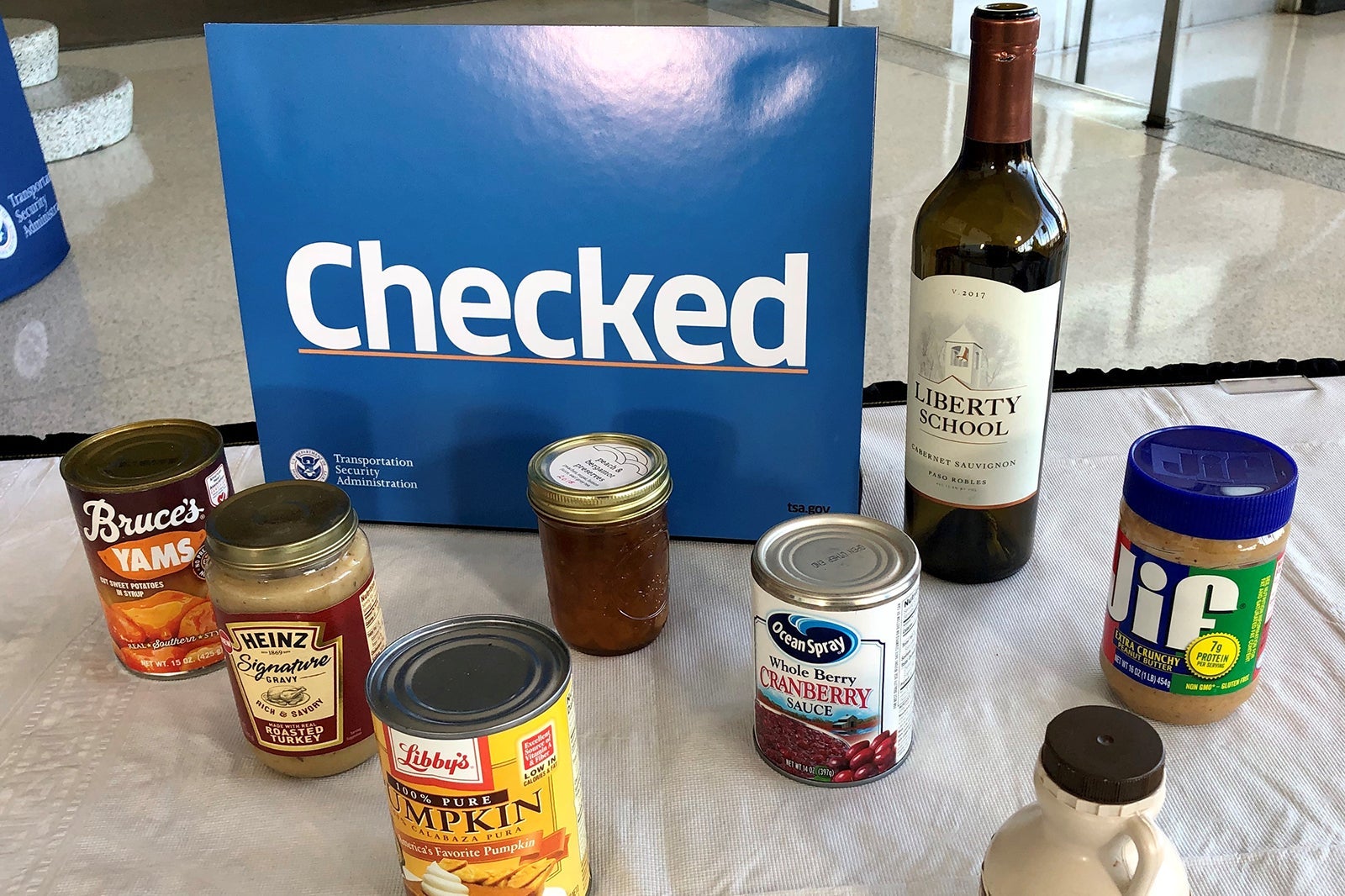
Many items can get through, along with spices. You need to check canned fruits and vegetables.
Gravies, sauces, jams, jellies, wine and spirits will need to go in checked luggage if they exceed that 3.4-ounce benchmark.
Just be sure to wrap and pack items carefully to avoid a mess in the event a fragile bottle breaks.
Luckily, if you're unsure what food can come on the plane, the MyTSA app has a helpful "What Can I Bring?" section. Type in your item, and you should be able to find out if you can carry it through a checkpoint or if it should be checked.
Related: Best times to book flights for cheap airfare
What foods can you bring through TSA?
With respect to Thanksgiving, here is a full rundown the TSA has shared about foods that are and aren't permissible in carry-on baggage.
Thanksgiving foods you can bring through a TSA checkpoint
- Baked goods, pies, cakes, cookies and brownies
- Meats, including turkey, chicken, ham and steak (frozen, cooked or uncooked)
- Stuffing, cooked or uncooked
- Casseroles
- Macaroni and cheese
- Fresh vegetables
- Fresh fruit
- Candy
- Spices
Thanksgiving foods you can't bring in your carry-on bag
- Cranberry sauce, homemade or canned
- Gravy
- Beverages like wine and Champagne
- Canned fruit or vegetables (since there's typically liquid in the can)
- Preserves, jams and jellies
If your item falls into the "no" category for a carry-on bag, you should still be able to pack it in your checked luggage. This is a good time to use those free checked bags and other airline credits available on that travel credit card in your wallet.
The TSA has set up various ways for you to ask your most burning questions, including on social media, through the TSA website and via text messages.
Bottom line
Every time the TSA catches a prohibited item while scanning a bag, it causes a delay at the checkpoint. During what's expected to be one of the busiest weeks of the year, those delays can add up.
Whether you plan to pack a bottle of hair gel or your family's traditional Thanksgiving casserole, consider whether the size and composition of your item make it eligible to pass through security.
On the bright side, no one will have to take off their shoes this year when passing through security.
Related reading:
TPG featured card

at Capital One's secure site
Terms & restrictions apply. See rates & fees.
| 5X miles | Earn 5X miles on hotels, vacation rentals and rental cars booked through Capital One Travel |
| 2X miles | Earn unlimited 2X miles on every purchase, every day |
Pros
- Stellar welcome offer of 75,000 miles after spending $4,000 on purchases in the first three months from account opening. Plus, a $250 Capital One Travel credit to use in your first cardholder year upon account opening.
- You'll earn 2 miles per dollar on every purchase, which means you won't have to worry about memorizing bonus categories
- Rewards are versatile and can be redeemed for a statement credit or transferred to Capital One’s transfer partners
Cons
- Highest bonus-earning categories only on travel booked via Capital One Travel
- LIMITED-TIME OFFER: Enjoy $250 to use on Capital One Travel in your first cardholder year, plus earn 75,000 bonus miles once you spend $4,000 on purchases within the first 3 months from account opening - that’s equal to $1,000 in travel
- Earn unlimited 2X miles on every purchase, every day
- Earn 5X miles on hotels, vacation rentals and rental cars booked through Capital One Travel
- Miles won't expire for the life of the account and there's no limit to how many you can earn
- Receive up to a $120 credit for Global Entry or TSA PreCheck®
- Use your miles to get reimbursed for any travel purchase—or redeem by booking a trip through Capital One Travel
- Enjoy a $50 experience credit and other premium benefits with every hotel and vacation rental booked from the Lifestyle Collection
- Transfer your miles to your choice of 15+ travel loyalty programs
- Top rated mobile app