Don't make these time-change mistakes when planning travel


Editor's Note
A few years ago, on a damp evening in late March in London, I learned the hard way that countries don't all change their clocks for daylight saving time simultaneously. After ordering a glass of white wine at a cozy bar in Bermondsey, I mindlessly scrolled on my phone while the bartenders chatted about the clocks jumping forward that coming Sunday. I nearly spit out my Chablis.
Back home in New York City, I had already skipped ahead one hour on the second Sunday in March. As I frantically Googled, I learned that in the United Kingdom, the clocks go forward one hour on the last Sunday in March.
Don't be like me and lose two hours of sleep in one month. When you travel, remember the following to avoid daylight saving time-related snafus and other time zone mistakes — and if you're in the U.S., don't forget most states fall back one hour this Sunday, Nov. 2.
Daylight saving time happens on different days around the world — or not at all

The U.K. isn't the only country that changes its clocks on a different weekend than we do in the U.S. For example, most European countries follow the same calendar as the U.K., moving clocks forward one hour on the last Sunday in March and back one hour on the last Sunday in October.
Generally, when traveling in the spring and fall, it's always best to check when the country you're going to falls forward or backward — and also whether that country observes daylight saving time at all. In fact, according to the Pew Research Center, about 66% of the world doesn't.
Though daylight saving time is commonly observed in North America and Europe, many non-European Union countries in Europe — including Armenia, Azerbaijan, Belarus, Georgia, Iceland, Russia and Turkey — stay on standard time year-round.
In 2023, Egypt became the only country in Africa to change its clocks when it reintroduced daylight saving time for the first time in seven years. Now, each year, its clocks move forward one hour on the last Friday in April and backward one hour on the last Thursday in October.
Not all states within the same country follow daylight saving time
It's also worth double-checking these things even if you're traveling within the U.S. In 48 states, daylight saving time runs from the second Sunday in March to the first Sunday in November. Arizona and Hawaii are the outliers that stay on standard time year-round. While it's less of an issue on an island like Hawaii, Arizona shares enough borders with other states that do observe daylight saving time that it can be problematic.
"Always double-check timing when flying in/out and on road trips through the state," Becky Blaine, TPG's newsletter managing editor and former Arizona resident, said. Otherwise, you can risk missing a flight or a reservation.

To keep it simple, remember that Arizona is in the Pacific Daylight Time zone from mid-March to early November, and the rest of the year it's in the same time zone as other states in Mountain Standard Time.
It's a similar situation in Canada. Generally, Canada follows the same daylight saving schedule as the U.S., but most of Saskatchewan, the Yukon and some parts of Quebec and British Columbia stay on standard time year-round.
In Australia, daylight saving time starts the first Sunday in October and ends the first Sunday in April in the Australian Capital Territory, New South Wales, South Australia, Tasmania and Victoria; meanwhile, the Northern Territory, Queensland and Western Australia don't observe it.
Private island resorts sometimes create their own time zones

Outside of daylight saving time changes, there are some general time zone issues to be aware of while traveling.
In countries as large as the U.S., Canada and Australia, it's easy to see why there are so many time zones. But Eric Rosen, TPG's director of travel content, also pointed out that in the Maldives, the airport is in a different time zone than some of the resorts in the tiny island nation.
Technically, the Maldives has only one official time zone: Maldives Time, which is five hours ahead of Coordinated Universal Time (often abbreviated as UTC). However, some of the archipelago's private island resorts add an hour to Maldives Time to maximize their guests' evening light.
For example, The St. Regis Maldives Vommuli Resort sets its clock one hour ahead of the official clock to what it calls "Island Time," but also provides guests with butlers who coordinate transfers to and from the airport so nobody accidentally misses a flight.
Before you go to the Maldives, be sure to check if your resort also does this.
Some places have half-hour time zones

Due to its geographic location, the Canadian island of Newfoundland is 90 minutes ahead of Eastern time instead of just 60 minutes ahead like the rest of Atlantic Canada. On a July trip, Nick Ewen, TPG's senior editorial director, found this challenging for calendar purposes.
While traveling in Newfoundland, he received an Outlook invitation for a 7:30 p.m. dinner meeting the following week and accepted it without thinking much about it. However, the actual dinner back home in the U.S. started at 6 p.m. — a detail he completely missed until the reminder popped up 15 minutes before. At that point, he realized he would be late.
Other places offset from UTC by 30 minutes include India, Sri Lanka, Afghanistan, Iran and some states in Australia. Want to be confused even more? Nepal's time zone is offset by 45 minutes due to its geography.
Mind your digital calendars
Even when not dealing with half-hour time zones, it can be easy to make similar mistakes when adding events back home to your digital calendar while traveling in a different time zone.
"Last year, I brought my middle son to a birthday party. We were running a few minutes late, but when we arrived, it seemed like the party was almost over," Tarah Chieffi, a senior writer at TPG, said. "While the kids were eating cake, I double-checked my calendar to make sure we had gotten the time right, and it seemed like we had. But then I went to check the invitation, and we had, in fact, arrived one hour late."
Her mistake? When she entered the party into her calendar while traveling, her calendar app defaulted to the time zone she was in and showed her the incorrect time back home.
"Now, I always toggle the time zone to my home time zone if I enter appointments into my calendar while I'm traveling," she said.
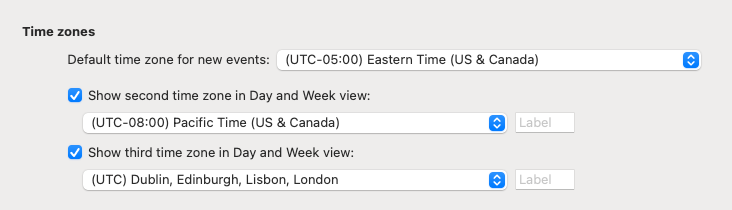
Another trick?
"Outlook lets you have up to three time zones showing on the calendar," Madison Blancaflor, TPG's managing editor of content operations, said.
Go to "Settings," then "Calendar," then "Time zones." Then, check the box for "Show second time zone in Day and Week view" underneath your default time zone. If you need a third one, you can also check that box.
Cruise ships often sail through multiple time zones
It's also important to remember that it's possible to quickly encounter multiple time zones on cruises — especially on transoceanic cruises, where you'll change time zones daily or almost daily. And if you're on a cruise traversing the Pacific Ocean, you could lose an entire day if you cross the international date line, like Clint Henderson, TPG's principal spokesperson, did when he sailed from Seward, Alaska, to Tokyo last year.
Even on shorter cruises, check if you'll have to change time zones. When I was on a five-day Alaska cruise earlier this summer, I changed time zones twice as we moved in and out of Alaska Daylight Time on a round-trip sailing from Vancouver (which was one hour ahead, on Pacific Daylight Time).

Cabin stewards usually leave notes on your bed at turndown to remind you of upcoming time changes. Clint said he had to set his clocks back between one and two hours each night on his cruise. But you can't always depend on your cellphone to correct the right time when it's in airplane mode and accessing satellite-based internet. Bring an analog watch or alarm clock to ground you if you don't know whether your device will update properly.
Related: Can a cruise help with jet lag? The answer might surprise you
Bottom line
When traveling, don't assume every country or state follows the same daylight-saving-time rules and schedules as where you live, and be mindful of time zone anomalies. Losing or gaining an unexpected hour can lead to lost sleep, arriving late to an event and, worst of all, missed flights.
Related reading:
TPG featured card

at Capital One's secure site
Terms & restrictions apply. See rates & fees.
| 5X miles | Earn 5X miles on hotels, vacation rentals and rental cars booked through Capital One Travel |
| 2X miles | Earn unlimited 2X miles on every purchase, every day |
Pros
- Stellar welcome offer of 75,000 miles after spending $4,000 on purchases in the first three months from account opening. Plus, a $250 Capital One Travel credit to use in your first cardholder year upon account opening.
- You'll earn 2 miles per dollar on every purchase, which means you won't have to worry about memorizing bonus categories
- Rewards are versatile and can be redeemed for a statement credit or transferred to Capital One’s transfer partners
Cons
- Highest bonus-earning categories only on travel booked via Capital One Travel
- LIMITED-TIME OFFER: Enjoy $250 to use on Capital One Travel in your first cardholder year, plus earn 75,000 bonus miles once you spend $4,000 on purchases within the first 3 months from account opening - that’s equal to $1,000 in travel
- Earn unlimited 2X miles on every purchase, every day
- Earn 5X miles on hotels, vacation rentals and rental cars booked through Capital One Travel
- Miles won't expire for the life of the account and there's no limit to how many you can earn
- Receive up to a $120 credit for Global Entry or TSA PreCheck®
- Use your miles to get reimbursed for any travel purchase—or redeem by booking a trip through Capital One Travel
- Enjoy a $50 experience credit and other premium benefits with every hotel and vacation rental booked from the Lifestyle Collection
- Transfer your miles to your choice of 15+ travel loyalty programs
- Top rated mobile app