Skip to content

Why It's Unlikely the FAA Will Be Sued for the 737 MAX

April 01, 2019
6 min read
U.S. Grounds All Boeing 737 MAX Aircraft After Viewing New Satellite Data
Why It's Unlikely the FAA Will Be Sued for the 737 MAX
The cards we feature here are from partners who compensate us when you are approved through our site, and this may impact how or where these products appear. We don’t cover all available credit cards, but our analysis, reviews, and opinions are entirely from our editorial team. Terms apply to the offers listed on this page. Please view our advertising policy and product review methodology for more information.

The first of several Congressional hearings into the safety of the Boeing 737 MAX, held last week, centered on the relationship between the Federal Aviation Administration and Boeing. Concern that the crash of Ethiopian Airlines flight 302 might be connected to a software problem discovered in the investigation into the Lion Air Flight 610 disaster forced the grounding of Boeing’s latest airliner.

With many fingers pointing at the FAA’s apparent lax oversight of Boeing during the MAX’s certification, senators want to know if allowing Boeing employees to serve as FAA designees in order to self-certify is the equivalent of putting the fox in charge of the henhouse, as Senator Richard Blumenthal suggested.

“Confidence in the FAA as the gold standard for safety has been shaken,” Calvin Scovel, inspector general for the Department of Transportation, told the members of the Senate Subcommittee on Aviation and Space. Scovel has been charged by Congress with conducting his own investigation, in addition to the half dozen other government probes already underway. But regardless of what Scovel or anyone else’s investigation uncovers, it will be difficult for people harmed by the MAX disasters to sue the FAA.

Reports in the Seattle Post-Intelligencer, the Wall Street Journal and the New York Times claimed that in its rush to get the 737 MAX to market, Boeing made several design changes including adding a stall protection system — the Maneuvering Characteristic Augmentation System or MCAS — that is now at the center of both accident probes. The FAA gave Boeing authority to certify MCAS as safe.
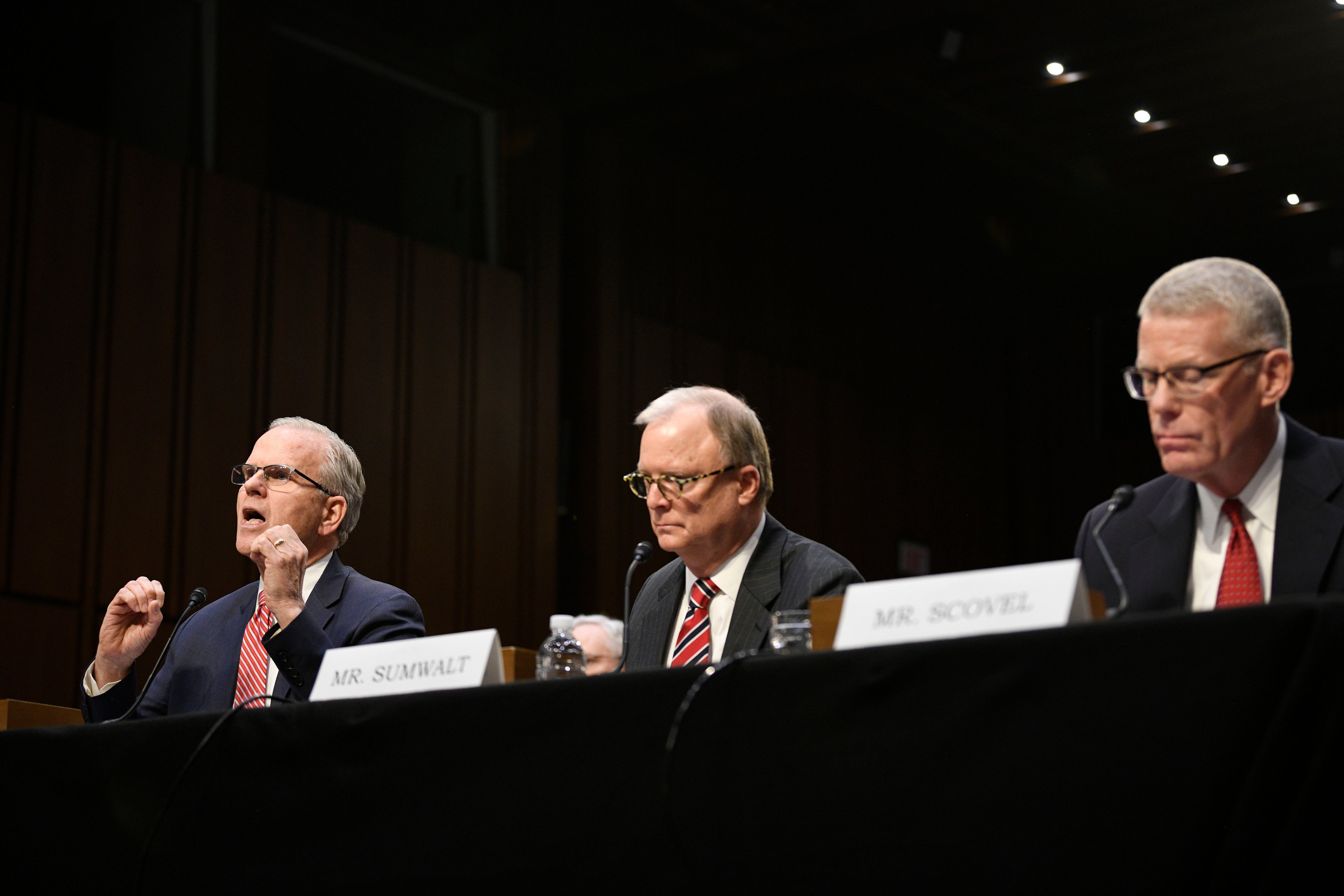
Daniel Elwell, acting administrator of the FAA, Robert Sumwalt, Chairman of the National Transportation Safety Board, and Calvin Scovel, the Transportation Department's inspector general, at the Senate Commerce Committee hearing on airline safety on March 27 (Photo by Xinhua/via Getty Images)

It is possible to sue the US government under the Federal Tort Claims Act enacted in 1946, but only within a narrow frame because government decisions, even bad decisions, are protected, lawyers explain. That protection was unanimously upheld by the US Supreme Court three decades ago following the crash of a Brazilian airliner in 1973.

At the end of a flight from Rio de Janeiro to Paris, a Varig Boeing 707 made an emergency landing in a field as it approached Orly airport. A cigarette had burned through the lavatory trash can and black smoke was billowing through the passenger cabin, asphyxiating many passengers before the airplane was even on the ground. 123 people died. Varig sued the FAA because, by law, the trash bin should have contained the fire. The FAA certified the jetliner even though the airplane failed to meet that requirement.

When the Supreme Court heard the case, all nine justices agreed that the burden falls on the regulated, in this case Boeing, to follow the law. When the FAA decides what it will and will not inspect, it is “exercising discretionary regulatory authority of the most basic kind,” the high court ruled.

The case is applicable to the decisions made during the certification of the 737 MAX, said Mark Dombroff, an aviation lawyer with the Washington firm LeClair Ryan who defended the FAA at the time as a lawyer with the Department of Justice.

The FAA’s decisions, whether good or bad, are within the scope of its responsibility, Dombroff said: “Regulators and the government have to be free to exercise their discretion free from the threat of liability.” The alternative, he suggested, would result in judges second-guessing the policy judgments of government professionals, and “would wreak chaos in the system.”

Daily Newsletter
Reward your inbox with the TPG Daily newsletter
Join over 700,000 readers for breaking news, in-depth guides and exclusive deals from TPG’s experts
Southwest Airlines Boeing 737 MAX aircraft are parked on the tarmac after being grounded, at the Southern California Logistics Airport in Victorville, California, March 28, 2019 (Photo by MARK RALSTON/AFP/Getty Images)

One exception is when workers fail to do as they should. If employees under the control of the FAA deviate from policy, a lawsuit might be permitted.

Mike Danko, an aviation lawyer with Danko Meredith in Redwood City, California, writes in the Aviation Law Monitor that a 2005 court of appeals case could open a path to a suit against the FAA’s use of Boeing employees as proxies.

“While the government has discretion to decide how to carry out its responsibility,” the decision reads, “it does not have discretion to abdicate its responsibility in this regard. When it does so, the discretionary function exception cannot shield the government.”

Brian Alexander, a plaintiff’s lawyer with Kreindler & Kreindler in New York who has successfully sued the federal government in the past, said the families of anyone killed in the 737 MAX crashes, or others harmed by what has happened since, might not want to go after the FAA.

“At the start, middle and end, regardless of the role the FAA played, Boeing, Boeing and Boeing is responsible for the safety of the airplane,” said Alexander.

“While there absolutely should be an investigation of the relationship and the specific roles played by manufacturers’ representing the FAA, and there should be an investigation into the FAA oversight, those issues are handled better by our legislative branch,” he said.

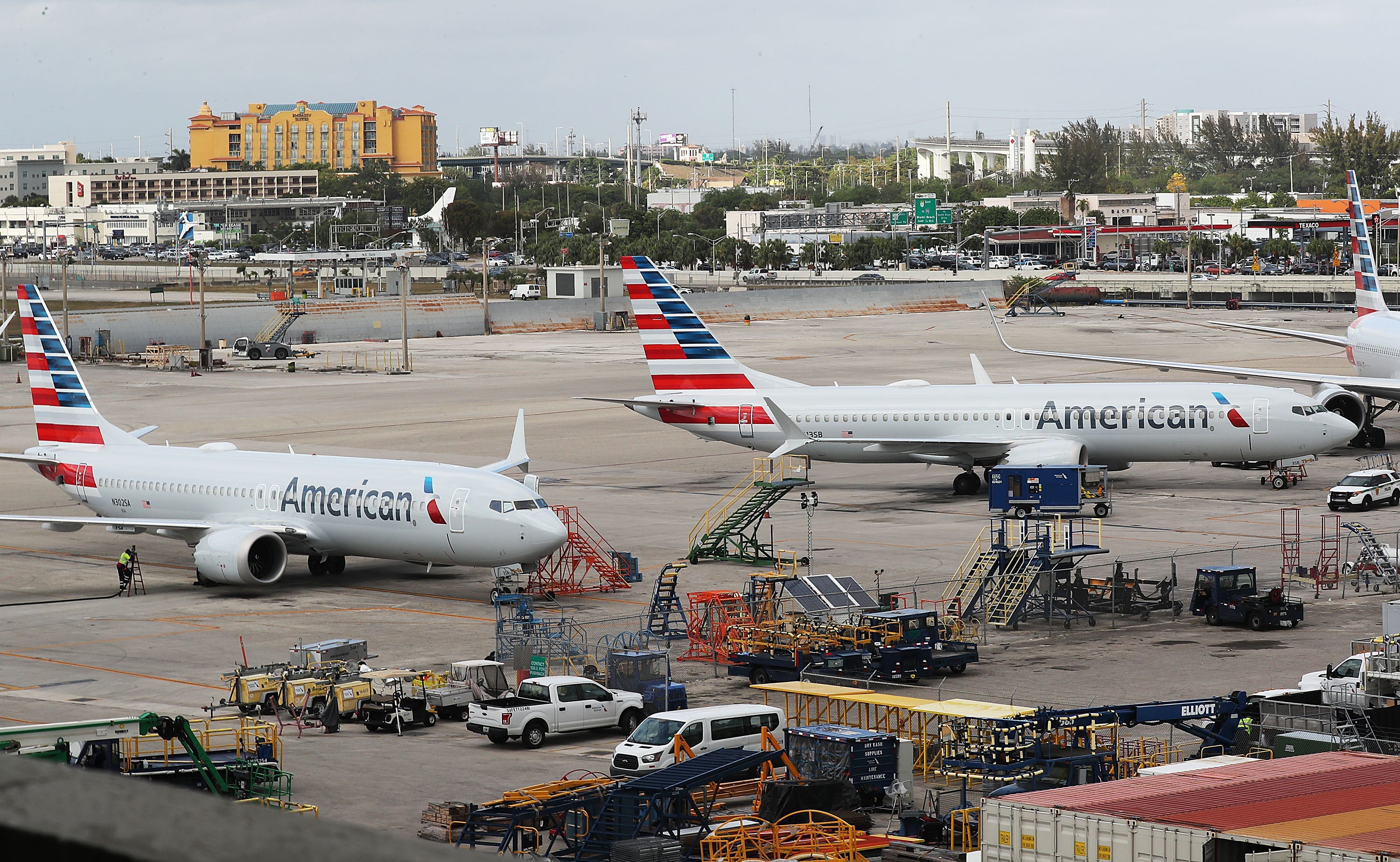
Two grounded American Airlines Boeing 737 MAX 8 parked at Miami International Airport on March 14, 2019 (Photo by Joe Raedle/Getty Images)

At the Senate hearing, politicians were lobbing questions at America’s two top aviation officials, FAA acting administrator Daniel Elwell and National Transportation Safety Board chairman Robert Sumwalt, as well as DOT Inspector General Scovel. But before the testimony ended, two lawmakers were already considering legislation.

Senator Ed Markey said he would like to see laws to prohibit airplane manufacturers from selling critical safety features as “extras,” and Senator Richard Blumenthal said he would work on a law targeting the FAA practice of delegating safety oversight to manufacturers.

Whether this is a promising sign, as Alexander suggested, or the chaos predicted by Dombroff remains to be seen.

Featured image by Getty Images

TPG featured card

Best for dining at restaurants
TPG Editor‘s Rating
4 / 5
Go to review
Apply for American Express® Gold Card
at American Express's secure site

Rewards

1 - 4X points

Intro offer

As High As 100,000 points. Find Out Your Offer.

Annual Fee

$325

Recommended Credit

Excellent to Good

Why We Chose It

There’s a lot to love about the Amex Gold. It’s a fan favorite thanks to its fantastic bonus-earning rates at restaurants worldwide and at U.S. supermarkets. If you’re hitting the skies soon, you’ll also earn bonus Membership Rewards points on travel. Paired with up to $120 in Uber Cash annually (for U.S. Uber rides or Uber Eats orders, card must be added to Uber app and you can redeem with any Amex card), up to $120 in annual dining statement credits to be used with eligible partners, an up to $84 Dunkin’ credit each year at U.S. Dunkin Donuts and an up to $100 Resy credit annually, there’s no reason that foodies shouldn’t add the Amex Gold to their wallet. These benefits alone are worth more than $400, which offsets the $325 annual fee on the Amex Gold card. Enrollment is required for select benefits. (Partner offer)

Pros

  • 4 points per dollar spent on dining at restaurants worldwide and U.S. supermarkets (on the first $50,000 in purchases per calendar year; then 1 point per dollar spent thereafter and $25,000 in purchases per calendar year; then 1 point per dollar spent thereafter, respectively)
  • 3 points per dollar spent on flights booked directly with the airline or with amextravel.com
  • Packed with credits foodies will enjoy
  • Solid welcome bonus

Cons

  • Not as useful for those living outside the U.S.
  • Some may have trouble using Uber and other dining credits
  • You may be eligible for as high as 100,000 Membership Rewards® Points after you spend $6,000 in eligible purchases on your new Card in your first 6 months of Card Membership. Welcome offers vary and you may not be eligible for an offer. Apply to know if you’re approved and find out your exact welcome offer amount – all with no credit score impact. If you’re approved and choose to accept the Card, your score may be impacted.
  • Earn 4X Membership Rewards® points per dollar spent on purchases at restaurants worldwide, on up to $50,000 in purchases per calendar year, then 1X points for the rest of the year.
  • Earn 4X Membership Rewards® points per dollar spent at US supermarkets, on up to $25,000 in purchases per calendar year, then 1X points for the rest of the year.
  • Earn 3X Membership Rewards® points per dollar spent on flights booked directly with airlines or on AmexTravel.com.
  • Earn 2X Membership Rewards® points per dollar spent on prepaid hotels and other eligible purchases booked on AmexTravel.com.
  • Earn 1X Membership Rewards® point per dollar spent on all other eligible purchases.
  • $120 Uber Cash on Gold: Add your Gold Card to your Uber account and get $10 in Uber Cash each month to use on orders and rides in the U.S. when you select an American Express Card for your transaction. That’s up to $120 Uber Cash annually. Plus, after using your Uber Cash, use your Card to earn 4X Membership Rewards® points for Uber Eats purchases made with restaurants or U.S. supermarkets. Point caps and terms apply.
  • $84 Dunkin' Credit: With the $84 Dunkin' Credit, you can earn up to $7 in monthly statement credits after you enroll and pay with the American Express® Gold Card at U.S. Dunkin' locations. Enrollment is required to receive this benefit.
  • $100 Resy Credit: Get up to $100 in statement credits each calendar year after you pay with the American Express® Gold Card to dine at U.S. Resy restaurants or make other eligible Resy purchases. That's up to $50 in statement credits semi-annually. Enrollment required.
  • $120 Dining Credit: Satisfy your cravings, sweet or savory, with the $120 Dining Credit. Earn up to $10 in statement credits monthly when you pay with the American Express® Gold Card at Grubhub, The Cheesecake Factory, Goldbelly, Wine.com, and Five Guys. Enrollment required.
  • Explore over 1,000 upscale hotels worldwide with The Hotel Collection and receive a $100 credit towards eligible charges* with every booking of two nights or more through AmexTravel.com. *Eligible charges vary by property.
  • No Foreign Transaction Fees.
  • Annual Fee is $325.
  • Terms Apply.
Apply for American Express® Gold Card
at American Express's secure site
Terms & restrictions apply. See rates & fees
Best for dining at restaurants
TPG Editor‘s Rating
4 / 5
Go to review

Rewards Rate

4XEarn 4X Membership Rewards® points per dollar spent on purchases at restaurants worldwide, on up to $50,000 in purchases per calendar year, then 1X points for the rest of the year.
4XEarn 4X Membership Rewards® points per dollar spent at US supermarkets, on up to $25,000 in purchases per calendar year, then 1X points for the rest of the year.
3XEarn 3X Membership Rewards® points per dollar spent on flights booked directly with airlines or on AmexTravel.com.
2XEarn 2X Membership Rewards® points per dollar spent on prepaid hotels and other eligible purchases booked on AmexTravel.com.
1XEarn 1X Membership Rewards® point per dollar spent on all other eligible purchases.
  • Intro Offer

    As High As 100,000 points. Find Out Your Offer.
  • Annual Fee

    $325
  • Recommended Credit

    Excellent to Good

Why We Chose It

There’s a lot to love about the Amex Gold. It’s a fan favorite thanks to its fantastic bonus-earning rates at restaurants worldwide and at U.S. supermarkets. If you’re hitting the skies soon, you’ll also earn bonus Membership Rewards points on travel. Paired with up to $120 in Uber Cash annually (for U.S. Uber rides or Uber Eats orders, card must be added to Uber app and you can redeem with any Amex card), up to $120 in annual dining statement credits to be used with eligible partners, an up to $84 Dunkin’ credit each year at U.S. Dunkin Donuts and an up to $100 Resy credit annually, there’s no reason that foodies shouldn’t add the Amex Gold to their wallet. These benefits alone are worth more than $400, which offsets the $325 annual fee on the Amex Gold card. Enrollment is required for select benefits. (Partner offer)

Pros

  • 4 points per dollar spent on dining at restaurants worldwide and U.S. supermarkets (on the first $50,000 in purchases per calendar year; then 1 point per dollar spent thereafter and $25,000 in purchases per calendar year; then 1 point per dollar spent thereafter, respectively)
  • 3 points per dollar spent on flights booked directly with the airline or with amextravel.com
  • Packed with credits foodies will enjoy
  • Solid welcome bonus

Cons

  • Not as useful for those living outside the U.S.
  • Some may have trouble using Uber and other dining credits
  • You may be eligible for as high as 100,000 Membership Rewards® Points after you spend $6,000 in eligible purchases on your new Card in your first 6 months of Card Membership. Welcome offers vary and you may not be eligible for an offer. Apply to know if you’re approved and find out your exact welcome offer amount – all with no credit score impact. If you’re approved and choose to accept the Card, your score may be impacted.
  • Earn 4X Membership Rewards® points per dollar spent on purchases at restaurants worldwide, on up to $50,000 in purchases per calendar year, then 1X points for the rest of the year.
  • Earn 4X Membership Rewards® points per dollar spent at US supermarkets, on up to $25,000 in purchases per calendar year, then 1X points for the rest of the year.
  • Earn 3X Membership Rewards® points per dollar spent on flights booked directly with airlines or on AmexTravel.com.
  • Earn 2X Membership Rewards® points per dollar spent on prepaid hotels and other eligible purchases booked on AmexTravel.com.
  • Earn 1X Membership Rewards® point per dollar spent on all other eligible purchases.
  • $120 Uber Cash on Gold: Add your Gold Card to your Uber account and get $10 in Uber Cash each month to use on orders and rides in the U.S. when you select an American Express Card for your transaction. That’s up to $120 Uber Cash annually. Plus, after using your Uber Cash, use your Card to earn 4X Membership Rewards® points for Uber Eats purchases made with restaurants or U.S. supermarkets. Point caps and terms apply.
  • $84 Dunkin' Credit: With the $84 Dunkin' Credit, you can earn up to $7 in monthly statement credits after you enroll and pay with the American Express® Gold Card at U.S. Dunkin' locations. Enrollment is required to receive this benefit.
  • $100 Resy Credit: Get up to $100 in statement credits each calendar year after you pay with the American Express® Gold Card to dine at U.S. Resy restaurants or make other eligible Resy purchases. That's up to $50 in statement credits semi-annually. Enrollment required.
  • $120 Dining Credit: Satisfy your cravings, sweet or savory, with the $120 Dining Credit. Earn up to $10 in statement credits monthly when you pay with the American Express® Gold Card at Grubhub, The Cheesecake Factory, Goldbelly, Wine.com, and Five Guys. Enrollment required.
  • Explore over 1,000 upscale hotels worldwide with The Hotel Collection and receive a $100 credit towards eligible charges* with every booking of two nights or more through AmexTravel.com. *Eligible charges vary by property.
  • No Foreign Transaction Fees.
  • Annual Fee is $325.
  • Terms Apply.