Why Airliners Fly So Close Above and Below Each Other
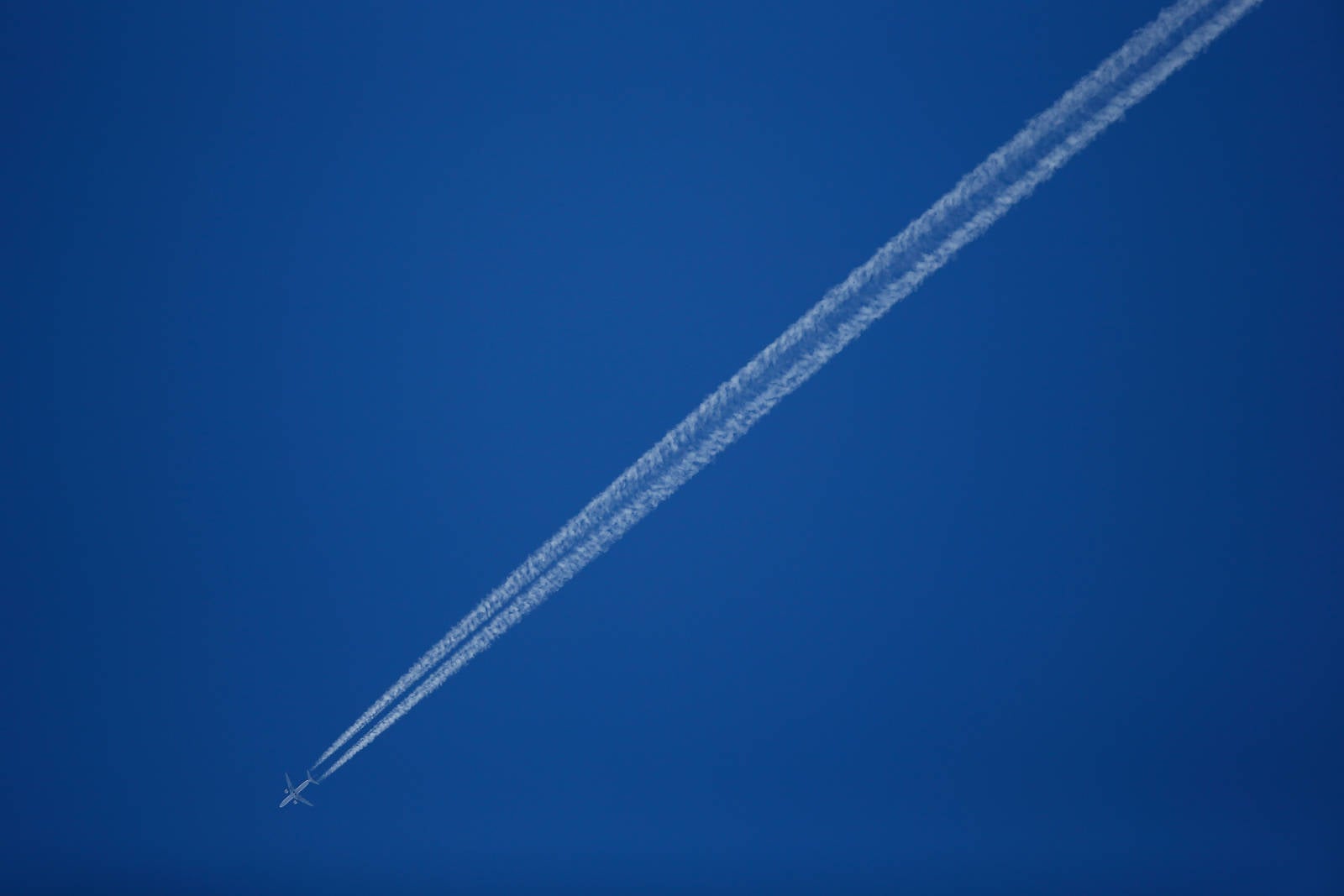
The gif below appears to be filmed by a pilot in flight. They knew from their displays that another plane was about to cross in the opposite direction above them, and were ready with a camera. The gif provides an astounding example of the vertical separation between commercial airliners high in the sky and the closing speeds at which they operate.
Just watch, and if you're like me, watch it on repeat.
It may come as a surprise, but airliners jetting across the sky are separated vertically by as little as 1,000 feet. And that's perfectly normal.
Here, the aircraft filming is behind and below the higher aircraft traveling in the same direction. 2,000 feet separates the two vertically. Jetting in the opposite direction is another airliner, which is 1,000 feet below the higher jet and 1,000 feet above the jet with the the camera — this happened in a "non-critical phase of flight," as pilots typically say. During takeoff or landing, for example, vertical separations would be larger.
Aircraft are separated vertically and horizontally in the so-called "flight levels," or altitudes above 18,000 feet, by air traffic control — that is to say, ATC will instruct the aircraft their heading and altitude.
Here's how it works.
How It Works...
All passenger planes will cruise eastbound at so-called "odd" flight levels; if they're heading east, the aircraft will fly at 33,000 feet (which pilots and air traffic control will refer to as FL330) or 35,000 feet (FL350), in increments of 2,000 feet. A westbound flight will cruise at "even" numbered flight levels — FL320 or FL340 — again in increments of 2,000 feet.
Nowadays, nations that are members of ICAO, the international organization that governs civil aviation, have implemented so-called reduced vertical separation minima (RVSM) above 29,000 feet and below 41,000 feet. With RVSM, one aircraft can be at FL320 and another at FL330, heading in opposite directions.
It hasn't always been this way. In fact, it really only took hold in the mid-2000s.

From the 1940s, aircraft above 29,000 feet were separated by 2,000 feet of vertical space as described above. The reason? Altimeters — instruments that indicate altitude to the pilots based on a system that measures the pressure in the air surrounding the aircraft — simply are not as accurate as pressure decreases and the aircraft gains altitude. In the flight levels, above 18,000 feet, the altitude is set by pilots at a standard barometric pressure of 29.92 so as to create a standard reference for all aircraft and avoid any variation. Below the flight levels, air traffic control will report the specific pressure in an area so that altitude readings will be standardized across aircraft in the airspace.
The change came about when computers started to play a larger role on the flight deck. Air Data Computers (ADCs) take the readings from the various instruments in the so-called "Pitot-static" system, whichmeasures air pressure and has improved over time, and determine the plane's airspeed and altitude with much more precision than a reading from a single instrument. In addition, GPS is used for calibration of the ADC data and to comply with the RVSM capability monitoring of aircraft, but is not required as part of the system.
... and How It Saves Fuel
Airlines will try to optimize their flight paths to take advantage of the winds aloft, and reducing the vertical separation between aircraft allows for more flexibility. Indeed, there is a fuel-burn penalty of about 1 percent for each 1000 ft below optimum cruise altitude, according to ICAO. (Jet engines are more efficient at higher altitudes.) That's a lot of fuel and a lot of money. In addition, RVSM doubles the number of aircraft that can use the flight levels, and with some 6 percent growth in the number of flights between 2004 and 2020 according to ICAO, more highways were needed.
It wasn't until the fuel crisis in the 1970s that airlines pressured ICAO to consider reducing the vertical separation in the sky.
Like anything aviation-related with a safety component, it took a long time for progress to be made. An ICAO panel began work in 1982, reporting in 1988 that reduced separation was technically feasible. It wasn't until 1997 that RVSM was first implemented, and it took until 2005 for it to become standard in North America and on Pacific and Atlantic routes. The project paid off, however. Within five years of implementation of RVSM, ICAO calculated fuel savings alone of some $200 million per year.
Aircraft are required to maintain certain approved instrumentation to take advantage of this reduced separation, as well as use approved autopilot systems.
And what about the impressive rate of closure between the two planes going in opposite directions in the gif above?
High school physics tells us that to calculate the closing speed of two objects, you sum the two speeds. If one aircraft is traveling, say, 801 mph over the ground (with a hefty tailwind), and the other aircraft is traveling, say 350 mph over the ground (with the opposite headwind), the closing speed is a whopping 1,151 mph. If the two aircraft are five nautical miles apart, they will meet in around 17 seconds.
The good news! is that they are separated by 1,000 feet.
Mike Arnot is the founder of Boarding Pass NYC, a New York-based travel brand, and a private pilot.
TPG featured card

at Capital One's secure site
Terms & restrictions apply. See rates & fees.
| 5X miles | Earn 5X miles on hotels, vacation rentals and rental cars booked through Capital One Travel |
| 2X miles | Earn unlimited 2X miles on every purchase, every day |
Pros
- Stellar welcome offer of 75,000 miles after spending $4,000 on purchases in the first three months from account opening. Plus, a $250 Capital One Travel credit to use in your first cardholder year upon account opening.
- You'll earn 2 miles per dollar on every purchase, which means you won't have to worry about memorizing bonus categories
- Rewards are versatile and can be redeemed for a statement credit or transferred to Capital One’s transfer partners
Cons
- Highest bonus-earning categories only on travel booked via Capital One Travel
- LIMITED-TIME OFFER: Enjoy $250 to use on Capital One Travel in your first cardholder year, plus earn 75,000 bonus miles once you spend $4,000 on purchases within the first 3 months from account opening - that’s equal to $1,000 in travel
- Earn unlimited 2X miles on every purchase, every day
- Earn 5X miles on hotels, vacation rentals and rental cars booked through Capital One Travel
- Miles won't expire for the life of the account and there's no limit to how many you can earn
- Receive up to a $120 credit for Global Entry or TSA PreCheck®
- Use your miles to get reimbursed for any travel purchase—or redeem by booking a trip through Capital One Travel
- Enjoy a $50 experience credit and other premium benefits with every hotel and vacation rental booked from the Lifestyle Collection
- Transfer your miles to your choice of 15+ travel loyalty programs
- Top rated mobile app