Which US Airports Are the Worst for Weather Delays?
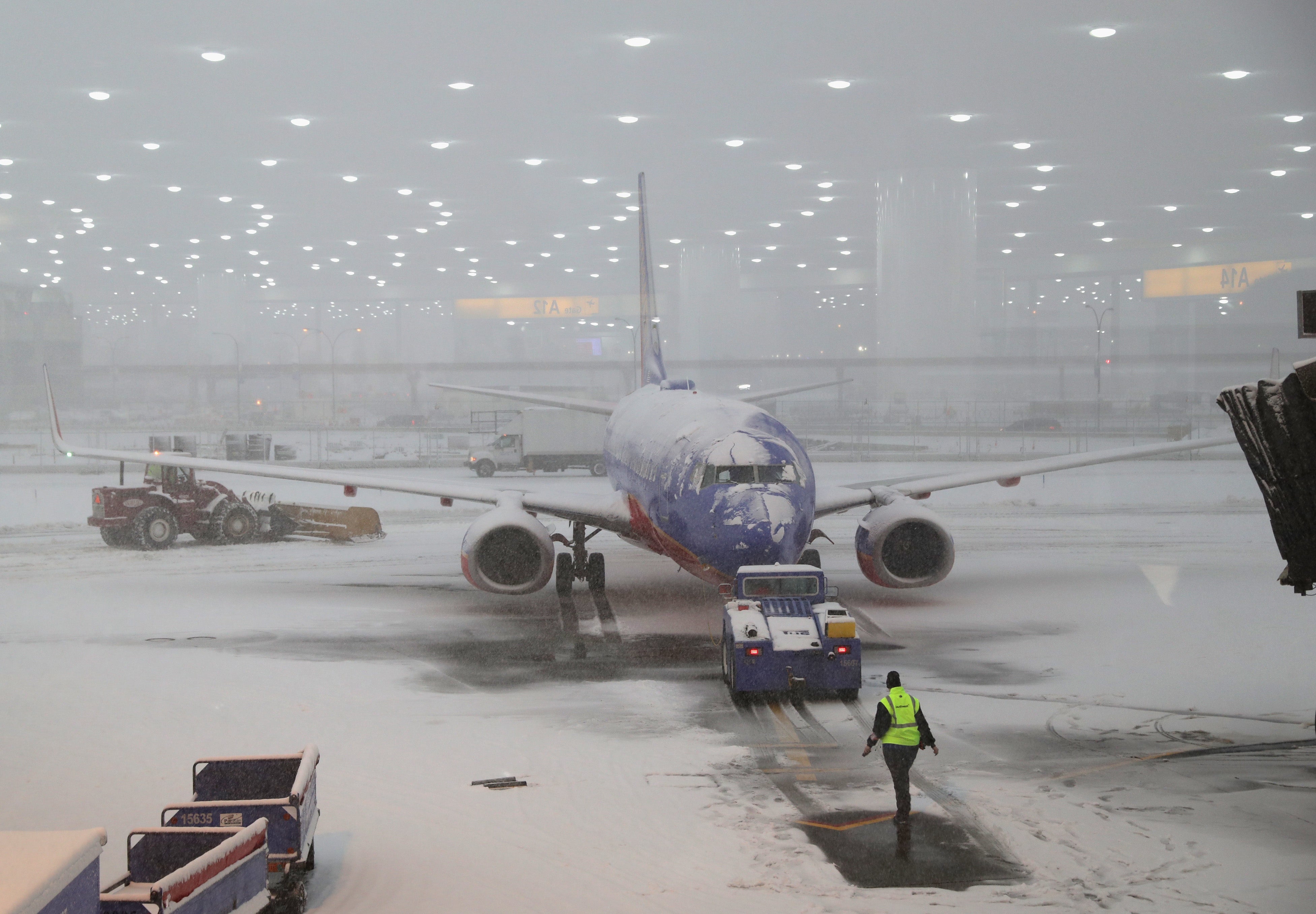
Winter chills and storms are upon us in the Northern Hemisphere. And in the winter, when you're sitting at the airport terminal waiting to get out, it feels like every flight is delayed.
Good news: that's not the case, and the data backs it up. But some airports are much worse than others.
In 2017, even during the coldest winter months of December, January, February and March, approximately 80% of US flights were on time. This is a slight improvement over 2016, when 77% of flights were on time. Importantly, in the US hub-and-spoke system, flight delays were spread evenly between the smaller regional airports and larger centers. This makes sense, as the hubs pass their delays outward to the network.
The percentage of delays due to extreme weather is going down, in fact, as the table below shows:
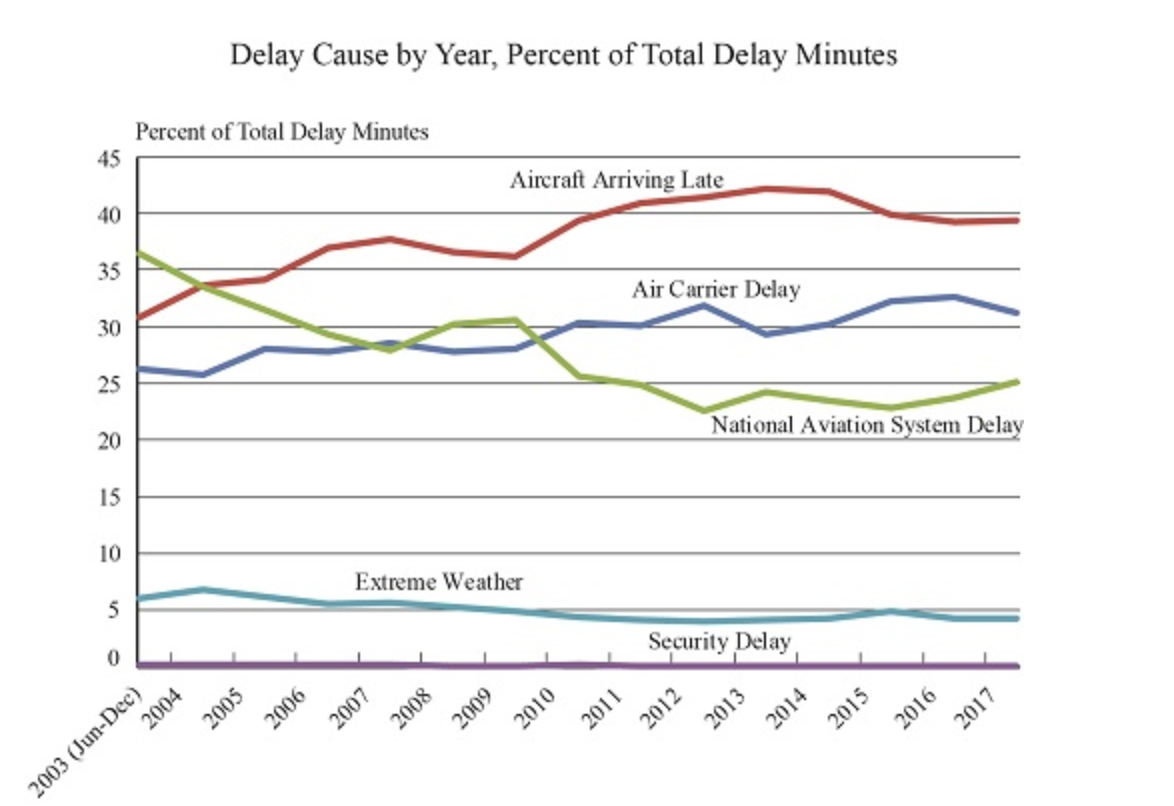
Among the data the airline industry is required by regulation to report to the Department of Transportation are on-time arrivals and departures, and the reasons for deviations. Weather delay stats are kept by the Bureau of Transportation Statistics.
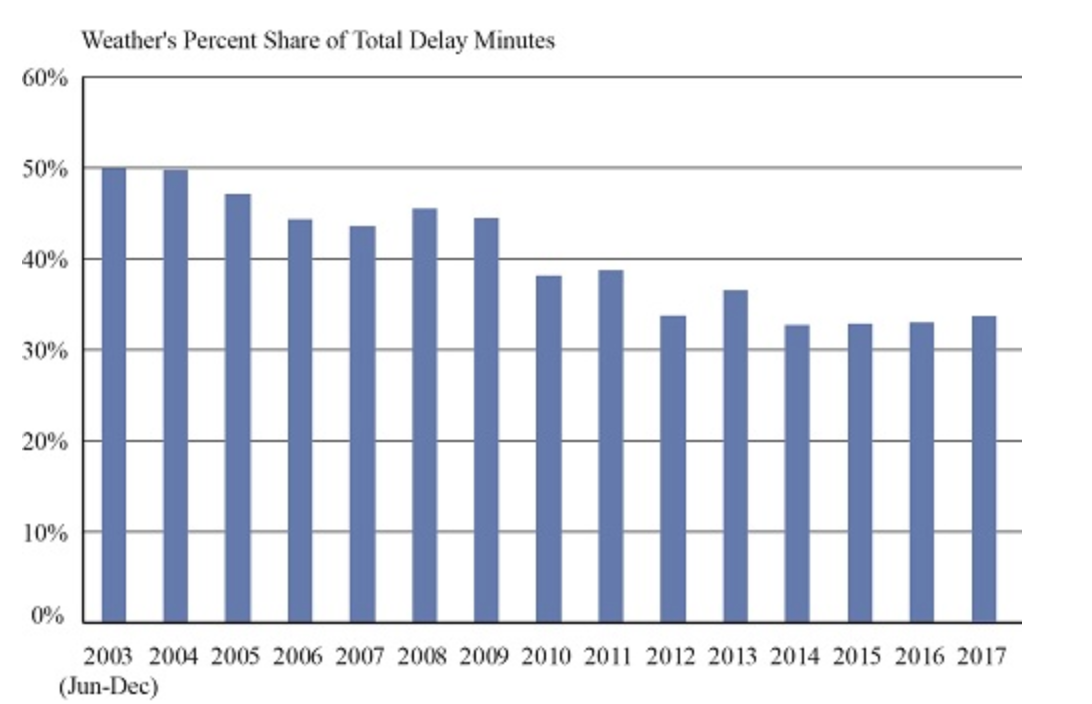
The table below provides a proxy for total weather delays, measured in minutes, for the period between October 2017 and October 2018. It includes delays to the National Aviation System that are not strictly weather-related, such as traffic pileups at the major hubs and late-arriving aircraft that may not be due to weather, but it excludes maintenance issues or airline-controlled delays. What we know is that between 50-60% of NAS delays are due to weather — but not extreme weather — and that airline-controlled delays represent less than 5% of the total.
Worst US Airports for Weather Measured in Delay Minutes
| AIRPORT | NATIONAL AVIATION SYSTEM DELAYS | EXTREME WEATHER DELAYS | LATE-ARRIVING AIRCRAFT DELAYS | TOTAL | % TOTAL |
|---|---|---|---|---|---|
Chicago O'Hare (ORD) | 1,707,353 | 270,189 | 1,867,386 | 3,844,928 | 6% |
Hartsfield-Jackson Atlanta (ATL) | 986,176 | 263,847 | 1,514,276 | 2,764,299 | 5% |
Newark Liberty (EWR) | 1,888,390 | 114,335 | 732,926 | 2,735,651 | 5% |
Dallas/Fort Worth (DFW) | 815,032 | 234,693 | 1,456,957 | 2,506,682 | 4% |
San Francisco (SFO) | 1,435,733 | 101,105 | 936,938 | 2,473,776 | 4% |
LaGuardia (LGA) | 1,207,991 | 169,228 | 807,517 | 2,184,736 | 4% |
Denver (DEN) | 527,483 | 108,565 | 1,159,518 | 1,795,566 | 3% |
Boston Logan (BOS) | 756,415 | 92,246 | 923,118 | 1,771,779 | 3% |
New York JFK | 825,634 | 98,234 | 705,328 | 1,629,196 | 3% |
Source: Bureau of Transportation Statistics, Weather Delays by Airport for the period from October 2017 to October 2018
ORD: Yeah, You Know Me

As would be expected, Chicago - O'Hare tops the list of airports to avoid in wintertime. This may not be to many flyers. But, when you compare it to ATL (which has around 30,000 more aircraft movements per year, or around 80 more per day) weather is quantifiably more a factor at ORD—the weather is 32% worse, when it comes to causing delays.
Now, ORD has robust deicing operations and nice places to hunker down if even that doesn't work, such as the United Polaris lounge with its à la carte dining, or the American Airlines Flagship First lounge. But because it is such a busy airport, a weather delay ripples through arrivals and departures here like no other. Indeed, Minneapolis, which has bad weather but less traffic, isn't even in the the top 10. Aircraft inbound and outbound at ORD were delayed a total of an equivalent of seven years during the year examined here.
The other usual suspects include LGA, JFK, EWR, BOS and DEN. No real surprises here.
But Wait — ATL, DFW and SFO?
Atlanta shows up on the list as the number two weather-affected airport, largely because of system delays and thunderstorms at ATL itself, and not in the wintertime. It's also Delta's major hub. This makes sense. The same goes for DFW, which is American's major hub, and also affected by so-called convective activity, i.e. summer thunderstorms.
What about SFO? San Francisco is so affected by the weather there is already a pre-written primer on weather delays for the media. SFO has two parallel runways separated by only 750 feet. FAA regulations do not permit aircraft to land side by side in poor weather conditions unless the runways are separated by 4,300 feet. According to SFO, this reduces operations by half during poor weather. And SFO gets plenty of poor weather, namely fog. So, if you think that weather delays are mostly a winter thing and mostly affecting places in the Northeast or Midwest notoriously prone to snowstorms, you're only half right — and the table above proves it.
Mike Arnot is the founder of Boarding Pass NYC, a New York-based travel brand, and private pilot.
TPG featured card
at American Express's secure site
Terms & restrictions apply. See rates & fees.
| 4X | Earn 4X Membership Rewards® points per dollar spent on purchases at restaurants worldwide, on up to $50,000 in purchases per calendar year, then 1X points for the rest of the year. |
| 4X | Earn 4X Membership Rewards® points per dollar spent at US supermarkets, on up to $25,000 in purchases per calendar year, then 1X points for the rest of the year. |
| 5X | Earn 5X Membership Rewards® points on prepaid hotel stays booked through AmexTravel.com or the Amex Travel App™. |
| 3X | Earn 3X Membership Rewards® points on flights booked through AmexTravel.com, the Amex Travel App™, or purchased directly from airlines. |
| 2X | Earn 2X Membership Rewards® points on prepaid car rentals booked through AmexTravel.com or the Amex Travel App™ and cruises booked and paid through AmexTravel.com. |
| 1X | Earn 1X Membership Rewards® point per dollar spent on all other eligible purchases. |
Pros
- Valuable dining and food-related credits
- Flexible rewards with airline and hotel transfer partners
- Multiple travel and purchase protections
- No foreign transaction fees
- Access to Amex Offers for additional savings (enrollment required)
Cons
- Not as useful for those living outside the U.S.
- Some may have trouble using Uber and other dining credits
- You may be eligible for as high as 100,000 Membership Rewards® Points after you spend $8,000 in eligible purchases on your new Card in your first 6 months of Card Membership. Welcome offers vary and you may not be eligible for an offer. Apply to know if you’re approved and find out your exact welcome offer amount – all with no credit score impact. If you’re approved and choose to accept the Card, your score may be impacted.
- Earn 4X Membership Rewards® points per dollar spent on purchases at restaurants worldwide, on up to $50,000 in purchases per calendar year, then 1X points for the rest of the year.
- Earn 4X Membership Rewards® points per dollar spent at US supermarkets, on up to $25,000 in purchases per calendar year, then 1X points for the rest of the year.
- Earn 5X Membership Rewards® points on prepaid hotel stays booked through AmexTravel.com or the Amex Travel App™.
- Earn 3X Membership Rewards® points on flights booked through AmexTravel.com, the Amex Travel App™, or purchased directly from airlines.
- Earn 2X Membership Rewards® points on prepaid car rentals booked through AmexTravel.com or the Amex Travel App™ and cruises booked and paid through AmexTravel.com.
- Earn 1X Membership Rewards® point per dollar spent on all other eligible purchases.
- Pay It® lets you tap in the American Express® App to quickly pay for small purchase amounts throughout the month and still earn rewards the way you usually do. Plan It® gives you the option to split up big purchases into equal monthly payments with a fixed fee. You’ll know upfront exactly how much you’ll pay.
- $120 Dining Credit: Earn up to a total of $10 in statement credits monthly when you pay with the Gold Card at Grubhub (including Seamless), Buffalo Wild Wings, Five Guys, The Cheesecake Factory, and Wonder. This can be an annual savings of up to $120. Enrollment required.
- $100 Resy Credit: Get up to $100 in statement credits each calendar year at over 10,000 qualifying U.S. Resy restaurants after you pay for eligible purchases with the American Express® Gold Card. That’s up to $50 in statement credits semi-annually. Enrollment required.
- $84 Dunkin' Credit: Earn up to $7 in monthly statement credits after you pay with the American Express® Gold Card at U.S. Dunkin’ locations. Enrollment required.
- $120 Uber Cash on Gold: Enjoy up to $120 in Uber Cash annually with your Gold Card. Just add your Card to your Uber account and you'll get $10 in Uber Cash each month to use on orders and rides in the U.S. when you select an Amex Card for your transaction.
- Enjoy complimentary Hertz Five Star® Status benefits like skipping the counter at select locations, adding an additional driver at no additional cost*, and vehicle upgrades**. Benefit enrollment and Hertz Gold+ registration are required. *Additional drivers must meet standard rental qualifications and must be a spouse or domestic partner to qualify as complimentary. Other additional drivers subject to fees. **Benefits are subject to availability and vary by location. Additional Hertz program Terms and Conditions including age restrictions apply.
- Book two nights or more with The Hotel Collection through AmexTravel.com or the Amex Travel App™ and receive a $100* credit towards eligible charges at over 1,400 upscale hotels worldwide. *Eligible charges vary by property.
- Book your travel through the Amex Travel App™ with added peace of mind – backed by American Express® service and support. Only for American Express® Card Members.
- Whenever you need us, we're here. Our Member Services team will ensure you are taken care of. From lost Card replacement to statement questions, we are available to help 24/7.
- No Foreign Transaction Fees.
- Annual Fee is $325.
- Terms Apply.