The US requires a negative COVID-19 test taken within 3 days to get in the country. But what if your flight is delayed?


Since January, U.S. airlines have maintained a pre-travel testing mandate under the guidance of the U.S. Centers for Disease Control and Prevention which requires incoming passengers to show proof of a negative COVID-19 test taken within three days of departure to the U.S., vaccination status notwithstanding.
This order has created a bit of confusion for travelers, due in no small part to the CDC's wording of a "3-day period" versus a 72-hour period.
"The 3-day period is the 3 days before the flight's departure. The Order uses a 3-day timeframe instead of 72 hours to provide more flexibility to the traveler. By using a 3-day window, test validity does not depend on the time of the flight or the time of day that the test was administered," the CDC says. "For example, if a passenger's flight is at 1pm on a Friday, the passenger could board with a negative test that was taken any time on the prior Tuesday or after."
In its defense, the CDC uses a "3-day period" rather than specifying 72 hours to refrain from afflicting travelers with a math problem — calculating the window based on the exact time of your scheduled flight — on top of an already stressful travel situation.
"If you plan to travel internationally, you will need to get a viral test no more than 3 days before you travel by air into the United States and show your negative result to the airline before you board your flight," the CDC advises.
In theory, the airline of your departing flight is tasked with checking this test, either when you check in for your flight or before boarding, as the CDC has lobbed the responsibility of confirming negative test results or recovery from COVID-19 for all passengers before boarding to airlines, as my colleague Victoria Walker previously reported.
"The CDC also said that airlines are responsible for ensuring any translation accuracy and may not shift this responsibility to a third party," wrote Walker.
Related: Why do vaccinated travelers still need a COVID-19 test to fly back to the US from abroad?
This pre-check by the airline seems to serve as validation with U.S. Customs and Border Protection so that CBP rarely checks the test by the time you reach customs, as I know from my recent trip to London as well as from my TPG colleagues who have all traveled much more than me throughout the pandemic.

Airlines do not make the rules when it comes to travel-related COVID-19 testing requirements, despite the responsibility, but they are the ones travelers go to in a panic for real-time questions about flying during these pandemic times, as the case was last weekend when the threat of Tropical Storm Henri canceled more than 850 flights throughout the Northeast.
Travelers scheduled to come back to the U.S. the weekend of Aug. 21-22 were left wondering whether a delayed flight would mean their COVID-19 test would no longer be valid if their new flight meant it fell out of the aforementioned three-day window.
Read more: What it was like flying home now that the US requires a negative COVID-19 test
One concerned traveler was Jeremy Jacobowitz, the popular food blogger formerly known as Brunch Boys. Jacobowitz chronicled his confusion regarding his scheduled flight from Montreal to New York City on Aug. 22 on Instagram, seeking clarity if his original COVID-19 test would be accepted by Air Canada if Henri caused a delay.
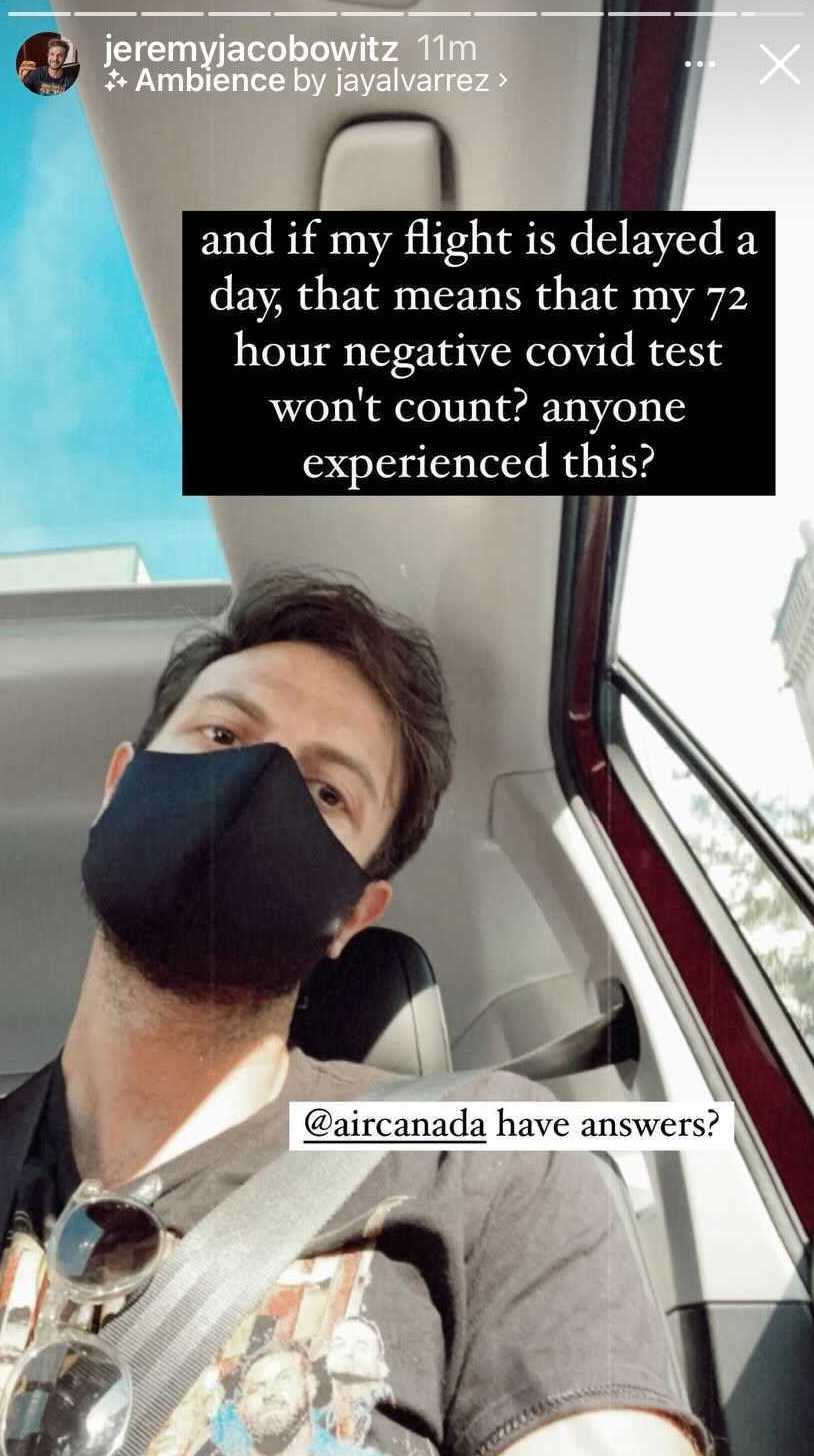
"An airline cannot grant exemptions to this law," an Air Canada spokesperson told me via email. "We have to follow the regulations of the government at the destinations where we travel to." Representatives from Southwest and Delta confirmed this and referred me to the CDC guidance.
Interestingly enough, the CDC actually has an exception policy built-in for delayed flights to accept an original negative test if your initial departing flight is delayed less than 24 hours past the three-day limit for testing.
"If the initial departing flight in your trip is delayed past the 3-day limit of testing due to a situation outside of your control (e.g., delays because of severe weather or aircraft mechanical problem), and that delay is 24 hours or less past the 3-day limit for testing, you do not need to be retested," per the CDC. "If the delay is more than 24 hours past the 3-day limit, then you will need to be retested."
The agency also grants a 48-hour extension for delayed connecting flights.
Many travelers are not aware of this policy, including Jacobowitz, who resorted to paying $150 to come back earlier on Sunday morning so he wouldn't have to be retested in case his noon flight was delayed.
Read more: CDC just released guidelines for airlines to verify a traveler's negative COVID-19 results

"One of the confusing things seemed to be that Canada was really strict with '72 hours' on the dot, and America was more '3 days' with leeway there," Jacobowitz told me via email.
Indeed, it appears that airlines may be offering flexibility for situations like these by accepting tests so long as they fall within 72 hours of an originally scheduled flight time, despite Air Canada, Southwest and Delta all saying that U.S. airlines cannot make exemptions to U.S. law.
"From my conversations with everyone DM'ing me, they all had different experiences with a delayed flight," said Jacobowitz, who has over 400,000 Instagram followers. "Some said as long as you don't leave the airport, they were fine, some said they were told absolutely not, they had to get a new test, and some were just left with more questions than answers. It looks like it's just how the airline wants to interpret these rules."
Although Air Canada did not initially ask for his test during check-in, the blogger confirmed that they eventually did so before boarding.
Related: Traveling soon? Here's where you can quickly get a COVID-19 PCR test for travel

In a surprise to no one, CBP was less than interested in verifying such when passing through customs.

Should you find yourself in an inevitable delay coming back to the U.S., Jacobowitz told his followers to consider packing an in-home COVID-19 test kit to avoid the hassle of finding a testing location in a foreign country.
"Buy an at-home kit before leaving America, unfortunately, they don't just sell kits like that in Canada," he said. "So it would have required me to pay for a rapid test there, which while widely available, and at the airport, the fees of these tests added up really quickly."
Bottom line, the CDC offers an additional 24-hour grace period for delayed flights outside of your control. While at-home testing options are not bulletproof, as users have reported hourslong waits for results, they are a backup option that offers flexibility, which is key in the game of pandemic travel.
Read more: Travelers facing hourslong waits for BinaxNow's in-home COVID test
TPG featured card

at American Express's secure site
Terms & restrictions apply. See rates & fees.
| 4X | Earn 4X Membership Rewards® points per dollar spent on purchases at restaurants worldwide, on up to $50,000 in purchases per calendar year, then 1X points for the rest of the year. |
| 4X | Earn 4X Membership Rewards® points per dollar spent at US supermarkets, on up to $25,000 in purchases per calendar year, then 1X points for the rest of the year. |
| 5X | Earn 5X Membership Rewards® points on prepaid hotel stays booked through AmexTravel.com or the Amex Travel App™. |
| 3X | Earn 3X Membership Rewards® points on flights booked through AmexTravel.com, the Amex Travel App™, or purchased directly from airlines. |
| 2X | Earn 2X Membership Rewards® points on prepaid car rentals booked through AmexTravel.com or the Amex Travel App™ and cruises booked and paid through AmexTravel.com. |
| 1X | Earn 1X Membership Rewards® point per dollar spent on all other eligible purchases. |
Pros
- Valuable dining and food-related credits
- Flexible rewards with airline and hotel transfer partners
- Multiple travel and purchase protections
- No foreign transaction fees
- Access to Amex Offers for additional savings (enrollment required)
Cons
- Not as useful for those living outside the U.S.
- Some may have trouble using Uber and other dining credits
- You may be eligible for as high as 100,000 Membership Rewards® Points after you spend $8,000 in eligible purchases on your new Card in your first 6 months of Card Membership. Welcome offers vary and you may not be eligible for an offer. Apply to know if you’re approved and find out your exact welcome offer amount – all with no credit score impact. If you’re approved and choose to accept the Card, your score may be impacted.
- Earn 4X Membership Rewards® points per dollar spent on purchases at restaurants worldwide, on up to $50,000 in purchases per calendar year, then 1X points for the rest of the year.
- Earn 4X Membership Rewards® points per dollar spent at US supermarkets, on up to $25,000 in purchases per calendar year, then 1X points for the rest of the year.
- Earn 5X Membership Rewards® points on prepaid hotel stays booked through AmexTravel.com or the Amex Travel App™.
- Earn 3X Membership Rewards® points on flights booked through AmexTravel.com, the Amex Travel App™, or purchased directly from airlines.
- Earn 2X Membership Rewards® points on prepaid car rentals booked through AmexTravel.com or the Amex Travel App™ and cruises booked and paid through AmexTravel.com.
- Earn 1X Membership Rewards® point per dollar spent on all other eligible purchases.
- Pay It® lets you tap in the American Express® App to quickly pay for small purchase amounts throughout the month and still earn rewards the way you usually do. Plan It® gives you the option to split up big purchases into equal monthly payments with a fixed fee. You’ll know upfront exactly how much you’ll pay.
- $120 Dining Credit: Earn up to a total of $10 in statement credits monthly when you pay with the Gold Card at Grubhub (including Seamless), Buffalo Wild Wings, Five Guys, The Cheesecake Factory, and Wonder. This can be an annual savings of up to $120. Enrollment required.
- $100 Resy Credit: Get up to $100 in statement credits each calendar year at over 10,000 qualifying U.S. Resy restaurants after you pay for eligible purchases with the American Express® Gold Card. That’s up to $50 in statement credits semi-annually. Enrollment required.
- $84 Dunkin' Credit: Earn up to $7 in monthly statement credits after you pay with the American Express® Gold Card at U.S. Dunkin’ locations. Enrollment required.
- $120 Uber Cash on Gold: Enjoy up to $120 in Uber Cash annually with your Gold Card. Just add your Card to your Uber account and you'll get $10 in Uber Cash each month to use on orders and rides in the U.S. when you select an Amex Card for your transaction.
- Enjoy complimentary Hertz Five Star® Status benefits like skipping the counter at select locations, adding an additional driver at no additional cost*, and vehicle upgrades**. Benefit enrollment and Hertz Gold+ registration are required. *Additional drivers must meet standard rental qualifications and must be a spouse or domestic partner to qualify as complimentary. Other additional drivers subject to fees. **Benefits are subject to availability and vary by location. Additional Hertz program Terms and Conditions including age restrictions apply.
- Book two nights or more with The Hotel Collection through AmexTravel.com or the Amex Travel App™ and receive a $100* credit towards eligible charges at over 1,400 upscale hotels worldwide. *Eligible charges vary by property.
- Book your travel through the Amex Travel App™ with added peace of mind – backed by American Express® service and support. Only for American Express® Card Members.
- Whenever you need us, we're here. Our Member Services team will ensure you are taken care of. From lost Card replacement to statement questions, we are available to help 24/7.
- No Foreign Transaction Fees.
- Annual Fee is $325.
- Terms Apply.