TSA reinstates flight crew self-defense classes as unruly passenger behavior continues

Unruly airline passengers are in the news these days.
On Thursday, two Hawaiian Airlines flights returned to the Honolulu airport due to unruly passenger incidents.
That same day, at a congressional hearing on in-flight incidents, the Federal Aviation Administration said that while rates of unruly passengers onboard commercial flights have dropped by 50% since early 2021, they are still more than double what they were at the end of 2020.
Passengers who flout the rules can face fines and end up on airline and FAA no-fly lists, but it's fight attendants and other crew members who must deal with the unruly passengers in real time in the air. And in a recent survey conducted by the Association of Flight Attendants-CWA (AFA), a major flight attendants union, 85% of flight attendants say they have dealt with unruly passengers, with close to 20% reporting that they've encountered physical violence on aircraft.
Some deescalating and self-defense tactics are part of regular and recurrent flight attendant training but, increasingly, flight attendants are looking for more tools to protect themselves from aggressive, out of control passengers.
One tool is the self-defense course the Transportation Security Administration (TSA) has been offering since at least 2015. Put on hold during the pandemic, TSA restarted the program in June and has hosted more than 50 classes around the country so far.
Related: Air rage crisis: Congress gets an earful on unruly flyer incidents aboard US flights
The voluntary four-hour training is offered to flight crew members free of charge and is held at 24 locations around the United States. All active flight crew members for domestic carriers are eligible to register for the training.
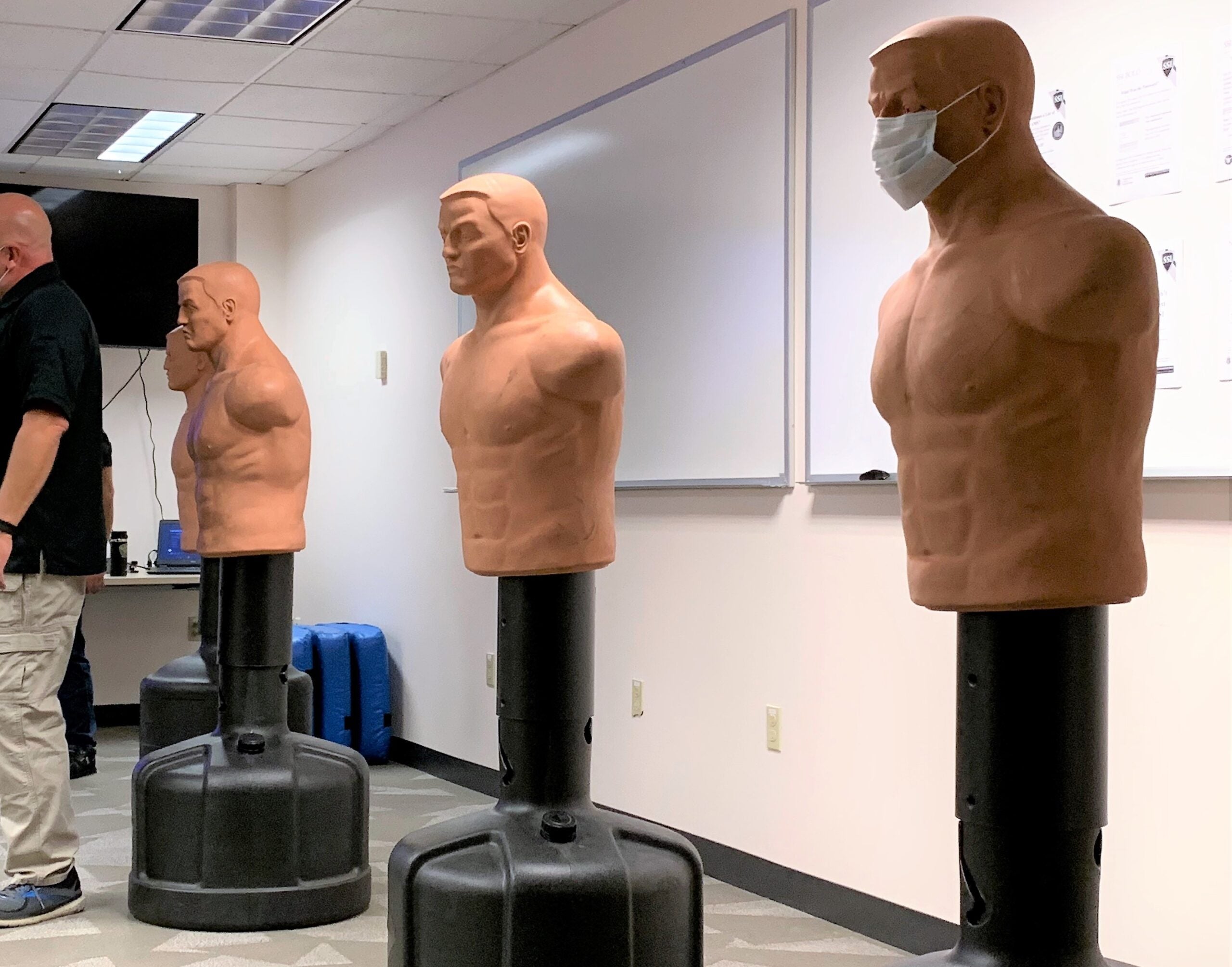
The Points Guy joined a class of 11 crewmembers at a Federal Air Marshal field office near Seattle, Washington, gathering at 8 am in a room with two Federal Air Marshal (FAM) instructors and several life-like mannequins used for self-defense training called BOBs – Body Opponent Bags.

Students ranged from Ashley, a flight attendant for two years who said she signed up not only to learn how to defend herself inflight, but for situations off the plane. "I want to learn more techniques so if someone attacks me on a layover or on my personal time, I know what to do." Barbara, a 35-year flight attendant veteran, was there for much the same reason. She said her airline's self-defense training was "not as detailed as this," and she was there to learn more techniques as well.
Related: 85% of flight attendants say they've dealt with unruly passengers this year
The class started with a welcome from Robert Selby, the Supervisory Air Marshal in charge of the Seattle field office of the Federal Air Marshals. He said that while airlines offer substantive training in deescalating tense situations on board and in self-defense, "this is another version of follow-on training" that is always evolving in response to current events and other situations.
Then the class was turned over to FAM instructors Brent and Chris. They were friendly, encouraging, and approachable throughout the morning course, but very no-nonsense when it came to advice and instructions.
"You're not going to beat someone up for not wearing a mask," said Brent, "but in situations when your life is in danger, we are teaching you to be the aggressor. We have one rule: you win."
From there, the class went through the paces of learning basic self-defense skills using personal weapons: fists, palms, the edges of hands, forearms, elbows, legs, feet, and knees.
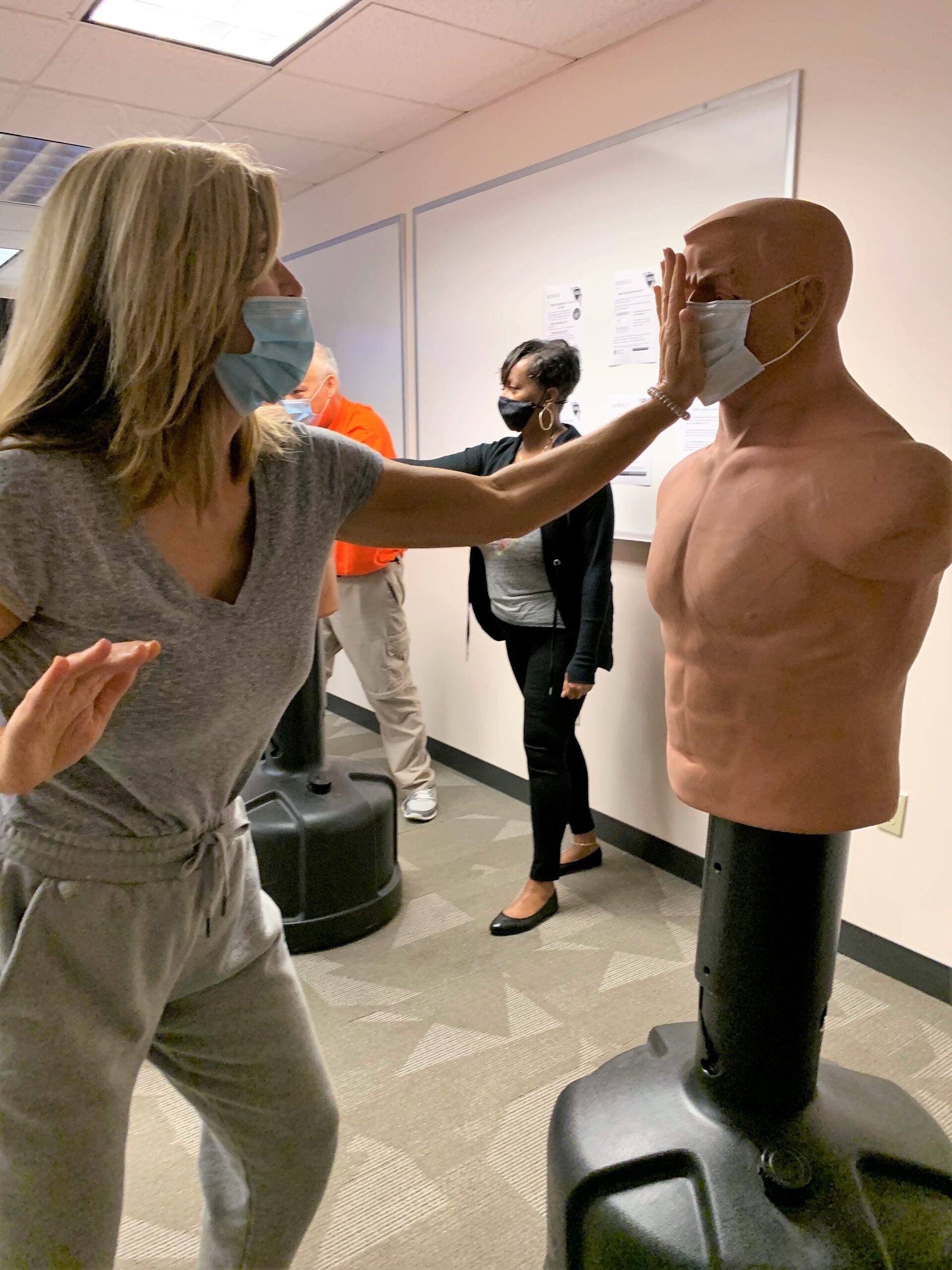
The BOBs, punching bags, and sometimes the instructors served as stand-ins for unruly passengers who were subjected to elbow strikes, hammer fists, eye gouges, clinches, foot stomps and knee strikes.
"I'm imagining doing this in my pencil skirt and heels," one flight attendant said.
Instructors pointed out the key target areas of the body – eyes, temples, neck, torso, and extremities – as acceptable targets when someone is in fear of their life and reminded these students that they had the added challenge of performing defenses tactics in confined spaces of an airplane.
Students were also reminded to verbalize while defending themselves, yelling words such as "help," "stop," and "back off." This not only reminds you to breathe, the instructors said, but alerts passengers and other crew members to come to your assistance.
In a nod to modern-day social media, one instructor noted that because other passengers will likely be videotaping an in-flight encounter, yelling those words helps make it clear what is happening and who is the real aggressor.
After several hours of learning and practicing individual self-defense skills, the final step was putting them all together in a role-playing session on an airplane simulator. One by one, class members approached the front of the plane where an air marshal was pretending to be a drunk passenger who attacks the flight attendant. Students went into self-defense mode, attacking a large, padded mat held by another instructor while other instructors stood by yelling encouragement to use newly learned skills, such as yelling and knee kicks.
"Wow, that was different than I thought it would be. My heart is racing," said a crewmember named Melissa, after going through that final exercise. "But I'm ready."
All images courtesy of the author.
TPG featured card
at American Express's secure site
Terms & restrictions apply. See rates & fees.
| 4X | Earn 4X Membership Rewards® points per dollar spent on purchases at restaurants worldwide, on up to $50,000 in purchases per calendar year, then 1X points for the rest of the year. |
| 4X | Earn 4X Membership Rewards® points per dollar spent at US supermarkets, on up to $25,000 in purchases per calendar year, then 1X points for the rest of the year. |
| 5X | Earn 5X Membership Rewards® points on prepaid hotel stays booked through AmexTravel.com or the Amex Travel App™. |
| 3X | Earn 3X Membership Rewards® points on flights booked through AmexTravel.com, the Amex Travel App™, or purchased directly from airlines. |
| 2X | Earn 2X Membership Rewards® points on prepaid car rentals booked through AmexTravel.com or the Amex Travel App™ and cruises booked and paid through AmexTravel.com. |
| 1X | Earn 1X Membership Rewards® point per dollar spent on all other eligible purchases. |
Pros
- Valuable dining and food-related credits
- Flexible rewards with airline and hotel transfer partners
- Multiple travel and purchase protections
- No foreign transaction fees
- Access to Amex Offers for additional savings (enrollment required)
Cons
- Not as useful for those living outside the U.S.
- Some may have trouble using Uber and other dining credits
- You may be eligible for as high as 100,000 Membership Rewards® Points after you spend $8,000 in eligible purchases on your new Card in your first 6 months of Card Membership. Welcome offers vary and you may not be eligible for an offer. Apply to know if you’re approved and find out your exact welcome offer amount – all with no credit score impact. If you’re approved and choose to accept the Card, your score may be impacted.
- Earn 4X Membership Rewards® points per dollar spent on purchases at restaurants worldwide, on up to $50,000 in purchases per calendar year, then 1X points for the rest of the year.
- Earn 4X Membership Rewards® points per dollar spent at US supermarkets, on up to $25,000 in purchases per calendar year, then 1X points for the rest of the year.
- Earn 5X Membership Rewards® points on prepaid hotel stays booked through AmexTravel.com or the Amex Travel App™.
- Earn 3X Membership Rewards® points on flights booked through AmexTravel.com, the Amex Travel App™, or purchased directly from airlines.
- Earn 2X Membership Rewards® points on prepaid car rentals booked through AmexTravel.com or the Amex Travel App™ and cruises booked and paid through AmexTravel.com.
- Earn 1X Membership Rewards® point per dollar spent on all other eligible purchases.
- Pay It® lets you tap in the American Express® App to quickly pay for small purchase amounts throughout the month and still earn rewards the way you usually do. Plan It® gives you the option to split up big purchases into equal monthly payments with a fixed fee. You’ll know upfront exactly how much you’ll pay.
- $120 Dining Credit: Earn up to a total of $10 in statement credits monthly when you pay with the Gold Card at Grubhub (including Seamless), Buffalo Wild Wings, Five Guys, The Cheesecake Factory, and Wonder. This can be an annual savings of up to $120. Enrollment required.
- $100 Resy Credit: Get up to $100 in statement credits each calendar year at over 10,000 qualifying U.S. Resy restaurants after you pay for eligible purchases with the American Express® Gold Card. That’s up to $50 in statement credits semi-annually. Enrollment required.
- $84 Dunkin' Credit: Earn up to $7 in monthly statement credits after you pay with the American Express® Gold Card at U.S. Dunkin’ locations. Enrollment required.
- $120 Uber Cash on Gold: Enjoy up to $120 in Uber Cash annually with your Gold Card. Just add your Card to your Uber account and you'll get $10 in Uber Cash each month to use on orders and rides in the U.S. when you select an Amex Card for your transaction.
- Enjoy complimentary Hertz Five Star® Status benefits like skipping the counter at select locations, adding an additional driver at no additional cost*, and vehicle upgrades**. Benefit enrollment and Hertz Gold+ registration are required. *Additional drivers must meet standard rental qualifications and must be a spouse or domestic partner to qualify as complimentary. Other additional drivers subject to fees. **Benefits are subject to availability and vary by location. Additional Hertz program Terms and Conditions including age restrictions apply.
- Book two nights or more with The Hotel Collection through AmexTravel.com or the Amex Travel App™ and receive a $100* credit towards eligible charges at over 1,400 upscale hotels worldwide. *Eligible charges vary by property.
- Book your travel through the Amex Travel App™ with added peace of mind – backed by American Express® service and support. Only for American Express® Card Members.
- Whenever you need us, we're here. Our Member Services team will ensure you are taken care of. From lost Card replacement to statement questions, we are available to help 24/7.
- No Foreign Transaction Fees.
- Annual Fee is $325.
- Terms Apply.