Total wipeout: How I failed miserably surfing on a Royal Caribbean cruise ship

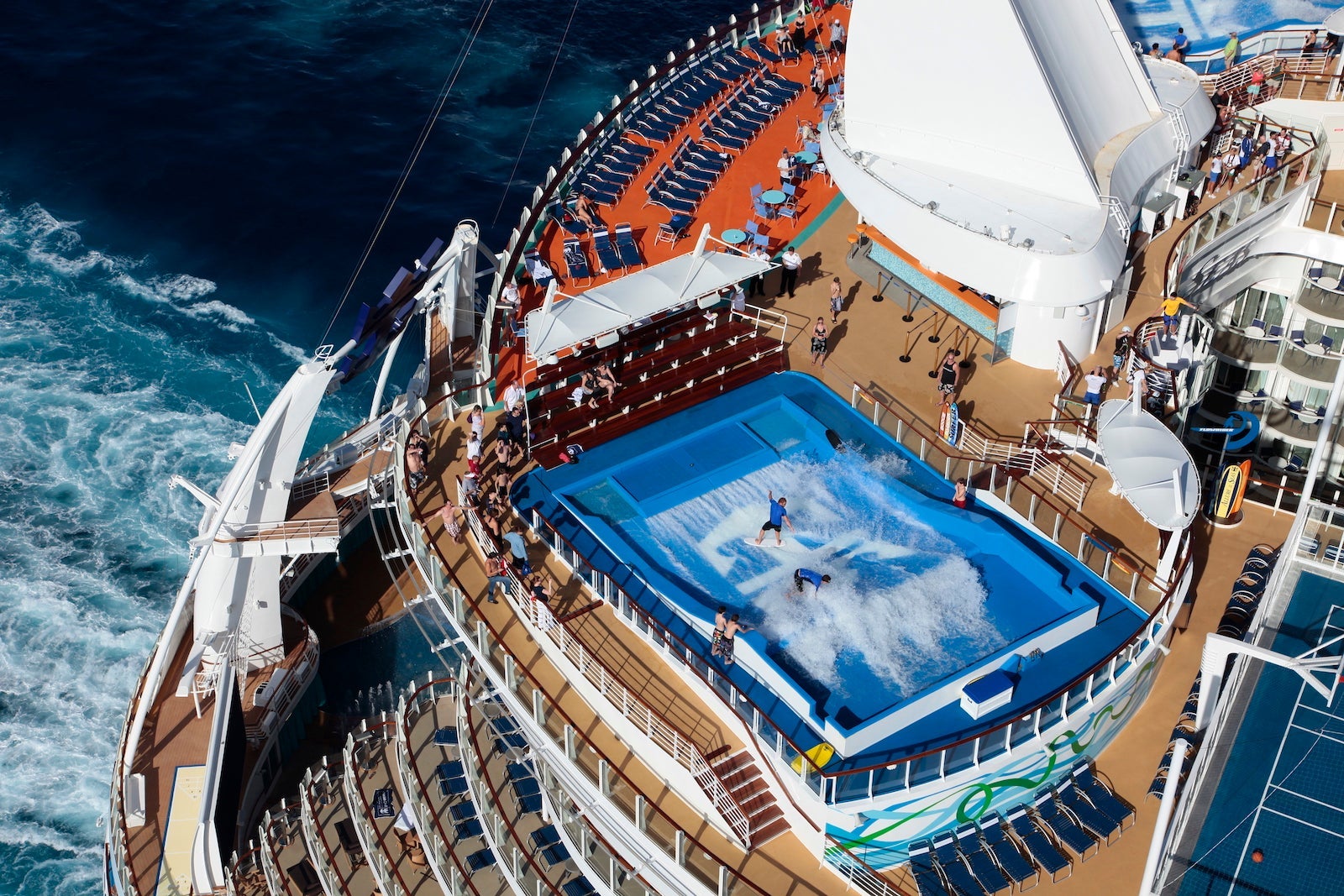
Let me start by saying that I am definitely not a surfer. I never have been, and I don't think I ever will be. So perhaps it's not totally surprising that I failed miserably when I attempted to go surfing on a cruise ship recently.
That said, I have done it successfully on two prior voyages, each several years ago. So what changed, apart from my age (and, if I'm completely honest, my level of physical fitness)?
Here's a look at what's required of passengers wishing to try Royal Caribbean's FlowRider surf simulator and why it's trickier to master than ever before.
[table-of-contents /]
What is the FlowRider surf simulator on Royal Caribbean ships?
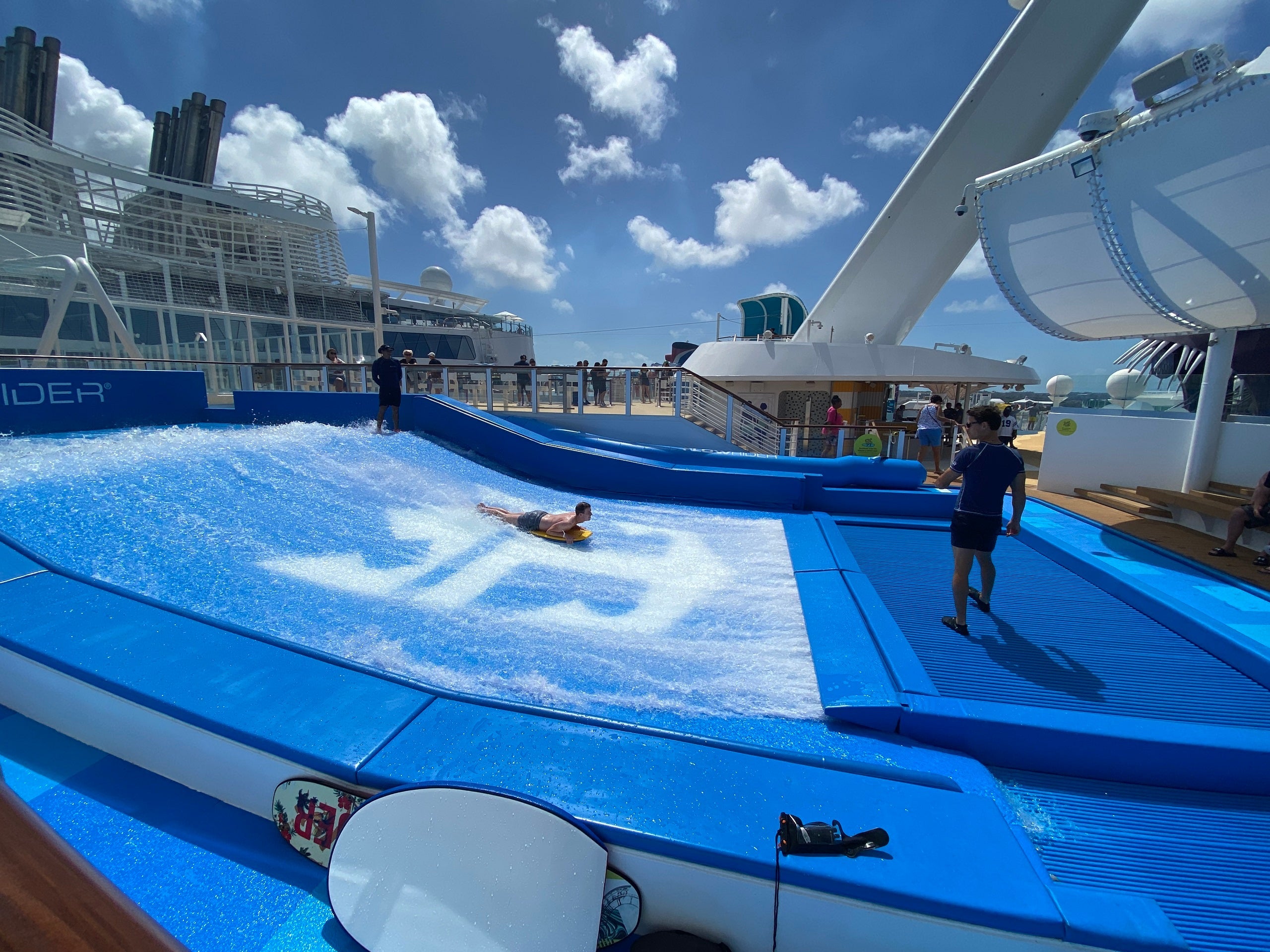
In 2006, Royal Caribbean put its first FlowRider on a vessel, Freedom of the Seas, allowing passengers to boogie board and surf on a cruise. Now, the line has them installed on nearly its entire fleet — specifically its Freedom-, Oasis- and Quantum-class ships.
The FlowRider began as a land-based way to simulate waves required for surfing. It has a semi-enclosed padded (like a wrestling mat) incline. High-powered jets spray water up the incline with enough force to allow riders to surf or boogie board.
There are dedicated times for each activity, noted daily on the Cruise Compass schedule and the Royal Caribbean app.
If you choose to give it a whirl, be prepared: There are bleachers at the bottom of the ride where people often gather to watch participants wipe out. Because spills are common, before you can try boogie boarding or surfing, you must sign a waiver and receive a wristband.
How did my first two attempts go?
My first encounter with the FlowRider was in 2009 during my first assignment as a cruise editor (for Cruise Critic, which owns the first two videos) on the first sailing of Oasis of the Seas, then the largest and most innovative vessel in the world. Notably, Oasis of the Seas was the first ship to boast two of the simulators.

As the youngest member of the team at the time, I was volunteered to try my hand at surfing. I signed a waiver, waited my turn and received a bit of instruction from one of the attendants, who had to hold my hand for quite a while until I was brave enough to let go.
I stayed upright briefly, but it didn't end well when I fell, hit my head and swallowed half of the pool. I learned two things that day: You have only a 50% chance of keeping your bikini top on (so wear actual clothes), and freshly dyed red hair will ruin a cruise ship's brand-new white towels. (Sorry, Royal Caribbean.)
My second try came seven years later, when I sailed on Freedom of the Seas in 2016. I wanted to improve on my original performance, so I decided to give it a shot and astounded myself by actually pulling it off.
With assistance from one of the attendants, I was able to stay on the board for much longer than the first time around. My analysis is that I was in better physical shape for the second go, and I also approached the task with a level of confidence I certainly wasn't able to muster for my third attempt.
How and why did I fail the third time?
View this post on Instagram
On the first revenue sailing of Wonder of the Seas, Royal Caribbean's newest and largest ship, I wrote an article about cramming as many activities as possible into two days on board. One of the items on the list was the FlowRider.
The older I get, the more I become aware of the fact that I'm not as fit or flexible as I once was, and I think a lot more about injuries. In addition, Royal Caribbean has changed some of its requirements for the attraction, which means it's quite a bit more difficult to surf successfully.
As I mentioned, I had to sign a waiver and procure a wristband from a desk near the FlowRider. As part of the line's new rules, I also had to watch an instructional safety video and perform various stretches in front of an attendant to verify my mobility — steps that aim to cut down on injuries, crew members told me.
From there, I waited in what was a rather short line (which perhaps indicates why Wonder of the Seas has only one FlowRider instead of two). When it was my turn, an attendant helped me hold my board in place. However, attendants are no longer allowed to offer physical assistance to passengers by holding their hands or arms until they move into position and acclimate to the proper posture.
Instead, passengers must put themselves on the board and push it away from the wall and into the jets on their own while maintaining their balance.
Because that's the most difficult part of the whole thing, it's easy to fail right from the start as I did. I couldn't get the board far enough back from the wall to reach the spray without it sticking to the mat.
Two attempts later, I was cut off, denied a second wristband that would have allowed me to surf for the remainder of the voyage, and told to try again the next day. I didn't fall, but I was still dejected, and I didn't have any desire to go back the day after.
What does this mean for cruisers?
Reasons various crew members gave me for the protocol change included passenger safety and COVID-19 social distancing. However, it's a policy that's both silly and discouraging, and it limits new surfers' ability to give the free FlowRider experience a fair shake.
Royal Caribbean does offer instruction and assistance for passengers who pay to rent out the FlowRider for private lessons (four to eight people and two instructors) at considerable cost. If you want to master this fun pastime as a beginner, your only real option is to pay to play.
Planning a Royal Caribbean cruise? Learn more with these stories:
- The ultimate guide to Royal Caribbean cruise ships and itineraries
- What I love about Royal Caribbean's new suite neighborhood
- The ultimate guide to Royal Caribbean cabins and suites
- The 6 classes of Royal Caribbean cruise ships, explained
- Why Wonder of the Seas is awesome for families
Featured photo courtesy of Royal Caribbean International.
TPG featured card

at Capital One's secure site
Terms & restrictions apply. See rates & fees.
| 5X miles | Earn 5X miles on hotels, vacation rentals and rental cars booked through Capital One Travel |
| 2X miles | Earn unlimited 2X miles on every purchase, every day |
Pros
- Stellar welcome offer of 75,000 miles after spending $4,000 on purchases in the first three months from account opening. Plus, a $250 Capital One Travel credit to use in your first cardholder year upon account opening.
- You'll earn 2 miles per dollar on every purchase, which means you won't have to worry about memorizing bonus categories
- Rewards are versatile and can be redeemed for a statement credit or transferred to Capital One’s transfer partners
Cons
- Highest bonus-earning categories only on travel booked via Capital One Travel
- LIMITED-TIME OFFER: Enjoy $250 to use on Capital One Travel in your first cardholder year, plus earn 75,000 bonus miles once you spend $4,000 on purchases within the first 3 months from account opening - that’s equal to $1,000 in travel
- Earn unlimited 2X miles on every purchase, every day
- Earn 5X miles on hotels, vacation rentals and rental cars booked through Capital One Travel
- Miles won't expire for the life of the account and there's no limit to how many you can earn
- Receive up to a $120 credit for Global Entry or TSA PreCheck®
- Use your miles to get reimbursed for any travel purchase—or redeem by booking a trip through Capital One Travel
- Enjoy a $50 experience credit and other premium benefits with every hotel and vacation rental booked from the Lifestyle Collection
- Transfer your miles to your choice of 15+ travel loyalty programs
- Top rated mobile app