Tulum and Cancun avoid lockdown again; 'orange' status extended for additional week

Editor's note: This post has been updated with new information.
Recently, there were warnings of an "imminent" lockdown in Quintana Roo — the Mexican state on the Caribbean coast that's home to such iconic resort getaways as Cancun, Playa del Carmen in the Riviera Maya and Tulum.
At the end of May, the governor of the state of Quintana Roo, Carlos Manuel Joaquín González, expressed ongoing concern for the high rate of COVID-19 cases in the region but said these areas would remain in the "orange" designation through June 6, and not enter a full lockdown. About a week later, the governor extended the orange status in the state for yet another week, through June 13.
Some indoor activities are allowed to resume but at limited capacity.
With its proximity to the United States, cheap flights on multiple airlines and relaxed entry requirements, Americans have traveled to destinations across Mexico, including Quintana Roo, throughout the pandemic. But as the COVID-19 crisis escalates in the region, here's what you need to know if you're considering a trip.

A COVID-19 surge in Quintana Roo
According to the Associated Press, Quintana Roo Gov. Carlos Joaquín said the state has seen several weeks of increases in cases and blamed the surge partly on Easter travel.
"We knew that there were large risks during Easter week, that there could be a greater number of infections. Unfortunately, that came to pass," Joaquín said, according to the AP.
On Thursday, May 20, Joaquín said the state of Quintana Roo would lean on five strategic measures (no large gatherings, mask distribution and more) to attempt to curb the spread of the coronavirus. But a "red" designation is not out of the question if the situation fails to improve.
The Mexican government uses a stoplight system, which is updated weekly, to determine what is allowed to open and what must remain closed in its states. The four metrics to assess the colors (green, yellow, orange and red) reflect numbers of new cases, hospital occupancy trends, current hospital occupancy rates and percentage of positive cases.

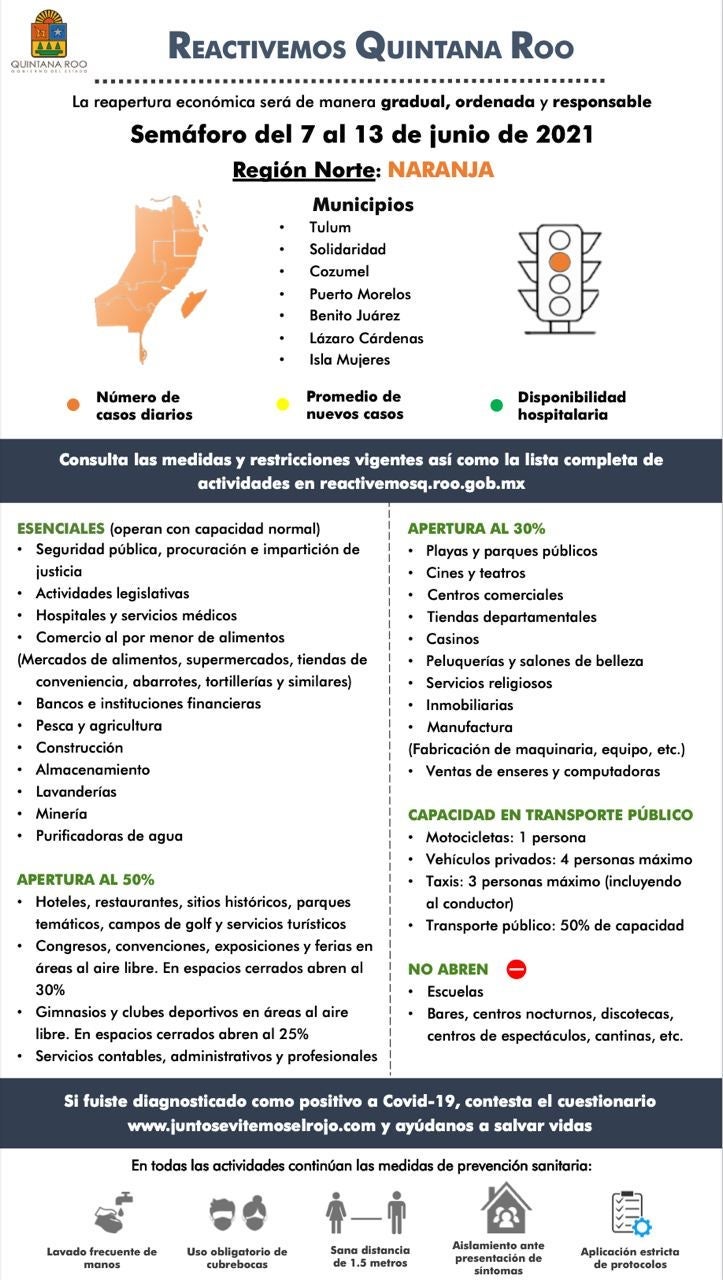
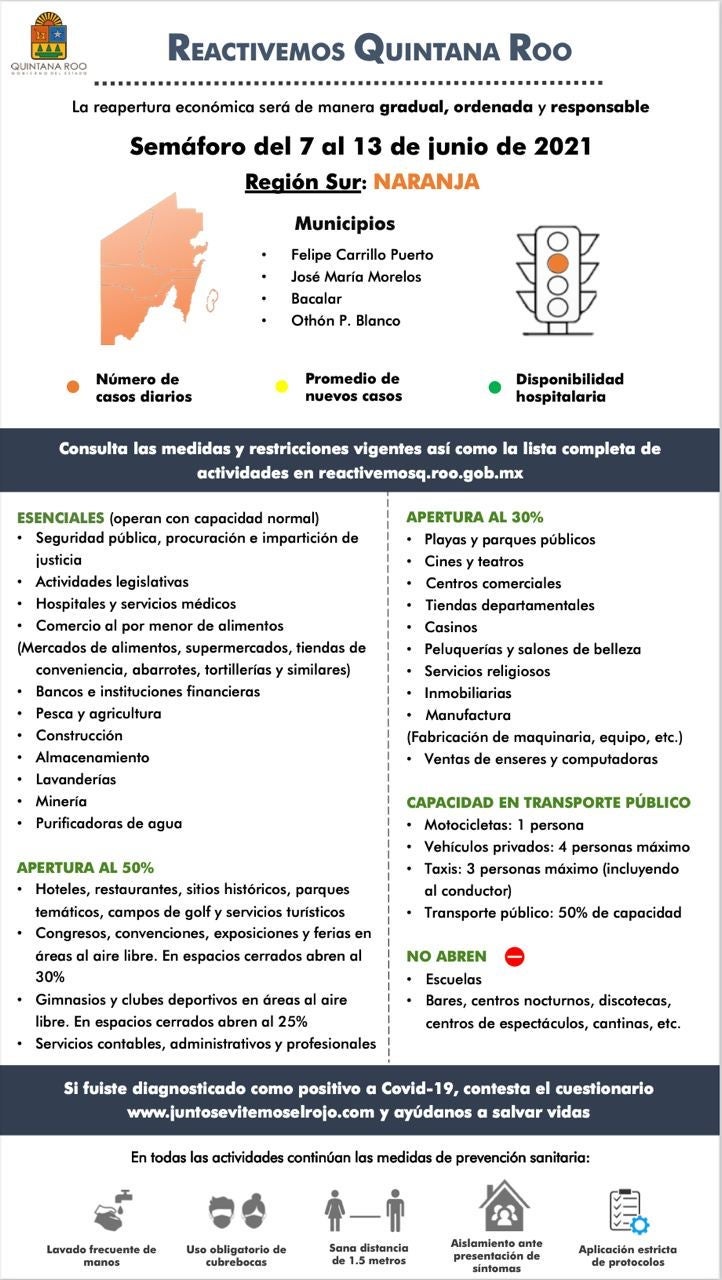
Quintana Roo will, for now, remain under the "orange" designation, which means that essential and nonessential labor activities are permitted but with certain limitations. Activities in public spaces are allowed but with restrictions, and tourist activities and hotels and restaurants are currently capped at 50% occupancy.
Previous restrictions on indoor gatherings have been loosened slightly, with conventions, exhibits and fairs able to operate in closed spaces at 30% capacity. Additionally, gyms are allowed to operate indoor facilities at 25% occupancy. Cinemas, theaters, malls, department stores, casinos, salons and churches are also able to operate at 30% capacity, and any gathering of 150 people or more must provide proof of negative results from an antigen test for every person present.
If Quintana Roo does ever reach the "red" designation, it will go into lockdown. Under the red designation, only essential activities will be allowed, and people will be restricted to a walk around their homes during the day.
Nightlife is prominent in places like Tulum and Cancun -- popular spring break destinations known for wild parties -- and even though bars, nightclubs and other entertainment venues are supposed to be closed at this time, according to the state government, travelers have noted packed bars in the region.
More than 228,000 people have died in Mexico since the start of the pandemic, trailing behind only the U.S., Brazil and India. According to World Health Organization (WHO) data, the country has recorded over 2.4 million positive cases.
The situation isn't much better when looking at Quintana Roo-specific numbers. The state has recorded over 27,000 cases of the coronavirus and nearly 2,800 deaths, though those numbers are likely an undercount.
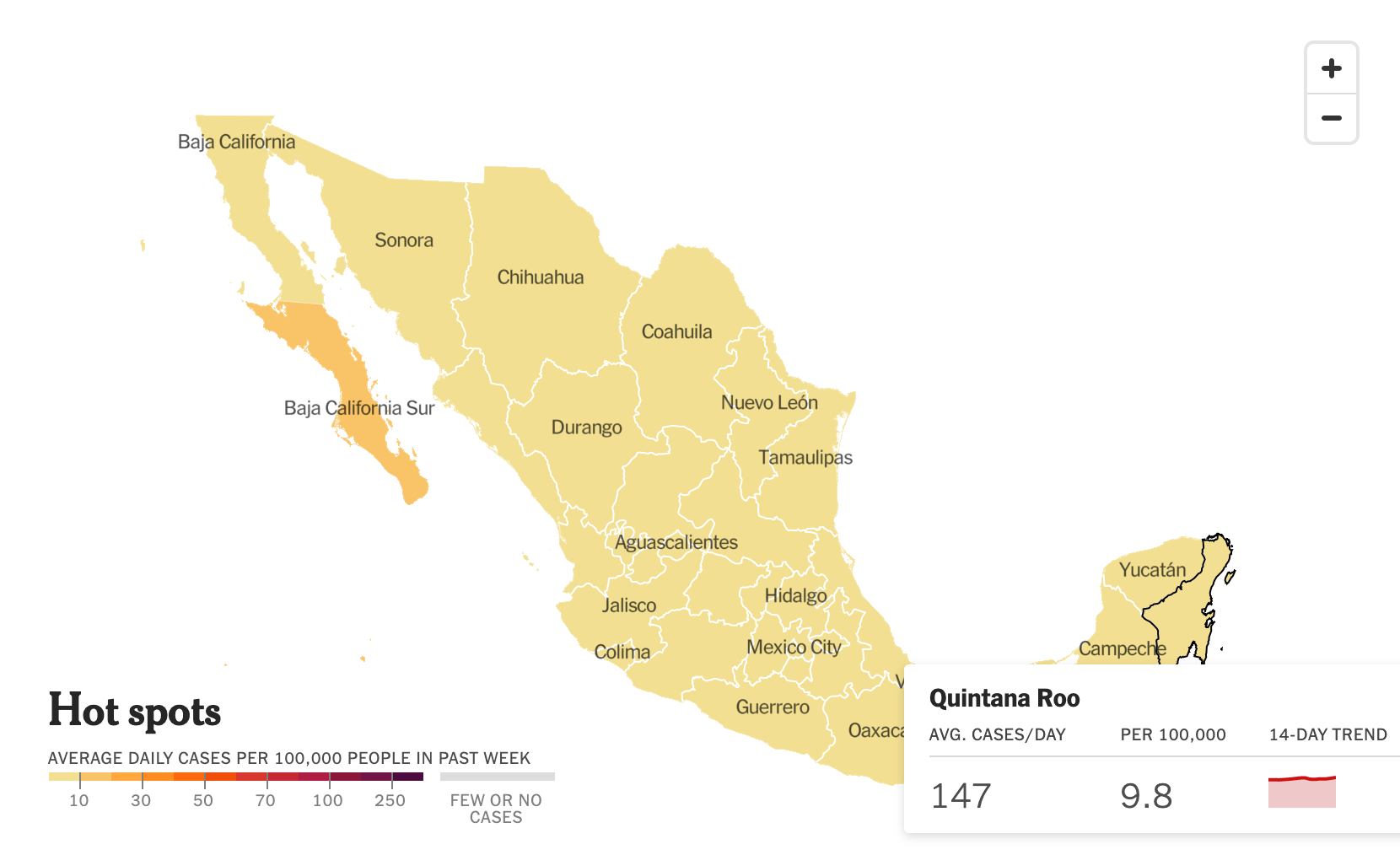
The New York Times puts Quintana Roo's daily average at 147 cases and notes an upward trend over the past two weeks. Only 11% of the country's population is fully vaccinated, and just 18% have received at least one of two doses.
In December, the CDC assigned Mexico a Level 4 "very high" COVID-19 designation (it's still at that status) and said that all travel to the country should be avoided. The U.S. State Department also assigned Mexico its highest warning, Level 4: Do Not Travel, though most countries are currently at that level.
Balancing the need for tourism with safety
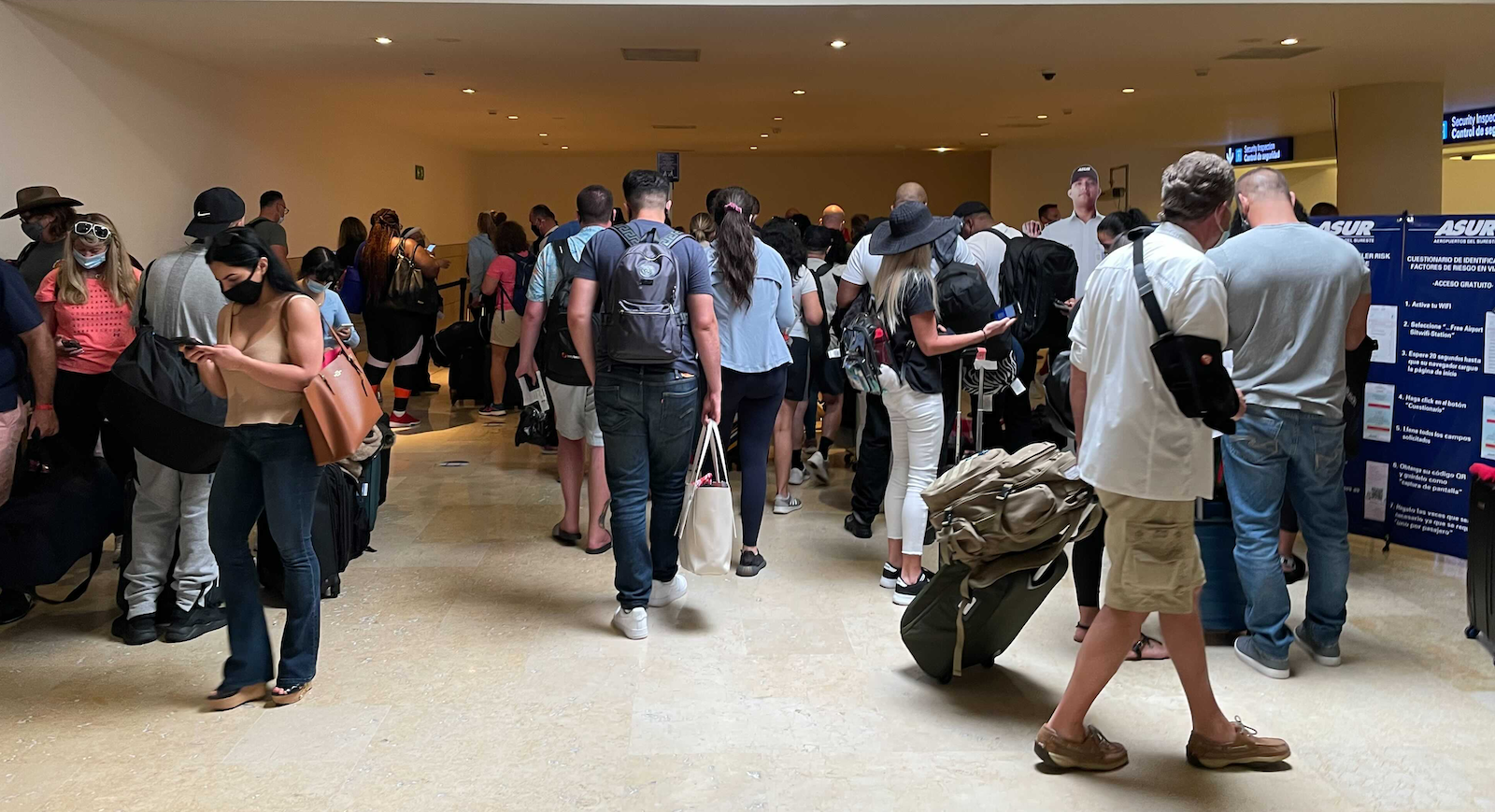
The COVID-19 situation in Quintana Roo is a messy confluence of the state's reliance on tourism, easy entry requirements and pandemic fatigue from foreign travelers.
A report from Airlines for America found that Mexico, which never closed its borders during the pandemic, was the "clear leader" in international travel in April, with most of those travelers being U.S. citizens. Tourism is the region's bread and butter, and COVID-19 decimated the industry, which relies on American and other foreign tourists.
When travel dried up at the onset of the pandemic last year, Quintana Roo was among the hardest hit, losing almost 64,000 jobs in about a month. Around half of Cancun's economy is directly supported by travel and tourism, according to the World Travel and Tourism Council (WTTC), and more than 40% of jobs directly support the industry. The organization in 2018 named Cancun the world's most tourism-dependent city.
Americans flocked to Mexico, and the Quintana Roo area in particular, during the pandemic because of inexpensive flights and cheap hotels. Nearly 1 million international travelers flew into Cancun (CUN) airport, the largest airport in the region, in April of this year, according to Grupo Aeroportuario del Sureste, known as ASUR, an international airport group in Mexico, the U.S. and Colombia.
Flights are relatively affordable, with several of the U.S.'s largest airports offering nonstop flights to Cancun, often as low as $200 round-trip. And the airlines are taking advantage of the increased demand: Frontier, for instance, reportedly doubled international flights to destinations to Cancun and Cozumel, according to Cirium, and airlines are flying full planes to Mexico due to interest from travelers.
Traveling to Mexico has also been relatively easy, compared to other international destinations. Beachgoers and vacation-seekers who arrive in Mexico are not required to self-quarantine or show proof of a negative COVID-19 test upon arrival. However, travelers could be subject to health screenings at airports and other points of entry. This is different from entry requirements for the U.S. and Canada, which require negative COVID-19 tests to enter their borders, even for fully vaccinated travelers.
Having a COVID-19 vaccine is also not a requirement like it is for some other international destinations.
And even precautions that have been put in place to prevent the spread of the coronavirus, such as physical distancing, could be more relaxed or not as strongly enforced.
Last November, a large music party in Tulum turned into an international superspreader event after several guests contracted the virus and brought it back to cities like New York. Other over-capacity parties have been shut down, and there's a ban on nightlife.
It's clear that Quintana Roo is in a precarious position, balancing public health with the need for tourism in popular destinations like Tulum and Playa del Carmen. But what has become clear is that there's limited time for the region to get back on track, before it faces its worst surge in COVID-19 cases yet.
The next stoplight rating for the Quintana Roo area will likely be announced for the week beginning June 10.
Additional reporting by Melanie Lieberman and Ashley Kosciolek.
Featured photo by Arthur Fonoretzky/Getty Images
TPG featured card

at American Express's secure site
Terms & restrictions apply. See rates & fees.
| 4X | Earn 4X Membership Rewards® points per dollar spent on purchases at restaurants worldwide, on up to $50,000 in purchases per calendar year, then 1X points for the rest of the year. |
| 4X | Earn 4X Membership Rewards® points per dollar spent at US supermarkets, on up to $25,000 in purchases per calendar year, then 1X points for the rest of the year. |
| 5X | Earn 5X Membership Rewards® points on prepaid hotel stays booked through AmexTravel.com or the Amex Travel App™. |
| 3X | Earn 3X Membership Rewards® points on flights booked through AmexTravel.com, the Amex Travel App™, or purchased directly from airlines. |
| 2X | Earn 2X Membership Rewards® points on prepaid car rentals booked through AmexTravel.com or the Amex Travel App™ and cruises booked and paid through AmexTravel.com. |
| 1X | Earn 1X Membership Rewards® point per dollar spent on all other eligible purchases. |
Pros
- Valuable dining and food-related credits
- Flexible rewards with airline and hotel transfer partners
- Multiple travel and purchase protections
- No foreign transaction fees
- Access to Amex Offers for additional savings (enrollment required)
Cons
- Not as useful for those living outside the U.S.
- Some may have trouble using Uber and other dining credits
- You may be eligible for as high as 100,000 Membership Rewards® Points after you spend $8,000 in eligible purchases on your new Card in your first 6 months of Card Membership. Welcome offers vary and you may not be eligible for an offer. Apply to know if you’re approved and find out your exact welcome offer amount – all with no credit score impact. If you’re approved and choose to accept the Card, your score may be impacted.
- Earn 4X Membership Rewards® points per dollar spent on purchases at restaurants worldwide, on up to $50,000 in purchases per calendar year, then 1X points for the rest of the year.
- Earn 4X Membership Rewards® points per dollar spent at US supermarkets, on up to $25,000 in purchases per calendar year, then 1X points for the rest of the year.
- Earn 5X Membership Rewards® points on prepaid hotel stays booked through AmexTravel.com or the Amex Travel App™.
- Earn 3X Membership Rewards® points on flights booked through AmexTravel.com, the Amex Travel App™, or purchased directly from airlines.
- Earn 2X Membership Rewards® points on prepaid car rentals booked through AmexTravel.com or the Amex Travel App™ and cruises booked and paid through AmexTravel.com.
- Earn 1X Membership Rewards® point per dollar spent on all other eligible purchases.
- Pay It® lets you tap in the American Express® App to quickly pay for small purchase amounts throughout the month and still earn rewards the way you usually do. Plan It® gives you the option to split up big purchases into equal monthly payments with a fixed fee. You’ll know upfront exactly how much you’ll pay.
- $120 Dining Credit: Earn up to a total of $10 in statement credits monthly when you pay with the Gold Card at Grubhub (including Seamless), Buffalo Wild Wings, Five Guys, The Cheesecake Factory, and Wonder. This can be an annual savings of up to $120. Enrollment required.
- $100 Resy Credit: Get up to $100 in statement credits each calendar year at over 10,000 qualifying U.S. Resy restaurants after you pay for eligible purchases with the American Express® Gold Card. That’s up to $50 in statement credits semi-annually. Enrollment required.
- $84 Dunkin' Credit: Earn up to $7 in monthly statement credits after you pay with the American Express® Gold Card at U.S. Dunkin’ locations. Enrollment required.
- $120 Uber Cash on Gold: Enjoy up to $120 in Uber Cash annually with your Gold Card. Just add your Card to your Uber account and you'll get $10 in Uber Cash each month to use on orders and rides in the U.S. when you select an Amex Card for your transaction.
- Enjoy complimentary Hertz Five Star® Status benefits like skipping the counter at select locations, adding an additional driver at no additional cost*, and vehicle upgrades**. Benefit enrollment and Hertz Gold+ registration are required. *Additional drivers must meet standard rental qualifications and must be a spouse or domestic partner to qualify as complimentary. Other additional drivers subject to fees. **Benefits are subject to availability and vary by location. Additional Hertz program Terms and Conditions including age restrictions apply.
- Book two nights or more with The Hotel Collection through AmexTravel.com or the Amex Travel App™ and receive a $100* credit towards eligible charges at over 1,400 upscale hotels worldwide. *Eligible charges vary by property.
- Book your travel through the Amex Travel App™ with added peace of mind – backed by American Express® service and support. Only for American Express® Card Members.
- Whenever you need us, we're here. Our Member Services team will ensure you are taken care of. From lost Card replacement to statement questions, we are available to help 24/7.
- No Foreign Transaction Fees.
- Annual Fee is $325.
- Terms Apply.