Rising oil prices do mean higher airline ticket prices, but the link is not as direct as you think
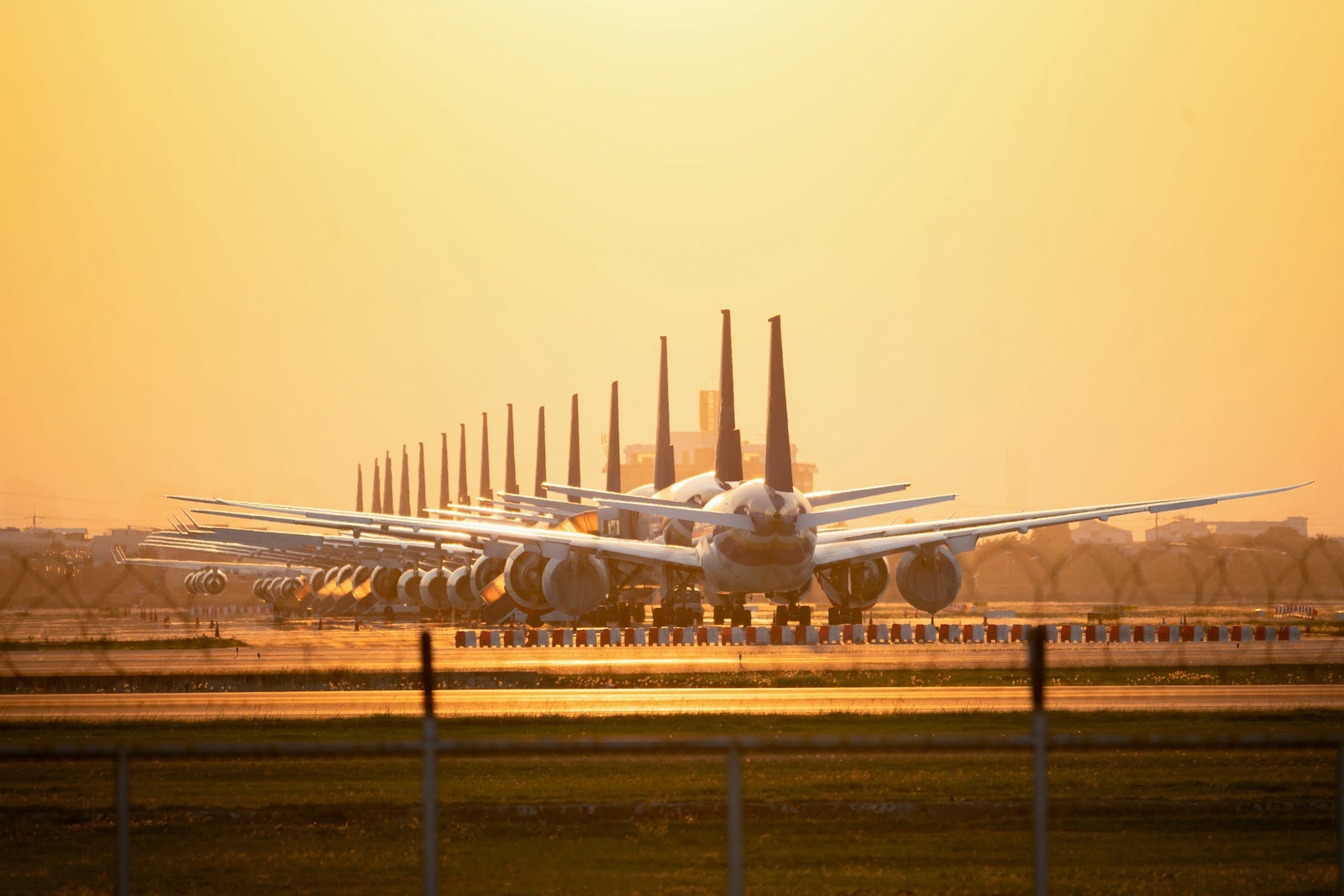
The price of oil has been on a meteoric rise since Russia's attack on Ukraine, hitting its highest levels in more than a decade. That's sure to pinch consumers — especially by sending prices up at the gas pump — but will it do the same for airfares?
Rising oil prices do put upward pressure on fares, but the cost of oil isn't the only factor in determining airline ticket prices.
In the U.S., strong demand had already enabled U.S. carriers to raise prices, with travel booking app Hopper saying this week that domestic airfares have risen 21% since the start of the year, while international airfares have risen 13%.
But it's been a different story in Europe, where demand recovery since the depths of the pandemic has been less robust. Some European carriers, such as Lufthansa and Ryanair, have tried to compensate for that with significant fuel hedging — or the practice in which airlines buy a contract for fuel in advance at a fixed or capped rate, one that doesn't change even if oil prices spike or drop.
Eduardo Mariz, a senior analyst for London-based Ishka, a global aviation information and advisory business, said that both hedging strategies and demand patterns influence ticket prices — sometimes in ways that don't directly mirror related increases in the cost of crude oil.
For domestic U.S. carriers, the stronger overall demand for tickets means airlines can pass the rising costs of fuel on to customers with less worry that travelers will balk at the increase in prices.
"Demand has recovered so they can raise fares without losing customers," Mariz said. "U.S. carriers tend to be unhedged, but the recovery has been stronger than for others, so we will probably see them raising fares faster."
By contrast, he added, "In other markets, where airlines still want to promote demand, they may be reluctant to raise prices right away" for fear of blunting the slower recovery in travel there.
As for the hedges, they can help inoculate airlines from rapid swings in fuel costs — allowing them to keep fares steadier even if oil prices rapidly rise or fall. Southwest famously employed fuel hedges during the 2000s which allowed it to lock in jet fuel prices that were dramatically lower than what competitors were paying — something that gave the carrier a huge competitive advantage in setting fares.

Standing with Ukraine: How you can join us in supporting the country now
Today, the three big global U.S. airlines — American, Delta and United — are unhedged. However, Delta operates an oil refinery. Additionally, Southwest Airlines and Alaska Airlines both have hedged some fuel needs.
Among Europe's carriers, Lufthansa said Thursday that it has hedged 63% of its fuel needs for 2022 at $74 a barrel, while Ryanair said Wednesday that it is 80% hedged at $63 a barrel through March next year. British Airways has said it is 60% hedged for the rest of the year, but did not specify the price cap. That ability to lock in those prices means that those carriers will feel less pressure to immediately pass along any jump in fuel costs.
Still, as Lufthansa reported earnings Thursday, Chief Financial Officer Remco Steenbergen said that despite hedging, the carrier will need to boost ticket prices to offset the cost increases.
At the same time, Mariz said that fuel prices fluctuate. "In the coming weeks we will see a lot of changes, so we still don't know how fast and how far they will increase."
"If oil production does increase, we could see the opposite," he noted. An Ishka report on Thursday said, "While fuel price increases are one of the most direct impacts of the current situation, they are also potentially the one that could be reversed the fastest, provided other oil-producing nations increase output."
Inflation threat: Airfare is about to get much more expensive, experts say. Here's what you need to know
Regardless, fuel costs are a major concern for airlines — even if changes in oil prices don't show up as quickly for passengers' airfares as they do for drivers at the gas pump.
Hopper economist Adit Damodaran said in an email that, "On average, 30% of an airline's operating costs are from fuel costs. This means historically a 10% rise in jet fuel cost would be associated with a 3% increase in operating expenses for the airline."
And, aside from the war in Ukraine, fuel prices had already been on a steady climb.
With the cost of jet fuel up 113% since the start of 2021, "We expect higher jet fuel prices to contribute to higher consumer airfare for 2022," Damodaran said.
Underscoring the complexities that can at least partially decouple fares from a direct tie to oil prices, he added: "The final ticket price travelers see for their trip may also vary depending on various factors like the fuel efficiency of a carrier's fleet and how much that carrier has hedged against jet fuel price increases."
The fuel dilemma: How pilots know how much to carry
In fleet age, American leads the major U.S. airlines: The average age of its mainline fleet is 11.3 years.
Average mainline fleet ages include 13 years for Southwest, 13.9 years for Delta and 16.5 years for United, according to company spokespeople. Among low-cost carriers, Frontier Airlines' and Spirit Airlines' fleets average 4 to 5 years old, while Alaska's is around 8 years.
Oil prices continued to inch up Friday, with Brent crude oil trading around $112 a barrel. As of midday Friday, oil had surged above $112 on the West Texas Intermediate crude exchange, the oil benchmark for the U.S. That's the highest price on that exchange since 2008.
Wall Street analysts have steadily raised estimates for how high those prices could go, with Goldman Sachs suggesting $120 a barrel while J.P. Morgan has mentioned $185 a barrel.
Before the Ukraine invasion, the last time oil prices traded at $100 was 2014. Prices have climbed steeply since 2020, when they averaged about $39 a barrel.
In the U.S., at least, airlines may try to pass some of those eventual fuel-cost increases on to customers as travel demand continues to be strong. The Transportation Security Administration said that 2.04 million people cleared security on Thursday and the numbers have been close to 2 million per day for some time now.
TPG featured card

at Capital One's secure site
Terms & restrictions apply. See rates & fees.
| 5X miles | Earn 5X miles on hotels, vacation rentals and rental cars booked through Capital One Travel |
| 2X miles | Earn unlimited 2X miles on every purchase, every day |
Pros
- Stellar welcome offer of 75,000 miles after spending $4,000 on purchases in the first three months from account opening. Plus, a $250 Capital One Travel credit to use in your first cardholder year upon account opening.
- You'll earn 2 miles per dollar on every purchase, which means you won't have to worry about memorizing bonus categories
- Rewards are versatile and can be redeemed for a statement credit or transferred to Capital One’s transfer partners
Cons
- Highest bonus-earning categories only on travel booked via Capital One Travel
- LIMITED-TIME OFFER: Enjoy $250 to use on Capital One Travel in your first cardholder year, plus earn 75,000 bonus miles once you spend $4,000 on purchases within the first 3 months from account opening - that’s equal to $1,000 in travel
- Earn unlimited 2X miles on every purchase, every day
- Earn 5X miles on hotels, vacation rentals and rental cars booked through Capital One Travel
- Miles won't expire for the life of the account and there's no limit to how many you can earn
- Receive up to a $120 credit for Global Entry or TSA PreCheck®
- Use your miles to get reimbursed for any travel purchase—or redeem by booking a trip through Capital One Travel
- Enjoy a $50 experience credit and other premium benefits with every hotel and vacation rental booked from the Lifestyle Collection
- Transfer your miles to your choice of 15+ travel loyalty programs
- Top rated mobile app