Skip to content

New York City's in the Midst of a Pizza War, and Not for the First Time

Jan. 10, 2019
7 min read
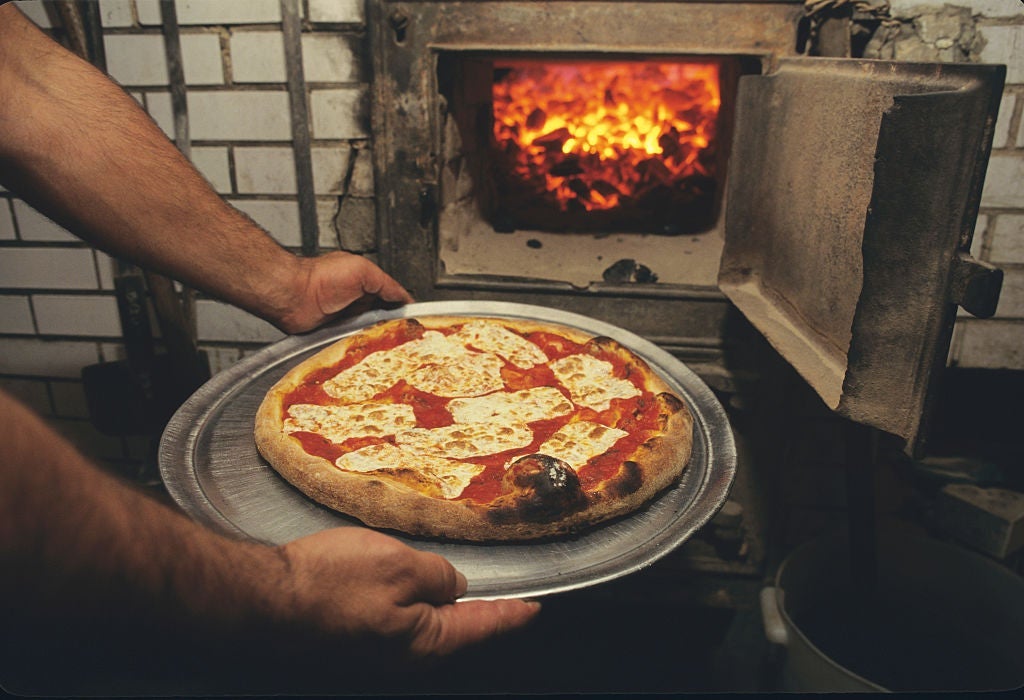
Close-up of Pizza Pies at Lombardi's Pizza Restaurant
New York City's in the Midst of a Pizza War, and Not for the First Time
The cards we feature here are from partners who compensate us when you are approved through our site, and this may impact how or where these products appear. We don’t cover all available credit cards, but our analysis, reviews, and opinions are entirely from our editorial team. Terms apply to the offers listed on this page. Please view our advertising policy and product review methodology for more information.

Pizza is, we all know, the world’s most perfect food. But in New York City — where pizza is both an everyday, anytime snack and an object of obsession and veneration — perfection is a double-edged sword, as the owner of one Manhattan pizzeria recently discovered in what's turned into a full-fledged pizza war.

If you’re ready to take sides and bite off a slice as a pizza warrior, of course, you could hop on a plane to New York and get on the front lines now. But before you tuck in your napkin, you should know what you’re fighting for.

Located in Manhattan’s Nolita neighborhood, Prince Street Pizza rose to fame over the last seven years for its signature Spicy Spring Pie: a square slice with crisp crust, garlicky sauce and enough curly-edged little discs of pepperoni to give a trypophobe a panic attack. Not only is it tasty, it's eminently Instagrammable.

Now, however, a former Prince Street chef has opened his own pizzeria, Made in New York, on the Upper West Side, and it features a pie nearly identical to the Spicy Spring. (It’s called the Spicy Pepperoni.) In response, Prince Street owner Frank Morano says he's pursuing legal action against the former employee, Frank Badali, a Made in New York partner who is credited with creating some of the original Prince Street recipes and who, Morano claims, broke a confidentiality agreement by taking his recipes elsewhere.

The dispute — which is fresh and therefore painful — is hardly the first pizza-related copycat battle in New York. For decades, New York pizzaioli have been innovating new flavors, styles and formulas, and for just as long, enterprising competitors have been cloning them.

The quintessential battle, in fact, began with a pizzeria at 27 Prince St., precisely where Prince Street Pizza now operates today. But back in 1959, it was Ray’s Pizza, started by 22-year-old Ralph Cuomo, according to a thorough page-one New York Times investigation. A few years later, Cuomo started another Ray’s, in East Midtown, then sold it to Rosolino Mangano, a Sicilian immigrant, who’d go on to have a dozen Famous Original Ray’s pizzerias by 1991. But Mangano, too, sold some of his shops, including to another non-Ray, Gary Esposito, who opened Original Ray’s pizzerias in Long Island and New Jersey.

Soon, Ray’s-themed pizzerias had proliferated so broadly that few New Yorkers even had any idea who or where the original Original Ray's actually was. (“I have never said that I am Ray,” Esposito told the Times. “That’s my claim to originality.”) In 1991, Cuomo, Mangano and Esposito even banded together to form a company, register a federal trademark and sue other businesses using the Ray’s name.

The funny thing is that Ray’s, Original Ray’s and Famous Original Ray’s were never really regarded as very good. [Editor's note: The plain slice at the Prince Street Ray's could be perceived as a thing of beauty.] By the late 1990s, you’d go to a Ray’s not because you particularly liked Ray’s pizza but because, more often than not, the pizza place closest to you was a Ray’s. What Ray’s had was ubiquity and branding.

Today, thanks to a pizza renaissance that started in the early 2000s, Ray’s has been superseded by dozens of other pizzerias — and by several other copycat battles. Last year saw Famous Joe’s Pizza and Famous Joe’s Pizza of the Village wrapped in a trademark fight. Back in 2006, Patsy’s Italian Restaurant, a Midtown place that opened in 1944, sued Patsy’s Pizzeria, which opened in East Harlem in 1933, over “a host of trademark and unfair competition claims.” (A federal court in 2011 decided neither owned the name.) And to make things more confusing, that’s only one of the Patsy’s-related pizza battles that has engulfed the city.

Daily Newsletter
Reward your inbox with the TPG Daily newsletter
Join over 700,000 readers for breaking news, in-depth guides and exclusive deals from TPG’s experts
Lombardi's Pizza, on Spring Street, was America's first pizzeria. (Photo by Mark Peterson/Corbis via Getty Images)

The other one involves Patsy Grimaldi, who opened a pizzeria called Patsy’s at the foot of the Brooklyn Bridge in Dumbo. Grimaldi’s uncle had worked at Lombardi’s, founded in 1905 as the first pizzeria in the US, and had actually started the East Harlem Patsy’s Pizzeria, but that uncle had died, and in 1995 Grimaldi found himself sued by the restaurant’s new owners. So he changed the restaurant’s name to Grimaldi’s, and it won acclaim for its coal-fired pies. In 1998, however, Grimaldi sold the business to a regular named Frank Ciolli, who by 2012 had turned Grimaldi’s into a 36-outlet national chain.

Alas, relations soon soured between Grimaldi and Ciolli, according to an extensive New York Magazine story. Ciolli’s cooks began to alter the pizza recipe, and when Grimaldi complained, he was dismissed and disrespected — this was not a pie that should bear his name! In 2011, when Ciolli decided to move the original Grimaldi’s just around the corner following a dispute with his landlord, Grimaldi seized his opportunity for revenge. He launched a new pizzeria — Juliana’s, named for his mother — right in the old Grimaldi’s spot, about a 60-second walk from the new Grimaldi’s. Ciolli was not pleased. Weeks before Juliana’s opened, he filed a court motion to block it; the motion failed.

Today you’ll find very long lines outside Grimaldi’s and often no lines outside Juliana’s — which says nothing, of course, about the quality of the pizza.

The dispute over names and, more importantly, reputations, is old-school, a relic of the families who over the last century made pizza a New York thing.

“I don’t eat anyone’s pizza,” Louise “Cookie” Ciminieri, who runs Totonno’s in Coney Island, told New York Magazine. “Because then they turn around and say, 'Totonno’s eats my pizza!'”

Still, according to Scott Wiener, who started Scott’s Pizza Tours in 2008, the New York pizza scene has historically been pretty chill.

“People like to manufacture rivalry,” he told TPG. “We see that, ‘Oh, there’s seven or eight of these coal-fired places around today. They all must have been enemies.’ But it’s just not true.”

Today, he said, “most pizzerias in New York are actually quite friendly to one another — it doesn’t make the news as much.” Mark Iacono of Lucali and Frank Pinello of Best Pizza are buddies, for example. “They’ll hang together. It’s way more helpful than it is detrimental.”

Even the efforts of Vera Pizza Napoletana to certify only those restaurants that make what it considers a true Neapolitan-style pizza have not caused much strife in New York. If that’s what you want, you can get it. If you want a Sicilian grandma slice or a Detroit-style pie, you can get those, too. (But if you want a Chicago pie, you'd better head west.)

And should pizza eaters even care about originality?

“Well,” Wiener said, “people love to visit an original, and of course there's a whole lot of history to going to one of the oldest places, but if your priority is about flavor, then it all doesn’t matter too much.”

For pizza makers, too, originality may be overrated. Consider Dom DeMarco, the 81-year-old proprietor of the legendary Di Fara, where until 2017 he was also the sole pizzaiolo.

“Putting basil on top of pizza when it comes out of an oven and putting olive oil and Grana Padano or some other hard cheese — that's not a real innovation,” Wiener said.

What people come for is a pizza made by DeMarco himself. You can’t copy that.

Nor, says Wiener, would you want to: “If somebody opens a pizzeria that [like Di Fara] had an oven on one side and a table on the other and then they would walk back and forth between the oven and the table — a distance that was so long it was unnecessary — and the cheese was on a different shelf and the tomatoes — like, the logistics of that place are so bad, if somebody copied that, God bless them.”

Featured image by Corbis via Getty Images

TPG featured card

Best for dining at restaurants
TPG Editor‘s Rating
4 / 5
Go to review
Apply for American Express® Gold Card
at American Express's secure site

Rewards

1 - 4X points

Intro offer

As High As 100,000 points. Find Out Your Offer.

Annual Fee

$325

Recommended Credit

Excellent to Good

Why We Chose It

There’s a lot to love about the Amex Gold. It’s a fan favorite thanks to its fantastic bonus-earning rates at restaurants worldwide and at U.S. supermarkets. If you’re hitting the skies soon, you’ll also earn bonus Membership Rewards points on travel. Paired with up to $120 in Uber Cash annually (for U.S. Uber rides or Uber Eats orders, card must be added to Uber app and you can redeem with any Amex card), up to $120 in annual dining statement credits to be used with eligible partners, an up to $84 Dunkin’ credit each year at U.S. Dunkin Donuts and an up to $100 Resy credit annually, there’s no reason that foodies shouldn’t add the Amex Gold to their wallet. These benefits alone are worth more than $400, which offsets the $325 annual fee on the Amex Gold card. Enrollment is required for select benefits. (Partner offer)

Pros

  • 4 points per dollar spent on dining at restaurants worldwide and U.S. supermarkets (on the first $50,000 in purchases per calendar year; then 1 point per dollar spent thereafter and $25,000 in purchases per calendar year; then 1 point per dollar spent thereafter, respectively)
  • 3 points per dollar spent on flights booked directly with the airline or with amextravel.com
  • Packed with credits foodies will enjoy
  • Solid welcome bonus

Cons

  • Not as useful for those living outside the U.S.
  • Some may have trouble using Uber and other dining credits
  • You may be eligible for as high as 100,000 Membership Rewards® Points after you spend $6,000 in eligible purchases on your new Card in your first 6 months of Card Membership. Welcome offers vary and you may not be eligible for an offer. Apply to know if you’re approved and find out your exact welcome offer amount – all with no credit score impact. If you’re approved and choose to accept the Card, your score may be impacted.
  • Earn 4X Membership Rewards® points per dollar spent on purchases at restaurants worldwide, on up to $50,000 in purchases per calendar year, then 1X points for the rest of the year.
  • Earn 4X Membership Rewards® points per dollar spent at US supermarkets, on up to $25,000 in purchases per calendar year, then 1X points for the rest of the year.
  • Earn 3X Membership Rewards® points per dollar spent on flights booked directly with airlines or on AmexTravel.com.
  • Earn 2X Membership Rewards® points per dollar spent on prepaid hotels and other eligible purchases booked on AmexTravel.com.
  • Earn 1X Membership Rewards® point per dollar spent on all other eligible purchases.
  • $120 Uber Cash on Gold: Add your Gold Card to your Uber account and get $10 in Uber Cash each month to use on orders and rides in the U.S. when you select an American Express Card for your transaction. That’s up to $120 Uber Cash annually. Plus, after using your Uber Cash, use your Card to earn 4X Membership Rewards® points for Uber Eats purchases made with restaurants or U.S. supermarkets. Point caps and terms apply.
  • $84 Dunkin' Credit: With the $84 Dunkin' Credit, you can earn up to $7 in monthly statement credits after you enroll and pay with the American Express® Gold Card at U.S. Dunkin' locations. Enrollment is required to receive this benefit.
  • $100 Resy Credit: Get up to $100 in statement credits each calendar year after you pay with the American Express® Gold Card to dine at U.S. Resy restaurants or make other eligible Resy purchases. That's up to $50 in statement credits semi-annually. Enrollment required.
  • $120 Dining Credit: Satisfy your cravings, sweet or savory, with the $120 Dining Credit. Earn up to $10 in statement credits monthly when you pay with the American Express® Gold Card at Grubhub, The Cheesecake Factory, Goldbelly, Wine.com, and Five Guys. Enrollment required.
  • Explore over 1,000 upscale hotels worldwide with The Hotel Collection and receive a $100 credit towards eligible charges* with every booking of two nights or more through AmexTravel.com. *Eligible charges vary by property.
  • No Foreign Transaction Fees.
  • Annual Fee is $325.
  • Terms Apply.
Apply for American Express® Gold Card
at American Express's secure site
Terms & restrictions apply. See rates & fees
Best for dining at restaurants
TPG Editor‘s Rating
4 / 5
Go to review

Rewards Rate

4XEarn 4X Membership Rewards® points per dollar spent on purchases at restaurants worldwide, on up to $50,000 in purchases per calendar year, then 1X points for the rest of the year.
4XEarn 4X Membership Rewards® points per dollar spent at US supermarkets, on up to $25,000 in purchases per calendar year, then 1X points for the rest of the year.
3XEarn 3X Membership Rewards® points per dollar spent on flights booked directly with airlines or on AmexTravel.com.
2XEarn 2X Membership Rewards® points per dollar spent on prepaid hotels and other eligible purchases booked on AmexTravel.com.
1XEarn 1X Membership Rewards® point per dollar spent on all other eligible purchases.
  • Intro Offer

    As High As 100,000 points. Find Out Your Offer.
  • Annual Fee

    $325
  • Recommended Credit

    Excellent to Good

Why We Chose It

There’s a lot to love about the Amex Gold. It’s a fan favorite thanks to its fantastic bonus-earning rates at restaurants worldwide and at U.S. supermarkets. If you’re hitting the skies soon, you’ll also earn bonus Membership Rewards points on travel. Paired with up to $120 in Uber Cash annually (for U.S. Uber rides or Uber Eats orders, card must be added to Uber app and you can redeem with any Amex card), up to $120 in annual dining statement credits to be used with eligible partners, an up to $84 Dunkin’ credit each year at U.S. Dunkin Donuts and an up to $100 Resy credit annually, there’s no reason that foodies shouldn’t add the Amex Gold to their wallet. These benefits alone are worth more than $400, which offsets the $325 annual fee on the Amex Gold card. Enrollment is required for select benefits. (Partner offer)

Pros

  • 4 points per dollar spent on dining at restaurants worldwide and U.S. supermarkets (on the first $50,000 in purchases per calendar year; then 1 point per dollar spent thereafter and $25,000 in purchases per calendar year; then 1 point per dollar spent thereafter, respectively)
  • 3 points per dollar spent on flights booked directly with the airline or with amextravel.com
  • Packed with credits foodies will enjoy
  • Solid welcome bonus

Cons

  • Not as useful for those living outside the U.S.
  • Some may have trouble using Uber and other dining credits
  • You may be eligible for as high as 100,000 Membership Rewards® Points after you spend $6,000 in eligible purchases on your new Card in your first 6 months of Card Membership. Welcome offers vary and you may not be eligible for an offer. Apply to know if you’re approved and find out your exact welcome offer amount – all with no credit score impact. If you’re approved and choose to accept the Card, your score may be impacted.
  • Earn 4X Membership Rewards® points per dollar spent on purchases at restaurants worldwide, on up to $50,000 in purchases per calendar year, then 1X points for the rest of the year.
  • Earn 4X Membership Rewards® points per dollar spent at US supermarkets, on up to $25,000 in purchases per calendar year, then 1X points for the rest of the year.
  • Earn 3X Membership Rewards® points per dollar spent on flights booked directly with airlines or on AmexTravel.com.
  • Earn 2X Membership Rewards® points per dollar spent on prepaid hotels and other eligible purchases booked on AmexTravel.com.
  • Earn 1X Membership Rewards® point per dollar spent on all other eligible purchases.
  • $120 Uber Cash on Gold: Add your Gold Card to your Uber account and get $10 in Uber Cash each month to use on orders and rides in the U.S. when you select an American Express Card for your transaction. That’s up to $120 Uber Cash annually. Plus, after using your Uber Cash, use your Card to earn 4X Membership Rewards® points for Uber Eats purchases made with restaurants or U.S. supermarkets. Point caps and terms apply.
  • $84 Dunkin' Credit: With the $84 Dunkin' Credit, you can earn up to $7 in monthly statement credits after you enroll and pay with the American Express® Gold Card at U.S. Dunkin' locations. Enrollment is required to receive this benefit.
  • $100 Resy Credit: Get up to $100 in statement credits each calendar year after you pay with the American Express® Gold Card to dine at U.S. Resy restaurants or make other eligible Resy purchases. That's up to $50 in statement credits semi-annually. Enrollment required.
  • $120 Dining Credit: Satisfy your cravings, sweet or savory, with the $120 Dining Credit. Earn up to $10 in statement credits monthly when you pay with the American Express® Gold Card at Grubhub, The Cheesecake Factory, Goldbelly, Wine.com, and Five Guys. Enrollment required.
  • Explore over 1,000 upscale hotels worldwide with The Hotel Collection and receive a $100 credit towards eligible charges* with every booking of two nights or more through AmexTravel.com. *Eligible charges vary by property.
  • No Foreign Transaction Fees.
  • Annual Fee is $325.
  • Terms Apply.